A Veteran, Author, And Entrepreneur With Kevin E. Eastman
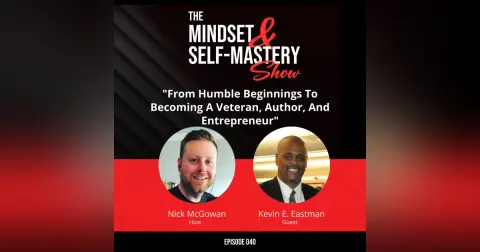


“If you have a goal, make a plan and get to it. Period. This year is not too late. You’re not too old. You’re not stuck in your ways. If you have a plan, if you have a goal, make a plan and get after it.”
In this episode, Nick speaks with Kevin E. Eastman who was in the Air Force as a sergeant. He learned things such as how to best effectively get his message heard, and his supervisor really helped him open up perspectives on his life and mentality.
He used to be the type of person who blamed everyone else for all the problems and misfortunes. But it was pointed out that if you look at yourself, you can see how you are the creator of your own world. Even something as simple as fear.
Fear exists, but it’s because we create fear in thinking about something that may or may not even happen. With that type of awareness, we can overcome so much more.
Kevin ended up journaling to help put things in perspective so he can change his life around. While reading through his entries, he thought this is a great way to help others, so he organized his writings and turned them into a published book.
About Kevin E. Eastman
Kevin is an Air Force vet, community activist, and mentor with a passion for helping others in achieving their goals. He has a fun but passionate approach to helping people with their self-development. He had to lot of lessons, and he’s trying to do his part to help others.
Resources:
Interested in starting your own podcast or need help with one you already have? Send Nick an email or schedule a time to discuss your podcast today!
nick@themindsetandselfmasteryshow.com
Thank you for listening!
Please subscribe on iTunes and give us a 5-Star review! https://podcasts.apple.com/us/podcast/the-mindset-and-self-mastery-show/id1604262089
Watch Clips and highlights: www.youtube.com/channel/UCk1tCM7KTe3hrq_-UAa6GHA
Guest Inquiries right here: podcasts@themindsetandselfmasteryshow.com
Your Friends at “The Mindset & Self-Mastery Show”
Nick McGowan
Hello and welcome to The Mindset and Self-mastery Show. I’m your host, Nick McGowan. And on this show, my guests and I unpack the stories that shape us, the lives that we lead on our path to self-mastery. So let’s not wait any longer. Let the games begin.
Nick McGowan
Hey, Kevin, welcome to the show. Man, it’s great to have you. How are you doing?
Kevin E. Eastman
I’m good. Pleasure to be here. Thanks for having me.
Nick McGowan
Absolutely. I appreciate you being on. I’m not going to lie to the audience here. This is actually round two of you and I. Last time something happened. You know, technology is great when it works. Kind of sucks at times when it doesn’t. But I’m a part of the group that you’re one of the moderators for one of the admins for.
Nick McGowan
I love the stuff that we get into in the group. And I really appreciate your authenticity within the group. Like a couple of the posts you’ve had to post recently that are like, maybe you people don’t understand this, but here’s how the rules work and here’s how that stuff is. So appreciate your for being human. So why don’t you give us some context?
Kevin E. Eastman
You kind of have to do that. You know, you want to be diplomatic as much as you can, but at some point you have to just be blunt and let people know. It’s like, look, we have rules. We’re all adults. You know, you keep trying to push the envelope and you’re forcing me to do things that I don’t need to do.
Kevin E. Eastman
You know, and if you can’t follow the rules, you got to go.
Nick McGowan
Yeah, that’s. It’s cut and dry. You know, I’ll be honest with you. I think you’ve got 15 or 16,000 people that are in the group, or maybe even more than that. I had a group for a little while that was small. A couple hundred people, but I now am an admin for a group that’s about the same size as yours.
Nick McGowan
And I see those things differently now. I’m like, Oh yeah, there are certain things that you just no more. You’re out. That’s it. Strike one and you’re done.
Kevin E. Eastman
Exactly. Exactly. You kind of have to have that that message that go through to, you know, for the majority of the people in the group, they do follow the rules. But there are a few that try to push the envelope. And if you let that person do it, then another person will say, okay, if they did it, then I can do it.
Kevin E. Eastman
And then it just then you’re right back to square one. So you kind of have to nip it in the bud. It’s like, look, you you post cryptocurrency in this group. You’re done is there is no this is the warning. I’m not saying it again.
Nick McGowan
Yeah. And just so the audience is clear, it’s not a financial group that we’re talking about where like crypto would make sense or something. This is about mindset and positivity and really the stuff that we’re going to get into. So Kevin, give us some context. What do you do for a living and what’s one thing that most people don’t know about you that’s maybe a little odd or bizarre?
Kevin E. Eastman
Well, I’m retired from the military. I spent over 20 years in the air Force, a book writer. That’s what I’m doing, a business management consulting. And I try to do that a little bit. Freelance business consultant to try to help people get to take their business to the next level. Something that’s odd about me, I wouldn’t say out of bizarre, but I mean, a lot of things a lot of people don’t realize about me that I was a drill instructor in the Air Force for three years.
Kevin E. Eastman
So I actually I tell people in a joking way, I actually get a paycheck to have an attitude. And I was real good at it. So. So it was fun, you know, in that sense, you know, a lot of people don’t realize what a drill instructor actually goes through on a daily basis. An interesting story. A lot of people they tell me that I resemble Damon Wayans, you know, the comedian.
Kevin E. Eastman
And and I was a drill and I was a drill instructor when the movie Major Payne came out. So I had to spend time telling people I am not him.
Nick McGowan
That’s too good. I Yeah. I got to be honest with you, Kevin, I’m one of those people that look at people, and maybe it’s just how I learn, but I tie them to, like, either an animal or who they remind me of. I think there’s probably only 8 to 10 different character types in this world. I saw the resemblance with the Wayans family at one point, and I honestly thought I was like, you know, that’s that’s potentially racist.
Nick McGowan
Like, pull that back, Nick. But the fact that you pulled it up and that you did the movie was out at the same time, I think I could see that.
Kevin E. Eastman
It was it came out and I’m sitting there like, no, that’s not me. I swear, that’s not me.
Nick McGowan
Well, men, especially you 20, 25 years ago or whatever. Like, I could really see it. I can’t see with the gray in there in that beard now. But that’s funny. Oh, man. So when I think of drill sergeants, I don’t really think of major pain, but I think of like the crazy ones that are yelling, but then at the opposite side, I’m familiar with the Bob Ross story where Bob Ross was a drill instructor and drill sergeant and most people are completely shocked by that.
Kevin E. Eastman
Well, there is a misconception about that. And what I would I tell people when I talk to them is you don’t have to say things loudly to be effective. You can actually whisper something to somebody. And if that person starts crying, you can walk out of the room without saying a word. I bet when you walk back in, everybody will know what you said, you know?
Kevin E. Eastman
So it’s not a matter of how loud you say it. What I what I did when I was an instructor is I used yelling as a time saver, so to speak. I didn’t want to repeat myself 47 times for the same thing, so I said it once very loudly. Unfortunately, there was somebody that was the the sacrificial lamb, so to speak, you know, and, you know, 45 other people don’t want to go through what that person went through.
Kevin E. Eastman
So I didn’t have to say it, but once. So that was kind of the way I did it. I wasn’t a big yeller because I used my experience as a as a teenager growing up myself. If your parents are yelling all the time and my parents didn’t yell all the time, but if you you hear that a lot, sooner or later, all you hear is yelling.
Kevin E. Eastman
You don’t hear what they’re yelling, you know, and the person will say, well, what did they say? I don’t know. You tell them or something. You know who’s yelling at something. So and that’s how I taught the instructors that I trained. It’s like, you don’t have to yell all the time. You, you you have to be effective with what you’re doing.
Kevin E. Eastman
So you have to be selective when you use the yelling part. So I didn’t do it all the time.
Nick McGowan
And I really appreciate you saying that. I, I feel like most all of our problems come from childhood trauma and what you’re saying with your parents not yelling, I actually grew up in a house where yelling was normal, at least in my mom’s house. I guess my dad’s house. So it was normal at different times. But I remember there would be like throwing of things, yelling.
Nick McGowan
Then years later, I got into relationships, specifically my my last marriage, that that didn’t work. She just shut down. And I was like, but I thought, this is how you did things. I thought, you yell and you throw things because of the trauma that I had growing up. So how did you take that knowing, hey, I have to get my point across, but not translating that into, you know, business and the career because I’m sure you don’t go and see your clients.
Nick McGowan
You’re like, Hey, so if they’re not getting the point, fucking yell at them now.
Kevin E. Eastman
Well, I mean you in like I said you it’s not how loud you say it. Say something is what you say. You know, there are ways to go around it. You know, sometimes you have to get the elevated voice, you know, and you have to at some point, you know, I do that with my daughter. You know, you have to raise your voice at some point, you know, but for the most part, you know, some people get it, some people don’t.
Kevin E. Eastman
You know, you just have to have that balance. And that’s what I talk about in the book that I wrote. I referenced balance throughout the book. You know, you have to maintain balance. And then when you don’t have that, when you have that imbalance is when the problems occur and people try to correct an imbalance by actually in balancing more, you know, on the other side.
Kevin E. Eastman
So you’re constantly tipping the scales instead of thinking about, wait a minute, how do I level this out? Instead of going from one extreme to the other?
Nick McGowan
Oh, yeah, like a seesaw. It’s go back and forth with it.
Kevin E. Eastman
Exactly.
Nick McGowan
So without without reading your entire book to us, but giving us some of those morsels of it, what sort of advice would you give to somebody to be able to not allow themselves to do that seesawing effect, but to find balance?
Kevin E. Eastman
Well, one of the things that I tell people is you have to look at look at is the situation is a situation really big. Are you making it big? You know, and and it comes back to introspective, you know. And that’s what happened to me when I was when I started thinking about, you know, what I was going through in my life because life wasn’t going the way I wanted it to go.
Kevin E. Eastman
And I had to have a supervisor sit down and explain to me, wait a minute. You know, let’s take a step back and look at things in a in a as a holistic, you know, approach. Instead of looking at things in like, you know, like nit picking everything apart, you know, look at it holistically. So it’s kind of like macro economics instead of micro, you know, it was macro within a micro.
Kevin E. Eastman
So I started looking at things in that, in that manner, and then it started to hit me. A lot of the things that I was dealing with, I was actually making bigger than they were. And one of the things I tell and I talk to people about is a lot of people tend to make things more difficult than they need to be.
Kevin E. Eastman
And that’s where the problem comes in. We overthink things.
Nick McGowan
Yeah, most people do. And that’s funny. The the scare factor that people instill in themselves and things like, I am so afraid to go do this thing because of the unknown or what have you, or they’re just like they just get stuck.
Kevin E. Eastman
Well, this is true. It’s interesting you say that because, you know, one of the things that I learned was fear. While it is a real emotion, it actually it isn’t real. And what I mean by that is it is based on something that may or may not happen. So you’re actually you’re putting the you’re actually creating the circumstance that you’re reacting to.
Kevin E. Eastman
And it may not even come to fruition. So you’re sitting there like, whoa, wait a minute, I’m controlling it, you know, and that’s when you start winning. Yet that moment of clarity is like, Wait a minute, I’m doing this to myself, you know? And then then you start looking at how real fear really is. And it’s a really emotion.
Kevin E. Eastman
But if you think about it in a sense, it doesn’t exist unless you put it there.
Nick McGowan
Well, yeah, but people find themselves in the middle of a fear case and they didn’t find themselves walking into it. They found themselves in it. So being in that moment, that thing is as real as they believe it to be, which when we think about it, it’s almost manifestation.
Kevin E. Eastman
And it goes it goes right back to perspective. You know how you see things, you know how you see, then how you see things is going to dictate the way you react to them.
Nick McGowan
I know when we talked before, they’d been on their A 1.0 when we first talked or a different conversation. But I think you were telling me that there are a couple actual pieces of history in your history that have shifted your life. I think there was something with somebody in the military that said a couple things to you and kind of shifted the way that you looked at things and helped you with that perspective.
Nick McGowan
So where do you think your perspective came from?
Kevin E. Eastman
Oh, absolutely. It was I had a supervisor in the Air Force said things weren’t going the way that I wanted them to go. And he had to sit me down. And he told me two things. And they actually were the accomplish two things. So what he did was, number one, he pissed me off. But number two, he got my attention.
Kevin E. Eastman
So what he what he did was he said, you know, I have seen you. He asked me two questions. He said, number one, why do you insist on shortchanging yourself? And I didn’t have an answer for it. You know, I was kind of stuck. You know, I was like, I didn’t think I was shortchanging myself, you know? So, you know, it kind of threw me off a little bit.
Kevin E. Eastman
And then he said, Number two, I’ve listened to you and you blamed any and everybody and everything for your misfortune. Have you ever looked in the mirror? And I had no answer to that, you know, and what he said was he said, I want you to take 48 hours. I want you to look at every scenario you’re upset with in your life and look at your role in that scenario.
Kevin E. Eastman
It may not be the determining role, but you had a role nonetheless. And some of the things that you’ve done could have shifted the outcome of that situation. And that forced me to have to go back to thinking to to shifting the way that I thought because it was like, oh, okay, yeah, I could have did that differently and it could have turned out differently.
Kevin E. Eastman
So it forced me to actually challenge the way I thought. And I discovered a lot of things that I didn’t like about myself, and I had to get out of that comfort zone in order to grow to another and another way of thinking.
Nick McGowan
Now, I know you get into some of that in your book as well. Was that part of was that one of the critical moments that actually helped you get to the point where you’re like, hey, I need to put together a book?
Kevin E. Eastman
Well, the book actually turned out it actually started out as a series of personal essays. I had no intention of publishing it. I started writing it just for self reflection. And when I started reading it as a reader and not as a writer, I was like, Wait a minute, I’m not the only one who can benefit from this, you know?
Kevin E. Eastman
So I decided to put the the essays together into a systematic approach and market it as a, as a book.
Nick McGowan
Make sense. What a beautiful evolution. You know, the fact that you had started to do some of that and just journaling and working through things and writing them out and then stitching them together. I can see where people would jump off the train multiple times before even getting to the point of writing that book or putting the book out.
Nick McGowan
And I think that’s a big thing that actually really infects a lot of people’s lives as they hop on the train a little too early. So how do you suggest that people keep that thing going, whether if it’s to get to a book or to get a new job or to find a spouse or whatever? What sort of advice would you give to somebody to keep themselves moving along?
Kevin E. Eastman
Well, the best thing I can do in your in anything you want to have a goal and a goal keeps you focused on an end result. You know, a lot of people, they they you know, what I’ve run into in my experience is, you know, there are obstacles in between, you and the goal. You know, they’re going to be there, you know, whether it’s mental, whether it’s physical, whether whatever, what have you.
Kevin E. Eastman
But as a military member, you have to think there’s a mission that needs to be accomplished regardless of what’s in between you and that mission. So you have to be willing to go over under, around or even through any obstacle that it happens to be in your way of accomplishing that goal. So, you know, you’re going to run into those.
Kevin E. Eastman
But then once I once I realized this myself is like a lot of the obstacles that I encountered I was actually putting there and the reason I was putting them there was because then I if I didn’t meet the goal, I had something to blame my misfortune on other than my own thinking. So it was easy for me and it was easy for me to say, okay, this is what stop me from doing it.
Kevin E. Eastman
No, your mindset is what stopped you from doing it. You just couldn’t figure out a way to get around that obstacle, and you figured that obstacles, ability to defeat you was bigger than your desire to succeed.
Nick McGowan
Well, I think at the end of the episode, ladies and gentlemen, thank you for coming. I mean, honestly, man, that the mindset is where everything falls on, too, because if your mindset is negative, then you’re going to continue to get negativity. If your mindset is positive, then you’re going to get positivity out of even the worst situations.
Kevin E. Eastman
You know, it’s funny you mention that because one of the funny things I wrote in the book, I said it in it said is plain English the way that I say it. And it makes perfect sense if you tell yourself something is going to suck, it’s going to suck, you know, and it just just the way it is.
Kevin E. Eastman
If you tell yourself something is going to suck, it is going to suck, you know, but you have to find ways for it not to suck in order for you to keep going.
Nick McGowan
Yeah, yeah, yeah. Remove the suck from the situation, I guess, is what we’re aiming for something and I want to pivot a little bit, but still stick with the whole military thing. I’ve recently had a couple of people reach out that are just getting out of the military and stepping back into civilian life. And some people are doing it with businesses.
Nick McGowan
Some people are just reaching out as potential clients or Hey, I need some help. Like I saw that you do coaching and this is what I’m going through. How did you handle that? Getting out of the military and out of that whole environment to then being a normal American again?
Kevin E. Eastman
Well, it was tough. It still continues to be tough. You know, and and the reason it is tough is because you you get into a certain frame of mindset, you know, as a military member for so long, you get, you know, used to how things work and everything is ABC This is what this is how you do it.
Kevin E. Eastman
You get here, you do this, you know, and and get it done, you know. Whereas in, in the civilian sector, it’s not so cut and dry. Sometimes it takes, you know, you get detours and then you have people that the bottom line of theirs is I want to make a profit, whereas in the military is not always a profit.
Kevin E. Eastman
That is the bottom line. You know, getting the mission done is more of the job done. So you had to you have to make those adjustments. And, you know, people don’t know what you do in the military. You know, they think they know, but they really don’t. You know, there’s so many hats that you have to wear. I know as a military recruiter that I that I was I had to have I had to be counselor.
Kevin E. Eastman
I had to be boyfriend, girlfriend, sister, brother, uncle, you know, you know, I had to be all of these things because you never knew what a person wanted when they were coming into the Air Force. So, you know, you had to wear all of these different hats, which means you were exposed to a lot of different things. You put that on a resume and people say, now, there’s no way you could do that.
Kevin E. Eastman
Well, I did it at and if you sat down to talk to me long enough, you would understand. Oh, yeah, he had to do a lot of different things, you know, so it can be an adjustment. And just the only thing I can tell a person that’s getting out in military, just trying to readjust to civilian life or adjust to civilian life for that matter, because I joined the military when I was 19 years old, so I would essentially my entire adult life was spent in the military.
Kevin E. Eastman
So I had to adjust, not readjust. I had to adjust to civilian life, you know, so it can be a growing, growing process getting out of that mindset and into, quote, quote unquote, normal life in like.
Nick McGowan
Let’s say, the first year, maybe two years of that. How did you manage your mindset through that and be able to transition over it?
Kevin E. Eastman
It took a while and going into support groups, you know, veterans of Veteran Affairs, talking with other people that have gotten out, find it mentors, you know, those type of things. You have to have an adjustment period for people that have been out that can kind of relate to what you’ve gone through to kind of get you to shift your mindset a little bit.
Kevin E. Eastman
And, you know, giving it, giving you an example. Once I got out of being a drill instructor, I took a readjustment period of getting back into my regular job in the Air Force because I was no longer being paid to yell and scream and throw stuff around and do all of the things that people think instructors do. And, you know, now I was working in a civil engineering job, you know, whereas basically is like, okay, keep my electricity flowing, keep my water flowing, keep my, you know, and keep me comfortable, you know, not that type of thing.
Kevin E. Eastman
So it was an adjustment.
Nick McGowan
Did you find yourself having a little outbursts where you’re like, Why isn’t this thing done? Hey, why is it that you start yelling at people? They go, Wait a minute.
Kevin E. Eastman
Absolutely, I did. You know, it’s interesting you say that because I had to kind of turn my emotions off to people’s uniforms because I was so in tune with having things just, you know, this is how your uniforms should be worn, you know. And in civil engineering, you’re not going to find very many people with iron sleeves because it’s not it’s not part of the everyday routine.
Kevin E. Eastman
You know, you get people in muddy boots, you know, you, because that’s what the nature of a job is, you know. But as a drill instructor, everybody’s boots have to you have to be able to see yourself in them, you know, and that and that type of thing, you know, from design. So it’s is things like that that you have to adjust to.
Kevin E. Eastman
But the key to it, you know, even in the military and in civilian life, in life in general, the key to it is being flexible. Flexibility helps a lot.
Nick McGowan
Oh yeah. You got to be able to pivot and adjust whatever other words you want to be able to use. But it is that flexibility that did that to you in the beginning of this. I appreciate being flexible because we had the issue with the first first one and you’ve had you’ve been awesome about it when we had to reschedule and make some changes and all that.
Nick McGowan
You’ve been totally good and I feel like a lot of that probably comes back to the flexibility that you had to have, but also sounds like you’ve had a little bit of a steps to be able to get out of being a drill instructor, stepping into something that was still part of the military, but not that same job.
Nick McGowan
And then stepping into something different, I could imagine that would be crazy to go from being a drill instructor, to like being a customer service rep or something. Now like you’re having what? What problem?
Kevin E. Eastman
Oh, it was. It was, it was until it was a total adjustment. I laugh at it now because if you think about a drill instructor and a recruiter, they are complete polar opposites of each other. You know, one year supposed to be this nice guy to get everybody to come into the military and what have you. And then on the other end, you have somebody that’s paid to be a raving lunatic.
Kevin E. Eastman
You know, the complete opposite is like, well, you know, so what would interested me in being a recruiter was actually being a drill instructor, you know, because I got people that came down as trainees, you know, and it’s like, how in the hell did you get past your recruiter? Well, as a recruiter, I know now how they got past, you know, but it was interesting how, you know, it’s like, wait a minute, I cannot believe nobody is somebody can not be this dumb and come into the military, you know, then you find out in in in on the flip side of that, as a recruiter, they’re not really dumb.
Kevin E. Eastman
They just, you know, they’re nervous. And what whatever the case may be and then when you have somebody screaming at you, you’re going to do some crazy stuff.
Nick McGowan
Yeah, it makes sense. Oh, man. So did you try to fix that? Were you like these recruiters? I’ll tell you something else. You jumped into the role to, like, try to fix it.
Kevin E. Eastman
Well, you know, I it was interesting. I had a funny story and I don’t know how it happened, but there was a particular recruiter in the Midwest somewhere, and I was a drill instructor. And for about not about nine or ten months straight, everybody that came from this recruiter I discharged from the military and I didn’t know they at all come from the same recruiter.
Kevin E. Eastman
And it got to the point where that recruiter was warning his people about me by name before they came down there. And I didn’t find out about it until one of my trainees at the end of training, he said, I was afraid, sir, because my recruiter warned me about you before I came down here, because everybody he sent to you, he you discharged.
Kevin E. Eastman
And I was worried about my own career and he said, I almost fell out when I almost cried when I saw your name as my instructor. And I was like, whoa, this this recruiter knows my name. That’s not a good thing.
Nick McGowan
But so now I think we need to go on with this a little bit. So how did you how did you remedy that? Because it sounds like that guy was like, I’m going to bring you in. And they were probably not the best fit. So maybe you was just try to fill quota, but then like you don’t want to get this dude.
Kevin E. Eastman
Well, it could have been a number of factors. I mean, it just so happens it was coincidental that they all came from this one guy, you know, A maybe he didn’t prepare his people well enough to in advance to go to training. And then when I got there, they didn’t realize that they were going to do that. I don’t know what the case was, but but there was one.
Kevin E. Eastman
The only way I found out was there was one kid that graduated that told me that his recruiter had warned him about me, warn him about me and my and my partner across the hall. And he said that he knew both of our names and he said he was he almost crapped his pants when he saw my name and his name on as his instructor, he said, I’m just not going to make it.
Kevin E. Eastman
I did not talk to the recruiter. No, I didn’t talk to the recruiter personally. But I did tell the I told the trainee when he went back and talked to his recruiter to let him know that it wasn’t intentional. I didn’t have any vendetta against him. You know, just here’s what he needs to do to prepare his trainees for basic training.
Kevin E. Eastman
And I think it went away after that.
Nick McGowan
So yeah, that guy probably went back and was like, Yo, dude, I won. I am the example. Use me.
Kevin E. Eastman
Exactly, exactly.
Nick McGowan
Oh man. So you went from from that and kind of figuring out how do you get acclimated with civilian life and then ultimately set up a book. So tell us a bit about what you’re doing with the book and what some of those core principles are in the book that you really help people with.
Kevin E. Eastman
Well, for me, the book is actually it. It was designed to not just help me, but it was to help one person. Of course, you want more people to read it. But but the ultimate goal was, if I can change one life, then it is worth what I did when I wrote it for, you know, because a lot of people out there, they have they have the hesitance about a quote unquote self-help book.
Kevin E. Eastman
You know, their whole there is nothing wrong with me, you know. Well, there was nothing wrong with me either, until I found out there was, you know, so you have to look at it in that sense. So what I try to do with the book is to give people a an example of a real person that has overcome adversity and found effective ways to, you know, to face to face it adversity and then find effective ways to overcome that adversity.
Kevin E. Eastman
So I use a lot of practical examples, my own experiences. You know what I’ve seen, what I’ve seen people do and go through those type of things. So the core principles about it actually, I actually use that word in the book, believe it or not, core principles on and on the chapter on relationships. I actually talk about core principles, but the overall message of the book, if you think about the title, the title says Don’t gamble on life improvement until you shift the odds, which is nothing more than a metaphor for a lesson I had to learn.
Kevin E. Eastman
Don’t try to make adjustments to your life until you shift your thinking that that and that’s basically what the the overall message of the book is. So a lot of people will read it. And I like to tell people my book is either going to help you or it’s going to help somebody, help you help somebody. You know, once you read it, you will decide who needs that book, you know, and it might be you who actually needs it.
Kevin E. Eastman
So for me, it was more of a pay it forward type thing because someone took they took the time out of their schedule to help me, and I’m trying to help someone else.
Nick McGowan
What? What an awesome thing. It’s such a selfless thing to be able to get that out there and understand that it’s not for some masses of people, which is almost very egoic, where you just think everybody in the world is going to love this because I wrote it and it needs to be out there to everybody. But for you to write it for one person, that’s huge.
Nick McGowan
And I think a lot of people talk that game. But what I know about you is that that’s actual truth and that you put it out there to be able to actually help people. So, I mean, I appreciate you doing that. Appreciate you being on the show.
Kevin E. Eastman
And you have to you have to take that mindset. You know, a lot of everybody every I cannot sit here and say that. A lot of people reading my book and buying my book would not be wonderful. That would be great, you know, but but to have someone buy it and have it sit on a shelf, it really is not doing any good.
Kevin E. Eastman
You know, it’s collecting dust. But I would rather people buy it and actually read it because they will find out. Oh, they’re I’m not the only one that’s gone through this or I know somebody that’s going through this stuff and I can help them. It’s about changing. It’s about transforming lives. And that’s the kind of message that I want to get through with with the book.
Kevin E. Eastman
You know, it’s not it’s about helping people help themselves or help someone else.
Nick McGowan
Yeah, what a great thing. Yeah. Especially to be able to help yourself because then once you help yourself, you can help others. If you don’t help yourself, then you’re doing what you’re saying is just, you know, kind of dealing with the symptoms almost and not actually getting to the root problem and stuff.
Kevin E. Eastman
It’s putting it’s putting a Band-Aid on a water leak. Eventually, the water is going to come back through.
Nick McGowan
Yeah, exactly. Or a bandage on a broken arm like the arms hang in there and you know, you put a bandage on it and it would forgive me and it’s fucking broken. What’s wrong with this? Oh, man. Well, Kevin, I appreciate you being on the show. It’s always great to talk to you, ma’am. What’s that? One piece of advice you’d give to somebody that’s on their path towards self-mastery?
Kevin E. Eastman
Oh, like I said before, you. If you have a goal, the best thing I can say is if you have a goal, make a plan and get to it. Period. The year is not too late. You’re not or you’re not too old. You’re not stuck in your ways. If you have a plan, if you have a goal, make a plan and get after it.
Kevin E. Eastman
That simple.
Nick McGowan
Is enough. Some people get afraid and they don’t ever take that step. But yeah, figure out that goal, put a plan together and I appreciate it. Kevin, I appreciate you being on here. Where can people find you? Where can they find the book and where can they connect with you?
Kevin E. Eastman
Oh, you can find me on social media. I’m on I’m on Twitter, I’m on Facebook, I’m on Instagram. I have a website, Kevin Eastman dot com. I always put my middle initial in there because the creator of the Teenage Mutant Ninja Turtles is also named Kevin Eastman. And that’s not me.
Kevin E. Eastman
The book is actually available on most of the online retailers through Amazon Kobo for people in in Canada. It’s on Apple Books, it’s on Barnes and Noble. So you can find it pretty much anywhere, but you can also find direct links on the website as well. And one other thing, the website has a2a2 chapter preview that I put.
Kevin E. Eastman
I put the first two chapters of the book on the website for free for anybody who wants to read it and find out what they can expect from the rest of the book.
Nick McGowan
That’s awesome. In I appreciate your heart for doing that and I’m going to have those links in the show notes as well. So again, Kevin, thank you so much for being on the show. I appreciate it.
Kevin E. Eastman
Thanks for having me. I appreciate it.
Nick McGowan
Another great conversation on today’s episode of The Mindset and Self-mastery show. So what did you think of the show today? Love to hear your thoughts. Check out the Instagram or Facebook page to join the conversation. If you enjoyed the episode, please jump over to iTunes and subscribe, liberate and leave a five star review. It helps us be found and helps others be healed.
Nick McGowan
If this episode opened your eyes, made you think, or smile at all, then I’m sure it’ll do the same for your friends. Check out the show notes for more info from today’s episod,e and check out other episodes on the mindset and self-mastery show website as well as our YouTube channel. Just go to YouTube and look up the mindset and self-mastery show.
Nick McGowan
Thanks again to our incredible guest for being real, honest and vulnerable with us today. And with that, remember, your mindset matters. And so do you.