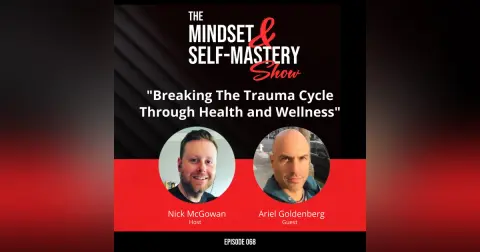
Breaking The Trauma Cycle Through Health and Wellness With Ariel Goldenberg


“There’s something kind of comforting about “I have one choice”.”
In this episode, Nick speaks with Ariel Goldenberg, who took a big leap by moving to America from Israel, wanting a better life. After moving here, both he and his wife put every ounce of their being into getting their business up and running, meaning they cut social activities, friends, and hangouts.
They kept pushing forward for about 6 years until they felt like they could relax a little bit. Getting into the fitness industry, Ariel has learned a lot about how our mindsets can set the tone for failure or success, both in and out of the gym.
Trauma is usually what holds us back, and taking care of your health can help overcome that, as our mindsets and who we are, and what we believe can change as we learn to push ourselves forward.
About Ariel Goldenberg
Ariel is a health and fitness coach. He works mostly with men over 40. He worked as a chef for a few years and then studied the science behind food and nutrition. He is a big believer in the mind as our greatest tool to become better physically and mentally.
Resources:
Interested in starting your own podcast or need help with one you already have? Send Nick an email or schedule a time to discuss your podcast today!
nick@themindsetandselfmasteryshow.com
Thank you for listening!
Please subscribe on iTunes and give us a 5-Star review! https://podcasts.apple.com/us/podcast/the-mindset-and-self-mastery-show/id1604262089
Watch Clips and highlights: www.youtube.com/channel/UCk1tCM7KTe3hrq_-UAa6GHA
Guest Inquiries right here: podcasts@themindsetandselfmasteryshow.com
Your Friends at “The Mindset & Self-Mastery Show”
Nick McGowan
Hello and welcome to The Mindset and Self-mastery Show. I’m your host, Nick McGowan. And on this show, my guests and I unpack the stories that shape us, the lives that we lead on our path to self-mastery. So let’s not wait any longer. Let the games begin.
Nick McGowan
Hey, Ariel, welcome to the show. How are you doing, man?
Ariel Goldenberg
Hey, Nick, how are you? I’m doing well. Thank you very much.
Nick McGowan
Yeah, I’m great. It’s good to catch up with you, man. So. Well, last year, we were running a group together, a men’s group, and doing some awesome things and have loads of meetings. And at one point, I was like, you have an incredible story. Why the hell have I never invited you on the podcast? And I think I like instantly apologized.
Nick McGowan
You’re like, That’s cool. I didn’t even think about it, but here we are. So thank you for being on the show.
Ariel Goldenberg
Absolutely. And very excited to be here and appreciate your invitation to be here.
Nick McGowan
Yeah, absolutely. Well, as the audience can hear, you’re not from Philadelphia like I am.
Ariel Goldenberg
I am not, you.
Nick McGowan
Know, a little further away. So why don’t you give us a little bit context, tell us who you are, what you do for a living, and give us what’s one thing that most people don’t know about you that’s maybe a little odd or bizarre?
Ariel Goldenberg
Well, my name is Ariel Goldberg. I was born and raised in Israel. I am a health and wellness coach. I work most mostly with men around the age of 40 and 50 and up in. And what people don’t know about me, I mean, right now they don’t know anything about me. So I don’t know. I don’t know really where to start.
Ariel Goldenberg
I immigrated here about 17 years ago with my wife, so that was a very, very one of the most dramatic events of my life. Absolutely.
Nick McGowan
Traveling with your wife?
Ariel Goldenberg
Yeah. At the time she wasn’t. Yeah. Yeah. Well, yes, that too. That too. But but I didn’t. I didn’t mean it. But at the time she was in my wife. We were dating only for two years when we were when we made the move here. She was very young and I was not as young, but still young. So it was it was quite an adventure.
Nick McGowan
So let’s just kind of get straight to it then going from from Israel to the U.S.. Well, you weren’t like a baby, where some people were like, look, my parents just picked me up and and we magically got over here and I had no say in it. It sounds like you had at least some say in that. But why don’t you give us a little bit of context?
Nick McGowan
Walk us through the story of like what did that look like to be able to get here? And you really how how you manage your mindset through that?
Ariel Goldenberg
Yes. I wasn’t a baby. I was actually 31. I had a pretty established whole life back in Israel. I was working as a as a cook and a chef for for about eight, nine years at the time. And then I met my wife back then, my girlfriend, and it was right at the moment when things started to be very difficult in Israel, financially.
Ariel Goldenberg
So in Israel. And today it’s much worse actually if you’re not some part of the tech industry, it’s very, very hard to to make a living. So for me as a chef, as much as it was, still is my passion. It wasn’t it wasn’t sufficient for me. And it was very it was very hard life. So also physically, you know, at some point when you when you’re working in a chef like ten, 12 years, 12 hour shift, you know, it puts a lot of toll on your knees and your back.
Ariel Goldenberg
And and so I met my wife and the idea was here, actually, she told me, let’s let’s move to the United States. And I thought that she was joking. She was 24, 24 years old. I thought that she was joking. But it took me about 5 minutes to realize that, no, she’s not joking. And I you know, I and back then, I really have had trust issues with people.
Ariel Goldenberg
But for some reason, I believed her. You know, she was serious. So, you know, we we planned our trip for about few for a few months, and we made the move. We started a business here. And when we came here, I think that for good, five, six years, we were pretty much in full on immigrant mode. And what I mean by that is you just work nonstop of on establishing your financial base basically here, keep keeping your head down.
Ariel Goldenberg
No social interactions, no friends, no family, no know nothing. Basically for five, six years, just working on a business and and starting a life and starting a financial base. And after, you know, time goes by and you kind of you start to allow yourself do other things. But, you know, still today, I think that we have this kind of immigrant mentality where you you come to a new place basically with nothing, actually with debt.
Ariel Goldenberg
We owed money and so you come here and you have this state of mind that you have to make it work. You just have to it’s there’s no other choice. You you burn your ships at the shore. Basically, there’s no going back. And it’s a very powerful state of mind because it kind of increases your chances of making it.
Ariel Goldenberg
I mean, I’m not saying you have to be a millionaire or anything like that, but you’re making it like that. So.
Nick McGowan
Hmm. It’s an interesting space, especially like when you think of burn the ships. Some people think like in a almost a drastically extreme version where they’re like, I have to cut off everything, cut off all these relationships and all these things and all that. But the fact that you were like, All right, we’re here. We have to make this thing happen, because then if you go back, you’re literally going backwards.
Nick McGowan
But did you think about it that way of like potentially going back and kind of going backwards in life or is it more of a pressure of like, if we’re here, we might as well just do the damn thing and do it right.
Ariel Goldenberg
I think it’s both. I think it both. I mean, I realized pretty quickly after maybe two months here that going back would be going backward. I mean, it was pretty clear that the potential of building a better life here is Israel versus going back. And, you know, Israel is not a third world country. It’s not like someplace in Africa we’re going back.
Ariel Goldenberg
You know, we’re not refugees. We were not in danger or anything like that, you know. But still, it was pretty clear that building a good life here is is there’s a good chance of doing that. And it would be much better than going back. So so I think that I think that my wife kind of she had an I the idea of of coming here but I was more of the driving force behind staying here so that how it worked out and you know that it’s more complicated because I mean, you leave your family behind, especially especially when it comes to my wife.
Ariel Goldenberg
That was a big, long crisis between us and my wife’s family. So it was a huge sacrifice. It was a huge sacrifice for both of us. But I think that both of us knew, even if we didn’t admit it back then, to ourselves and to each other, we we knew deep inside that this is what we should do in order to turn our life around, even personally, not just not just for financial reason, when both of us are coming from not an easy background, you know, families and, you know, other in their events, you know, in the army service in Israel.
Ariel Goldenberg
So it was clear for both of us that it was it was still is a good move. So, yes.
Nick McGowan
That’s interesting stuff, man. So you’ve hit on a couple of things already that I want us to be able to take a kind of a look back together and think about that moment a couple moments. But starting with the one where she had said, hey, let’s go to the U.S. and you’re like, oh, that’s cool. Oh, wait, you’re serious?
Nick McGowan
And and then unpacking those pieces of how the rest of the journey looked to be able to get here because you went from, oh, are you serious to I’ve got to do five or six hard years of really working to build this thing. And what did that look like now from the perspective that you have, being able to take the wisdom from it and go, Oh shit, there were times where I mismanaged my mindset or I’m glad I did this specific thing.
Nick McGowan
So let’s break that down a little bit.
Ariel Goldenberg
You know, I think that that well, it would be a little bit of an exaggeration to say that we’re young and stupid, so so we didn’t think about what we were doing. But on some level, it is true. We didn’t have a plan. We didn’t have any plan. So those five, six years that I just mentioned, there was nothing that I thought about back then.
Ariel Goldenberg
I didn’t know how long it will take. I wasn’t aware of any of those stages in the process of establishing and building a life here. Maybe it’s a good thing, you know? Maybe it’s a good thing. It would be a huge obstacle if I had those things in my mind because we we were in the state of mind.
Ariel Goldenberg
Let’s just try it, see what happens. You know, we had a very we had a pretty good idea for a business and art business. We started here and we started the business. It went well pretty quickly and we just kept going, you know, it’s with no no plan, just kind of on the go. I didn’t think so much about what we were doing and maybe it’s a good thing, so.
Nick McGowan
Oh, yeah, I’m sure. Yeah. Because if somebody said, Oh, you want to do this, well, great, it’s going to be a pain in the ass. Then when you get there, you’re going to have to put five, probably six years into doing hard work and things you don’t want to do. At that point, you’d be like, Oh, I know you were serious about this, but no.
Nick McGowan
And most people, I think for the most part, most successful entrepreneurs specifically talk about the craziness that had gone through their story. And they’ve even admitted, like, have somebody told me, this is exactly what’s going to happen? I don’t think I would have signed up for it because it sounds crazy, but you learn so much stuff through it.
Nick McGowan
So looking back at that whole time now, let’s even say the six years and a little before you moved, what do you think you got from that wisdom wise that the audience would be able to take from that? Because, like I said to you before, we even hit record, there are a lot of people that haven’t ever gone through that transition from one country to the next.
Nick McGowan
And there are more people that don’t have any idea what that would look like to even move from state to state. So kind of working through that for anybody that’s thinking about moving and doing that big leap, what sort of advice do you have for that?
Ariel Goldenberg
I think that, you know, looking backward, I think that that maybe the most important thing is to have a very strong intention in your mind about what you want, what you would like to achieve. And when I say intention, it’s just the then the initial spark. You don’t have to have a plan. You don’t have to know how you’re going to achieve whatever, whatever it is you want to achieve.
Ariel Goldenberg
But you have to have a very strong intention and it’s it’s you know, it takes a lot of trust and faith. I would say you need to believe that what you’re doing is is is the right move and you need to have that type of conviction. Now, I think that the problem today in in the case of many people is that they have too much choice.
Ariel Goldenberg
It’s the luxury that is a blessing, but it’s also a curse when you don’t have when you don’t have too many choices, there’s something relaxing about it. There’s something that is kind of comforting about it because, you know, well, I have one choice. I have to do that. There’s there’s no other way. So there’s something very kind of you don’t have the luxury or the curse of looking to the side.
Ariel Goldenberg
And so maybe I do that. No, maybe I do that. You just have one path that you have to walk on no matter what, and you just keep walking on the same path, very focused. And if you do that, I mean, it’ll get you somewhere for sure.
Nick McGowan
So it’s a good point. I know there are certain people that kind of manufacture that sort of thing. As you’re talking about it. What comes to mind is when like I think of Mark Zuckerberg and he’s probably the easiest one to point out where he kind of has an outfit for work where it’s basically the shirt and pants that he always wears constantly.
Nick McGowan
I know I’ve kind of fallen into that where I’m like, look, if I have a black shirt on and maybe shorts, you know, like I’m totally good and that’s about it. And you remove those thoughts of like, I don’t want to have to figure out what I’m going to wear every day. And there’s a lot of people I’ve talked to since COVID where they’re like, now they get to work from home.
Nick McGowan
There are certain things that I don’t have to think about because you don’t have to think about the trip to the office. You don’t have to think about What am I going to wear today? Did I do laundry? It’s like I’m going to wear the same basketball shorts and I’ve got five different shirts that I wear or whatever that looks like.
Nick McGowan
So have you found yourself doing more of that where you kind of remove the different options and go, Oh, I’ve got A or B and I’m going to pick A and just pull and go with it.
Ariel Goldenberg
You know, I try to do that as much as I can. You talk about clothing, so I see my clothing as uniforms. I don’t I don’t spend too much time and energy in picking my clothes. I just like you said, I work right now. It’s like 100% from from home and zoom meetings and text and email. So, you know, that’s completely out of the way.
Ariel Goldenberg
I actually heard an interesting story about President Obama at the time. Maybe it’s every president in you had said they don’t choose what their you know, what kind of suit that they’re aware on a certain day. They don’t choose what they’re going to eat because they have such a high level of decision fatigue anyway and crucial decisions like we’re not talking about like, you know, so so they’re trying to put all those trivial daily decisions aside just to create more space for the more important stuff.
Ariel Goldenberg
And I think that that can can be applied to each and every one of us, even if you’re not the president.
Nick McGowan
So, yeah, yeah. Most of the people that are listening to this aren’t the president. Maybe at some point they have aspirations to be or they’re like, I can do better than that guy. But that is an interesting thing to be able to kind of take those decisions out, and especially for all of us as we go throughout our day.
Nick McGowan
This this recording is in the beginning of the year. So most people are thinking now like, what do I need to change do differently? By the time this comes out, it’s probably going to be April ish, something like that. So people are well into their year. So as you’re now, well into your year, what sort of decisions are you pulling back on and making changes to that you go, Hey, maybe I don’t need to think about that or get as in-depth with that because I’ve found that people and you probably experience this too, especially as a health coach, where they get fascinated almost about this one stupid thing.
Nick McGowan
And you’re like, It’s not the stupid thing, it’s the thing below that. It’s the core principle of that thing. So based on everything that you’ve learned and you’ve gone through and kind of along the same principle, how does that interact with your business and your clients?
Ariel Goldenberg
Well, you know, I like I like you said, I’m a health and wellness coach and we’re recording this in beginning of January. So everybody are in the midst of their New Year’s resolution. And and I don’t know if you if you’re familiar with this statistics about New Year’s resolutions, but they tend to I think that’s about like 70% of them are completely forgotten by the end of February.
Ariel Goldenberg
So so you’ll see this crazy spike in gym memberships the beginning of January. I see it in my gym right now. It’s crazy.
Nick McGowan
Still happening.
Ariel Goldenberg
But I know for yeah, I know for sure that in a month and month and a half, it’s going to go it’s going to go back to normal. So what’s the problem with it? Why? You know, because people are like you said, they’re focusing on on the byproduct. They’re not focusing on on stuff that comes before that on the base and and and the base is just acquiring this state of mind of almost acquiring an identity of someone who is trying to achieve better life.
Ariel Goldenberg
In my case, better health, better strength. It’s not about your gym membership. It’s not about losing £20. It’s not about, you know, lifting more weight at the gym. It’s more about the basic change that you need to make with yourself and by, you know, applying a different identity. It sounds extreme, but but that’s that’s how people succeed in this field and in anything else in their lives.
Ariel Goldenberg
I think.
Nick McGowan
So. Go ahead. Take that a little further, because the identity thing is a very interesting topic. And for people to think how you want me to change my identity, that’s everything I am. And I know that’s not what you’re saying because it’s it’s even deeper than that. So unpack that a little bit for us.
Ariel Goldenberg
So I think you’re familiar with James Clear, the guy who wrote Atomic Habits, and he gives a very good example. I’m sorry. Okay. Sorry. He says basically, let’s say that someone tries to quit smoking. And so you got two guys. One says he’s being offered a cigaret and he says, well, I’m trying to quit. The other guy says, I’m not a smoker.
Ariel Goldenberg
So that’s a huge difference, I think. And that can be applied to anything that you do in your life. Health and fitness is very, you know, very applies to health and fitness, too. And when you when you apply this type of identity, you can be consistent with what you’re doing. And you can be sure that obstacles are going to present themselves on the path and difficulties and things that are going to go against you.
Ariel Goldenberg
But if you apply this identity, if you’re able to be more consistent and start over each and every time, so, so it’s really, it’s really about applying the identity and changing your state of mind before anything else. And it doesn’t matter if it happens at the end of December or mid April or July, it doesn’t matter. So this is why when it comes to the New Year’s resolutions, I tend to kind of be, you know, take it with a huge grain of salt.
Nick McGowan
So I agree. It’s almost funny to me when people talk about New Year’s resolutions because I’m like, Oh, okay, that’s where you’re at. And other people that talk about the the goals that they have and the incremental growth and what they’ve done that’s transferring over from one year to the next. It just happens to be the start of a brand new year to me.
Nick McGowan
I realize that that person gets it, or at least they’re on the path to get it and bring up the atomic habits. I, I love that story specifically because I was a smoker for a handful of years and then at one point it just completely grossed me out. I was like, I’m done. And there was a situation where I tied so much negativity to it that it was no longer a thing.
Nick McGowan
I wasn’t a smoker, but that didn’t hit me, you know? It made sense to me, but it hit me harder. When I read that in the book, I was like, Huh, that makes total sense because of the identity. So working with your clients that overall health and wellness and kind of getting them the break that, do you find that a lot of the stuff that you do is really just getting into the actual habits and the reasons behind those habits that ultimately just fix other problems automatically?
Ariel Goldenberg
Absolutely. And and it takes some time to for people to to let that information sink in, because, you know, most people they come to me because they want to lose fat and they want to get stronger and they want to. So they have very specific pinpoint goals, like I would say, above the surface goals. But what I try to teach them that if you want to create a sustainable, long lasting change, you have to go back and and first of all, identify the bad habits where they coming from, why they’re coming from.
Ariel Goldenberg
How long have you been carrying those habits? So there’s there’s. It’s just that. So what you coming to me with? You know, those 20lbs? This is just the tip of the iceberg. So we’re talking back. We’re talking decades back, like, how did you grow up? What environment? What was your dynamics with your parents? You know, I’m not a therapist, but there is a there is a lot of overlapping between what I do and I dare say, therapy.
Ariel Goldenberg
It just cannot be separated from from health and fitness. It’s tightly related.
Nick McGowan
Yeah. And I think most everything comes from some sort of childhood experience or childhood trauma. So I found myself at times having having issues, eating and just like scarfing down food because I’m or being a little kid and thinking I don’t know where the next meal is going to come from or being in a house and my brother and sister and be like, I don’t know if I’m going to get anymore because those two little monsters just keep eating everything.
Nick McGowan
But it’s interesting how you go back from that sort of stuff. So with the clients that you’re working with, you are you find that there are certain times where people are like, I don’t want that. I want the quick fix and that’s all I want. Or Do you find more times than not that most people are they’re willing to do the work, but maybe just a bit begrudging to start?
Ariel Goldenberg
I think that most people get get it. I mean, most people, even if they come with that specific quick fix, they when I start explaining the higher goal and I make the connection between their health and fitness and, you know, the higher level of like, what is your life purpose? What is the what is the meaning of all this?
Ariel Goldenberg
Why do you want to? Why do you want to get leaner? Why do you want to get stronger? And you make that connection. People get it. People understand that their health and fitness is not just about, you know, getting six pack and all of it, which is great. By the way. I’m not I don’t have anything. It’s a nice byproduct to have.
Ariel Goldenberg
But when I talk to especially men and they say, listen, you want to be there for your family, right? You want to be there for your family as long as you can. And with the best quality, not just, you know, in a wheelchair, in so people can live to be 90, but what’s their quality of their life. So I talk to them not just about life span, but also a health span.
Ariel Goldenberg
And and there’s a guy by the name of Peter Attia. He’s a doctor and his life project, his longevity. So he presents a very interesting concept, which is if you want to kick ass at 80, which I assume all of us want to, you cannot afford to be average at 50 because there’s going to be there is a natural decline in your strength and muscle mass and health in general.
Ariel Goldenberg
That’s that is inevitable. So you have to create this buffer right between that and 30 years forward. And so you have to sort so the message is basically start early, just start as early as you can. And even if you haven’t start right now. Right. So you just cannot afford to be average.
Nick McGowan
Yeah, that’s a that’s a tough pill for people to swallow because I think for the most part, a lot of people don’t think of themselves as average and if they do and they’re okay with being average, then you’re fighting an uphill battle because they’re already like they’re done. They’ve already given up at that point. There are a lot of people that even if they talk a good game, they still have a bunch of bullshit that goes on in their head where they talk this negative experience about stuff and it’s hard for them to kind of break that stuff down.
Nick McGowan
So I appreciate that you bring that out of your clients almost right off the bat, like we got to get into this stuff before we get into the the topical layer of the fact, like we need to get deep into that. So how did you get to that point, though? Because there are other coaches out there that are like, Oh, you should read and this is exactly what we do.
Nick McGowan
But they don’t go deeper than that and they might help that person carve out their body. But in four or five, six months, they’re back to Flab City. But how do you how did you get to the point where you can actually talk about that? What did your journey look like to that?
Ariel Goldenberg
Well, you know, I saw it a lot and by studying, I don’t I just I don’t just mean academics like, you know, getting my my credentials and, you know, becoming a nutrition consultant and all of that. I studied through experience. You know, I’m a I’m going to be 50 years old next April. So I experienced firsthand all those experiences that men my age are going through.
Ariel Goldenberg
And men life is life is short, they say. But life on a different level are very long. It’s a long journey. And you just you just learn on your body and on your mind by exploring your body and your mind, you know what’s going on. You know why. When I’m going to exercise, when I go to the gym, are the benefits just just physical?
Ariel Goldenberg
What are the what are the benefits on a time span of a week or a month or a year or a decade? Right. So I just learn those things from first hand experience. And it seems to me that you just cannot separate the mental from the social, from the physical, from even the spiritual, right. It’s all a continuum of one thing that all those elements are feeding each other and part of the whole you just cannot separate those things.
Ariel Goldenberg
And if someone you know, when I work with men, it doesn’t doesn’t mean that we cannot work on those quick fix goals. We we can do that. But if you really want to if you really want to get healthy and strong for the next decades, we have to touch on those other elements and levels that you may not expect, you know, to do, to touch on in the process.
Nick McGowan
Makes sense. I mean, it seems to me it’s almost like putting a bandage on it. If you’re just looking for the quick fix, you’re like, Well, here’s a bandage, but it’s actually a gaping, festering wound that you need to get into and do hard work on. So people have a hard time with that, not the audience that listen to this show.
Nick McGowan
So I’m sure they’re eating this all up and enjoying it. But are there a couple major moments that you can look back at on your life that are sort of pivotal, moments that shaped you to who you are now and some of these core principles that you have?
Ariel Goldenberg
Well, you know, I I was an athlete as a teenager. I was a swimmer. I was a competitive swimmer. And my father really pushed my brother and me to to be competitive swimmer. And pretty much my whole from the age of nine to the age of 16, I was pretty much spending most of my time in the swimming pool.
Ariel Goldenberg
I had constant smell of chlorine on my body, so and so I think that when you do something like that at such a young age, there is an imprint of that that will carry you, will carry you for the rest of your life, a pivotal moment was when my father died. My father died when he was 55 of a stroke.
Ariel Goldenberg
So my father was a smoker. He he was a drinker, wasn’t healthy man. Ironically, he didn’t know how to swim, ironically enough. Which is crazy. Right.
Nick McGowan
But he forced you kids. Yeah. Yeah.
Ariel Goldenberg
And we were competitive swimmers, so. So when he died, he died at 55, right. Of a stroke. Not a healthy person, not mentally, not physically. And I wasn’t in contact with him five years before he died. I was so angry at him that I just you know, I was traveling in South America when my mother notified me about what happened.
Ariel Goldenberg
And I didn’t come to the funeral. I was so angry. So so he died at 55. I’m 50 years old. So as you can imagine, that kind of stuck in my mind. I have that side of my family that it’s a mystery to me. Probably not the great genes on earth, you know, from him. So I huge part of my decision to go that route of nutrition and health and fitness and wellness in general was because of that, I just make a decision that I’m not going to do the same thing.
Ariel Goldenberg
I’m going to be different. It’s like whatever he was, I decided to be the opposite. So huge element of my in everything I do today.
Nick McGowan
Yeah, well, I want to get into the, the issue that you have with your path and how there was a lot of anger and frustration there. What did that look like and how are you? How are you dealing with that now?
Ariel Goldenberg
Well, it looks like my relationship with my father was based on fear, basically. So my and my coping mechanism back then was to kind of sneak and to hide, as opposed to my brother, who used to be much more confrontational. And he suffered much more because of that. I chose a different way, which was maybe a bit smarter to minimize the friction between my father.
Ariel Goldenberg
But I don’t know if maybe there there’s an experience as a when your brother is is suffering, you’re suffering the same way almost. You know, it all happens in a very small apartment, so it doesn’t really matter. So today, as a father, that’s again, it’s a huge element in my life. I can definitely see when I’m in the role of a father to my daughter.
Ariel Goldenberg
Sometimes I see my I see my father kind of rises in me. Kind of I see I can see the same I can experience the same type of anger and that that can be frightening. But that’s part of my journey to to break the cycle. I made a decision and my wife did the same. And again, going back to our journey to here is to break the cycle of all the trauma and all the suffering.
Ariel Goldenberg
And we’re not going to do the same mistakes with our daughter. And I know that I failed from time to time for sure, but I think we we have developed a level of awareness that that puts it puts us in a much better place than our parents did and a necessary stage of all of this is forgive you know, forgive your parents understanding that this is where they were in terms of their level of awareness back then.
Ariel Goldenberg
And it took me a long time. It took me a good 20 years to to realize that and to go through this process of forgiveness, let go of the anger to the point where to today? I can I can have good thoughts about my father, strangely enough, you know, but it’s it’s a great feeling, you know? It’s a great feeling.
Ariel Goldenberg
And it’s such a necessary part of the process. If you really want to make your life better or improve your life, you have to you have to let go of that. I think someone said some very smart person that I know said you cannot grow from a place of the victim. It’s not going to work. So.
Nick McGowan
Yeah, and with the forgiveness, it’s not always about the other person or for the other person. It can be for you and should be in a lot of cases where you need to be able to forgive. And that doesn’t allow that person to even enter back into your life. If you don’t want them to. No credit with your father, he can, but at least physically.
Nick McGowan
But anybody else you can forgive people in life and not be lenient with how they are or what they are and not let them back in. And I think to go along with the health and wellness, it’s not just the forgiveness of that, but it’s also the forgiveness of yourself. I think think about when people are like, all right, I’m not going to eat sugar or I’m not going to do this, not going to do that, not going to smoke a cigaret.
Nick McGowan
And then they smoke a cigaret and they just go down that negative hill and then they just compound on that. And it sounds like you’ve I like that you hit on breaking the cycle because that seems like a key and core concept here of being able to be aware of it and then doing something about it and acting upon that to actually break the cycle.
Nick McGowan
And you’re in the middle of literally doing that not only for your family, but for your clients as well. And in some ways you needed to go through that chaos and bullshit to be able to be in this spot now. And it’s great that you can actually look back and have some at least pleasurable moments that you can think of with your dad because of that forgiveness, instead of just seething and being hateful toward it.
Nick McGowan
But have you also forgiven yourself for not going to the funeral and not being there with your family? Has that been a part of that as well?
Ariel Goldenberg
Yeah, you know, I forgive myself about that. I let it go. I see forgiveness. I understand forgiveness today. More like of like more like letting go on a spiritual level. I believe that will forgiveness comes only from one place and it’s from above. I know it up to us, but the letting go part is it’s so important. And and what you said about breaking the cycle, I just want to I just want to make sure that people understand that breaking cycle is not it’s not like a quick event that happens one day and you’re done.
Ariel Goldenberg
Breaking the cycle is a life project, really. It’s a life project. It takes time and it’s an ongoing. And you’re never you’re never really there there. Like it never really ends getting out of the cycle. It’s a it’s an ongoing process that will carry me, you know, to the end of my life, I think. But I can safely say that I’m in a much, much better place than they used to be, that’s for sure.
Nick McGowan
Yeah, that’s kind of the hope, right? You know, even if from today to tomorrow, you want to be in a better place or maybe differently said and you know, in some circles better said, however they want to put it, but not as bad as you were the day before, be it better or not as bad. But it’s it’s still that growth and it kind of goes back to the Atomic Habits book in a sense, with that incremental growth.
Nick McGowan
That’s always been a thing that has really helped me kind of ground myself in a sense to be able to take that incremental growth and go, I’ve got three or four different lists of things and stuff and all this stuff, and you know what? If they all don’t get done, the world is not going to end. And if it does, none of this shit matters.
Nick McGowan
It’s beautiful. So being okay with those moments and trusting in those moments. So is there anything specifically that you want to get into about that that you get into with your clients that have helped them to kind of stay in those moments and be present?
Ariel Goldenberg
Yeah, you know, I tell my clients that sometimes I’m being asked not just by my clients, but by just, you know, people I appreciate or friends. Like what is the most important thing, the most important advice that you can give to someone who tries to make a change for the better in their health and fitness? Like what type of fitness plan?
Ariel Goldenberg
What type of meal plan? You. So I said, look, it’s forget all of that. The most important thing or the most the best plan you can have is is one thing at it and one thing only. It’s the plan that you can be consistent with. That’s it. It doesn’t matter if you go keto or paleo or vegan or whatever, and you do or strength training or interval training or yoga or just just whatever you can be consistent with.
Ariel Goldenberg
And I say that because people need to realize that when they start this type of journey, they’re going to fail. And I say that to all my clients on on the first day you are going to fail. It’s like, what? Why am I hiring for you for saying, listen, it’s going to happen for sure 100% that you are going to fail.
Ariel Goldenberg
It’s not a question if it’s going to happen, it’s just a question when it’s going to happen. Most likely it’s going to happen sooner than later. Right. It’s like I’m not I’m not trying to put you down. I’m just trying to give you the reality so you can use it as just now. You can relax, you know, just throw all your perfect perfectionism out the window.
Ariel Goldenberg
You can relax. You are you are going to fail. But the most important thing is that you’re going to start over. Every time you’re going to fail, you’re going to start over and what I found with with clients who I’ve been seeing for enough time is that when you’re failing enough times and you accumulate these experience of failing, it just becomes easier and easier.
Ariel Goldenberg
Okay. I failed again. I start over, fail again, start over. But I’m consistent, right? I’m consistent with the process. And it’s important to also know that when people fail, they think, Oh, I’m starting over from scratch now. I have to go back to, No, you’re not starting from scratch. Whatever you achieved up until that point where you failed is with you.
Ariel Goldenberg
It’s yours. You’re not losing that. It just goes like that. So it’s not linear. I’m doing it. People may not see what I’m doing in my head, but the process is not linear. Is not linear. You’re going to step forward, step back, you know, five steps forward, 17 steps back. Doesn’t matter as long as the trend, as long as the overall trend is progress, as long as the overall trend is going up and you have to do it enough time to realize that you can you cannot accumulate that type of experience if you do it only for one month and just just give up.
Ariel Goldenberg
Right. So so consistency. I would say it’s the one thing, right? The one thing is just consistency. Just be on the path, keep walking on the path. Whatever happens.
Nick McGowan
You are you clearly know the podcast and you’ve clearly listened to episodes because the last question I always ask is, what’s that one piece of advice you give somebody on their path towards self-mastery? And you’re like, the one thing, here it is. And that’s the beautiful thing to be able to point out, because it is that consistency. And I think the takeaway that I get from that is it’s about the body of work.
Nick McGowan
It’s not the thing that you’re doing right now. It’s how you piece those things together and how it all relates. Then, yeah, as you get older, even like there are times where I talk to people in 38, then I talk to people that are 25 and they’re like, Oh, I didn’t think about it that way. It’s like, Why did because I got punched in the fucking mouth doing it the wrong way and I had to learn from it.
Nick McGowan
And you go from those things and you’re able look back, but it is the body of work. Is there anything else you want to add to that since you’ve already answered the question?
Ariel Goldenberg
No, I know I think the body of work is a great definition of all of this and it really ties together to what we said before about identity, because the body of work creates the identity. If you’re in the past and you go to the gym for two years, you know, with all the failures, with all the obstacles that happened along the way, if you do it for two or three years, you develop a body of work that your body does, your body and mind do not forget.
Ariel Goldenberg
And you become an athlete. You become that person that goes to the gym. You don’t workout. You don’t do that. Those pounds that you want, you become that person that goes to the gym. And on days that you don’t, you feel weird. It’s like, I feel weird because it’s part of who I am. It’s part of my identity, you know, not going to the gym for three days.
Ariel Goldenberg
It feels weird. I feel sick. Something is wrong with me. So. So this is where it becomes automatic. You don’t have to push yourself. The next time you go to the gym, you’re. You’re waiting for it. You’re anticipating go, go, going to the gym or having a good meal and all of that. So and that’s like where this is where it becomes like you’re on autopilot basically.
Ariel Goldenberg
It doesn’t create and it doesn’t requires any effort. You’re just that person.
Nick McGowan
That’s a good point. And I think it also gets back to it’s just it’s part of you at that point. So you don’t have to think about what am I going to wear? You know, like it’s one of those things you’re like, Oh, cool. On this days, these times, I go to the gym and I do these certain things.
Nick McGowan
Maybe there’s some thought to that. And look, man, you’ve helped me with that. I know I’ve, you know, pulled the trigger a couple of times, were like, Hey, I’ve got questions about this, questions about that. And especially with cardio, even a couple of months back where you’re like, here’s what you should do. Here’s how you step that up.
Nick McGowan
And because of the habit that I had of being able to go to the gym and it was already in place, it was easy to be able to go, Okay, I can jump into that. But it was difficult. Like I had a failure. I screwed up my leg, wasn’t able to go back for a couple of weeks, but because that habit was there, it was easier to get back on that bike.
Nick McGowan
And the reason why I bring that up is because we need to just have that habit started. So even for the people that are listening right now that are like, Oh yeah, I get it. But you had that thing. Well, you know, you can start that thing like now you can start it while listening to this episode.
Ariel Goldenberg
Don’t wait for motivation to save you.
Nick McGowan
Yeah, you can turn off all the noise outside and you can just go do the damn thing. At least start doing something. And maybe one of the best things is to pick up that book, the Atomic Habit book, like we’ve kind of hinted at and talked about a couple of times because it is that incremental growth that consistently makes up the body of work.
Nick McGowan
So it’s always great catching up with you. I appreciate you being on the show and something that people don’t know about you is that this is your first podcast episode. Yeah, you did a great job, man. I’m so happy that you’re here. I love the knowledge and the wisdom that you have and how caring you are, how deeply caring you are.
Nick McGowan
And I appreciate you as a friend and and I really appreciate you being on the episode today.
Ariel Goldenberg
Thank you so much, Nick. It’s been it’s been a pleasure. I really I feel honored that you invited me. It’s been fun. And I hope that, you know, people can get some some something good about what we said. I think there’s a need outside there is that there is a you know, people need to get those messages big time.
Nick McGowan
Well, hey, where can people find you? Where can they connect with you?
Ariel Goldenberg
My business name is Active Remedies so people can find you on active remedy dot com, active remedy dot com. And that’s pretty much my my center, my hub. You know, people can connect with me and get the idea of what I, what I do for in my practice perfect.
Nick McGowan
And all that’s going to be in the show notes. So thank you, everybody, for being on with us today. And Ariel, thank you for being on the show, man. I appreciate it.
Ariel Goldenberg
Thank you so much, Nick.
Nick McGowan
Another great conference session on today’s episode of The Mindset and Self-mastery show. So what did you think of the show today? I’d love to hear your thoughts. Check out the Instagram or Facebook page. Join the conversation. If you enjoyed the episode, please jump over to iTunes and subscribe rate and leave a five star review. It helps us be found and helps others be healed.
Nick McGowan
If this episode opened your eyes, made you think or smile at all, then I’m sure it’ll do the same for your friends. Check out the show notes for more from today’s episode and check out other episodes on The Mindset and Self-mastery show dot com as well as our YouTube channel. Just go to YouTube and look up the mindset and self-mastery show.
Nick McGowan
Thanks again to our incredible guests for being real, honest and vulnerable with us today. I’d like to thank our sponsors and most importantly, I’d like to thank you, thank you for hanging out with us today. Your support means the world to us. And with that, remember, your mindset matters. And so do you.