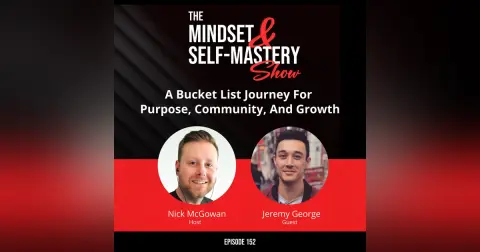
Bucket Lists, Purpose, Community, And Growth With Jeremy George


“My darkest moment became a privilege, giving me a near-death perspective without being on a deathbed.”
In this episode, Nick speaks with Jeremy George about the transformative power of bucket lists. Jeremy shares his personal journey of overcoming suicidal ideation by pursuing 52 bucket list goals in 52 weeks, emphasizing the importance of confronting mortality, the role of community in achieving goals, and the necessity of embracing failure as a stepping stone to success. The conversation highlights how taking small steps can lead to significant personal growth and fulfillment.
What to listen for:
- Bucket lists can serve as a powerful tool for self-discovery.
- Confronting mortality can lead to a deeper understanding of what truly matters.
- Failure is a natural part of the journey towards achieving your goals.
- The act of trying new things can reignite enthusiasm for life.
“At rock bottom, I stopped caring about others’ perceptions, focusing only on what mattered to me.”
- Rock bottom helps you stop worrying about what others think and focus on what truly matters to you.
- Tough times often show you how strong you really are and push you to prioritize self-care.
- Stripping away outside expectations can lead to a stronger, more resilient you.
“Many people at the end of life regret what they didn’t do more than what they did—regretting leaps they didn’t take or creative ideas never explored.”
- Regrets about what wasn’t done remind us to take action now on what matters.
- Creativity and bold ideas are often what we miss the most, so make time for them.
- Embracing life’s uncertainties allows us to grow and prevents regret later on.
About Jeremy George
Jeremy is a TEDx Speaker and Founder & CEO of BucketMatch, an online platform that empowers people to conquer their bucket lists by connecting them with like-minded people and helpful resources.
- https://www.bucketmatch.ai/
- https://www.linkedin.com/in/jeremy-george/
- https://www.instagram.com/jgeorge04/
Resources:
Interested in starting your own podcast or need help with one you already have? Send Nick an email or schedule a time to discuss your podcast today!
nick@themindsetandselfmasteryshow.com
Thank you for listening!
Please subscribe on iTunes and give us a 5-Star review! https://podcasts.apple.com/us/podcast/the-mindset-and-self-mastery-show/id1604262089
Watch Clips and highlights: www.youtube.com/channel/UCk1tCM7KTe3hrq_-UAa6GHA
Guest Inquiries right here: podcasts@themindsetandselfmasteryshow.com
Your Friends at “The Mindset & Self-Mastery Show”
Nick (00:00.239)
Hello and welcome to the Mindset and Self Mastery Show. I’m your host, Nick McGowan. Today on the show we have Jeremy George. Jeremy, what’s up, man?
Jeremy George (00:13.153)
Nick, excited to be here. Thanks so much for having me on.
Nick (00:15.863)
Absolutely. I’m really looking forward to the conversation. I think there’s a lot that we’re going to be able to get into. I love the idea of just a bucket list. Some people have them. Some people are all over them. Some people just have grand ideas of like one day I’d like to do this thing, but it is a different thing when you start to really put it down on paper or just think about it a little deeper than just like, you know, that’d be cool at some point, but like, why, why do you want to do those things? What does it happen?
or what happens when you go do those things. So, hey, why don’t you kick us off? Tell us what you do for a living and what’s one thing most people don’t know about you that’s maybe a little odd or bizarre.
Jeremy George (00:53.485)
Sure. So I’m a founder and CEO of a company called Bucket Match. We just recently launched. So still very, very much in the early days. But what it is is we’re an online platform connects people based on their bucket list goals. So obviously, you know, happy to chat bucket list goals and all that good stuff. But I think one thing that’s a lot of people don’t know about me that was kind of the seed for why I started this company is I during COVID, I was laid off from my job and
Instead of going back and trying to enter the workforce, I decided to assume something completely different, which is I spent the next year deliberately going after a bunch of things on my bucket list. I tried to do 52 goals in 52 weeks. And the reason I did that is actually a more somber kind of catalyst than a lot of people realize. And I’m sure we’ll talk about that today. But yeah, that’s something most people don’t know is that I tried to do 52 bucket list goals in 52 weeks.
Nick (01:49.446)
What a cool thing, just right off the bat, you know, being able to say that you’ve done that, even if it’s just to yourself, like nobody else matters in that sense. But for you to be able to go, I did this thing. That’s fucking cool. I really love the journey as much as certain times I fucking hate the journey of just doing all these things. Because sometimes you’re like, this is cool. I want to do it. And oftentimes as you get deeper and you go through things, if somebody were to say, well, knowing what you know now, would you still do it?
Jeremy George (01:57.155)
One more time.
Nick (02:17.23)
That’s sometimes a really hard question because sometimes it would be no. Like this was a whole lot to go through, but I’m sure you can’t not change in some ways as you start to go through those things. So talk to us about the idea of just the bucket list in and of itself, because we’ll get into the pandemic thing, changing the way that people operate, changing the way that people look, but for you to go, all right, I wanna get out of this and actually dive into it. What was it about?
Jeremy George (02:31.811)
100%.
Nick (02:47.403)
even just the idea of a bucket list that moved you.
Jeremy George (02:50.627)
Yeah. So there’s multiple layers to my answer to that, you know, and so I’ll kind of, I’ll start at the high level and then go down. Originally, I started a bucket list when I was 19 years old. So was a freshman in college and I was inspired by this TV show about a guy, a bunch of guys, it was called The Buried Life. And they all felt like they were sort of stuck. They didn’t really want to follow the status quo. They didn’t know what they wanted out of life. So they built this bucket list and they decided to go try to do a bunch of things. As a 19 year old, I thought, wow, that’s really cool.
I like that they have direction, there’s a purpose. I’ve always felt like there’s so much to do in the world, right? How can I try to do all of it? And so that’s where the bucket list began. And then what I would do is every year I would revisit the list. would cross some things off that I’d done, maybe add some more new ideas and kind of repeat that cycle. Over time, I started adding a lot more things, but I wasn’t really crossing things off. And then if we fast forward to April, 2019, so.
The reason that date stands out to me so much is I was living in New York at the time. I had hit various milestones in my career, in my finances, and in my overall lifestyle that I thought were supposed to make me happy. Right. And it’s like such a cliche story. I’m almost embarrassed that I even fell into this trap. But I hit those milestones and I realized I wasn’t any happier. Right. And that actually put me on this very different path.
Nick (04:04.333)
Truth, though.
Jeremy George (04:15.083)
and I started to spiral into suicidal ideation because I started believing that happiness isn’t actually attainable. Once I got to that point, I wasn’t sure if I had any reason to keep going, right? Because I just thought I’m just gonna keep chasing the next thing after the next. And I struggled with that for about a year. Then in December of 2019, right before COVID, my mom,
Nick (04:30.413)
Hmm.
Jeremy George (04:43.555)
went in to get back surgery and the back surgery did not go according to plan. I wake up to a call from my dad. I’m living in New York at the time, but they’re in California. He says, Hey Jeremy, mom’s in the ICU. If you can make your way over here as soon as possible, that would be good. And I’m sorry.
She’s alive, by the way. Sorry. So, you know, it’s a good ending, happy ending. But I remember on that flight over, sort of feeling really silly and kind of ashamed because, you know, I was contemplating ending my own life. And here my mom is, you know, intubated, knocked out in a hospital bed, fighting for hers. And on that flight over, it’s what I…
That’s when I decided I was going to do something about it. And thankfully, as I mentioned, you know, my mom, she’s alive now. She’s actually doing great. She’s, you know, she’s fully mobile. Her brain did not have any brain damage or, you know, no severe brain damage. And I got the lesson without the consequence. so then, you know, going into 2020, I’m convicted to like do something. Right. And then COVID happens. And of course, we’re all forced to reconcile with how fragile life can be. And it can just be turned upside down at any moment. And then I get laid off from my job.
And so I had this unique opportunity where I said, you know what? The reason I think I’m unhappy is because I’ve been neglecting all of these things that I wanted to do and try and experience in life because I was pursuing all these vanity metrics that don’t actually matter to me. And so I said, let me just try it and see what happens. So I took out my bucket list. I brushed off the dust. You know, it hadn’t been touched in a while. I changed a few things. I pulled out the 52 things that
got me most excited and I said, all right, let’s try it. Let’s try it for a year. I’m going to do as many of these things as I can. And if at the end of the year, I still feel like life is meaningless, well then maybe I’ll allow myself to take my life at that point. And thank God, know, obviously I’m here today. It truly did save my life. And it feels so kind of cheesy to say that. And I think for folks that haven’t gone through that suicidal ideation, that sort of sense of hopelessness, it’s hard to fully grasp. But that’s the reality of it.
Nick (06:45.963)
Hmm.
Nick (07:03.179)
Well, I’m glad that your mom’s good. That’s got to be real rough, especially a six, seven hour flight, going from one coast to the next, being up in the air thinking any fucking thing could be happening right now. And that can be a heavy burden on people just no matter what. But the additional heavy burden of seeing that you were thinking about taking your life while somebody else, somebody who means so much to you is fighting. What a mind fuck, you know, but like what a beautiful thing to be able to
Jeremy George (07:05.868)
Yeah, thank you.
Nick (07:33.251)
Move from that. I’d really love for you to be able to understand that Doesn’t matter what the fuck anybody else thinks about any of this like you’ve pointed out a few times I feel a bit ashamed of this or if you’re weird with that, dude There’s no shoulds in life. There’s none of that and if anybody shitty about it like that I’ll fucking tell you something about them For you to be able to look at this and see these opportunities and go well fuck this I want to do this thing and I want to figure this thing out
I really appreciate that you are as honest as you are, because it could be easy to turn it and be like, yeah, well, things were really rough. And you know, then I did this amazing thing and everything was great. And now here I am. But that’s not fucking true. Like that’s not 100 % real. And context is so important in so many different ways. So to be able to point out that you were like, all right, cool. This is what this is going to look like. And if not at the end of it, then that’s when I’ll do this thing.
There are so many people that do go through that and don’t talk about it. I remember telling myself when I was younger, the day that I don’t cry about this is when I do it. And when you start to open up and have those conversations and people go, I said the same shit, or I said something similar. That’s why being able to understand that we do have this life, even if we have many, many, many lives, who the fuck cares? We are here right now.
Jeremy George (08:45.047)
Yeah. Yep.
Nick (08:55.625)
And if we’re going to do something with what we have right now, then we get to actually do something about it. And you’re right, a lot of people looked at what they were doing during the whole pandemic and going, well, the fuck I’m locked down. What, what is life at this point and all of that. And for you to actually step in and say, all right, I’m going to do this and I’m going to do these things. wasn’t just because you want it to explore your life was literally on the line with it. The reason why I bring that up is I think so many people don’t understand that their life is on the line.
And I don’t mean that in a negative connotation. Like think about the vanity of making money and doing these things. This is all just bullshit that we’re fed. Like you should have a successful life. You should make X amount of money. By the time you’re X years old, you should have a family and you should, and you should, and you should, and none of that fucking matters. So I wanna take a bit of a step back, but look at the 52 and look at
what happened as you started to work through a few of them, with hindsight being 20-20 in a sense, where you went through two, three, four of them and went, okay, cool, I’ve learned something. By 20, 30, 40, I could assume you were probably a different person. So what did that path look like and what are some of the pivotal things that you notice looking back at it now where you’re like, fuck, this is, these steps helped me to get where I’m at.
Jeremy George (10:04.247)
Yeah.
Jeremy George (10:18.433)
Yeah. Yeah. Well, you touched on something that I just want to underscore really quickly, which is you said, I think something along the lines of your life is always on the line. Right. And I think that’s absolutely true. And I think that for a lot of folks, if you. If you aren’t confronting mortality out of fear, then I think you’re doing yourself a disservice. And what I mean by that is if you truly think about yourself at the end of your life, right.
And you hear all these stories about folks who had near near-death experiences, who have completely shifted their perspective on life. There have been countless studies done with folks, you know, sitting in hospice or, you know, laying on their death beds, basically. And there was one study, I think it was done at Cornell, that found that 76 % of people at the end of their lives, when they’re reflecting back on, you know, the time that they had on this planet, 76 % of those folks will regret the things that they didn’t do more than the things that they did. Right.
the leaps that we didn’t take, the romantic interests that we didn’t pursue, the creative ideas we never tried. Those are the things that you’re gonna regret when you’re at the end of your life. And I feel in many ways that my darkest moment is actually a huge privilege because I was 28, 29 years old thinking that I’m on my deathbed, thinking it’s only a matter of time before I just take my own life. And I wanna be clear, I wasn’t actively suicidal so I hadn’t actually made any attempts.
My biggest fear, because I’m such an action taker, my biggest fear was that it would get dark enough that I would say, dude, just do it, right? Fuck it. And that was why I was so terrified that if I didn’t do something different, I was gonna take that action. And so I had this unique opportunity where I was actually in great health, right? I was safe, I was secure. I didn’t have all these things that would force me to feel like I’m on a deathbed other than my own sense of fear. And so I asked myself, well, if I was to die tomorrow, what would I regret?
And that was my bucket list. was all these things in life that it’s like, you know, you just want to experience just for the hell of it. And as you said, sometimes it works out. Sometimes you look back and say, I would never do that again. You know, I, dyed my hair blonde. That was fun. I’ll probably never do that again. I wrote and I recorded a rap song just cause I was curious. I’ll probably never do that again, but it was such, you know, it was a great experience. and so I think that, you know, if you really think about a bucket list, a lot of people think it’s just.
Jeremy George (12:42.219)
you know, epic travel and adventures and all these sort of privileged things. And if that matters to you, that’s great. Put it on your bucket list. But a true bucket list is just literally anything you want to do before you die. And maybe that’s you want to reach out to your biological father who you’ve never met and you want to, you know, say thank you or whatever it is. Right. Tell them you love them. Maybe it’s you want to try writing. You’ve got this creative outlet, but you’ve been stuck in this nine to five job and you haven’t given yourself the freedom to pursue that dream.
Nick (12:59.58)
Hmm.
Jeremy George (13:08.525)
There’s all kinds of goals that I hear when people really get vulnerable about their bucket lists. And I guarantee you, if you just confront mortality and truly ask yourself, if I was to die tomorrow, what is the thing that I would regret? Write that thing down and then take one step towards it. Now I learned a lot of other lessons that I’m happy to share, but that’s kind of the first three that I would say really stands out to me. And for me, what I found was,
I started to rediscover my enthusiasm for life and wanting to live and finding purpose and having meaning in waking up every day. And so, you know, small steps.
Nick (13:41.415)
Mm-hmm.
Nick (13:49.04)
Hell yeah. And you’ve pointed out a couple of times like it, this sounds kind of cheesy or that or whatever, because certain people can think like, well, yeah, I hear you with the small steps or I can hear that it was a dark time, blah, Same time. It’s, it’s also really true. Like if we just be here in the moment, then we think about, can only do what we can do in the moment. And sometimes those small things that we think are like small or stupid or whatever.
that are part of our bucket list, that means something to us. Who the fuck cares what it means or doesn’t mean to anybody else? And you touched on purpose too. I think there’s a lot of times where people think, and I don’t know what the actual root cause of this is. It can be really easy to look at social media and say that it is, but that’s almost similar to saying, the guns kill people. No, it’s not the inanimate object. It’s the asshole behind it that’s pulling the trigger.
But there’s something to it where people go, well, man, if my purpose or my bucket list isn’t this big grandiose thing, then it doesn’t matter. Somebody’s bucket list item might be to make a really great meal that they’ve never done before, what might be to draw something. It might be to draw it with your opposite hand and see how weird it is or whatever. You know, it could be so many different things that are small things that don’t have any significance to anybody else.
but purpose, bucket list, all these things, we can sometimes get lost in wealth. It’s not this big grandiose thing. Then what’s the point? Did you tackle that at all, going through, even putting on your list, like, I don’t know if I wanna put this down, because this seems stupid or small or whatever. How did you mentally handle that?
Jeremy George (15:27.235)
Absolutely.
Jeremy George (15:39.169)
Yeah. So, you know, I did all of the above, right? I think there was a lot of value in having those big lofty aspirational goals too. It gave me this sense of like excitement and this zeal for like, let’s just give it a shot. One of the best things about being in your sort of rock bottom is like you said, you kind of don’t give a fuck. And that has truly become my superpower, I think, is you don’t actually care how this is going to be perceived.
purely care if it matters to you and if it’s worth pursuit. And if so, then you do it, right? And so because of that, I allowed myself to like dream big and also be totally happy with subtle things. So one thing on my bucket list is to deliver a Ted talk. I’ve always thought that would be really cool. Another thing on my bucket list is to, you know, start my own company, run a million dollar business. Let’s try that. I biked down the coast of California, which is a 650 mile bike ride.
over 10 days because I wanted to see what that experience would be like. But I also had a lot of silly things. Like I wanted to complete a thousand piece puzzle. I’d never done that before. Right. Let’s just try it out and see. I wanted to write three handwritten thank you letters because I have heard that that is a good thing to do. Right. And that it actually allows you to get out of this sort of depressive state that I was in. I meditated every single day for 90 days because, know, I have been told that
30 days to build a habit, 90 days to create a lifestyle. These are all just things that I had heard that I wanted to try. And I threw them on a bucket list and then I really spent some time looking at it and I pulled out the 52 that meant the most to me. And the one key ingredient that I realized as I was going through this process is that it’s actually about the people. And so what I mean by that is as I was pursuing these goals, I started sharing my bucket list just with people, friends, family, anyone who would listen.
And I started finding that most people were just like, cool, that’s great, right? Like, good luck. That in and of itself was helpful. But what was really awesome was when you start to see other people that wanted to join in and maybe they wanted to help you with a goal or they could connect you to someone else who would be able to help you with that goal, save you money on it, know, hooked you up with a, with an exclusive ticket, whatever it is. and I, so I made it a rule that for every single goal on my bucket list that I tried to accomplish, I would recruit at least one person to help me out in some way. And.
Nick (18:04.772)
Hmm.
Jeremy George (18:05.731)
By the end of the year, the main takeaway was it’s about the people. That’s what makes life worth living. I should say, even though I tried to do 52, I only completed 32 of them. So, you know, by academic standards, that’s like a D minus, but it was never really about actually crossing off everything on your list. It was about the active pursuit of something that mattered to me and finding other people that wanted to join in.
Nick (18:21.733)
You
Jeremy George (18:32.129)
And it’s not always easy, right? You might be lonely for a while in pursuit of something that matters a lot to you. But if you keep sharing it with other people, eventually you’ll find someone that wants to help out. I’ll give the TEDx talk as an example. You know, I wanted to give a TED talk. I didn’t really know how I would do it. I did this project. I was like, maybe this is what I should talk about. I reached out to 11 different TED events. Only one of them got back to me. The other 10 said no, or just didn’t respond at all. But all it took was that one, right?
Nick (18:52.11)
Mm-hmm.
Jeremy George (19:01.441)
And then I had this opportunity to give this talk. And then the talk came out and all of a sudden, all these people are sending me messages, sharing their stories of how they felt like they were just floating through life. They weren’t deliberately attacking it in a way that would make them happy. And that was the seed that I needed to start the company that I have now.
Nick (19:19.243)
One of the coolest things of all of this is that you made a decision at one point to take one fucking step. And that one step turned into all of these things. You could have made a different step that could have ended it. And I think for the people that really feel that and get really close to the void, they then can understand the magnitude of that, which again is like we we have that power. We can remove ourselves from this.
Jeremy George (19:29.538)
Yeah.
Nick (19:49.036)
We can also continue on and struggle in certain ways and experience all the joy and all these things, but do incredible things that we can’t even really think of right now. Like there are certain things that you can put on your bucket list that I’m sure in 10, 15, 20 years from now, you’ll look at and go, well, I see how this was actually a stepping stone to this thing. Because I started these things and I reached out to these people, led me to this other situation, which then made me think and feel that I want to do this something other.
other thing than what was originally that item number 48 on the list, you know? But you have to make those steps to be able to do it. I point that out because I think one of the big things that I know I can struggle with at times and I have over the course of time and the more that I have conversations with clients and people on the show, it’s like we can sometimes really get lost in what’s going to happen in the future. We can worry about it. We can plan for it. We can do all that stuff.
Jeremy George (20:24.003)
Yeah.
Nick (20:44.866)
We can also really worry about the shit that’s happened in the past and think that we are the sum of all those things where all we really have is the ability to take that next step and being able to see how do we make changes and what do we do from here. So you’ve gone through a lot of it and I appreciate the vulnerability and the honesty with it. Like if you came on in here and you’re like, I’ve done all of them and so many more and like all this shit and it’s like you didn’t. And really I think part of that is also showing that you have, you have more to go with the journey of it.
Like that 52 will probably turn into, I don’t know, 102, 202. But that’ll also help so many other people start with two and start to look at just a couple of things. And that’s, it seems like that’s part of your purpose in life, at least for right now, what that looks like and the way that you’re getting that out there. So for the people that are trying to figure out how do I live into my purpose? How do I take those steps but
Jeremy George (21:24.056)
Yeah.
Nick (21:42.189)
How do I take that small immediate step that I could take right fucking now? What’s that piece of advice you give to somebody that’s on their path towards self-mastery?
Jeremy George (21:50.839)
Yeah, I think that in order to truly understand what it is that matters to you, you do have to just try a bunch of things. And that is totally anecdotal from my own personal experience, right? I tend to be someone who overanalyzes and I try to like think through lot of things. And what this experience taught me, I tried to do 52 things in a year that I had literally never done before, right?
So I was constantly a novice. was constantly a beginner over and over and over again. And I think as adults, it’s really hard for us, right? When you’re a kid and you’re learning how to ride a bicycle for the first time, it’s more expected of you. As adults, you don’t want to be back in that stage where you’re a beginner, you’re a novice. But I truly think that that is what you do. And so, you know, just to reiterate, step one is confront mortality or confront the end, whatever that is, right? It doesn’t have to be the end of your life. Maybe it’s, you know,
the end of I’m gonna graduate college. So confront the end of that, right? You will never be a college student again. Or the end of my 30s, confront the end of your 30s, you will never be younger than 30 ever again, or 40 ever again. And then reflect back, right? Sitting in this moment, what am I gonna regret that I didn’t do? And then the beauty of it is you actually have time to then do it.
So then write all of that down and don’t over index on, know, is this worthy of being on my bucket list or not, as we talked about, just write everything down, give yourself a moment to digest it, and then look at which of those actually speaks the most to you. The last goal that I would suggest, or excuse me, the last step that I would suggest is, we talked about recruiting a friend, celebrate failure. The only way that you are going to make progress on anything is if you fail.
it is very unlikely that you’re gonna succeed the first time. And if you do, that probably means you weren’t pushing yourself enough. And so get addicted to failure because what that really means is you actually have taken the first step. And so what I would do is any time that I had a goal that I was trying to pursue and I wasn’t able to do it or I got rejected or someone didn’t respond to my message, I would reward myself in some way, right? Treat myself to something, give myself a high five, whatever it is.
Jeremy George (24:06.563)
Create the neural pathways in your brain to start to truly get addicted to that failure because it means that you’ve actually started.
Nick (24:15.799)
Great way to put that, you know, it can be really easy for us to look at things and even think about different people have failed over and over and over again. And like, those are great stories and can easily be just an external story where you go, that’s cool for somebody else. But it can mean so much more for us when we start to fail and get frustrated or get confused or what have you, and then go, okay, well, I see how these things start to stack up. And then being able to take the wins with that, especially being able to treat yourself.
Because soon as said that, I thought you were just like, well, I fucked this thing up. I’m going to go get ice cream. That’s what I’m going to do. You know, and that’s got that’s got a powerful thing to it. Because then instead of being like, well, shit, you beat yourself up about it, you have to go, I will. What happened? And really, what happened is all that happened. Somebody said no to you. That’s all that happened. There’s no reason to interpret anything else. It just you then get to go, okay, they said no, maybe I’m closer to a yes, or maybe I need to ship this a little bit.
Jeremy George (24:49.505)
Yeah.
Nick (25:14.25)
instead of being grumpy and upset and pissed off about it. and I appreciate you just having the mental fortitude that you have. And I’m sure there’s a lot of dark times and things that we could have really gotten into, but you’ve covered a lot of that too, where it’s like, there were some really pivotal things where we as humans just have an opportunity to make a decision. And that next step is that decision to be made. So, and I appreciate you being on today. And before I let you go, where can people find you and where can they connect?
Jeremy George (25:44.323)
Yeah, totally. So, you know, first thing I think I want to say there is for anyone, if you are struggling, right? And if you’re going through, you know, similar thoughts that I described before depression, suicidal ideation, I hope that you will reach out, right? Connect with somebody, feel free to contact me and I’ll give my contact information, but reach out to a friend, family member, trusted neighbor, doctor. That’s the first person I told. I didn’t talk to my family for a very long time.
I know how hard that can be to try to unveil something so vulnerable about yourself to people that you’re closest to, but tell somebody. So I just wanted to make sure to highlight that. It’s really critical. If you want that somebody to be me, you can find me on LinkedIn. Just search Jeremy George bucket match, and I should be the first person to pop up. If you go to www.whatayourproject.com, that’s where you can see more about this experience I had trying to do a bunch of random shit from my bucket list.
And then of course, if you’re at all inspired and curious to check out Bucket Match, it’s www.bucketmatch.ai.
Nick (26:54.33)
And again, thank you so much for being on today. It’s been great having you.
Jeremy George (26:58.253)
Likewise, thanks, Nick. Thanks for having me.