Cancer Doesn’t Define Your Life, You Do, Embrace The Suck With Terry Tucker
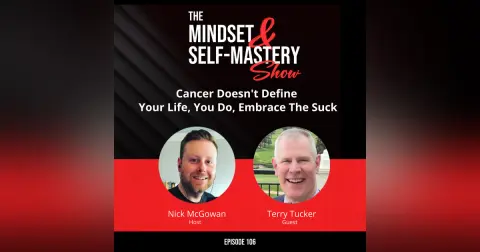


“We are born with everything we need to be successful in life already inside us. We just need to pull it out and use it to our benefit.”
In this episode, Nick speaks with Terry Tucker, who candidly shares his rare melanoma diagnosis and the acceptance of mortality, imparting a profound message about embracing life, facing fears, and recognizing that everything needed for success is already within. He reflects on the divine guidance he believes led him to write his book, emphasizing the importance of surrounding yourself with supportive people and the significance of pursuing passions despite fear. Terry draws parallels between his SWAT team training, battling cancer, and the stages of grief, revealing how each life experience contributed to his resilience. This episode serves as a testament to the strength forged through life’s challenges and the wisdom gained by prioritizing what truly matters.
What to listen for:
- Terry’s lessons from early experiences speaking on podcasts
- The introversion that came from being a cop
- Why you should never write a book to make money
- His belief that God puts people on our path to guide us
“People were suggesting that I write a book, and I was really against it. Like, ‘Nah, I don’t want to write a book.’ There’s that old joke that says when we talk to God, it’s called prayer; when God talks to us, it’s called schizophrenia. So God has never told me to write a book, but I have a fairly strong faith life. And I think what God did is he puts people in our path that make the suggestion. And the more people that make the suggestion, I think I’m smart enough to say, okay, maybe this is something that I should do.”
- Asking for honest feedback on the first drafts of his book
- If it were easy to write a book, everyone would do it
- Terry’s experience training to be on a SWAT team
- How all of his life experiences helped him with battling cancer
- Prioritizing the people and things that matter most
“If there’s something in your heart that you believe you’re supposed to do, but it scares you, go ahead and do it. Because at the end of your life, the things you’re going to regret are not gonna be the things you did. They’re gonna be those things you didn’t do, and by then, it’s gonna be too late to go back and do them. Take your pick; it’s up to you. It’s your show.”
- Terry’s experience getting diagnosed with a rare form of melanoma
- Navigating the stages of grief that showed up
- The powerful lessons he learned from being on sports teams
“One of the big things I learned from being part of team sports, and I think it can be whatever team you’re on, whether it’s your colleagues at work or your family, whatever it is, is the importance of being part of something that’s bigger than yourself. You realize on a team that if you don’t do your job, not only do you let yourself down, but you let your teammates down, your coaches down, your fans down, etc. And if you think about it, the biggest team game that we all play is this game of life.”
- Learning to take life and its struggles day by day
- Why death doesn’t scare Terry and how he focuses on living
- We’re born with everything we need inside of us; we just need to use it
About Terry Tucker:
Terry Tucker is a motivational speaker, author, and international podcast guest on the topics of motivation, mindset, and self-development. He has a business administration degree from The Citadel (where he played NCAA Division I college basketball) and a master’s degree from Boston University. In his professional career, Terry has been a marketing executive, a hospital administrator, a SWAT Team Hostage Negotiator, a high school basketball coach, a business owner, a motivational speaker, and for the past ten years, a cancer warrior (which has resulted in the amputation of his foot in 2018 and his leg in 2020). He is the author of the book “Sustainable Excellence, Ten Principles To Leading Your Uncommon and Extraordinary Life.”
- https://www.facebook.com/motivationalcheck/
- https://www.linkedin.com/in/terry-tucker-9b5605179/
- https://www.motivationalcheck.com/
Resources:
Interested in starting your own podcast or need help with one you already have? Send Nick an email or schedule a time to discuss your podcast today!
nick@themindsetandselfmasteryshow.com
Thank you for listening!
Please subscribe on iTunes and give us a 5-Star review! https://podcasts.apple.com/us/podcast/the-mindset-and-self-mastery-show/id1604262089
Watch Clips and highlights: www.youtube.com/channel/UCk1tCM7KTe3hrq_-UAa6GHA
Guest Inquiries right here: podcasts@themindsetandselfmasteryshow.com
Your Friends at “The Mindset & Self-Mastery Show”
Whenever I speak to especially young people, I always tell them, if there’s something in your heart, something in your soul that you believe you’re supposed to do, but it scares you, go ahead and do it. Because at the end of your life, the things you’re going to regret are not going to be the things you did, they’re going to be those things you didn’t do, and by then it’s going to be too late to go back and do them.
Hello and welcome to the Mindset and Self Mastery Show. I’m your host, Nick McGowan. Today on the show I have Terry Tucker. Terry, how are you doing today? I am great, Nick. Thanks for having me on. I’m really looking forward to talking with you. I’m looking forward to it as well. We were joking before I hit record that I think we originally connected like a year and a half, maybe two years ago, whatever it’s been, like basically however long I’ve had the show for. And we’ve had to push things back. Some of those were my fault. I know you needed to move a couple of things. There was some family stuff that was going on and all.
So I’m glad that we’re able to talk. ah When I first saw the information come through, however long ago it was, I remember thinking, wow, there’s gonna be some great conversation we’re gonna have. And then today, when I looked back through the information, a few things really stood out to me that we’re gonna get into. Like you being a SWAT team, hostage negotiator, most people can’t say that they could even handle that.
Most people kind of look at stuff like on TV and they’re like, oh, that’s crazy. Or I would do this and that sort of situation. I really, really doubt that they would do anything close to that. And I’m sure you’ve heard that stuff too. Maybe somebody like having coffee or a drink with you and they’re like, oh, how did you handle that? So I’m excited to get into that. But hey, man, why don’t you tell us, what do you do for a living? And what’s one thing that most people don’t know about you that’s a little odd or bizarre? Yeah, right now I’m pretty much a cancer patient, but I have started a…
a speaking business, actually started it during COVID and you know, everything shut down, you know, and like so many other companies, you got to figure out how to retool, how to redo what you were doing. And somebody had reached out to me and said, would you like to be a guest on my podcast? And I said, sure, what’s a podcast? mean, literally, I absolutely no idea. they’re like, well, we kind of have a discussion. Then we put it up on social media. And I’m like,
Okay, I remember my first time, I was so nervous, I had Post-it notes all around the camera. You know, and they would ask me a question, I would kind of lean in and read the Post-it note. I was horrible. I mean, hopefully I’m better now, but that’s kind of how I started doing podcasts. And now that things have opened up, I’m back to kind of doing in-person and some virtual speaking as well. One thing that people don’t know about me, I played college basketball against Michael Jordan his freshman year.
when North Carolina won the national championship and it was my senior year. And kind of a funny story, my youngest brother, fast forward 20 years later, my youngest brother is a basketball coach at Loyola Academy in Chicago, and he is coaching Michael Jordan’s two sons. And he said, one day at the end of practice, I’m teaching the kids a drill, I look up, nobody’s paying any attention to me at all. So I look where the kids are looking, which was over at the door, and Jordan had come into the gym as a dad.
to pick up his kids and take them home after practice. So my brother looks at him and says, hey, Michael, you’re a little bit of a distraction. Would you mind stepping out? And Jordan said, sure, coach. I’m sorry. I didn’t mean to interrupt. My brother thought later, I’m probably the only coach in the history of basketball that ever kicked Michael Jordan out of Instead of being like, hey, man, come on in. We can take as much time as you want. Please, be the goat and come on in. Absolutely. So did you?
So we have to touch on that a bit. I’m a huge basketball fan and especially the 90s Bulls. I mean, I’m from Philly, so Sixers through and through, but they sucked in the 90s besides when they got got into the finals and then just got their asses kicked. But that’s a different story. So did you have to guard Michael? Do you remember playing him at all or what? No, actually, James Worthy was the big gun on North Carolina at that point in time.
And this was 1982, boy, I’m really dating myself now. And they had this tournament called the North-South Doubleheader. They played it in the Charlotte Coliseum. They took two teams from North Carolina, which happened to be North Carolina and North Carolina State, and two teams from South Carolina, which happened to be my school, the Citadel and Furman. And we played around Robin Friday, Saturday night. So Friday night playing North Carolina, who in 1982 goes on to win the national championship. And then the next night,
played Jim Valvano and North Carolina State, who the following year, 1983, they went on to win the national championship. So unbeknownst to me, on one weekend, I had the opportunity to play against two national championship teams. So what happened to Citadel? Why didn’t you guys win? The other two won? Yeah, they were much better. I mean, we were all Division I schools, but there’s Division I, and then there was us, Division I. So just a much smaller school. Wow. So do you?
Obviously, you know what both James and Jordan have done or Worthy and Jordan have done. ah Could you see any of that? I know it’s interesting to think about how Worthy was the man back then. I mean, he even had a stellar career, but he didn’t have a Jordan career. So could you see some of that? And Jordan, honestly, no. It was his freshman year. It was still relatively early in the season. And again, I’m going to date myself big time.
I played college basketball when there was one, no three point shot and two, no shot clock. So North Carolina was famous for their four corners, you know, we’re going to get a lead and then we’re going to spread it out and we’re just going to waste time and win the game that way. And Dean Smith, their coach was a wizard at doing that. Wow. What a cool thing. And that’s, that’s a, that’s the reason why I asked that question. What’s one of those things that most people don’t know about you? Cause most people can’t say.
played against Jordan and Worthy. Yeah, it’s pretty cool. You are dating yourself in some ways, but not bad for the younger people. Listen to this episode. He’s not 140. You’re crazy. It wasn’t that long ago. Oh, man. So I know there are a lot of people that jumped on the podcast and I’m jumping around a little bit, but a lot of people that jumped on the podcast train in 2020 because it’s like, all right, well, COVID we’re all stuck here.
It’s funny, I have conversations with people all the time where they’re like, yeah, I wanted to start a podcast or I started a podcast and then realized how difficult it was and just stopped. There was, think like 60 or 70 % of the podcasts that started in 20 just died off because everybody was like, this seemed cool, but this is a lot of work. This is an immense amount. Even for a guest to be able to show up and have those conversations. Now it sounds like you kind of do this full time in a way, not only the podcasts, but.
What does that look like for you to go out and have these conversations? Like, how has it started from you basically jumping on an online radio show, as some would say with podcasting, into what you’re doing now? Yeah, I mean, I am a very introverted person. I don’t like sharing my story. I don’t want people to know about me. And part of that was, I think, being a cop. kind of wanted to, you didn’t want people to know you were a cop and things like that. So.
You know, to come out and to share my story, to share my, my law enforcement story, but my story about cancer and things like that, it’s like, was incredibly uncomfortable for me. I don’t remember, about eight months ago, I was a guest on a podcast and the host was a former NFL player. This guy was like six, eight, like 320 pounds. And I remember we were talking afterwards and he said, you know, Terry, when I started my podcast,
I was scared to death that nobody would listen to me. And I’m like, Marcus, you made it to the pinnacle of professional sports. How could you have thought that nobody would want to listen to you? He’s like, you know, this is a whole lot different than playing professional football. And his brother’s actually in the pro football hall of fame. And I’m like, Marcus, my god, you’re natural at this. I’m so glad you did that. But I think it goes to show you that I don’t care what you do.
And I hate the words imposter syndrome, but I think all of us wonder, our story matter? Does our story make a difference? And I remember reading an article recently that said, it was a survey that was done like 86 % of people surveyed felt that they had a book inside them, whether it was a memoir or a fiction book or whatever it was. And less than 1 % of those people will ever write that book.
And I think in a lot of ways that’s kind of sad. It’s very sad, but why do you think that is? I think it’s incredibly difficult to write a book. I mean, I have written a book. I think it’s hard to do. I mean, just not only to write it, to get it published and to cut through the clutter that’s out there. Another article I read said that there are 800 books published in the United States every single day.
So, you know, mean, unless you have a publicist and you’re getting out there and stuff like that, you know, people always say, never write a book if you want to make money and never write a book if you want to get famous because neither one of those things are going to happen by writing a book. Write a book because it’s something that’s in your heart and that you want to do and share with whoever is out there who’s going to read it. Yeah, that’s interesting. uh There are a lot of people that want to write books. uh There’s an arm and bike company that helps people do that, but
the biggest thing that I look at, not just the book writing, but the path to get to that point. There’s a lot of traumatic experiences. There’s a lot of crazy things that have happened to people. There’s a lot of beautiful things that have happened to people. But it’s interesting how people think no one wants to hear it. No one wants to think about it. No one wants to talk about it. But at the same time, those are typically the same people, because it’s pretty much all of us, that are so self-conscious about the things that we do. Where it’s like, oh, well.
people are gonna think about it this way, or people are gonna look at me this way. And for the most part, people don’t give a shit. They just care about themselves. They’re thinking about themselves. They do. People don’t care about you and your book. I hate to say that. And I mean, if you got a good publicist and you can get out there and you can make it on Good Morning America or something like that, you’ll probably sell a lot of books. But for the most part, it really, I think I’ve given away more books than I’ve actually sold. And for me, that was okay because it was…
Here I’ve got some things that I’ve worked for me I don’t purport to have all the answers But here are some things that have worked for me and I’m putting them out there in the hope that maybe somebody can glean those things and it’ll work for them as well That’s a key thing. Have you thought about how you’ve removed? What the outcome would be from yourself because a lot of people do think well I want to write a book because I want to be famous or I want to do it this way or that way
when in all reality they just need to get it out because it actually needs to get out of their system. They’re meant to write that thing and get it out there. And there are people that will read it and get something from it that they’ll probably never hear from. They’ll never know. I didn’t, you know, people were suggesting that I write a book and I was really against it. Like, no, I don’t want to write a book. You know, there’s sort of that old joke that says when we talk to God, it’s called prayer. When God talks to us, it’s called schizophrenia. So God has never told me, you know, how to write a book.
But I have a fairly strong faith life. And I think what God did is he puts people on our path that make the suggestion. And the more people that make the suggestion, I think I’m smart enough to say, OK, maybe I should take a look at this. Maybe this is something that I should do. And I always say, I wrote the book, but I think it was inspired by something that was much bigger than me. Sure. It’s like God will speak to us in different ways. And sometimes it’ll be through different people or.
books or movies. think there are sometimes like have you ever you ever flipping through the radio stations and basically being able to put sentences together? Yeah. God will do that sort of stuff. You’re like, all right, dude, I get it. I’ll go do this thing. uh It’s interesting how many people don’t ever actually feel that calling and do something with it. They’ll be aware of it, maybe, but they won’t do anything with it. So let’s get into that a little bit. Even if you didn’t feel like
got boomed down from the heavens and was like, Terry, write the book now. That’s typically not going to happen. I mean, I guess like situations like Harriet Tubman, where he’s like, I need you to go back to Maryland. She’s like, I don’t want to. But, you know, to be able to feel different things that come up, like what did that feel like for you to be able to actually go, all right, I think I get the point and I need to go do this thing, even though it’s going to be big and scary. Yeah, I mean, when I when I started to write, it was
I had these sort of 10 principles. So it was basically building stories under these principles. And they’re real stories about real people. But it was, okay, how do I do this? I didn’t know what to do. And so I gave myself two, really two rules. I number one, I’m going to write at least one page every single day except Sunday. I’m going to take a day off on Sunday. And number two, I’m not going to edit anything until I have at least the first draft.
So I would sit down at the computer and honestly, Nick, there were days it was like, I would finish writing and be like, okay, I wrote absolute garbage. You know, I could have written five pages like this absolute garbage. This is never going to make it into a book. And then maybe the next day would write a couple of pages that were good. And then, you know, a couple of pages that were garbage. And so this whole process went on and eventually I had this book edited like, okay, I think I’ve got it. And now you’re like, what do I do?
How do I know if this is any good? And so I farmed it out to a couple friends of ours. He’s a former Navy SEAL. She’s a former uh prosecutor in a large city. And I’m like, please, please read this and be brutally honest with me. This is junk. This is horrible. It should never see the light of day. And they both came back and said, no, you need to get this published. And so I’m like, OK, then it was how do I do that? I could self-publish.
A friend of mine had said, hey, I’ve got this guy, he and his wife do a not-for-profit publishing company. And kind of a funny story, you know, I was in law enforcement before, this guy was in law enforcement. I was in a drug unit, he was in a drug unit. He was a police chief in Louisiana. And one day one of his buddies said, hey, will you come out to California and put on a presentation for authors who want to be able to incorporate police tactics in their books. And that sounded like, you know, they don’t know what they’re talking about.
He’s like, yeah, sure, free trip to California. He goes out there, he ends up meeting his wife, who is at least a 50 time bestselling New York Times author fiction book writer. He gets out of law enforcement, they get married and start this not for profit publishing company, and I got hooked up with him. So it was like, I had cover designers and layout designers and editors, and I would have never been able to do that had I just tried to do it myself.
Man, how cool is that? That was great. When you start taking those steps and you actually start walking that path that you’re meant to be walking, things are just going to open up for you. And then even with your discipline. So obviously, with the show’s name being The Mindset and Self Mastery Show, there are times where people ask me, what is self mastery? And ultimately, it’s discipline. It’s being disciplined in what you do. And that right there is one of those disciplines of saying, all right, every day I’m going to write some sort of trash or some sort of gold. I’m just going to write.
It’s like, it makes me think of Jerry Seinfeld. He writes a joke every single day. And there are different jokes that are absolute garbage, but it’s that discipline of being able to do it. Now, is that something you got from somewhere or was that one of those kind of divinely inspired things where it was like, you just need to write every single day? I think I go back to basketball. You know, I started playing basketball when I was nine years old and played all the way up until I graduated from college. And I actually
was able to go to college despite having three knee surgeries in high school. So I knew the importance of having, you know, certainly being motivated, but also having the discipline to initiate good habits. I always talk about sort of that three-legged stool. You know, if you have motivation, but you don’t have discipline or good habits, it doesn’t matter what you do. You know, if you have discipline and good habits, you don’t have the motivation, again, I think you need all three. And if you’re missing one of those,
things become much more difficult in your life. And most people don’t want to do hard things. But that is how you grow. That is how I’ve managed to survive 11 years with cancer and multiple amputations and things like that. That’s how I wrote a book. Because it was like, this is hard. But the hard is what makes it good. I mean, if it was easy, everybody would do it. It’s the hard stuff that you’re willing to commit your life to.
with the understanding that you may never be successful at this, but it’s something, as you mentioned earlier, it’s something inside you. know, and whenever I speak to especially young people, I always tell them, if there’s something in your heart, something in your soul that you believe you’re supposed to do, but it scares you, go ahead and do it. Because at the end of your life, the things you’re going to regret are not going to be the things you did, they’re going to be those things you didn’t do, and by then it’s going to be too late to go back and do them.
It’s sad that some people think of those as just nice little thoughts or anecdotes about life. Like, yeah, you want to do what you feel you’re here to do. And then they’ll be like, but I have to work and I have kids and I have this and I have that. It’s like, I have to live this thing. Like life should look some sort of way. It should look that way or it shouldn’t look that way. Now, I’m glad that you brought up the cancer and you’ve talked about the, your background in being a police officer and all.
But to go from, I’m going to write a page every day. That’s a hard thing to do in some ways, but I could imagine it’s not as hard as being in a hostage negotiation situation or, hey, we’re going to have to take a limb. So I want to go down this path. Which way would you like to go? The hostage negotiator or the limb loss first? Take your pick. It’s up to you. It’s your show. Well, like we talked about, I guess, before we hit record, the hostage negotiating, that
That’s outside of you. So that’s a piece that you literally have somebody’s hands or life in your hands at that point. So how did you get into that and how did you manage like, are there any major times that come up where you’re like, this is one of those pivotal moments where we lost somebody or I could have lost somebody. And this is what I learned from it. I was a police officer in Cincinnati, Ohio, so a fairly large city. And we had a SWAT team. And for those who don’t know how SWATs usually organized,
Usually there’s tactical officers, tactical teams. Those are the men and women with all the toys and the guns and things like that. And then there are the negotiators. And we used to kind of kid the tactical team that if we did our job that they didn’t get to use any of their toys and things like that. And so there was an opening on the negotiating team. And so I had to do a physical fitness test. I had to meet with the psychologist. I had to take psychological exams. And then I had to meet with the team and it was…
It was an all or nothing thing. I mean, if one person gave you the thumbs down, you didn’t get on the team. so fortunately, I was given the thumbs up. And so I got on the team and I’ll never forget my first day of training. You know, there’s a very simple scenario. Hostage with a hostage taker behind a locked door. I spent the entire time talking to the hostage. I mean, they’re like, you realize you’re supposed to talk to the hostage taker, not the hostage. Like, yeah, I kind of figured that out.
You know, so it was a lot of on the job training. We worked with a psychologist. You we may do a scenario and he would say, oh, did you think this person maybe was schizophrenic and might’ve been off their medicines or, oh no, I never thought about that. So I mean, there was a lot of, that was just kind of how we trained. It was just scenario based. We’ll try things. And I’ll give you a quick story. We were negotiating with a 15 year old kid who was barricaded, did not have a hostage, but he had a gun.
We had tried everything we knew how to do. So we told him, we’re like, look, we’ll call you back. So we hung up, we got together, we kind of huddled. Like, what do you think? And one of the older guys said, hey, he’s 15 years old. He’s a kid. Let’s scare him. So we came up with this thing. We had the tactical team break a window and throw in a flash bang device that just makes a loud noise and a bright light. And within 15 minutes, he was out. So I mean, sometimes all the…
the good things that you know how to use work. And sometimes you just got to act like a parent and say, all right, you know what? I’m going to act like your dad, get your butt out here and knock this stuff off. I want to go down that path a little bit with the psychological side of it. Not just a 15 year old, but I think there are people that could think, well, if there’s a hostage situation, somebody’s crazy or there’s something that’s happening. Did you ever really take into account or do they have any training of?
being able to get back in somebody’s history to find where the trauma was or what led them to that point. Or was a lot of it just you deal with what you’ve got right now or is that more so just from, I guess, the boys with the toys that are like, let me just get in there and shoot them to death. Like, wait, hold up. Let’s talk it out and figure out if we can get them out of there safely. Exactly. mean, our whole goal was to get people safely. I think back to the Samuel L. Jackson SWAT movie, you know, hot.
SWAT is a life-saving organization. Yes, it is. Absolutely. We want people to get out safely. And so the way we did this, we did this as a team. So yes, there was a primary who was negotiating, who was actually on the phone or on the headset talking to the individual, but then sitting right next to them, listening to everything that was going on was another one of us, another uh negotiator. And then we had three or four, maybe five people doing what I used to call working the crowd.
In other words, we’re talking to family members and stuff like that. You know, why are we here? What precipitated this? What can you tell us about him? Has he ever, you know, is he off his meds? Whatever exactly what you were saying. So as a primary, you may get a note from your secondary that says, don’t talk about his mother. Because the team learned that he had a big fight with his mother and he grabbed the gun and he barricaded himself in the house. So a lot of times we had that. But then there were a lot of times where we had
absolutely nothing. And when I first started, they gave us this formula about how we communicate with each other. And the formula was 7, 38, 55. 7 % of how we communicate are the words that we use. 38 % of it are the tone of voice that we use with those words. And then 55 % were the uh body language and facial expressions. So understanding that formula,
You realize that as negotiators, you didn’t have that 55 % because you weren’t with the person. I mean, you weren’t in the room. You could be blocks away talking on a phone. So a lot of times it was, well, let’s pick a rabbit hole and go down it and see where we go. But we couldn’t see if we said something. You know, the person kind of rolled their eyes like, oh, what an idiot. I can’t believe he asked me that, you know? And they would, no, that’s not what I meant. Okay, so then you had to regroup.
and go down another rabbit hole until you started to figure that out. we got real good at certainly figuring things out based on what people were saying, but also what they weren’t saying and how they were saying it. So how do you feel like that helped you later on with your cancer? Being able to go from that and dealing with yourself with it. I mean, certainly it helped me. think…
You know, all the experiences that I had in my life helped me with cancer, know, doing hard things, doing difficult things. And I’ll say this as negotiators, there was about 90 % of the time we were successful at getting the person out safely, but about 10 % of the time, you know, if we were negotiating with a homicide suspect who killed three people and he knew they had all the evidence and he knew he was going to prison for the rest of his life.
Sometimes those people would say, I’m not doing that. And they would take their own life. And while that is absolutely tragic, and I don’t mean to sound cruel or heartless, I never lost any sleep over that. Because I knew, number one, I did everything I could to get that person out safely. I worked with great people and I had great training. So at the end of the day, if you’ve got a gun and you’re barricaded, pretty much you’re going to decide how this thing ends. That’s a pretty difficult situation to be in.
not lose any sleep over it. I’m sure people, there are tons of people, I mean, they have a issue at work and they lose sleep over it. They have a little argument with their spouse and they lose sleep over it. How did you not, like what are those sort of takeaways that the audience can have from that of like, how do you actually manage that? I think you have to ground yourself with something that’s important. And I mean, certainly law enforcement in general, first responders, I guess, specifically, we…
You know, there’s a higher incidence of alcohol use, of drug abuse, of divorce and things like that. And certainly had opportunities. Hey, let’s go out for a drink after the shift. And for me, it was like, no, sorry, love you guys, know, lay down my life for you, but I’m going home. Because for me, that was my sanctuary, my wife and my daughter. It was like, I don’t want to go out and tie one on. I want to go home and be with the people that I love and that I care about and that love and care about me. And that, that grounded.
That was like, okay, if I’m spending time with you, this is good. It allowed me to decompress. I mean, I would tell my wife some things. Our daughter was very young and never told her anything, but it was just being with the people that meant the most to me that I found that grounded me. So I guess I would suggest to your audience, find those things or thing that ground you. Maybe it’s faith, maybe it’s family, maybe it’s friends that you can talk to, that is.
And one thing we always did, I don’t care if we spent 10 hours on a call up, after every call up, we got together and debriefed. What went right, what went wrong, how can we make this better, what should we do differently the next time? So there was always the opportunity to say, you know, man, I wish I would have done this and maybe that guy wouldn’t have done that. So we had an opportunity amongst ourselves to kind of debrief and let a little of the gas out. And then I went home and…
was with the people that I loved the most. Was it difficult for you to be able to turn things off? Like if you were in a hostage situation an hour ago, as soon as you walked through the door, were you able to close that and just be in family time? I was. Again, my family, they were my sanctuary. Being home with them, I was not a big guy. I want to go out. I want to do something. No, I just want to be with my family.
And I didn’t have 15 kids, it was just my wife and daughter and I. So those were the people that I enjoyed. And those were the people we would laugh and have fun with and play games and do all that kind of stuff. that’s, it doesn’t have to be complicated. It can be the simple things in life that you enjoy that you listen to music or you play word games or whatever you end up doing that kind of brings you back to reality. Because, I mean, let’s face it, most people’s
Next door neighbors are not hostage negotiators. And most people couldn’t handle having 15 kids. Yes, exactly. a lot. That would be like, I’m going to go back out to work. I need to get away from this. I’m going to work a lot. Yeah. Or maybe they should go to work more often. You have 15 kids. Somebody needs to close their legs. So let’s talk about the cancer. You got through all the hostage negotiations, all that.
And there are things that you’ve shared that you’ve learned from that that I’m sure helped you with some of it. But I do want to know about the crazy times where you thought, all right, God, what is this? And are you you calling me home? Is this the end of it? Like, how did you talk to me or talk to us about what that looked like when you got the news, like how that came about? But how did you handle your mindset through that, knowing that this is going to be dark and scary? Yeah, I was.
I was diagnosed with a rare form of melanoma. And most people think of melanoma as too much exposure to the sun and it affects the melon, the pigment in your skin. I have an incredibly rare kind of melanoma that has nothing to do with sun exposure. It is a kind that appears on the bottom of the feet or the palms of the hands. I had a callus break open on the bottom of my left foot, right below my third toe. And at the time I was a girls high school basketball coach in Texas.
And so I didn’t think much of it because as a coach you’re on your feet a lot. But after a few weeks of it not healing, I went to see a podiatrist, a foot doctor friend of mine. And he took an x-ray and he said, Terry, I think you have a cyst in there and I can cut it out. And he did. And he showed it to me. It was just a little gelatin sack with some white fat in it. No dark spots, no blood, nothing that gave either one of us concern. But fortunately or unfortunately, he sent it off to pathology to have it looked at. And then two weeks later, I get the call from him that we all dread.
And as I mentioned, he was a friend. And so the more difficulty he was having explaining to me what was going on, the more frightened I was becoming. Until finally he laid it out for me, and this just scared the heck out of me. He’s like, Terry, I’ve been a doctor for 25 years. I have never seen the form of cancer that you have. You have this incredibly rare form of melanoma. And he recommended I go to MD Anderson Cancer Center in Houston to be treated. And so I did.
What MD Anderson told me was, yeah, this is pretty much a death sentence. We have nothing to offer you but surgery. If it’s somewhere we can cut it out, we will do that, but we have no drugs, no therapies, nothing that can help you. So they put me on this weekly injection of a drug called interferon, as my oncologist used to say to try to kick the can down the road and buy you some more time. I took a weekly interferon injection and the side effects were that
of that were that it gave me severe flu-like symptoms for two to three days every week after each injection. And I took those weekly injections for almost five years. So imagine having the flu every week for five years. And that was a time when I really felt I wanted to die. I mean, I remember saying, look, there’s living and there’s not dying. And I’m in this not dying category, really not contributing anything kind of.
taking from everybody and things like that. And I was so sick of being sick that I literally prayed to die. I was not contemplating suicide at all. I was just like, look, God, I’m not this. I’m just not dying. Take me out of this. Get me out of here. Obviously, he didn’t. But he certainly gave me the strength to go on because I mean, sometimes winning the day for me was literally getting out of bed and making it to the couch where I would spend the rest of the day.
How did you handle your mindset through that? mean, five years of that. It’s not like you, I’m sure if you knew like, all right, today’s day one, you’re gonna do this for five years. You could see some sort of light at the end of the tunnel, but not knowing that there was any of that and being in this gray area of like, just kill me and just take me now. How did you actually handle that? Besides having conversations with your wife and I’m sure friends, but like in those tough times, ah how did you handle that? Yeah, I mean, I absolutely went through
I think the stages that we would associate with grief. First it was, I can’t possibly have cancer. I’ve done everything right in my life. I was an athlete, I ate right, I did all this stuff. I can’t possibly have cancer. And then I got to, I got mad. I can’t possibly have cancer. I’ve done everything right in my life. And then our daughter was in high school at the time. So there was a sort of bargaining with God type of things. Like, look, just let me live long enough to see her graduate from high school. And then I got…
I got down, I got depressed, I felt sorry for myself. And then I just got to a point where this sucks, but I’m going to have to embrace the suck, for lack of a better term. I do not like these cards that I have been dealt, but I’m going to have to play these cards to the best of my ability. And so it was literally every day, was just, I never, you know, if you would ask me, what are your goals? I got no goals. I mean, I’m just focused on today.
I’m not even worried about tomorrow, because I don’t know how I’m going to make it through tomorrow. I’m just trying to make it through today. So it was, I think it was just a very small incremental callousing of the mind. Of, okay, this sucks. I’m to have to deal with this suck today. Don’t worry about tomorrow, just deal with it today. And then you handle it. And then you’re able to do it the next day. And then the next day. And then the next day. And you do that every day for five years.
you get pretty calloused. You get pretty like, all right. And I was the biggest wimp in the world. I mean, when I was a little kid, I used to, my mom would take me to the pediatrician. I’d wait till she got out of the car and I’d lock all the doors from the inside. know, and this was before key fobs and stuff like that. So she’d have to go get the pediatrician. We played this cat and mouse game. I was scared to death of anything medical. And now, and I think this is an important point. One of the big things I learned from sports, from being part of team sports,
I think it can be whatever team you’re on, whether it’s your colleagues at work or your family, whatever it is, is the importance of being part of something that’s bigger than yourself. You you realize on a team that if you don’t do your job, not only do you let yourself down, but you your teammates down, your coaches down, your fans down, et cetera. And if you think about it, the biggest team game that we all play is this game of life. Yeah. What a crazy thing for you to have those days where you go through the whole
grief transitions in a sense, but to have those days where you’re just trying to get through the day itself. But it’s interesting how you can embrace the suck. You can totally embrace, all right, this is what it is, this is how it is. I’m actually reading a book right now where they’re talking about the Dharma that people have, your purpose in life, and embracing that piece of it, and embracing what this has done for you and how you can actually use it. Look, here you are now.
speak to different people, you’re on different podcasts, you’re talking about these things and you’ve grown from it, but you’ve also lost some things from it. So are there times where you still think about the situations before and wonder how could I have gotten through that without ever having gone through this sort of situation? Or do you just look at it and go, look, I’m here where I am today because of who I’ve been and what I’ve gone through and just take it day by day still? I do literally.
take it day by day. I mean, I had my foot amputated in 2018, five years of what I explained to you on interferon, and it became so toxic to my body that it ended up in the intensive care unit with a body temperature of 108 degrees, which is usually not compatible with being alive. And so I have to stop it. And literally, the cancer came back immediately in the exact same spot on my foot where it had presented five years earlier. So you’re kind of like, I went through all that for nothing.
You know, it came back immediately after stopping it. So I had my foot amputated in 18, had my leg amputated in 2020 during the middle of the COVID pandemic. My wife literally dropped me off at the hospital for my amputation. I was not allowed to have anyone with me. I was the only surgery that day. Supposed to be in the hospital for 10 days to two weeks after losing my leg. I was in the hospital for 48 hours and then sent home. It’s like figured out.
figure out how to get around with not having a leg and stuff like that. And I remember about eight months after I had my leg amputated, and I also found out I had tumors in my lungs, which I’m still being treated for, my oncologist showed me my CAT scan. And I have no medical background, I don’t know how to read a CAT scan, but you can kind of look at it and say, well, that sure doesn’t look like it belongs there, and things like that. I had these huge tumors in my lungs, I had fluid all around the pleural spaces on the outside of my lungs, and I remember looking at my oncologist and saying,
How was I alive? And he kind of got, I’ll never forget, he got this grin on his face and sort of put his head down and started shaking his head and he said, I don’t know because you shouldn’t have been. Which said to me, know, God’s not done with me yet. When I die, where I die, how I die, way above my pay grade, spend more time worried about the living part, but that living part is literally day to day. It’s not, where am I going to be in five years? Cause more than likely I’m not going to be here.
How do you handle that? Just thinking more than likely you’re not gonna be here in five years. Death does not scare me. I mean, when I found out had these, you know, my leg was amputated and I had these tumors in my legs, I went with my wife to the mortuary and to the cemetery and to the church and I planned my funeral. And because I do these podcasts and I speak about motivation and need to keep moving forward, I actually had some people that kind of reached out was like, well, planning your funeral is kind of defeatist, don’t you think? And I was like, well, what?
Last time I checked, I think we’re all going to die. As far as I know, we’re working on a cure for life right now. Every one of us is going to die. But not every one of us is really going to live. And I heard a Native American Blackfoot proverb years ago that I absolutely love. And it goes like this. When you were born, you cried and the world rejoiced. Live your life in such a way so that when you die, the world cries.
and you rejoice. That’s what I want. That’s what I’m looking for. So death is not really scary because I think I’ve lived the purposes for which I was put on this earth to do. And now you’re doing what you’re doing. Wow. So I’ve appreciated the conversation. There’s a lot that we’ve gone into and I’m sure we could keep going on a lot of this. But what’s that one piece of advice you’d give somebody that’s on their path towards self-mastery? I think a lot of times we feel
that we are born empty and that once we kind of get through childhood and get out of school and sort of get into life, that our job should be to fill up that emptiness. You I’ve got to get a good education, get a great job, make a lot of money, drive a nice car, live in a nice house, have a great life, you know, all that stuff. And what I found is it’s not that we’re born empty. It’s just the opposite. We are born full.
We are born with everything we need to be successful in life already inside us. We just need to pull it out and use it to our benefit. So instead of thinking about what I can get, which I think people, you can never get enough. There’s never enough. You’re always gonna want more, more, more, more. And you think by having more, you’re going to be happier. You’re going to be more fulfilled. And you’re not. It’s not about what you could give. It’s about opening yourself up, letting yourself,
overflow with the things that you have, emptying yourself out for the betterment certainly of yourself, but of your family, of your community, of the people you work with. And if you do that, I think you’re gonna be much, much happier in your life. And I’ll end with this quick story. Most of us know Fred Rogers, Mr. Rogers from Mr. Rogers’ Neighborhood. He educated so many kids, including me, on public television.
When Fred Rogers died in 2003, his family was going through his effects and they found his wallet. And inside his wallet was a scrap piece of paper on which Mr. Rogers had written four simple words, life is for service. If you remember that, I think you will find your self mastery wherever you’re looking for it. Well, if you had a mic in your hand, you could have dropped it at that point.
Well done, Terry. That was pretty awesome. And I mean, I just really appreciate that you’ve gone through what you’ve gone through and you are who you are. I’m sorry that you’ve gone through the things that you’ve gone through, but I appreciate you being open and sharing. There are a lot of people that go through stuff, maybe not as difficult or maybe even worse, that they don’t ever want to talk to anybody else in the world. They just want to shut off and shut in. And I really hope that those people listen to this episode and that they have some sort of
inspiration to be able to actually have those conversations even if it’s just with somebody around them. So again, Terry, thank you for being on the show. Before I let you go, where can people find you and where can they connect with you? Well, Nick, thanks for having me on. I really enjoyed talking with you. I have a blog. It’s probably the easiest place to get a hold of me. It’s called Motivational Check. I have recommendations for books to read, videos to watch. I put up a thought for the day every day. Everything is there and you can get to me with a message. Is it motivationalcheck.com?
That’s awesome. Again, Terry, thank you so much for being on the show today. We appreciate your time. Thanks, Nick.