Courage Through Neural Mastery (Part 2) With Gazit Chaya “Z” Nkosi
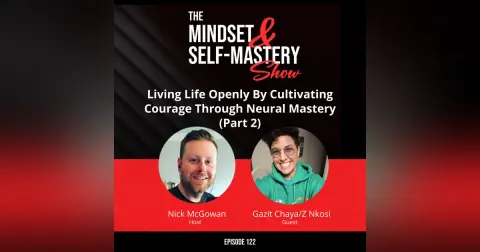


“Your body is wise. It will tell you everything you need to know. The timing for growth and change is different for everyone, and that’s okay.”
In this episode, Nick and Gazit Chaya “Z” Nkosi dive into understanding and managing the nervous system to improve overall well-being. They explore how historical trauma and societal conditioning have impacted our nervous systems, leading to various dysregulations. Z emphasizes the importance of reconnecting with our bodies and listening to our signals to navigate stress and emotions effectively. They discuss practical techniques, including mindfulness, movement, and self-inquiry, to support the nervous system’s regulation.
What to listen for:
- The impact of historical trauma on the nervous system
- Importance of reconnecting with the body
- Practical techniques for nervous system regulation, like mindfulness practices, movement exercises as well as self-inquiry and reflection
- Recognizing and responding to physiological cues
- Empowerment through self-awareness and self-compassion
- Addressing societal conditioning and redefining authority over oneself
- The role of personal growth in reducing violence and fostering resilience
“When everything started to go downhill, that was the moment. Our nervous systems have handled generational trauma, but what do we do with this information?”
- Understanding historical trauma and how it affects our nervous system
- What we can do when we’re experiencing trauma again
“Supporting my nervous system is straightforward—breathing, vocalization, movement, and mindfulness—embedded in every Indigenous and wisdom tradition”
- About the importance of reconnecting with our bodies
- How we can effectively manage stress
- The signals to look and listen for when stressed
“Your body is wise. It will tell you everything you need to know. The timing for growth and change is different for everyone, and that’s okay.”
- The Power of self-awareness and self-compassion in fostering resilience
- Discussing the possibility of less violence and trauma both within ourselves and in society
About Gazit Chaya/Z Nkosi
Z (they/m) is grateful to now be enjoying the roller coaster of life after decades of suffering from a victimhood mindset. They are excited to share what they’ve learned in this earth school through their podcast, YouTube channel, courses, and coaching programs, with their core mission being to live and love into the absolute innocence of all beings.
- https://www.anexperiencer.com/
- https://www.youtube.com/@bethechange88
- The video mentioned in the episode: https://youtu.be/onDtD7TOxE0
- “Earth School With Z” Podcast: https://podcasts.apple.com/us/podcast/earth-school-with-z/id1717154192
Resources:
Interested in starting your own podcast or need help with one you already have? Send Nick an email or schedule a time to discuss your podcast today!
nick@themindsetandselfmasteryshow.com
Thank you for listening!
Please subscribe on iTunes and give us a 5-Star review! https://podcasts.apple.com/us/podcast/the-mindset-and-self-mastery-show/id1604262089
Watch Clips and highlights: www.youtube.com/channel/UCk1tCM7KTe3hrq_-UAa6GHA
Guest Inquiries right here: podcasts@themindsetandselfmasteryshow.com
Your Friends at “The Mindset & Self-Mastery Show”
Nick McGowan (00:04.645)
Hello and welcome to the mindset and self mastery show. I’m your host Nick McGowan and today on the show I have Zee. Zee you’re back. How are you?
Gazit Chaya Nkosi (they/m) (00:15.886)
I’m so glad to be back. This is fun.
Nick McGowan (00:19.493)
Yeah, I’m really excited for this. So as I told you, and for the people that listen to this show, first off, thank you for listening. But this is the first two parter that we’ve had on this show so far. When Z and I first spoke, and if you just listened to the episode from last week, great, this is just going to be consecutive. I want us to just kind of pick up. But we had first talked about the nervous system and the work that they do within nervous systems and helping people with their own nervous system.
And as you heard from that last episode, we didn’t really talk about nervous systems much. Something we got too close to the end of it, but really not much. And this is a really, not only a vital system within our own beings, but it’s something I think that is kind of passed by, overlooked, almost like not given the respect and credit that it’s due, just like how we as humans, if we stop breathing, we die.
but we don’t really think about our breathing. We don’t think about it unless there’s a problem or it’s hard to breathe or there’s something going on. That’s when you think about it. But that system is part of that. And I want us to be able to talk about that in a handful of different ways. And as you all know, listening to these episodes, we can go on tangents on different things, but I want to be focused on the nervous system because we can still get on tangents with that because there are lots of different pieces around it.
I’m going to pull back a little bit. See, why don’t you take it and let’s talk a little bit about, first off, give, you know, give us some credibility of yourself. Who are you? Why can you talk about this? And then we’ll start to get into what is actually your nervous system and why is it important.
Gazit Chaya Nkosi (they/m) (02:06.51)
Yeah.
Totally. Well, I’m so grateful that you had me back on so that we could focus on this because I tend to get off in all sorts of directions and often people are like, but weren’t you going to do something about nervous system? So thank you for corralling me. So how do I know about the nervous system? So two sides of it. One is that I’m a person who has been through a lot of personal trauma and have, you know, scraped,
through so much suicidal thinking and depression and anxiety to try to find a life that’s worth living. So I had to do a lot of this research and training of my nervous system out of sheer desperation. And that’s how I first came to polyvagal theory was my doctor was trying to support me in finding something.
to support myself when I was coming out of a really solid period mental health wise and then I started perimenopause and everything took a real turn for the worst and I was like you’ve got to be fucking kidding me because I had worked so hard for the decade prior and I wasn’t willing to do antidepressants because I previously had that really increase my suicidal thinking and
So I was like, that’s not an option for me. And that’s basically all that was being offered to me. And I had, I was just feeling really desperate and she came across Polyvagal Theory, sent me to a free workshop and I was blown away because it just made so much sense.
Gazit Chaya Nkosi (they/m) (03:50.414)
And it is so beautiful, particularly because when you understand the nervous system, you understand that nobody is operating off of poor character or even poor mental health. There is just a system.
that is running, that is meant to keep us alive and meant to keep the species going, which has progressed over evolution. And it is not good or bad. It’s not mentally healthy. It’s not mentally ill. It’s just…
running a program and when we understand it, we can work with it. When we don’t understand it, it can send us into all sorts of haywire thinking and behavior that can present as mental illness or can present as.
you know addiction or all sorts of things and so it really is an empowering piece of information for people to understand and it is also something that can take away a lot of the shame and guilt and blame that we put on ourselves and others when we are having behavior or when others are having behavior that doesn’t line up with what we think should be happening. So I love it.
My favorite thing about it is that it shows that we’re all just absolutely innocent and that we’re just responding to our nervous systems that are evolutionarily designed. And it gives us a set of skills that we can use to support ourselves in reaching for responses rather than reactions to the challenges that are inevitable as human beings on this planet.
Nick McGowan (05:15.109)
Hmm.
Gazit Chaya Nkosi (they/m) (05:34.606)
So the other piece that like qualifies me quote unquote is that after I learned about this polyvagal theory, I found out that there is a modality called the safe and sound protocol that can be, you can get certified in it if you’re an occupational therapist, a speech pathologist or like a behavioral practitioner like a.
licensed clinical social worker or a psychologist. And I happen to be a speech pathologist. So I worked 15 years as a speech language pathologist in public schools. I was trained in neuroanatomy and behavioral development and all of those kinds of things through my masters with that. And then went on to, after finding out about polyvagal theory, became certified in the Safe and Sound Protocol. So I’ve had a certification specifically to understanding polyvagal theory and how to apply it clinically.
but I have my whole education as a speech pathologist that also supported my understanding of development, behavior, nervous system, all of that good stuff. So I’m speaking from both sides of the coin, which I think really brings a richness to my understanding, because those who are just coming from a clinical perspective tend to see it as like a…
Nick McGowan (06:38.213)
Hm.
Gazit Chaya Nkosi (they/m) (06:50.254)
you’re the client, I’m gonna fix you. And I’m like, no, I’m the client. I’m doing this because I wanna feel like I have more choice in my life and that I’m not just subject to this never ending storminess of trauma, depression, anxiety, suicidal thinking. So I really am so grateful that it came across into my life the way that it did.
Nick McGowan (06:52.485)
Mm -hmm.
Mm -hmm.
Nick McGowan (07:19.365)
Oh, yeah. Well, that’s part of the reason why I wanted to have you not only on the show for the first time, but have you back on the show. One of the key, I think, tenants to what we really operate within from the company’s perspective and also this podcast is being able to have quality, authentic guests that are on the show specifically, I guess, for this podcast, being able to have people that have gone through stuff, but then also being able to have.
the levels where you can talk about things from let’s say clinical side, but also from a look I fucking get it side. I’ve gone through this. I understand it. It’s part of the process whenever anybody reaches out or we reach out to people about being on the show is to make sure that there’s that level to that. It’s always fun to me to be able to see when people are a certain way.
but that they can get deeper because they have gone through that because that’s really where this shit is. That’s where actual transformation happens when we can get down to the nervous system per se. And something also I want to point out, the word system of it, because something that we’ve talked a lot about on this show, I’d say in the past year or so is systemic thinking, systems, the problems within systems.
how things can happen from the systems, be it a religious system, education, you know, gender, all of the, all the different systems that are out there, but how your nervous system again is just, it’s a system. It’s running a program and how we are innocent at that base level of that. It’s funny. Cause I think about how different people and funny is probably not the right word. It’s interesting because I think about how people are like, you know, I’m just fucking angry. That’s how I am. I’m just angry.
And it’s like, well, at this point, you’re probably right because that’s what you’ve just resolved yourself to be. But why are you just angry? And where does that actually come from? I often think that most everything will come from childhood. There’s trauma, there’s something that happened at childhood. Even if it was a beautiful thing where you’re like, wow, I really like Oreo ice cream because my grandparents would take me for ice cream and that was such a special thing.
Gazit Chaya Nkosi (they/m) (09:17.838)
Mm -hmm.
Nick McGowan (09:37.093)
Or I don’t like bicycles because I got hit by a car when I was seven or whatever it was, you know? So being able to understand that, but then I think the nervous system takes that even deeper, but still puts it as kind of a binary way. It’s like ones and zeros in that sort of sense where you can’t, you can’t talk ill of, or even elevate it in a way that it shouldn’t be because it’s just a fucking system. So take that and run with it a bit.
Gazit Chaya Nkosi (they/m) (09:47.694)
Yeah.
Gazit Chaya Nkosi (they/m) (10:02.798)
Yeah.
Yeah, it’s just a technology, you know, system, systemic thinking, like some systems can be changed. The nervous system is just a technology of a system of functions within our body. And it is actually perfectly designed. So in a maybe pre agricultural nomadic society, even if you want to say like evolution wise pre mammal,
nervous system in terms of the sympathetic and the dorsal, which are two of the circuits that we understand from a polyvagal perspective. So the sympathetic is what we commonly hear referred to as fight or flight. So it’s that mobilized energy, that running away or that fighting energy. And then the dorsal is like a freeze -fawn response. So the like playing dead, if you think about it, sort of pre -mammal.
Those two are just wired into us for survival of the species and they are going to operate optimally in an environment where threats are actually life -threatening. So if you think about it, pre -mammal, we’re like a little alligator, let’s say. If the alligator hears like a roar,
or the pounding of hooves or the sound of thunder or the rumbling of an earthquake, that alligator is going to know like, okay, we’re about to die or we’re about to be in a life threatening situation and we need to take immediate action. And there’s a great visual that I wish I could share with everybody, but I’ll see if we can explain it. In the brain, the nervous system in that moment will tell the alligator, okay.
Gazit Chaya Nkosi (they/m) (11:54.83)
you need to just go directly from the processing of the sensory information to the motor cortex so that you can run or fight. Okay. Or you can play dead, right? It’s just, we’re going to go immediately to motor cortex so we can have a reaction. Okay. A great way to think of that for our lives is if I put my hand on a hot stove, I’m going to skip.
my frontal cortex. I’m not going to think about it. I’m not going to decide if the, you know, stove had bad intentions or maybe if the stove had child childhood trauma or, you know, maybe if I really don’t believe that the stove will hurt me, I won’t get hurt. No, we’re just going straight to the motor cortex. We’re pulling that hand right away so that we don’t get burned, right? And that’s a nervous system doing its job. It’s brilliantly designed. What happened sort of post agricultural, um,
development is that society became wired to productivity rather than to nature. So the cycles of nature support people in having nervous systems that can respond to threat that’s actually life threatening and then can like process those chemicals through their body that supported them and being able to run or fight.
And then they can sort of come back to neutral and it all works out beautifully. But when productivity became the thing that governs our responses to threat, we started having threats like you’re gonna not be on time to work. So you have to wake up before you’re fully rested or you’re going to be on a schedule according to your work. So you can only eat when the person says you can eat rather than eating when you’re hungry. You can only go to the bathroom.
when you’re told that it’s time to go to the bathroom, you are going to spend a lot of time and energy doing something that is not nourishing to your system in order to be able to survive. So it’s like everything got kind of like weird. It doesn’t all add up to what the physical body just needs. So we call that a neuroceptive mismatch. It’s where my…
Nick McGowan (13:44.485)
Hmm.
Gazit Chaya Nkosi (they/m) (14:09.23)
my the technology that I was running that worked really well when I was just an animal out in the woods is now getting confused because I’m giving it weird signals. So my nervous system is saying like, Hey, your bladder is full. Can you go to the bathroom? And I’m like, three years old. And someone just said like, Nope, it’s not time to go to the bathroom yet. Hold it. Right. And so then our nervous system is like, What does that mean?
And we do that over and over and over and over again. You know, you’re in kindergarten and you’re starting to wiggle your body and you start to sing a song because it sounds fun. And someone says, quiet and hold still. Right? And so over and over and over and over, when these things happen, the nervous system starts to go like, I don’t really know what’s going on anymore. And I’m confused. And so I’m going to give you mixed signals. I’m going to…
Nick McGowan (15:01.157)
Hmm.
Gazit Chaya Nkosi (they/m) (15:02.158)
Like for some people, I’m going to shut down. I’m not going to give you much information. For other people, I’m going to give you a ton of information. I’m going to give you panic attacks because I can’t get your attention any other way. You know, and the nervous system just is doing all of this work. And then we start to use substances to avoid the messages that the nervous system is giving us or we overwork ourselves because we don’t want.
Nick McGowan (15:13.029)
Mm -hmm.
Gazit Chaya Nkosi (they/m) (15:27.47)
that quiet moment when our nervous system might tell us like, you’re exhausted or you need to freak out and sob for five days. We’re just getting so out of whack with this beautiful technology that it’s not serving us. And that’s where we right now have the opportunity to come and share this information with people that any behavior that you’re being told means you’re mentally ill or that you’re a problem or that something’s wrong with you, whether it is…
Nick McGowan (15:34.661)
Hmm.
Gazit Chaya Nkosi (they/m) (15:57.198)
that you’re distracted at work, or it’s that you think about wanting to die all the time, or it’s that you can’t stop using substances, or it’s that you blow up every relationship that you get into, or you get fired from every job, whatever it is, all these behaviors that you’re being told mean you should try harder and you should get it together, there is likely something going on with your nervous system related to that that needs support.
And if you’re able to support your nervous system consistently with the basic animal needs of daily mindfulness, which is just being in the present moment, paying attention to your senses, daily movement, which is essential for moving these chemicals through our bodies, and basics of eating, sleeping, those things will take you so far.
in having the capacity to shift out of behaviors that are not working for you anymore in such a different way than you need to fix yourself or try harder or have more character or, you know, visualize or manifest or all these things that get really complicated and that in this world, like, sure, I know that manifesting and all that works, but if I’m…
of whack with my nervous system, it’s not going to work because I’m coming from a place of desperation and fear and all my results are going to reflect desperation and fear. And so it’s just a gentler, very animal, generous way to look at behaviors that are not working for you and support yourself in being able to understand what those behaviors are about and then choose something different if that’s right for you.
Nick McGowan (17:23.781)
Mm -hmm.
Nick McGowan (17:46.277)
Hmm. Yeah, I’m glad you touched on the energetics. That’s a thing that I think can also be overlooked. The energetics of what you have, the capability that you have, the capacity that you have, what feels right, what doesn’t. And it’s so interesting as you do more work that you then see different things, like specifically with a nervous system. And as you’re talking, I can think about just different situations that happened as a child. I make jokes at times.
I was even saying to my partner recently about I remember being a little kid and watching the windshield wipers going back and forth and going, it’s it’s it’s it’s and I was just making noise and just I’m a musician and I’m just making noise and how it just aggravated the woman I call mother was and she’d be like, shut the fuck up stop. And she was not
Gazit Chaya Nkosi (they/m) (18:36.718)
Yeah, yeah.
Nick McGowan (18:39.365)
I don’t think she was really irritated with me per se. She was probably irritated with something else that ties back to her nervous system and how there’s just responses that are really reactions that are things that are unknown where they’re like, I’m just fucking hurting or I’m angry. And like the more work you do, the more that you can see that stuff and you can be aware of it. But the, there’s a lot that you, that you laid out a whole lot that you laid out. And I think with.
Gazit Chaya Nkosi (they/m) (18:45.486)
That’s right.
Gazit Chaya Nkosi (they/m) (18:52.751)
Yeah.
Nick McGowan (19:09.477)
us all being at a basic level, innocent, and that we’re working off of a program. I think that can help us detach in a healthy way where we can step outside of it and go, Oh, it’s a program. I’m not fucking crazy. I don’t want to kill my entire family. I don’t want to do the crazy thing or I don’t want to drive off this bridge or whatever it is. It’s trying to actually get to a resolution where we feel good and we feel whole. And you also passed.
Gazit Chaya Nkosi (they/m) (19:23.758)
Yes. Yes.
Gazit Chaya Nkosi (they/m) (19:30.798)
Yes.
Gazit Chaya Nkosi (they/m) (19:34.894)
Yes.
Nick McGowan (19:39.333)
several thousand years to go from, well, we were nomadic, then we figured out agriculture, and now here we are in the 2020s. There’s a whole lot of stuff that happens with that. But the reason why I point that out is there’s also generational trauma that has been compounded where now we are in this spot where people are like, we have to, you have to do this, you have to hustle. I think some of that hustle culture is finally starting to stop a little bit.
Gazit Chaya Nkosi (they/m) (19:48.846)
Yeah.
Gazit Chaya Nkosi (they/m) (19:55.726)
for sure.
Nick McGowan (20:08.933)
Um, but that’s still in that that’s still in our being and it’s been there for so long. Like even to think about, and it’s funny cause I’ve recently listened to lectures on brief history of the world all the way back to as far back as it could go. Um, uh, what was it in Mesopotamia on the, on the river bed and then being able to step outside of that into agriculture and how that changed everything.
Gazit Chaya Nkosi (they/m) (20:11.374)
Mm.
Gazit Chaya Nkosi (they/m) (20:22.446)
Mm.
Gazit Chaya Nkosi (they/m) (20:26.574)
Mm -hmm.
Mm -hmm.
Nick McGowan (20:37.605)
And I remember having the aha moment of like, fuck, that was it. That was the moment. That was when everything kind of went, started to go downhill and things shifted. And it’s so wild to think that our nervous system not only handled that back then, but has handled the generational trauma and everything that has happened since then. But that’s all good information to have. So what the fuck do we do with it?
Gazit Chaya Nkosi (they/m) (20:40.558)
That was it. Yeah.
Gazit Chaya Nkosi (they/m) (21:03.822)
Well, you know, first of all, we get to have that moment to say, oh, hey, it’s not me, it’s my nervous system. And hey, it’s not you, it’s your nervous system. And that’s an amazingly powerful shift, right? Because if it’s not me, it’s my nervous system, I get to then go, oh, okay, well.
Nick McGowan (21:12.293)
Mm.
Gazit Chaya Nkosi (they/m) (21:31.438)
Supporting my nervous system is pretty ABC, you know, it’s not super complicated. Trying to like completely change who I am on the planet sounds very daunting.
But if I’m able to be like, all right, let me see what I can do. Let me look at my life. Like, am I doing daily nervous system exercise, which is very straightforward. It’s four areas, according to Polyvagal theory, breathing, vocalization, movement and mindfulness. And those four practices or areas of practices are embedded into every single indigenous and wisdom tradition. If you think about it, you know, we’ve got.
Nick McGowan (22:12.773)
Hmm.
Gazit Chaya Nkosi (they/m) (22:13.39)
yoga, any type of Tai Chi or Qigong, all those things are movement based, right? Any kind of collective dancing or movement rituals that were connected with war, all of those are movement. We’ve got vocalization, you’ve got chanting, you’ve got group singing, you’ve got all of the pieces that are connected to all those wisdom traditions there. With mindfulness, you’ve got
all sorts of traditions of meditation and visualization, right? And then breath work, almost every tradition has some system of breath work. And if they don’t do it directly, they access it through the vocalization, through the chanting and the singing that creates steady breathing. So those four areas can just be plugged right into our life as a starting point. Anybody can get free access to.
bazillions of nervous system exercises online just by looking up those four areas. So that’s a like amazing way to just give yourself a huge jumpstart because doing those exercises in a daily way, even for just 10 minutes a day builds up a reservoir of when I say nervous system, I’m primarily talking about the vagus nerve. I forgot to mention that.
Nick McGowan (23:12.101)
Hmm.
Gazit Chaya Nkosi (they/m) (23:37.358)
So the vagus nerve is this nerve that goes from the base of our brainstem, down along our auditory canal, on both sides of our throat, out to our lungs and our heart, in with every major organ, our reproductive organs and our intestines. So it is telling the organs and the lungs and the heart and the intestines, you can function because we’re safe.
or you cannot function because we’re not safe. So mental health is not mental. It is super physiological and it starts with that vagus nerve and the vagus nerve is either saying safe or not safe, right? So when we start to give ourselves at least 10 minutes a day of one of these types of nervous system exercises, pick your pleasure. Don’t have to do all of them.
And you don’t even have to do them 10 minutes at once, you know, 30 seconds here or there. When we give that to our vagus nerve, we build up a reservoir of like a toned or resourced vagus nerve. Okay. That’s a huge starting point that’s free for anyone. Right. And then when we start to ask ourself regularly, how am I feeling?
That is the best way to start to reestablish a trusting and respectful relationship with your nervous system. Because like I said, all through our lives and as you mentioned, generationally or epigenetically, we’ve been in a system for thousands of years of disrespecting the nervous system, right? Waiting for an external authority to tell us that we can take care of ourselves. So when we start to become the authority of ourselves,
and start to say, what do I feel? What do I need? And starts to build that relationship with the nervous system and the nervous system becomes a much better communicator. So that in real time, I can be in a stressful scenario and my nervous system can say, hey, we think we need to freak out. We think we might be dying. And I get to say, oh, thank you so much for that information. I’m gonna check the facts for us.
Nick McGowan (25:41.445)
Hmm.
Gazit Chaya Nkosi (they/m) (25:57.806)
I’m gonna make sure what’s going on. If I am in a life -threatening situation, I’m gonna go ahead and go into full, you know, five alarm, whatever that phrase is, freak out. If I’m not, then I’m gonna support that nervous system by giving it either some gentle movement or some deep breathing or something like that. And then I’m gonna follow up with some self -inquiry. I’m gonna give myself that good…
therapy, or whether it be talk therapy, somatic therapy, doing the work of Byron Katie, doing some coaching, whatever version of that is right for me. And I’m going to understand why did my nervous system interpret A, B, or C as a threat, so that I can better understand some of that epigenetic stuff that I inherited, right, generational trauma that I inherited. So I’m not going to be able to nail down like,
so -and -so five generations ago died while eating potato chips, so every time I smell potato chips I get a little anxious. I’m not gonna be able to nail down that level of specifics, but I am going to be able to now in the moment be like, I’m feeling stressed around these potato chips, and then be able to support myself in saying, are potato chips still a problem? And that little part of me that’s trying to keep myself alive.
It might take a little work, it might take a couple of weeks of supporting that part of me to be like, you know what, I think maybe we can try potato chips again. And little by little, we rebuild this connection so that we just have this great communication and we’re not just battered around by these waves of challenges in our life.
Nick McGowan (27:33.765)
Mm.
Hmm. I think a lot of times it can be easy to think that part of life is just the battering where you’re just getting battered back and forth. And it can be difficult to ask what’s actually going on or what’s happening. As you’re talking about it, I’m thinking about obviously self -awareness is a huge piece of all of this. It’s almost a catalyst or Genesis to all of it. Because if you can then look at it and go, huh, I’m feeling a sort of way. I’m also wondering if.
Gazit Chaya Nkosi (they/m) (27:55.758)
It is.
Nick McGowan (28:04.997)
People can make little decisions throughout the day that can help them. Like I know I’m a very sacral person. And if I get aggravated and frustrated, what that means to me is I need to fucking stop. I’m doing the opposite of what I should be doing. And by should, I mean based on the way that I operate in my system. And different people are different. So some people relate to that. Some won’t. And some have other. I want to use the word trigger, but.
Gazit Chaya Nkosi (they/m) (28:19.342)
Yeah.
Nick McGowan (28:34.341)
in that sense of like, hey, here’s just something to be mindful of. Um, but making those small decisions, like I think if somebody were to say, Hey, do you want to go do this? Like, uh, the, the common one with couples, even what do you want to do for dinner tonight? Sort of thing. Do you want to go do this? You want to do that? Being able to feel into what feels right and making a decision that feels right. That isn’t selfish, but still isn’t.
Gazit Chaya Nkosi (they/m) (28:34.862)
Right.
Gazit Chaya Nkosi (they/m) (28:48.558)
Yeah.
Nick McGowan (29:00.645)
anti self, you know, like, you know, I would really like to get tacos or something, because that feels right to me. And that’s a decision I want to make, or even excluding people from that and doing something for yourself. I remember having somebody I worked with years ago in an office that they would have meetings and I could tell they get frustrated and they would take a walk around the building. And I remember thinking, why are they doing that? And I’d ask them, they’re like, it’s just an easy way for me to be able to get out of that, out of that environment, out of the space.
Gazit Chaya Nkosi (they/m) (29:02.894)
There you go.
Gazit Chaya Nkosi (they/m) (29:25.902)
Very smart.
Nick McGowan (29:29.413)
It also gets me away, allows me to process the things and I can come back in. And I come from a background of aggravation and frustration. I was like, well, do you find yourself really upset? They’re like, no, there’s just how I process. And that’s beautiful because that’s how they process. So for you who’s listening to this and you’re feeling like, Hey, I can feel that there’s some of this. I need to actually be better to my nervous system. Do you suggest that they make some of those tiny little decisions and
Gazit Chaya Nkosi (they/m) (29:51.438)
Yeah.
Nick McGowan (29:55.397)
Is there a little process that they can go through that’s digestible for them?
Gazit Chaya Nkosi (they/m) (29:59.342)
Yeah, 100%. I actually have, if you want to, I have a video that lays out something that would take more time than we have. That’s just like when you’re dysregulated and it goes through sort of like a flow chart of where you can go. So I can give you that link. So if people want to watch it, but what it basically boils down to is that first question, how am I feeling physically?
Okay, and we’re gonna start to get to know, am I feeling more mobilized? Do I feel more like running, screaming, smashing things, fight flight? Or do I feel more immobilized? Like I wanna hide in a cave forever and never see anyone again. Okay, so we’re gonna see if either of those two things are coming forward in our body.
in body sensations. So fight, flight, mobilized might feel like jitteriness. It might feel like ansiness. It might feel like you want to punch someone in the face, right? It’s some of that more like, it might feel like more panicky. And the, the dorsal or the immobilized might feel more like fatigue, heaviness, lack of appetite, you know, just no motivation. Okay.
or like real isolation, I don’t want to see anybody. So we’re going to first ask which one of those is coming up more. Sometimes it’s a mix. Sometimes it’s those two things pushing up against each other. But as we get to know it better, we can see those nuances. We want to start with just, do I feel like mobilized or immobilized? If I feel like I’m mobilized more of that fight flight, I want to offer myself some gentle movement. And this is because the nervous system,
we can think of it kind of like a car. If the nervous system is in that mobilized, it’s like that gas pedal is all the way down. And if we throw it into park with like, I’m gonna do some deep breathing, we’re gonna jack ourselves up, right? You’re gonna destroy the engine, okay?
Nick McGowan (31:48.421)
Hmm.
Gazit Chaya Nkosi (they/m) (31:58.542)
So when you’re in that mobilized place, you wanna just let your foot off the gas a little bit, but you’re still going. So it’s a gentle movement. So that might be some side to side rocking. That might be a walk like your person did. That might be some slow and steady wall pushups or stretching, okay?
So that’s a first step for the mobilized. And once you get through that gentle movement, you might come to a place where you’re then able to do some deep breaths, you then able to do a little self reflection. Basically, we’re trying to get ourselves out of that lower brain and back into the frontal lobe. Okay. So gentle moment movement when you’re mobilized. And then when you’re more immobilized that I want to hide in a cave and never see anyone ever again. When you’re there, you want to
Orient. So connect in with your environment. So I am going to use the five senses to do that. So I might find something in the room of every color of the rainbow. I’m going to look for something red. I’m going to look for something orange. I’m going to look for something yellow, something like that. I might do a body scan. I might say, what do my feet feel like? What do my ankles feel like? What do my calves feel like? Right. I might sit quietly and see if I can identify three different sounds.
Nick McGowan (32:58.405)
Mm.
Gazit Chaya Nkosi (they/m) (33:17.006)
I might pick up an object and describe it fully as best I can, what it looks like, what it feels like, what textures, what does it smell like, what does it do. So connecting in with the senses is a way to orient and that brings us up out of that immobilized place. And then again, once you’re a little bit out of that way and back into the.
moment, then you can reach for some breathing or what have some self reflection eventually. So those are my like, real quick and dirty what you can do in real time. A lot of these things you can do even if you’re in a room full of fellow workers, and you don’t want to be visible, you know, you can you can start to like,
even clench your fists and hold some tension and then release them. That can be a form of gentle movement under the table, you know, or if you’re in a Zoom call, you can do these without being noticed. So that’s sort of the like first go -to to support yourself in real time with dysregulation, right? But what I really want to emphasize is this is not just putting out fires, because if you just put out fires, you’re going to be on a hamster wheel of putting out fires forever, right?
We’ve got to put in that intentional 10 minutes a day of mindfulness, 10 minutes a day of movement in whatever way that’s right for you. It’s not exercise. It doesn’t have to be cardio, right? It’s just moving your body like an animal. So if you watch a cat, they don’t run on a treadmill for an hour a day, but they’re regularly stretching and moving around the body and taking slow walks, you know, so just movement.
And then mindfulness is being in the present moment. And again, you can watch animals for this. They’re noticing when they’re hungry. They’re noticing when they want to go to the bathroom, they’re noticing when they want to sleep and they’re following those cues and going ahead and doing those physiological things. So that would be the two pieces, like the daily mindfulness and movement, along with offering yourself the responses to the mobilization immobilization. And then long term,
Nick McGowan (35:16.101)
Thank you.
Nick McGowan (35:29.221)
That’s great stuff.
Gazit Chaya Nkosi (they/m) (35:31.79)
you want to do the self -inquiry, right?
Nick McGowan (35:34.629)
Hmm. Yeah. I can see how it stacks and how it works with each one of them. And I think it’s also a great way to be able to break it down kind of simply. Um, cause this is simple yet complex where there are lots of pieces to it, but at the same time we can, we can make those little movements. Um, I think something that really stood out to me was about if somebody’s already in motion or they’re
feeling angry about something, it seems now that it’s kind of wrong to say to them, well, breathe. I know I’ve been told that where it’s like, I’m really instantly instantly because I continue to move. Yeah. I’m like, yeah, really fucking breathe. I’ll fucking breathe you, you know, like where no, really I need to get the energy out. And yes, there are different people that maybe that will work for differently, but it sounds like there’s momentum with it.
Gazit Chaya Nkosi (they/m) (36:08.846)
You’re like, fuck you.
Gazit Chaya Nkosi (they/m) (36:17.902)
Yeah.
Nick McGowan (36:29.989)
where if you do, if you get to the point where you’re like, all right, I just feel like I just want this all to be done, then maybe you just sit down. That’s where you can just breathe for a minute. But if you’re like, I’m gonna tear this whole house apart, well then maybe just walk out of the house and take that little bit of walk. And it seems like the energy, if the energy is telling you to relax, then ease into that for a second. If the energy is telling you to go and do something with that energy, then.
Gazit Chaya Nkosi (they/m) (36:45.326)
Yes.
Nick McGowan (36:59.013)
you can ease into that as well. So that seems like a simple thing for us all to be able to take away from it where whatever you’re feeling in that moment, whether it’s to go put something into action or to just sit down, ease into either of those. Yeah, and that it’s easier said than done. You know, when you’re in that moment, it’s like a muscle though, you got to be able to actually flow through that. And it’s so wild how different people will say things like, Oh, just calm down.
Gazit Chaya Nkosi (they/m) (37:12.91)
Yeah, gentle.
Gazit Chaya Nkosi (they/m) (37:18.222)
Yeah.
Nick McGowan (37:28.741)
where they don’t want things to go crazy, but they don’t understand or they’re not thinking from the perspective of your nervous system. But it makes me kind of laugh like you’re, you’re probably never going to hear a parent with a kid that’s freaking out, be like, Ooh, you can freak out a bit, but just easy like let it out. But I think of like letting out kind of the air of a balloon almost, you got to let it out and just relit relet it release in a sense, but
I think that’s a good takeaway to be able to say if you’re in an active state or you’re going to slow down, either way, just ease into either one of them. So along that line, what’s that piece of advice you’d give to somebody on their path towards self mastery that has to do with their nervous system?
Gazit Chaya Nkosi (they/m) (38:18.318)
Yeah, I mean, the number one question if I just off, I could offer one thing to someone to empower them is just to start asking that question. How is my body feeling? Your body is so wise. It is so wise and slowly but surely your body will tell you everything you need to know because again, back to those cats and dogs that we watch, you know,
They didn’t take a course on polyvagal theory to figure out how to support their nervous system. When they don’t want to be touched, they hiss at you. When they want to sleep, they just go to sleep. When they want to eat, they’ll bug you until you give them food, you know, and we lost that.
because we were trained to put the authority outside of ourselves. And when you, you know, the very title of your show, Self Mastery, is I don’t want an external authority anymore. I wasn’t designed to have an external authority. I was designed to be a sovereign being and I have all of the technology within me to be able to live into that sovereignty and be a creator. And when I give someone else authority over me,
That’s when I start to have maladaptive behaviors. I believe that this is one of the greatest ways that we can reduce violence on a large scale. Because if I’m not being violent towards myself, and if I’m understanding that the violence being thrown at me is a result of a dysregulated nervous system instead of a villain who I am being victimized by, when I get to see someone outside of me who’s being violent and I get to say, wow, you’ve got a lot going on with your nervous system.
I wish you the best and I’m going to get out of your way. That changes the way that violence can affect us on a large scale. Because if I’m being gentle and kind with myself and I’m following what I need as the authority of myself, I am not going to become so dysregulated that I have to lash out at everyone around me.
Gazit Chaya Nkosi (they/m) (40:27.534)
or kill myself because it’s too fucking hard, right? So it is an extremely powerful tool to just start asking that question. How am I feeling physically? And then eventually to say, what would feel supportive in this moment? And it takes practice and commitment, but I really do believe that we are designed incredibly well.
And that when we come back to that original design, we can have so much power as creators and reduce violence within ourselves and then within the world around us.
Nick McGowan (41:08.741)
It’s so interesting that we have the responsibility, the opportunity, the just all of it wrapped together, you know, to be able to do all of this. It can be a lot, but it can also be extremely fulfilling and life giving and life changing. I think I think about how I was, how people I know have been in the past and as you work and learn and grow.
Um, or the opposite of that, the people that don’t do the work, they don’t grow, they don’t learn, they keep compounding, they keep making excuses. It kind of makes you feel sad, um, because they are going down that path and they don’t have to, there’s opportunity to do something a bit different. So, Z, I appreciate you being on again and for all the insight and I hope that everybody that’s listening to this episode and the last episode that you were on.
Gazit Chaya Nkosi (they/m) (42:02.094)
Yeah.
Nick McGowan (42:08.421)
really gets a lot out of this and that we can all understand that it’s a system at play. Really, everything that’s going on, there’s a system at play. And we can see the system for what it is. We can do something with it, or we cannot do something with it. It’s really up to us to be us to be able to do that. So again, thank you so much for being on the show again.
Gazit Chaya Nkosi (they/m) (42:28.974)
Yeah, Nick, can I add just one closing thought on that last thing that you said?
Nick McGowan (42:33.893)
Yeah, please.
Gazit Chaya Nkosi (they/m) (42:34.574)
Okay, so I just want to speak to anyone who’s in that moment of feeling like they don’t have the strength or wherewithal to access this information or to make changes in their life right now. I really believe that you can’t until you can. And so all those people that yeah, it’s hard to watch someone who’s not on the path to to grow themselves and to, you know, come into their own authority. I just believe that
the timing is okay for everyone. That when and if they are divinely offered the resources to be able to access that information, it’ll be coming at the right time for them and that.
I just don’t understand how that works because I’m not the one running this matrix. But I know that if someone had given me this conversation back in 2022 when I overdosed, it would have just sounded like gobbledygook to me. And if they had said, you know, well, you’re just letting your life go down the tubes, that would have felt really.
really just heartbreaking to hear because I did not have the resources or capacity to do any of this work at that point in time. And many of us will die in this lifetime before we get to it. And my impression is we get several rounds, as many rounds as we need. And so I love to just bring that grace in if this resonates with you and you feel like you can access this wonderful. If not, that’s okay too.
Nick McGowan (44:10.245)
I appreciate you adding that last little bit before I let you go. Where can people find you and where can they connect with you?
Gazit Chaya Nkosi (they/m) (44:17.07)
My website is anexperiencer .com, A -N, experiencer .com. And on there you can find my YouTube channel, which has a lot of these topics and resources and things. And you can find out how to work with me. And I have some online courses and I do a number of different things. So it’s all there on the website.
Nick McGowan (44:40.133)
Awesome. Thank you again for being on the show. Appreciate it.
Gazit Chaya Nkosi (they/m) (44:42.862)
Yeah, thanks.
Nick McGowan (44:47.941)
All right, cool.