Family, Grit, and Entrepreneurship With Dan Flores
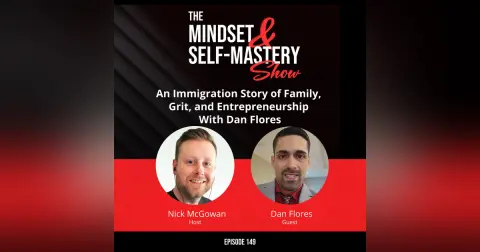


“Maybe this is all happening because I was meant to carry the mission that they started.”
In this episode, Nick speaks with Dan Flores, a fitness and life coach, who shares his personal journey from overcoming health challenges as a child to navigating cultural transitions as an immigrant. Dan discusses the sacrifices his parents made for a better life, his struggles in the construction industry, and his eventual awakening to entrepreneurship. He emphasizes the importance of living each day to the fullest and cherishing the moments we have with loved ones.
What to listen for:
- Support from family is crucial during tough times.
- Entrepreneurship can stem from dissatisfaction with traditional careers.
- Living each day like it’s your last can enhance gratitude.
- Finding purpose often comes from understanding our roots.
“I was thinking, ‘Did my parents give up everything so that I would work a regular nine to five?”
- Grappling with the weight of our parents’ sacrifices for us can influence our future decisions.
- A 9-to-5 work life isn’t for everyone, and it can feel like we’re out of alignment with our own desires or a sense of purpose.
- Dan’s drive to do something impactful and meaningful is greater than following a conventional path.
- Re-evaluating what success looks like for us, considering not just our own desires but the legacy of our parents’ efforts.
“My parents came over here, they left everything behind… they had their degrees in Peru, but those degrees couldn’t transfer here, so they pretty much had to start from the bottom up.”
- Dan and his immediate family showed incredible resilience and determination in rebuilding their lives from scratch.
- Understanding our parents’ sacrifices can drive our own ambitions.
- Many skilled immigrants are forced to work in lower-skilled jobs without being able to transfer credentials to all of their hard work
- The speaker likely views their parents’ struggle as a source of strength and inspiration, motivating them to succeed in their own path while honoring that journey.
“No matter what job I transitioned into, no matter what company I worked for, I couldn’t be happy.”
- Traditional employment can leave us feeling unfulfilled in multiple ways if we’re not being true to ourselves.
- The pursuit of happiness in work seems to be a significant driving factor for the speaker, but they haven’t found a job or company that fits that.
- This was a huge turning point for Dan to explore entrepreneurship
- Like most employees searching for fulfillment, jumping from job to job can be a sign of burnout or a deeper need to find our purpose.
About Dan Flores:
Dan is a fitness and life coach, motivational speaker, and founder of The Warrior Lifestyle. His mission is to help others achieve the ultimate life and become relentless. Whether they want to be healthier, be more driven, or become a leader for their family, they can accomplish it together.
Resources:
Interested in starting your own podcast or need help with one you already have? Send Nick an email or schedule a time to discuss your podcast today!
nick@themindsetandselfmasteryshow.com
Thank you for listening!
Please subscribe on iTunes and give us a 5-Star review! https://podcasts.apple.com/us/podcast/the-mindset-and-self-mastery-show/id1604262089
Watch Clips and highlights: www.youtube.com/channel/UCk1tCM7KTe3hrq_-UAa6GHA
Guest Inquiries right here: podcasts@themindsetandselfmasteryshow.com
Your Friends at “The Mindset & Self-Mastery Show”
Nick (00:01.582)
Hello and welcome to The Mindset, self-mastery show. I’m your host, Nick McGowan. Today on the show I have Dan Flores. Dan, what’s up man, how you doing?
Dan Flores (00:12.359)
Good, good, Nick. Thank you for having me.
Nick (00:14.382)
Yeah, man, I’m excited that you’re here. We’re gonna get into a lot of great stuff. Why don’t you kick us off? Tell us what you do for a living and what’s one thing most people don’t know about you that’s maybe a little odd or bizarre.
Dan Flores (00:25.844)
Sure. So my name is Dan. I’m from Hartford, Connecticut. I am a fitness and life coach and a peak performance speaker. And one thing that a lot of people don’t know about me is that when I was a kid, I actually suffered from a concave chest in my, pretty much my sternum, which is causing a little bit of heart issue as well.
Nick (00:48.11)
Is that something they were able to remedy like a suction cup? Like pop it out a little bit?
Dan Flores (00:51.285)
Not a suction cup, but I wish it was that simple. But no, it required a pretty big surgery, two surgeries actually to be exact.
Nick (01:02.402)
Wow, so was that literally just pressing on your heart and on your ribs and everything else? Your lungs?
Dan Flores (01:06.972)
Yeah, so what happened is it didn’t happen until probably like my teens. Like when I was 12 years old, that’s when like the pain started. But over time, my sternum was caving inward, right? Instead of growing out like a regular chest. And obviously your heart is right behind your sternum. So over time, the pain kept intensifying, it kept becoming more frequent. And I told my mom at 13 years old, I told her, was like, Mom, I think I’m having a heart attack because my heart hurts.
Nick (01:34.488)
Peace.
Dan Flores (01:36.104)
She took me to the hospital, they did exams and x-rays, et cetera. And then they told me good news and then not so good news. You have a concave chest, the good news is that it is fixable. The not such good news is that it’s gonna be a long process, it’s gonna be a long recovery. There’s gonna be a lot involved in it, but it is repairable.
Nick (01:57.499)
So what do they have to just like basically cut everything open and crack it and raise it?
Dan Flores (02:02.875)
Yeah, so thank God it wasn’t like that. So basically what they did is they cut me, I actually have two scars on my ribs on each side. So what they did is they pretty much placed a metal bar right behind my sternum. Okay, they sewed me up and that bar kind of poked my sternum out so that it’s straight, it’s more straight. And then that took the pressure off my heart. Now I want you to imagine this because when I woke up from, in the recovery room,
Nick (02:15.138)
Okay.
Dan Flores (02:31.077)
It felt like an elephant was standing on my chest. Because you’re think about it, you’re taking a bone that’s bent and you’re straightening it in a matter of a few hours. So, yeah, I was in physical therapy, I was in hospital for about a month and a half, two months. My parents had to get my homework and drop it off at the hospital because I wasn’t going to school at that time. I had to get two copies of each textbook, copies I could keep at home and copies I could keep in school.
Nick (02:41.432)
Jeez.
Dan Flores (02:59.647)
And every week I would do all my homework. My parents would submit it by the end of the week and then pick up my new assignments. Yeah.
Nick (03:09.392)
That’s gotta be wild, especially as some kid going through that. Has that affected you physically, like as you got older and you started to put on muscle mass and all of that? Or has that actually helped? it like set a table?
Dan Flores (03:17.391)
I was gonna say,
Dan Flores (03:25.422)
Yeah, actually, Yeah, so obviously, I feel a lot better. My health isn’t at what isn’t at risk anymore. It would have been if it just if if there was no solution, right, it would have been a pretty big deal. The doctors did tell me that after the surgery, at some point after filling the pretty much the muscle around my chest that I’ve been spending the past few years working on, because what happens is when you’re when.
when your chest grows inward, it affects your muscle development in that area. So they specifically told me, listen, if you want your chest to remain normal and remain healthy, you have to start working out. So I didn’t do that until I got much older, right? This was about the first surgery to put the rod in was at 13. Second surgery to take it out was at 15. So it was in my body for two years. And I started working out when I was about 17.
I listen to the doctors and I feel great. I kind of feel like, it’s funny you mentioned that at such a young age, it’s like imagine you’re 13 years old, you feel like you’re having a heart attack. That doesn’t often, those aren’t words that often comes out of a 13 year old mouth. So, yeah, exactly.
Nick (04:36.302)
No, unless it’s drug induced. That’s a whole different story. You smoke some random stuff, got some from some random kid at school, you might think you’re dying. But that’s, man, that’s crazy. It also makes me think like there were some kid that I grew up with. I don’t remember the kid’s name is just a neighborhood kid when we were little. And he had basically like a bowl in his chest. And at one point, I remember walking into his house, probably is like nine or 10. And the kid was eating cereal.
Like he knew I was coming over so he was just being funny about it. But now I think like a few years after that, I think they moved maybe a year or two later, he probably had some sort of issues. Like if it was, it was deep enough for him to eat friggin cereal out of his chest, which is just a wild thing. But to think that you had to have that in there, I’m glad that it’s no longer in there. It almost sounds like it was like braces almost. It’s like they get it in there, put it in there, set it, remove everything. And then a few years later, you’re able to actually start to build upon it.
what a crazy thing and what an awesome thing that your parents are able to actually do that for you. You know, I think about kids that are in other countries or even kids that are in poor sections of this country that can’t can’t do that. They can’t get their cleft lip lip fixed or they can’t get some surgery that they need or sometimes they just can’t even get their feet straight because they’re pitching toed or something and being able to kind of move that stuff. Or you’d mentioned to me and
Not only in the intake stuff, but when we were talking about moving here from another country and I, I could imagine that not only as a 13 year old being stuck in the hospital and dealing with all of that and having to go through that throughout all high school, that could affect mentally things, but what about you getting over here to this country and being able to try to learn the culture and everything that went along with that? I would imagine that could potentially really.
mess with you, in an easy way to put it.
Dan Flores (06:35.294)
Yeah. Yeah. So my journey, actually, I love telling the story, because my journey actually started with my parents. Okay. So we’ll dive into that real quick. My parents, moved here because they actually had a friend who made the shift from Peru to America. Like he was already living here and my uncle and and my dad were friends with him and they were kind of, exchanging messages and phone calls and their friend was telling them, listen, there’s great opportunities down here. There’s a housing, there’s job opportunities.
I think you guys could really prosper here. And the more they talked, the more my uncle and my dad wanted to move. So they spoke to my mom, convinced her. Now, here’s the thing. When they eventually got their visas approved and they made that shift, they actually left me in Peru. I didn’t come with them right away. So I was about six months old when this happened. I have a brother who’s two years older than me. So because they didn’t know what was going to happen, they didn’t know if their plan was going to work. They didn’t know if they were going to.
come back to Peru and it just things didn’t work out, right? So they actually took my brother with them because he was older, he could eat, he walk, he could pretty much be self-efficient. Me on the other hand, I was six months old. So I stayed in Peru with my grandparents for three years. Once my parents were stable and were able to provide me with a good home, they came back to Peru and picked me up and took me to the US. About six months to maybe a year later, my grandparents who raised me in Peru,
came to America as well because at that time, obviously we didn’t have a lot of money. We didn’t grow up with a lot of money, right? Just like a lot of immigrant family or just a lot of families in general. So my parents were working multiple jobs and they couldn’t always afford a babysitter. They didn’t really feel comfortable leaving me on a daycare. I can’t blame them. So the best solution is, hey, let’s bring your grandparents down here. They can stay here and they can pick you up from school. They can drop you guys off. They can take care of you guys while we’re working, which was a
crucial part of me growing up. Right. So I transitioned into when I transitioned to America. I don’t remember the initial stages because I was still a little too young. But I do remember when I started going to school, I remember because I was still learning the language. Right. Because at the the at the time I was only speaking Spanish. So I do remember as a kid being picked on a lot when I was in school. Right. That lasted for a few years, mostly in elementary school.
Dan Flores (09:00.799)
I got over to daycare, elementary, cetera, pre-K. as I was transitioning from elementary to medical school, that kind of away, right? Because my accent got better. I started speaking more. I got more into it with the culture. But in the beginning, it wasn’t like that. I got picked on a lot.
you know.
Nick (09:20.755)
Kids can be cruel, you know, just like in general but hurt people tend to hurt other people and No matter if it’s child if it’s a high school kid or if it’s somebody in their 40s 50s 60s Whatever if they don’t actually work through the things that they’ve gone through They could just spew that on to somebody else. They can just pick on other people I’ve had a conversation recently somebody on the podcast where we’re talking about trauma
Dan Flores (09:22.457)
Yeah.
Nick (09:48.898)
being little t trauma that can turn into big t trauma just in the morning getting the hell out of your house. If there’s a couple kids and mom and dad or whatever that situation looks like if people trying to get to work, get the kids here, do this, do that, that can be traumatic. And then that you literally get into school and think about the first thing they tell you like, all right, calm down, we’re going to do class today. You’re like, Are you kidding me? I just went through hell getting the hell out of my house trying to get fucking butter on a piece of bread so I can eat something and
get on my way to school and this was traumatic. It’s gotta be tough for you and your family to be here and work through all that stuff. But it also seems like there’s a bit of an undertone of like total love. And I’m just assuming, so tell me if I’m wrong, but it sounds like your parents are trying to do the best that they could for you. Your grandparents are trying to do the best they could for you and your brother or whatever siblings and family that’s all in that house. And then being able to get into school and kind of work through things.
at what point did it start to kind of kick in where you were like, all right, I want to actually look at the way that I work on my physical body. And maybe it was because of the the surgery that you had. But then also being able to look at things different. Like if somebody grows up, they’re used to the neighborhood, they’re used to all the kids are used to school, they’re used to the American systems. That is vastly different than somebody coming in going, well, I was here for a few years, and now I’m in this new place. And I’m learning all these new things.
What sort of things do you think that you were able to actually take from that childhood whole experience into the work that you do now?
Dan Flores (11:24.78)
Yeah, yeah, I it’s funny because when I was that young, you don’t always understand the sacrifices that your parents made for you. Right. I was you know, I was good at you know, I was in fitness, I played a little bit of sports. So I did my own thing growing up. But I actually didn’t hear the entire story or pieces of the story until I got much older. I was a late teen, early 20s. This is when my parents started to slowly feed me the information about what truly happened through that transition coming here.
Nick (11:32.302)
Yeah.
Dan Flores (11:55.019)
And it’s like the more I heard about the story, the more I learned to appreciate their sacrifice and really understand, really see the whole picture. And I think at that point, that’s when I realized, okay, my, my parents came over here. They left everything behind. They left their families, their careers, you know, they, they, they graduated college over there. So they had their, their degree, whatever degrees they have in Peru, their degree, degrees they couldn’t transfer here. Right. So they pretty much had to start from the bottom up.
you know, working minimal jobs, minimal wage. So I’m thinking to myself, that’s really where, where, where something sparked that had like this burning desire inside of me. was like, man, maybe, maybe this is all happening because I was meant to carry the mission that they started. So that was like the first kind of like the first idea, the first nugget that happened was when they were starting to tell me these stories and then, graduated high school, went into college, right. And I went into college for construction management. Okay.
Now had a great, great time in school, got my degree, went into construction, been in construction industry for 12 years, left it last year. but as I got into that industry, I go, I, it’s funny, I went back to thinking those thoughts, like, you know, am I really doing what my parents always envisioned me to do? My demand that they always envisioned me to be. And working the right, not that there’s anything wrong with it for whoever does it, but for me, working the nine to five wasn’t, wasn’t it for me.
Right. I realized that about two to three years into the construction industry, that that wasn’t the case. You know, I forced my I tried to force myself to like it because I went to school for seven years, got my degree, a lot of debt. So I kind of forced myself to OK, let me give this a shot. But it’s like the more I was in it, the more I was like, man, like, is this really like my parents really give up everything so that is this it? Just work a regular nine to five, seven, seven to five, two week vacation a year. Right. Get a check.
every week or two, like that’s crazy to me. So at that point, I really started looking into entrepreneurship.
Nick (14:03.032)
There’s a lot when you think about what your parents had done to be able to set you up. In some ways it also doesn’t really matter. And what I mean by that is like they had done whatever they did because that was what their purpose and what their path looked like. It’s up to you to do whatever you want. But having that burning desire inside, it can be really easy for a lot of people. And all of us, I think, tend to fall into some sort of trap with that because of systems that are set up. Like you need to go to school and then you need to pay money to go to another school.
to then get a job where you make some money, but then you try to retire later on in life with about 40 % of what you really couldn’t live off of anyway. So good luck kid. That’s tough. But that deep inside power and that fuel that you’re feeling, I think is that that’s part of your purpose. And then it’s really up to you to be able to show it however you feel fit to be able to do that. So that’s cool that you’re.
Dan Flores (14:41.386)
Yeah.
Nick (14:57.878)
you’ve felt that like, want to do more because my parents didn’t just come here just so I can do whatever this thing is. But if that were your purpose, man, that would be it. Like that would have been your jam. You could have built some incredible buildings or been part of those projects or whatever. But when you know that I need to actually shift away from it, sounds like freedom is a big thing to you as well. Which as entrepreneurs, we can. That’s one of the F words we can use freedom.
Along with some of the other ones, cause sometimes it can get really, really tough, but if there’s that deep purpose inside of us, no matter what shit’s happening, we can go through it. So you had said 12 years that you were there. You also said, I realized after three, we can’t just skip past all those other years because I want to, I want to hone in on that a little bit because there are people that we talk to as clients as part of choose your calling and people that I talked to on the podcast and even just people I
run into and shoot the shit with where they’re like, man, I’ve been doing this thing for X amount of years. I’ve been doing it for so long. I don’t know how to get out of it. Or I feel like I’m supposed to do this thing. And then they just do this. And sometimes it takes people years and years and years because of that just linear thinking when it comes to how time is. So it can be really easy for us to look back at his history or historical data and go, well this happened. And then 10 years later, this thing happened.
Fuck, there’s a lot of shit that happened within 10 years. So talk to us about what you would actually walk, went through and walk through from your vision now, looking back at that and going those eight, nine, whatever amount of years there was where you were like, well I needed to go through more of that because that actually set me up better because I’m sure you, you and I could both agree that if you jumped at year four, even you wouldn’t be where you’re at now. There was more stuff for you to go through and work through.
Dan Flores (16:49.469)
Right.
Nick (16:52.718)
But if I gave you the choice back then, like, hey man, you can get out and shit might be a little rough, or you’re gonna get out and shit will be a little rough, but at least you’ll be better suited for it. You’d be like, well, fuck it, I went out now. Most people would, but you didn’t. And you work through all those things. So what were some of those key, I guess, lessons and really things you can look back at and be like, damn, I needed to work through that because here’s where I’m at now.
Dan Flores (17:15.485)
Yeah, when I was in construction, I was something I like to call a floater. so I started when I graduated the semester before I graduated, I had my internship and I was kind of my foot through the door. So I stayed with that company that I entered with, stayed with them for about two to three years. Really had a bad experience with them towards the end, because just the direction the company was going, I didn’t really agree with and.
And in my opinion, it wasn’t the most ethical things that they’ve done. Right. So especially for their employees. And I’m very big on the employees being a big part of the business. You know, so even though I was on the management team, I was I was kind of on their team, So what I mean by a floater is I worked for about five different construction companies. So I left that one to work for another company. Did that. We did site work a lot of.
road work, bridges, just a lot of construction, like transportation work. OK, so that was great. Got laid off from that because the company started to lose a few projects. So they laid a few people off, transitioned into a general contractor. OK, which because up to that point, I was only working for subcontractors working for a general contractor, which.
Nick (18:34.328)
Mm-hmm.
Dan Flores (18:36.637)
was not fun because I’m the type of person where I like to move around. I can’t just stay in sitting in a desk and looking at a computer all day. And that’s unfortunately a lot of that a lot of general contractors. That’s what their their PMs and their superintendents do. So they didn’t really like that position. Left that for it. Just the point I’m getting across is that I just I could never be happy. It’s like no matter what job I transition into or what company I work for, I just couldn’t be happy. So I’m just sitting there. I’m like, man.
Like what’s going on? Is it just me or is that or am I just in the wrong industry? Like what’s happening here? So over time, one of my birthdays was coming up and my brother got me my first ever entrepreneurial book. I wasn’t much of a reader. I hated reading books in school and those are really the only books I ever read. So I just, hate reading in general. But when he got me this book, I was maybe about somewhere in my late twenties. Okay. I was working for about the third construction company at that time.
Nick (19:08.312)
the
Dan Flores (19:35.642)
He bought me this book, The Tenant Show by Grant Cardone. You might have heard heard about that. So. I kind of tossed it to the side in the beginning, I’m like, all right, whatever, it’s just a book, whatever. But a few months later, I was just picked it up, read the first two pages. That’s where it started. And I was like, I like what I was reading. was like, OK, I’ll read two more pages and then two more pages. And then I ended up reading the book. And that book is kind of was sparked. That entrepreneur that that.
I described that burning desire earlier, right? So now I kind of know where to focus that on. And I’m thinking, well, maybe I should get into entrepreneurial ship, but I was still in construction. I didn’t really know how to get entrepreneurial ship. Even though I was reading these books. So from books, I went to podcasts and networking events and stuff like that. Still working in construction. Okay. But I just, I wasn’t happy there. I wasn’t happy no matter what company I went in. And here’s the thing, construction is a rough industry.
You know, you got, got to have a thick skin when you’re working that industry. There’s a lot of stuff that goes wrong. Everything’s your fault. You know, I’m in the management department, so everything’s going to be my fault, right? Cause I’m running the, I’m running the projects, individual project. There’s a lot of time away from your family. There’s a lot of early mornings at a lot of late nights. And I felt like I had no control of my life, you know, and it goes back to, this what all I’m destined for just to just be here? Did that’s it? so.
Once I read that first book and I started reading other books, that’s where I started making the transition and kind of exploring a little bit more into entrepreneurship. Got, went into networking events, started to meet people that aligned more with the person I wanted to be. That’s where that kind of transition happened.
Nick (21:22.154)
It’s so cool once you start down a path, no matter how you start it, whatever you start off with. I feel like part of that is like an external calling to us of like, hey, check this thing out. And it’s on us to be able to answer that call, do something with it. Start to read a page or two pages as you said, and then read another two pages, go try this, try that. But if we get back to the thing where you were unhappy, I think that’s a core thing that a lot of people can skip past.
because they can go, I’m unhappy because, and they rattle off whatever excuses. Instead of actually going deeper and say, well, the unhappiness is just an emotion, just a learning you there’s something here. You may be unhappy because your boss is a douchebag, maybe. That might be a real thing. You might be unhappy because you’re just not being fulfilled and you’re not feeling like you’re doing the thing you’re here to do.
And sometimes the next thing that you get into will not be the thing you’re here to do. Sometimes it’s the next four or five things. It’ll take you a while to be able to get to that point. But even just taking that first step and saying, all right, I’m unhappy, but why am I unhappy? What do I do with this? I appreciate that you look toward entrepreneurship. I feel like a lot of people look to be an entrepreneur, especially around the pandemic in 2020. Everybody was kind of shut out or.
close out of the business they were working in and they were like, well, fuck, I see people on social media that make billions of dollars, selling whatever thing and being a coach about whatever and whatever and I want to try that thing. And a lot of people got into it. I think it was the most people in 2020 that started a business. And then 21, there was like a 4 % increase on top of that. But that 20 from 19 to 20, I think was like a 40 % increase or something crazy like that where a lot of people just jumped into it. A lot of people also jumped out of it.
Because that wasn’t really the thing. They’re trying to just jump from thing to thing to thing instead of getting back to the basic of it go, well, why the fuck am I unhappy? What would be fulfilling to me? What’s the thing that I can look at? So you had mentioned even as a younger kid that there was something inside of you that was already there. There was some sort of spark. So let’s talk about that because that’s the core component to it. That actual spark, not you having a business or you being in construction or any of that.
Nick (23:42.602)
If we remove all those things and be agnostic to it, it’s realizing that there’s that spark in there and being curious about it. So what was your curiosity like toward that spark?
Dan Flores (23:52.856)
Yeah, as I mentioned earlier, the spark really came from everything my parents sacrificed. And I think a big part of that, I think a reason why it’s always been inside of me is because I come from a hardworking family. My parents work ethic is like no other, grandparents work ethics like no other. So to some extent, I kind of feel like it’s a little bit genetic. But I go back to everything they sacrificed. I lost my grandparents a few years ago. And I had
Nick (24:12.312)
Hmm.
Dan Flores (24:21.824)
a great time with them. But often I wonder, what if they never came here? You what would my life be like? You know, what would my what my mom had to stop working, which would only leave one person working. And we wouldn’t be in the house where we live. Maybe we would have been somewhere somewhere smaller, rougher neighborhood. Right. So that spark really just when this just came from everything they sacrificed for me and my brother, you know, and I grew up.
You know, my my dad didn’t even have a car when he was working these these jobs. You know, he would either ride with a co worker or he would walk. You know, at times it was snowing and he would walk to work. My mom’s days days off, she would take me and my brother to school and take care of the house. And she was getting sick, too, because my mom gets sick very easily when it’s cold out. So it was there were there were a lot of constraints. So I thank God that my grandparents were in the picture because they really
put a lot of pressure off of my parents for sure. But it always comes down to, listen, everything they sacrificed, they left their families. I mean, I can’t imagine leaving my family. can’t imagine having a kid and leaving him at six months old for three years. I can’t imagine that, right? I will never, although I understand the journey they went through, I can never fully empathize with it because I don’t know what that’s like. I never had to my kid.
Nick (25:21.528)
Yeah.
Nick (25:34.958)
Jeez. Yeah.
Nick (25:46.744)
Yeah. Yeah.
Dan Flores (25:49.353)
You know, so I feel like I have to do them justice, you know, and my brother feels the same way. You know, my parents carry this torch for as long as they could. Now it’s up to me and my brother to carry it the rest of the way. You know.
Nick (26:04.78)
Hmm. Yeah, and there’s really no rest of the way like there’s no end to it. You know, if you and your brother both go off and have children and that continues great. But honestly, man, it might even just be people you talk to. There might be somebody that listens to this podcast that they continue to carry that torch because of the work that you’re doing. Because of the stuff that has happened, even just a realization of like, man, yeah, leaving your kid at six months and then showing up a couple years later and
Dan Flores (26:10.203)
Of course, yeah.
Nick (26:34.316)
Like that’s got to be super tough. But at that point, it sounded like that was the decision to be made. And that’s huge. You then also get to make your own decisions and figure out how you want to impact and show up. And that support system is a huge component to it. I love being able to talk with people about whatever support system you have, whatever it looks like, even if it’s small or some massive support system, being able to see it for what it is, because sometimes that support system
is not really a support system. Sometimes it’s just, you know, people that are close to you and they’re like, well, my parents have told me this or my siblings or my friends have told me this. And it’s like, well, that’s not really support. It sounds like what you got was support and love that actually helped you propel a bit. But there were different things that happened just like everybody has ups and downs and all that sort of stuff. Were there any like key moments that you can look back at? Maybe one specifically where you’re like, man,
being here in the States, this actually really shifted everything that I was thinking. And you can look back at and say, put you on the trajectory that you’re on right now.
Dan Flores (27:42.191)
Yeah, I think when I graduated high school and I was trying to transition into whatever it is I was going to transition into, at the moment I didn’t know what that would be, my parents were really there to help support me and help me make a decision. And they were there to tell me, listen, if you don’t know what you want to do right now, that’s OK. I kind of felt like I was letting them down. It’s like they did all this stuff and I don’t even know where I want to carry this torch to.
You know, so having my parents, my grandparents were still alive at the time. So having them there with me and we kind of went through that journey together. The reason I chose construction was because when I was when I was little, I always used to help my dad renovate the houses. So I would always have like the little hammer and it would just be a good way for us to bond together. And I was always with them. My grandfather was there as well. So it really be a good bonding experience. That’s a memory that I really, really cherish.
Nick (28:30.318)
Yeah.
Dan Flores (28:37.486)
Because unfortunately, we might have some listeners where they might have lost their dad. You know, they didn’t grow up with a father figure or the grandfather or they might have lost their son or something like that. Right. So when you have those moments with the people that you love and you have that support system, it’s really, really important to treasure it because you never know when it’s going to be the last time you’re going to see them. You know, so it’s it’s they really helped me, especially maneuvering into what I was going to be that the man I was going to become.
they were definitely there to help me with that.
Nick (29:09.4)
Yeah, that loving piece is a major part of that. I was actually talking with somebody recently where certain people will spew out, like let’s say on social media or even just in a group, they’re like, my God, it’s Mother’s Day. If your mom’s around, you should absolutely go see her. It’s Father’s Day. If your dad’s around, you should go see her. It’s like, you also have to keep in mind context because if it’s safe, you should go see them. If it’s not safe, you should not.
like just black and white in that sort of way. even for you, knowing that you had that love with them that you can cherish, some people may not have that, but they may have that with other people. Or there are people that became part of another family through a friend in high school or something like that. And that became more of their family or even people that their family is really just friends that they’ve accumulated over the course of time. Like it just happens. You can have…
family in different ways, but that loving support is a core piece to it. And not just like, you have to do it because they’re your parents, like, that’s cool. They brought you into this planet. But that’s about all if they do more than that. And it’s great, cool. But you then get to decide how you want to go about that. I love that you had that love and that they did what they did. I’m right there with you too. Like I, I don’t have any kids. So I can’t imagine what that’s like to leave your kid but to leave a six month old go away like
They must have really put a lot into that. And then for them to be able to do it. And here we are years and years later having these conversations. We can’t skip past that shit. That was, that must’ve been super difficult for them, but you’ve gone through a lot. You’ve worked through a lot. So in that sort of vibe, what, what’s that piece of advice you’d give to somebody that’s on their path towards self mastery?
Dan Flores (30:55.989)
Yeah, the one thing I would say, and I touched on this a little earlier, is I found out that living each day like it was your last is a good way to cherish each day on its own, right? Because we’re so busy in our day. We have kids, we have businesses, we have spouses, we’re all over the place throughout the day. very, not too often do we actually sit down and reflect on what we’re grateful for, right? We’re always like, I’ll just do it tomorrow. I’ll do it tomorrow, right?
We live life like we have unlimited days and that’s simply not true. Right. If you’re able to, I want you just the audience that’s listening, I want you to just picture the perfect day. All right. You know, you got a 10 out of 10 in your fitness and your nutrition, spending time with your family, your business, you just you attack your day, you put all your heart and soul into it. You followed your call and you spoke your truth and you just had a 10 out of 10 day. I mean, that to me is a win. Right. But very few people can do that because typically people
will focus on one area in their life. Like they might focus on business, but they might not be there for the families. They might focus on fitness, but they’re not eating right. Right. So, holistically, I would say if you focus on each day separately on its own, just focus on that one day, how can I get a 10 out of 10 in this day? How can I put all my love and care into this day and take that with you? It will allow you to cherish each day so much more. I started to implement this about two years ago into my life.
And once I did that, can’t honestly can’t. mean, things happen, right? Things happen all the time, but I can’t remember be having a totally bad day. You know, because for me, there is no tomorrow. There’s only today. That’s the only thing I’m worried about, right? Because the way you show up today is are you going to show up tomorrow? So I can’t sit here and plan for a 10 out of 10 day tomorrow if I don’t get a 10 out of 10 day today. You know, it’s just it’s a snowball effect, right? You you carry those wins into tomorrow and that will prepare you to have a better day tomorrow.
Nick (32:34.274)
Yeah.
Nick (32:38.615)
Yeah.
Nick (32:46.176)
Yeah.
Nick (32:52.426)
I even if we break that down a little bit more to a macro level, there’s really no day. This is all just string, a string of moments. Like even with people that are like, well, it’s today’s Thursday. Cool. It’s really not. It’s just another day. It’s just a string of moments. Like even the concept of a weekend is really bullshit. Like when you think about it, it goes back to Ford being like, yeah, exactly. But it’s all, it’s each and every moment and being present in those moments and being thankful. And
Dan Flores (33:06.826)
Ha
Dan Flores (33:13.635)
Time’s an illusion.
Nick (33:22.1)
I get what you’re saying, like reading in between the lines of it. It’s not just like the bullshit gratitude of like, well, I’m grateful for all these things. It’s like, really, you gotta feel it. You gotta understand like, I’m really actually pleased and thankful for this and being here in the moment. Just like having conversation with people and not listening to say the next thing after that, but listening to go, all right, I’m here, I’m here with you. You know, and I…
That’s part of the reason why I love this platform is because it’s literally just you and I right now Yes, it is the audience is gonna listen to this but this isn’t live They’ll listen to it in a month or whenever it comes out So us being able to be in this moment string these times together and this has been great I appreciate you being on today before I let you go. Where can people find you and where can they connect with you?
Dan Flores (34:09.404)
Yeah, so the best way to find me and connect with me is on Instagram. So my Instagram handle is DanFluarezLifestyle. So just shoot me a DM. If there’s anything I I talked about that you want to touch more base of, if you want to get to know me a little bit better, if you want to work with me in the future, just shoot me a DM. I’d be more than happy to connect with you.
Nick (34:26.08)
Awesome. Dan, it’s been great having you on today. Thank you so much.
Dan Flores (34:28.795)
Thank you. Take it easy.