Legal Accountability, One Clerkship At A Time With Aliza Shatzman
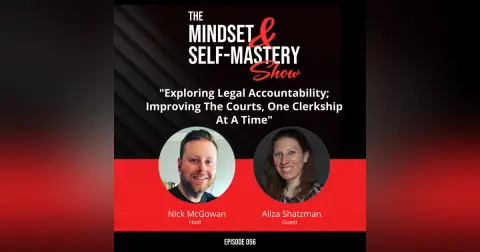


“Focus your work and your life on issues that galvanize you”
In this episode, Nick speaks with Aliza Shatzman, who went to school for law and became a clerk so she could get a government job. She needed to clerk under a judge for 1 year; that was the last of her requirements. Unfortunately, she was unknowingly assigned to a judge who had a history of mistreatment of clerks. He discriminated against women, and Aliza was no exception. He mistreated her as well and ended the clerkship early.
Aliza tried everything in her power to get a job, but with the clerkship ending early, it made it almost impossible.
After a year, she finally landed her dream job, only for it to be revoked because the judge made a bad statement about her. Not only did this revoke her job offer, but it also revoked all the job interviews she had. Not only had this judge harassed her then, but he continues to do damage. So what is Aliza to do?
She created a non-profit organization aimed at ensuring that law clerks have positive clerkship experiences while extending support and resources to those who do not.
About Aliza Shatzman
Aliza is the President and Co-Founder of The Legal Accountability Project, a nonprofit aimed at ensuring that law clerks have positive clerkship experiences while extending support and resources to those who do not.
Aliza earned her BA from Williams College and her JD from Washington University School of Law, where she served as an Associate Editor for the Journal of Law & Policy. After law school, Aliza clerked in D.C. Superior Court during the 2019-2020 term.
In March 2022, Aliza submitted written testimony for a House Judiciary Subcommittee hearing about the lack of workplace protections in the federal judiciary, detailing her personal experience with gender discrimination, harassment, and retaliation by a former D.C. judge.
Aliza now regularly writes and speaks about judicial accountability. She has been published in numerous forums, including the UCLA Journal of Gender & Law, Yale Law & Policy Review, NYU Journal of Legislation & Public Policy, Above the Law, Law360, Slate, Ms. Magazine, and Balls & Strikes.
Resources:
Interested in starting your own podcast or need help with one you already have? Send Nick an email or schedule a time to discuss your podcast today!
nick@themindsetandselfmasteryshow.com
Thank you for listening!
Please subscribe on iTunes and give us a 5-Star review! https://podcasts.apple.com/us/podcast/the-mindset-and-self-mastery-show/id1604262089
Watch Clips and highlights: www.youtube.com/channel/UCk1tCM7KTe3hrq_-UAa6GHA
Guest Inquiries right here: podcasts@themindsetandselfmasteryshow.com
Your Friends at “The Mindset & Self-Mastery Show”
Nick McGowan
Hello and welcome to The Mindset and Self-mastery Show. I’m your host, Nick McGowan. And on this show, my guests and I unpack the stories that shape us, the lives that we lead on our path to self-mastery. So let’s not wait any longer. Let the games begin.
Nick McGowan
Hey, Eliza, welcome to the show. How are you doing today?
Aliza Shatzman
I’m good. Thanks for having me on the show.
Nick McGowan
Yeah, absolutely. I’m glad that you’re here. I’m excited to get into the conversation with you. I got to be honest with you. I don’t have to too much to say specifically in what you’re doing. But I know this is a big thing, especially after we’ve done a recent episode with somebody you’re connected with as well. Mike Bassett And that kind of opened up doors to other people that that want to be able to hop on the show.
Nick McGowan
And as we were talking before, this is really about the person. But I know you’re deeply passionate about what you do, so I’m excited to get into all of this. I don’t want to take your thunder or anything, but why don’t you kick it off and tell us what you do for a living? And one thing that most people don’t know about you, it’s maybe a little odd or bizarre.
Aliza Shatzman
Yeah. So I am the president and co-founder of the Legal Accountability Project. We are a nonprofit aimed at ensuring that law clerks have a positive clerkship experience and then extending support and resources to the ones who don’t. And then interesting thing about me, I’m a tattoo enthusiast. I have four tattoos I’m planning my fifth for when we announce our first law school partner for the Legal Accountability Project, which should be soon.
Aliza Shatzman
So yeah.
Nick McGowan
Nice. All face tattoos is that’s what comes next.
Aliza Shatzman
I have one on each rib, one on my lower back, and then persiste on my left wrist.
Nick McGowan
So, yeah, isn’t it addictive? Like, you’re sitting in the chair and you’re like, Oh, what else am like, what? What’s happening next? Like, calm down. You still got another couple of hours?
Aliza Shatzman
Yeah. Yeah. I mean, most of mine only took, like, an hour, an hour and a half. So I thought about, like, a sleeve that might be my next one.
Nick McGowan
Will say I’d suggest it, I’d suggest.
Aliza Shatzman
It fancy.
Nick McGowan
Especially when you’re sitting there and you’re like, Oh, man, what else can we do? Especially if you get an artist. It’s like, Maybe we can do this, we could do that. Next thing you know, he’s got your entire body just covered in tattoos, and you look like one of those reptilian people.
Aliza Shatzman
Yeah, I don’t think I want one that takes multiple sittings like, I’ve seen people go in when I’m getting a tattoo and they’ll be like, Just draw on me for a couple hours. I don’t know if I’m there yet.
Nick McGowan
No, that’s a little much. Yeah, there are people that they basically use. Their body is like a sticker board. They’re like, this is a cool sticker. Just put it here. And I’ve seen different people. I’m like, Why do you have set the Hamburglar? Why is the Hamburglar on, you know, kind of drunk one night and here we go.
Nick McGowan
So I guess most people would know about your tattoos because it probably doesn’t come up in, like, normal conversation with your nonprofit, right?
Aliza Shatzman
I’m not a normal conversation, but I work out and just a sports bra and running shorts. So everybody at the gym sees me as this like person with a lot of random tattoos. I mean, they’re not random. They all have meetings, so. Yeah.
Nick McGowan
Yeah. You don’t have the Hamburglar on you somewhere.
Aliza Shatzman
No, I’m not planning to.
Nick McGowan
Well, you never know. You might make friends with an artist and just sit down and just go for it. So if the hamburger ends up on your body, you let me know.
Aliza Shatzman
All right.
Nick McGowan
So tell us a bit about how you got into what you’re doing and break that down a bit, because not everybody listen to this show is in the same path of life as you are. So as you got into what you’re doing and really the purpose behind it all.
Aliza Shatzman
Sure. So I got into this advocacy work based on my personal experience with gender discrimination, harassment and retaliation during and after my clerkship. So after I graduated from Washington University School of Law in Saint Louis in 2019, I aspired to be a homicide prosecutor in the DC U.S. Attorney’s Office. So I decided to clerk in D.C. Superior Court during the 2019 to 2020 term because I knew that D.C. prosecutors appeared before D.C. Superior Court judges.
Aliza Shatzman
And for folks who are not attorneys, the messaging around clerkships in the legal community and in law schools is just uniformly positive. It’s this profession confers this position confers only professional benefits. You will develop a lifelong mentor mentee relationship with this judge, and judges deserve just absolute respect and total deference. So I started this clerkship in August of 2019 and beginning just weeks into it, the judge for whom I clerks began to harass me and discriminate against me because of my gender.
Aliza Shatzman
He would kick me out of the courtroom and tell me that I made him uncomfortable and that he just felt more comfortable with my male co clerk. He told me I was bossy and aggressive and nasty things that would never be said to a man would be said that they were, you know, assertive or confident. The day I found out that I passed the D.C. bar exam.
Aliza Shatzman
So that’s a big day for any young attorney. The judge called me into his chambers, got in my face and said, You’re bossy and I know bossy because my wife is bossy. I was devastated. I remember crying in the courthouse bathroom, crying myself to sleep at night. I wish I could be reassigned to another judge for the rest of the clerkship, which was supposed to last a year.
Aliza Shatzman
But my workplace didn’t have any sort of employee dispute resolution or ADR plan that might have enabled that to happen. So I confided in some mentors and they advised me to stick it out, and I knew they needed a year of work experience to be eligible for a government job. So I tried to stick it out and we transitioned to remote work during the pandemic and moved back to Philly in March of 2020 to stay with my parents and worked remotely.
Aliza Shatzman
And the judge basically ignored me for six weeks before he called me up in late April and told me he was ending my clerkship early because I made him uncomfortable and lacked respect for him, but he didn’t want to get into it. And then he hung up on me. So i called d.c. courts h.r. And they said there’s nothing they could do.
Aliza Shatzman
H.R. doesn’t regulate judges. Judges and law clerks have a unique relationship. Then they asked me whether I knew that I was an at will employee. So then I reached out to my law school to WashU, seeking out support. Assistance advice. Found out this judge had a history of misconduct that law school officials and professors knew about at the time.
Aliza Shatzman
I accepted the clerkship, but decided not to share with me. Presumably because they wanted another student to clerk. So it took me about a year after that to get back on my feet. This is all pretty devastating. And as I applied for jobs, I had to field a lot of questions about why this job it ended early, why the judge wasn’t listed as a reference finally secured my dream job in the D.C. U.S. Attorney’s Office as a prosecutor and moved back to D.C. in the summer of 2021.
Aliza Shatzman
And I was two weeks into training. I’d already started working there when I received some more really devastating news that alter the course of my life. I was told the judge had made negative statements about me during my background investigation that I wouldn’t be able to obtain a security clearance and that my job offer was being revoked. And then a couple of days later, I had a job offer, an interview offer for a different job with that office, and they revoked that, too.
Aliza Shatzman
Based on the judge’s same negative reference I was two years into my legal career, and this judge just seemed to have enormous power to ruin my reputation and destroy my career. So I filed a formal judicial complaint, hired attorneys, and in the summer and fall of 2021, participated into the investigation into the now former judge. And we were partway through that when some attorneys reached out to me privately and told me the judge was on administrative leave pending an investigation into other misconduct.
Aliza Shatzman
At the time, he filed the negative reference about me. But the U.S., oh, the government employer wasn’t alerted to that until several months later when pursuant to our private settlement agreement. So separate from anything the judiciary could or would do for me, the former judge issued a clarifying statement addressing some but not all of his outrageous claims about me.
Aliza Shatzman
But by then, the damage had been done and had been way too long, and I am pretty much blackballed from what I thought was my dream job. And during the summer, I became aware of proposed legislation called the Judiciary Accountability Act. Or Jay that would extend Title seven protections to Judiciary employees, including what clerks. Currently, folks like me are exempt from Title seven mean.
Aliza Shatzman
We can’t sue our harassers and seek damages for harms done to our lives. I stayed in touch with House and Senate offices involved with drafting that bill, and when a hearing happened in the House Judiciary Committee in March of 2022, I submitted written testimony, sharing my story, advocating for that legislation. And in the weeks following it, I began to toss around some ideas for a future further advocacy work with my friend, WashU classmate and now co-founder Matt Goodman.
Aliza Shatzman
And we launched our nonprofit in June to address various gaps that I see in the clerkship application process and in these really unregulated workplaces.
Nick McGowan
Well, that sounds like a mess. It sounds like chaos from the start, but it’s also interesting that you bring up that you’re partners. Matt Maybe this is a giant assumption, but I assume that’s a male.
Aliza Shatzman
Yes. Is that a good assumption?
Nick McGowan
Well, I thought it was safe. You never know. I mean, it is 20, 22. So Matt, going through, I assume a clerkship as well, did he not deal with any of the B.S. that you dealt with at all?
Aliza Shatzman
So, Matt did not clerk, but his previous position was in judicial education, so training judges on DUI and other issues. So that’s kind of how he comes to this work. But, you know, he’s been there with me from the start since I filed my judicial complaint. He was immensely supportive and I thought it was a good person to kind of launch this venture with.
Aliza Shatzman
We’ve complementary skill sets. He does a lot more the tech stuff, some of the business stuff and yeah, he’s I am advocating based on my personal experience, which I think is important but also creates unique challenges. He is not so. He can be more level headed when I’m like, Oh my god, can you? This clerkship director told me our policy is we don’t warn students and I’m so upset and he’s like, Yeah, chill out, we’ll deal with it.
Aliza Shatzman
So but yeah, he has a great attitude like what kind of promise and deliver. So if it law school needs something, we’ll say we can do it and then we’ll do it. And he kind of always encourages me to go forward and assert myself and just kind of, you know, power through which I appreciate.
Nick McGowan
Yeah, that’s cool. It sounds like you’ve got a good a good partnership there. I think the biggest thing that stands out to me and law aside, or industry aside, it’s just when shitty people do shitty things, really, when somebody is not treating you the same way. No, I could understand. Like if you did come in and you started yelling at somebody and saying things, they’d be like, Yeah, she’s bossy.
Nick McGowan
She’s yelling at us. But that would be similar if some dude came in and started yelling at things. However, I think you’re right. I know you’re right that when you say that they would look primarily at men and say, Well, he’s just a bit aggressive because I’ve been in that spot. I’ve been in sales for a row since I was a toddler, basically.
Nick McGowan
And I know there have been people that have told me, you’re kind of aggressive, but they’ve never told me. They’ve never actually, like, dismissed me. Like, it sounds like you were kind of dismissed for being potentially just excited about things or what some people would consider passionate about what they’re doing. There was a question that kept coming up in my mind was, what the hell happened to him as a child?
Nick McGowan
Did anybody come out of the light and say, Hey, he was touched as a kid or something happened because something is clearly wrong there? Now you said that he’s a former judge, so you say whatever you can legally say on the show, go for it.
Aliza Shatzman
Yeah. So my settlement just means I can identify him by name and I don’t. Yeah. Yeah. So D.C. courts judges are Senate confirmed their article one judges but they don’t have life tenure so they can be removed. So he wasn’t voluntarily retired from the bench. He had a history of misconduct. He had mistreated other clerks, other court employees.
Aliza Shatzman
And it’s interesting. I mean, I think it’s a larger criticism about maybe we should be appointing that way, maybe chief executives should be appointing better judges. Because what I to the extent I’ve talked to some of his former colleagues, yeah, he was bad guy, you know, when he was a law firm associate, too. And I think that kind of happens.
Aliza Shatzman
I don’t understand how some of these appointees just get like power push through the process. I mean, we should be appointing better judges and we should be scrutinized in them. And we should be thinking about judges as like employers running a small workplace. They’re not gods. They don’t deserve to be deified. They don’t deserve absolute respect and total deference.
Aliza Shatzman
And I hate that the legal community continues to like convert its power upon them. Yeah.
Nick McGowan
I mean that’s that’s huge to say they’re not gods because you’re right, nobody nobody’s really a god anyway when it comes to this sort of stuff. And even if even if there were gods, you would think that actual gods being here, they probably wouldn’t be that mean, as it sounds like some people are. And I really again, I don’t think it’s as much an industry specific thing as it sounds like we’re kind of starting to break some of the mold of that because if you think of a small business CEO that’s just kind of a douchebag, that guy could be a CEO of Fortune five company, still be a douchebag, but that’s just going to
Nick McGowan
trickle down to a lot more people and make things a lot worse. So it’s the people problem. So how do we fix that problem and how do you suggest with what you’re doing it will actually fix that? Or is this kind of a bandage in a sense to be able to help people bridge from somebody being a douche to somebody being, you know, nicer potentially?
Aliza Shatzman
Well, I would distinguish judges from other employers and other industries because they have life tenure. So not, say, court judges, but federal Article three judges have life tenure. They can only be removed by congressional impeachment, which basically never happens. And so they really are able to evade scrutiny and avoid accountability. So I would say.
Nick McGowan
That that’s where the God syndrome comes in.
Aliza Shatzman
Definitely. And the longer these folks are on the bench, I think the more the God complex kind of evolves, which I think is troubling and speaks to the fact that maybe these folks should not have life tenure. But yeah.
Nick McGowan
Yeah. Why do they have life tenure from somebody outside of it? I’m not in law at all. So why do they automatically give them life tenure?
Aliza Shatzman
I that’s how the courts were structured. When Article three created these judges. They conferred upon them life, tenure or tenure during good behavior, which is de facto life tenure. The problem is, even state court judges that have ten or 15 year terms, they run unopposed or they are just rubber stamped for reappointment. So when I speak to state court judges and even ones who are doing the right thing, I mean, they perceive themselves to have de facto life tenure.
Aliza Shatzman
So it’s really a problem with deifying judges and legal community. And then in terms of what we’re doing about it, I mean, my nonprofit is working on several initiatives that are really going to transform the clerkship landscape and really just ensure that law students considering clerkship have the info they need to avoid misbehaving judges. So we hope that eventually fewer folks will apply to clerked for these notorious harassers and that that will also lead to some larger changes.
Aliza Shatzman
If you are a judge and you’re no longer getting a good crop of clerks, well, maybe you’ll change your behavior. And if you can’t, I mean, it’s a way to change in sunlight on folks who need to be disciplined.
Nick McGowan
So that’s funny. So do you think they could be like, all right, here’s a couple quirks. These people kind of seem like jerks. Let’s give them to the other. Let’s give it to the jerks. So there’s just, like a big bunch of them. I don’t I don’t know if the judges would be like, wait, these people are really mean.
Nick McGowan
They’re worse than I am. Maybe I should change my ways. Hold up. You know.
Aliza Shatzman
I mean, I suggested one. So we do I do a lot of events for the Legal Accountability Project. So I’m at law school. So my words got twisted when I suggested this at an event a couple months ago. But I suggested for judges who are mistreating their clerks, one form of discipline could be to take away their clerks.
Aliza Shatzman
They can clerks can be reassigned, so take away all their clerks, and they have to do all the work, all the research in the writing. We can’t remove these folks, but we could punish them in that way. And some, like I mean, clerkship director who is kind of not acting in good faith, suggested that I want to abolish clerkships, which is untrue.
Aliza Shatzman
So we have a couple of bad actors in the clerkship workplace. But yeah, I mean, we should be thinking of creative ways to discipline these judges in the absence of changing the life tenure situation.
Nick McGowan
That’s interesting. Yeah, it’s like, how do you screw with a demigod at that point if somebody is trying to play God like, all right, well, take away all the toys so you can’t use people now. You got to do everything on your own.
Aliza Shatzman
I mean, the other issue is that law clerks who face mistreatment and this issue is pervasive and unaddressed in both the state and federal courts. But law clerks are quite fearful of reputational harm in the legal community, which is, you know, an employer punishing you for speaking out against your harasser or judges retaliating against these former clerks. And there really are no protections against that.
Aliza Shatzman
So law clerks are not speaking out even in the face of outrageous mistreatment, enabling these judges to continue to get away with it. And they know nobody’s going to speak out against them. And I think that’s one reason why things are so tough for my former supervisor. I mean, somebody was speaking out and unfortunately.
Nick McGowan
You know, what do I do?
Aliza Shatzman
Yeah, unfortunately, people should have spoken out sooner, but I just really want to like as I am sharing my experience publicly and so frequently, it’s about empowering law students to demand safer workplaces, but also inspiring current former clerks to speak out against their harassers. And it’s really by shining sunlight on these radically, unaddressed and secret issues that were going to change the culture and that’s a bigger that’s a bigger challenge going from one of deifying judges and disbelieving law clerks to one where everybody brings their full selves to work and no judge thinks that he’s going to get out away with outrageous mistreatment.
Nick McGowan
Oh, what a novel idea. Everybody just don’t be a jerk. But we start at that level.
Aliza Shatzman
But it’s really about I mean, changing the culture, though, like they people get away with harassing behavior because nobody questions them and people are fearful.
Nick McGowan
Well, have you seen more and more people come out of the woodwork, even pull you to the side, like little sidebar, like, hey, I’m glad you’re doing this because and whatever their story is.
Aliza Shatzman
Yeah. So I receive outreach like social media, emails, stuff like that every day from current former clerks thanking me, confiding in me, sharing their stories for the first time, which is very gratifying. And I receive disproportionate outreach from the law schools that are our toughest administrations, where they say things like, you know, we’re blessed to work with only good judges in this circuit.
Aliza Shatzman
All our students have a positive clerkship experience, so I receive disproportionate outrage from those law school. The issue is most of them say they will never speak publicly, which is always hard to hear. And my co-founder likes to call me like a heat shield. So I take the heat for people who can’t. And that’s fine. But I really do think more folks should be empowered to speak out.
Aliza Shatzman
I mean, I it’s been healing and empowering for me every time I share my experience and what I really try to tell people who are fearful is that there is no guarantee that if you stay silent, the judge who mistreated you will stop mistreating you. But there there’s nothing to destroy someone in a position of power. There’s nothing to stop them from continuing to mistreat you, to destroy your career and like there was a lot of dialog.
Aliza Shatzman
There is a lot of dialog each clerkship application cycle and social media and Twitter and stuff like that about clerkships. And during this several month period when I was going through the judicial investigation. Yeah, when I hadn’t yet spoken publicly, I found the conversation enormously frustrating because it was so uniformly positive and I was just waiting to share my story.
Aliza Shatzman
Like eight months ago, if I were some rando talking about clerkships, nobody would care. Like what is, you know, now they know that I’m like a trusted source. So I can comment, but I cannot imagine facing mistreatment and then deciding to stay silent for the rest of your career. How enormously painful and isolating that is because people tell me or people who kind of speak out and say the right professional decision would have been not to report.
Aliza Shatzman
Those folks I know are kind of, you know, conveying their personal pain in their decision not to speak publicly. So I would encourage everybody that it’s empowering to share your experience and it will help somebody else.
Nick McGowan
Oh, big time. I love that you brought that up as the last bit of that. It’ll help somebody else. I think, no matter what the story is, even with the podcast, I mean, this has been therapeutic, but it also helps a lot of people. And as you talk more and more and more about it, it also helps you to better understand how people work, how things work, etc. Just like with you talking about the situations you have or open the door to somebody else.
Nick McGowan
I’m sure there are times where somebody says something. We’re like, Huh, I’ve been doing this a little while. I’ve seen a lot of things talk to a lot of people, but that’s new or that’s something that’s a bit different. So how would you encourage somebody that is maybe in law or in some 9 to 5 job or their career and they have somebody in leadership that’s honestly a pain in the ass them and kind of makes their life kind of hell at times.
Nick McGowan
How would you how would you encourage them to be able to work through that situation?
Aliza Shatzman
Yeah, I mean, the hard thing is it’s really about documenting everything, taking notes, confiding in people and keeping track of who you’ve confided in. And that’s not anybody’s first idea. When somebody is mistreating you and your boss is harassing you, your first saw is not. I should take notes and like keep track.
Nick McGowan
You documented.
Aliza Shatzman
It really is so important as I think about going through the judicial investigation and the notes I kept in the documentation I had. Like now I take copious notes after every conversation. I mean, like most conversations and that is why, because I know how important it is to be able to have a record and I was in law school events a couple of weeks ago where we calling out a clerkships director who was stonewalling us.
Aliza Shatzman
And I checked my notes. I pulled out my notes and started reading from her email and like, you know, that’s because we documented. So yeah, it’s about keeping track of what’s going on. And I would also encourage people to reach out. You are the equivalent file of complaints. I mean, there is no reason to continue to endure mistreatment and it’s hard because like a workplace, h.r.
Aliza Shatzman
Is set up to protect the employer and not the employees and really our tort laws right now. I mean, if you’re thinking about suing someone, those are also set up to protect abusers and they shouldn’t be. So it’s difficult, but nobody should continue to undergo mistreatment. And yeah.
Nick McGowan
What would you suggest they actually have that conversation? Because you’re right. I mean, if somebody is being mean or mistreating you in any way, you don’t automatically think, hmm, who if I talk to you about this thing and, you know, kind of walk through all of that, but did did you have a conversation or did you try to have a conversation and it just didn’t work like one.
Nick McGowan
Would you suggest that somebody actually take that next step first being to actually have a conversation with the person and go, Hey, what’s up? Why you hating on me?
Aliza Shatzman
Oh, gosh, I’m trying to think, did I ever say, Why are you mistreating me? I don’t think so. I mean, he would call me into his chambers and just start berating me. And the thing about these clerkships and the enormous power disparity between law clerk and judge is clerks know that these folks have enormous power over our careers and reputations and that, you having a conversation is probably not going to change bad behavior.
Aliza Shatzman
So I think it’s a little different clerkships than in some other jobs. Like if you work at a law firm or you work in some other industry, there are other places you can go. You can go to a coworker, you can go to another supervisor. The problem with these clerkships and why it’s a workplace, it’s so conducive to harassment is because it’s so isolated.
Aliza Shatzman
It is a couple law clerks and a judge working long hours behind locked doors in stressful circumstances. And there’s no place for a law clerk to go because every judge considers their workplace to be their little fiefdom. And you talk to judges about like calling out their colleagues, they’ll say it’s not my chambers, it’s not my business. So if you are in a position of power, it’s about having those tough conversations.
Aliza Shatzman
When you see a colleague acting badly. But I mean, it’s definitely if you’re in a workplace facing mistreatment, it’s about addressing it sooner rather than later. I know it’s enormously scary and difficult, but the longer you let those issues fester, the worse they’re going to be. And if you haven’t kept notes and you haven’t kept track, it’s going to be even more challenging.
Aliza Shatzman
But I definitely see as a future of mine on profit one initiative we want to create a employment attorney database to connect law clerks with attorneys who can help because like to take the enormous steps that I did, filing a complaints, participating in the investigation. You need to have an attorney and that is hard, especially if you’ve just been fired, like where are you going to get the money for?
Aliza Shatzman
That’s and in the judicial context and the legal community attorneys are notoriously unwilling to take on law clerk cases because they fear retaliation or reputational harm by judges. So it’s also about encouraging attorneys to take on these tough cases. And I’m enormously grateful for everything my attorneys did for me. So, yeah, there’s a lot of issues that need to be addressed in the legal community.
Nick McGowan
I’m learning. Yeah, yeah. As you kind of opened it up more and more, it’s interesting how it’s kind of like a festering problem that’s within its own niche that has its own little bubbles. I could I’ve never been in those circles, but I could imagine hearing somebody go away. That’s now my chambers. They do like how they run their businesses, how they run their business.
Nick McGowan
But at the core, we’re all human. So if you know that somebody is being mistreating another human, there should be some problem with that at a human level. But then again, if they’ve played that same game for years and years, decades or even centuries, I mean, how far back does it go? And you mentioned earlier when I asked about how do they get life tenure?
Nick McGowan
Well, it was written that way. Makes sense. If a god or a demigod is basically going to write something up, might as well serve them. So I think it’s a whole different can of worms we can get into on the whole government realm and all of that sort of stuff.
Aliza Shatzman
Yeah, I mean, change is going to be especially slow in the judiciary because these were folks interpreting the laws, which makes it enormously difficult. And right now the only workplace protections are judiciary, internal self-policing. And honestly, when judges are tasked with investigating and potentially disciplining their colleagues, internal self-discipline leads to a lack of discipline because judges are just notoriously unwilling to discipline their colleagues.
Aliza Shatzman
And so it’s a couple issues. It’s issues in the judiciary and a lack of workplace protections. It’s the exemption from Title seven. It’s the fact these judges are never disciplined and judges are just defending their colleagues. Judiciary leadership is saying harassment, retaliation are just not big problems. Is the legal community continuing to defy these judges? And it’s also law schools.
Aliza Shatzman
And this is the reason my nonprofit is working on initiatives with law schools. They are part of the problem, funneling students into clerkships they know or suspect or bad in order to fluff up their number of law clerks. And I think they should be the first to step forward and make changes. They are the ideal vectors for change.
Aliza Shatzman
I mean, clerkship directors are focused on the number of placements period. Good, bad, devastating career ending and they really some of them just don’t care. I’ve had deans and clerkship directors, including the deans of my law school, WashU tell me that our official policy is not to warn students about judges who we know harass their clerks. That is outrageous.
Nick McGowan
Policy to not warn people crazy.
Aliza Shatzman
Yes, it’s outrageous and despicable. Yes. And look, when I talk to people who are acts like Harvard or Yale, when allegations came out against former Judge Kozinski and the late Judge Stephen Reinhart, well, bubbled up is that all the faculty knew that these were notorious harassers, but they also did not disclose this information to students who continue to pursue Ninth Circuit fancy clerkships with notorious harassers.
Aliza Shatzman
The people who most need the info are these impressionable students taking the first important steps in their legal career. And the idea that it is professors and administrators at these law schools concealing information. It’s just despicable. It’s really despicable.
Nick McGowan
Yeah, that is a lot. I think there’s there’s a lot of that. It sounds like you’re doing with with the organization. But one thing we haven’t touched on is a major piece that has to deal with you and your mindset. How did you deal with that? Not thinking about where you’re at now, but looking back to where you were kind of looking at that movie as you were dealing with this, as you were kind of going through it and then starting down the path of maybe I need to actually do something about this because the guy’s not letting up.
Nick McGowan
How did you manage those days without either freaking out or just saying, Screw it, I’m done? How did you manage that?
Aliza Shatzman
Yeah. So my story also has several iterations. So there was the first part when I was fired from this clerkship during the pandemic, staying with my parents, and then I was just trying to find a new job. I had written up a judicial complaint. I had connected with some judges I intended to file it with the local Judicial Conduct Commission, but I wanted to wait to file it till I had a new job because I feared the judge would retaliate against me.
Aliza Shatzman
And so then it was about just trying to find a new job. And the pandemic was hard on my family. I was just a terrible time, so I needed to find a job. So then there was the iteration where I move back to D.C. and there’s this outrageous negative reference, and I was fortunate to find attorneys pretty quickly.
Aliza Shatzman
I filed my complaint pretty quickly and got that moving. And look, the judicial misconduct investigation was just an enormously painful process. And it took me a while to decide what to share publicly about that. And I have written and spoken a little bit more recently about it. The investigator handling my complaint, she said things to me like, you must have done something wrong because the judge hired you in the first place.
Aliza Shatzman
She spent like 3 hours needling me about why I couldn’t adjust to the judge’s unique work style of harassing me. It was just terrible. And then after a couple of months that I was told my complaint was going to be dismissed, and because it was a judicial misconduct investigation, they didn’t have to issue findings. Of fact, I had no appeal rights.
Aliza Shatzman
We were just done. And so it was enormously isolating. I hadn’t told my family anything. I hired attorneys on my own. I confided in a few friends a little bit. But look, when people are going through any sort of misconduct investigation open, let alone any sort of like Title seven or workplace litigation, it’s enormously isolating. And it was really terrible time.
Aliza Shatzman
Pretty early on in that process, I decided that I wanted to speak publicly about my experience. There was a former clerk for the late Judge Reinhart, who testified before a House Judiciary in 2020. And I watched that testimony when I was still deep in the clerkship hellscape, and I found that very empowering. And her message of, you know, you’re not alone.
Aliza Shatzman
I thought that was amazing. So I watched your testimony bunch times and then I started working on a Law Journal article with the UCLA Journal of Gender in Law, which I thought was going to be my first public statement and the intro and conclusion of my personal story. And then the body of it is advocating for the Judiciary Accountability Act and an amendment to cover the D.C. courts and other Article one courts.
Aliza Shatzman
So this House Judiciary hearing happened in March and gave me an opportunity to speak sooner. But like I wrote this really lengthy. I mean, it started as 50 pages that end up being hundred pages, law journal article like over Labor Day weekend and like three days not sleeping, writing the first drafts, I was just powering through it and that was healing.
Aliza Shatzman
And then, you know, doing advocacy work and writing and those things were healing as well, which is why I am such an advocate for people sharing their stories. It’s been empowering and healing for me, and it’s gratifying that people thank me and tell me that it helps them too. I want other people to know that they are not alone and the DC Commission on Judicial Disabilities and Tenure, that’s the regulatory body for local judges.
Aliza Shatzman
I think they thought that dismissing my complaint would silence me and I’m confident that the former judge and his legal team thought that too. And that hasn’t silenced me in any way. It definitely made me feel shame and pain in the early days, wondering what people would think when they knew that my complaint had been dismissed. But the vast majority of complaints by law clerks are.
Aliza Shatzman
And that says nothing about the complainant and everything about the system that set up to protect these misbehaving judges. But I know that as I’m sharing my story publicly, I hope it’s one of empowerment. But I’m also talking about all these terrible things that happened to me and our law clerks and other folks going to think it’s not worth coming forward.
Aliza Shatzman
I hope that’s not the message. My message is you should absolutely come forward because we’re not going to change the culture until there’s just a groundswell of folks sharing their stories.
Nick McGowan
So that’s interesting. It sounds like you kind of got on to the mission almost pretty quickly where you saw there was an opportunity to jump on the mission. And I get that it’s helping you process as you go. Almost like I think of like a closet where you’re like, I’m going to clean out this closet that hasn’t been cleaned out 15 years.
Nick McGowan
You got to take everything out and process through it and then figure out what’s trash or what you’re keeping. But you’re still in the mission to be able to do that thing. So outside of the mission and doing the work on the mission, how were you actually taking care of your mindset and you as a person daily? Like what does that look like for you?
Nick McGowan
Do you meditate, you journal or do you just wake up and you just eat a bowl of let’s get after it and just go straight into it?
Aliza Shatzman
Pretty much I go to sleep and wake up thinking about judges and clerkships. And I mean, honestly, when I was a law student.
Nick McGowan
So there’s zero balance.
Aliza Shatzman
No, not at all. Like when I was a law clerk, I law student. And going through all this, I never thought I’d spend all my time, like, thinking about clerkships and judges. And yet that’s what I’m doing. I mean, I work out every day, though. I’m usually on the elliptical responding emails or doing things related to the nonprofit.
Aliza Shatzman
But I mean, I have a good support system now, and it’s really been strengthened, honestly, by my speaking publicly and becoming somewhat of a public figure on these issues. I now have a much better support system than when I was actually going through the judicial complaint process. And I appreciate that. And I hope that people who are, you know, empowered and galvanized by my story will reach behind them and help the next person as well.
Nick McGowan
Yeah. And keep it going. That’s great. Hey, what’s that one piece of advice you’d give to our audience that’s on their path toward self-mastery?
Aliza Shatzman
Oh, gosh, that’s a good question. Find something that inspires you to get up in the morning and, you know, focus your work and your life on issues that galvanize you. I mean, I have really combined my work and my personal mission, my personal story. And I think that’s important that if you are working on issues that inspire you, if you are doing something every day that galvanizes you to keep going, I mean, that’s how you’re going to find meaning in your life.
Aliza Shatzman
Certainly how found meaning in my own life.
Nick McGowan
So that’s great. That’s awesome. And it’s been such a pleasure having you on. I appreciate being able to get into these deep topics and I appreciate that there’s somebody like yourself that’s saying, Well, if nobody else is going to step up to do it, I’m tired of this B.S. and you’re going to go do it. So that’s beautiful.
Nick McGowan
Hey, where can people find you and and connect with you?
Aliza Shatzman
They can find on LinkedIn using my name Aliza Shachtman or Abdelaziz a on Twitter and they can look at our nonprofit’s website that’s legal accountability project dot org and they can email me there, reach out. I’m always happy to chat with people about these issues.
Nick McGowan
Awesome. Again, thanks again for being on the show. We appreciate your time.
Aliza Shatzman
Thanks for having me.
Nick McGowan
Another great conversation on today’s episode of The Mindset and Self-mastery show. So what did you think of the show today? Love to hear your thoughts. Check out the Instagram or Facebook page to join the conversation. If you enjoyed the episode, please jump over to iTunes and subscribe rate and leave a five star review. It helps us be found and helps others be healed.
Nick McGowan
If this episode opened your eyes, made you think or smile at all, then I’m. It’ll do the same for your friends. Check out the show notes for more info from today’s episode and check out other episodes on the Mindset and Self-mastery showcase. Tom as well as our YouTube channel, just go to YouTube and look up the mindset and self-mastery show.
Nick McGowan
Thanks again to our incredible guests for being real, honest and vulnerable with us today. I’d like to thank our sponsors, and most importantly, I’d like to thank you, thank you for hanging out with us today. Your support means the world to us. And with that, remember, your mindset matters. And so do you.