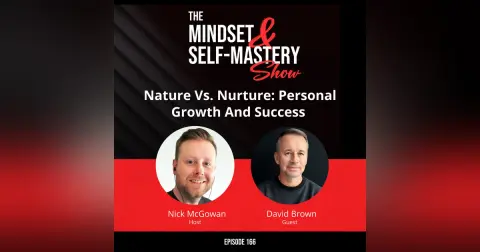
Nature Vs. Nurture: Personal Growth And Success With Ex-Navy Seal David Brown


“The only easy day was yesterday.”
In this episode, Nick speaks with David W. Brown, a former Navy SEAL and author. David shares his journey from being the smallest kid in school to overcoming adversity and becoming a Navy SEAL.
What to listen for:
- Opportunities arise when you least expect them.
- Overcoming adversity builds character and resilience.
- Success is a personal definition, not a societal one.
- The journey of self-discovery is ongoing and essential.
- Facing fears reveals true strength and capability.
- Not quitting is important, but succeeding is the goal.
- Your past experiences shape your future potential.
- Embrace challenges as opportunities for growth.
- Mindset is crucial in overcoming life’s obstacles.
- Every evolution in life will eventually end, leading to new challenges.
“Quitting football taught me a big lesson in my life about quitting”
- Walking away from something can sometimes teach you more than sticking it out.
- One bad choice doesn’t define you; it’s how you respond that matters.
- The moment you realize you don’t like how quitting feels, you start making different choices.
- Sometimes, a mistake lights a fire in you to never make it again.
- Feeling ashamed of quitting led to a mindset shift that made future challenges non-negotiable.
“When you get an opportunity, you take it”
- If you hesitate too long, the moment might pass you by.
- Even if you don’t feel ready, stepping up is how you grow.
- You can’t always predict the outcome, but taking the leap is often worth it.
- You don’t need to have it all figured out—just start.
- The right opportunity can change everything, but only if you take it.
About David Brown
David was always the smallest person in school, yet standing just 5’3″ tall and weighing 110 pounds, he became a Navy SEAL. After earning his bachelor’s degree, he went on to become an NCIS, EPA, and Department of Interior special agent. Even though he was picked on and bullied in elementary school and was told he could not do certain things because of his size, he overcame impossible odds to be professionally successful and retire at the top of the government ranks as a Senior Executive.
Resources:
Interested in starting your own podcast or need help with one you already have? Send Nick an email or schedule a time to discuss your podcast today! nick@themindsetandselfmasteryshow.com
Thank you for listening!
Please subscribe on iTunes and give us a 5-Star review! https://podcasts.apple.com/us/podcast/the-mindset-and-self-mastery-show/id1604262089
Watch Clips and highlights: https://www.youtube.com/channel/UCk1tCM7KTe3hrq_-UAa6GHA
Guest Inquiries right here: podcasts@themindsetandselfmasteryshow.com
Your Friends at “The Mindset & Self-Mastery Show”
Nick McGowan (00:03.727)
Hello and welcome to the Mindset and Self Mastery Show. I’m your host, Nick McGowan. Today on the show we have David Brown. David, how you doing?
David W. Brown (00:15.665)
I’m doing excellent, Nick. Thanks for asking.
Nick McGowan (00:17.049)
Absolutely. I’m glad that you’re here. I’m really excited to get in all this I need to get the cat out of the bag. You are an ex-navy seal and what a cool thing I could only imagine the Chaos the experiences the life lessons the shit moments the all the things that come into that and that’s part of the reason why I wanted to have you on the show is be able to talk about not only those experiences but how they relate to people that aren’t seals or will never become the seal
And I even made a joke, you know, before we hit record, like what about the people that are standing in their office wanting to slap somebody across the face with that coffee cup? Like, how do they not? What do they do differently? And how do they manage themselves through it? But why don’t you kick us off? Tell us what you do for a living and what’s one thing most people don’t know about you that’s maybe a little odd or bizarre.
David W. Brown (01:06.206)
Currently, I am the author and I am marketing my book, Anne Goliath. And the thing that people don’t know about me is I am a former semi-professional wakeboarder and I competed on a water ski show team in the Midwest.
Nick McGowan (01:25.388)
water ski show team in the Midwest. That that’s pretty interesting just by itself. Did you grow up like outside of a lake or did you and your family go or like, how did you get in all that?
David W. Brown (01:34.09)
You
David W. Brown (01:40.916)
Well, as you can imagine from being a Navy SEAL, I was always interested in the water. I didn’t grow up in the Midwest. And in fact, I didn’t take up wakeboarding or skiing until I was in my mid thirties working for the Environmental Protection Agency. I was a special agent and I bought a house on a lake. And within six months, I learned how to taught myself how to wakeboard. I was sponsored by a number of companies. And then I joined the the arch rivals, which is out of St. Louis. Makes sense, right? The St. Louis Arch.
and we were called the Arch Rivals and we competed around a team of probably 40 or 50 people. And we did the stuff like you see at Cypress Gardens, you know, we built pyramids and ramps and I was flying over people and on my wakeboard jumping over people and we were doing all kinds of fun stuff.
Nick McGowan (02:29.579)
And what a cool thing. And especially in your thirties, like I grew up as a rollerblader and an aggressive skater. And I remember there were friends that skateboarded and they did it after high school for a few years. I even tried to skate a few years after high school and like wrecked my ankle and was like, note to self, I’m not 15 anymore. But there are certain people that are like, nah, you can’t do it when you get older. You can’t do certain things. And that’s a clear
Like you bought a house and within six months you were like, fucking, I’m going to do this thing and get sponsored to do it. And next thing you know, you’re jumping over people. What a wild thing. Like you probably didn’t think about that a year before. Like, you know what? In about nine months, I’ll be 50 feet in the air flying over somebody with a board underneath.
David W. Brown (03:15.914)
It wasn’t in my wildest imagination. But when you get an opportunity, you take it. we’re going to talk about that some more, what opportunities are and how and why people get them.
Nick McGowan (03:29.079)
Yeah, well, I mean, let’s jump into that. Let’s actually give a little bit of context of the things that you’ve done and then just lead right into that.
David W. Brown (03:38.41)
Okay. Go ahead.
Nick McGowan (03:38.721)
So yeah, starting off just as you said, you didn’t grow up in the Midwest, but how you kind of grew up, the way that you grew up, the things that you dealt with as you grew up and how you got into being a Navy SEAL, because that was sort of the reason of, part of the thing that stood out to me, you talked about your height and size and still becoming a Navy SEAL, but there was a lot that I’m sure you had to go through even as a kid, getting in through middle and high school and then getting into becoming a Navy SEAL. So give us context with that.
David W. Brown (04:10.462)
bottom line is if I did not have the experiences that I did growing up, I would have never been able to make it through buds. was disadvantaged as you pointed out, and my height. was always growing up I was always the smallest kid in school. In fact, I was smaller than most of the smallest girls in school and I was picked on just like everyone else. But I never saw my height or my weight as a disadvantage. You know, I
So for some reason in my mind, I was like, well, I can run faster than you. can hide in places. I can climb trees better than you can. So it doesn’t bother me to be a small kid because there was a fat kid and there was a tall kid and there was a skinny kid. you know, even though I got picked on, always stood up for myself. And once I learned if I landed the first punch, I usually could win the fight because people really don’t want to fight. Right. And they and very few people actually been hit in the face.
Nick McGowan (04:47.457)
Yeah.
Nick McGowan (04:58.323)
Yeah
David W. Brown (05:06.058)
And so when you get a punch him in the nose, doesn’t matter how big or small you are, somebody is going to be like, oh shit, I don’t want that to happen again. So I learned how to fight at a very early age and that gave me a lot of confidence. And moving into my teenage years, I tried to play football and I could tell you when a guy who weighs 88 pounds tries out for the football team, you learn real quick about physics.
Nick McGowan (05:11.455)
Yeah.
David W. Brown (05:34.224)
And when a 150 pound kid runs into an 88 pound kid, they get slaughtered. And I got slaughtered. And it taught me a big lesson in my life about quitting. I quit the football team. It was the worst experience I had in my life. I was ashamed. I felt this big. I felt as big as that I was. And I knew I needed to get out of that slump. I was a high school kid and I felt like I was insignificant.
And that’s when I changed, I had an epiphany. I was like, okay, I gotta get out of this. So I joined the wrestling team. And when you’re wrestling, you wrestle the people you’re saying, wait, right? So I wrestled at 98 pounds till I was a high school senior. And I did really well. I was a district champ at 98 pounds. And that really helped me build my confidence back and my muscle structure because I wanted to be a Navy SEAL.
Nick McGowan (06:15.072)
Yeah, way class.
David W. Brown (06:34.708)
didn’t even know what they were until I went to the Navy recruiter back in 1980. weren’t, there weren’t any movies or books about Navy SEALs. So I went to the Navy recruiter and I’m like, he gave me a book that says these are jobs you could do in the Navy. And all of a sudden I come across the page that says UDT SEAL. And I’m like, wait a second. They jump out airplanes, they have machine guns, they blow up stuff. And I’ve been watching James Bond and, and get smart.
Nick McGowan (06:41.395)
you
Nick McGowan (07:03.691)
Yeah
David W. Brown (07:04.202)
I know that’s funny, all the movies voyage to the bottom of the sea. And so I’m like, and I love Jacques Cousteau. So I’m like, I’m gonna be Jacques Cousteau with a machine gun. That’s what I’m gonna do. And so I walked into the recruiter, I said, this is what I’m gonna do. And I weighed, I didn’t even weigh a hundred pounds at the time. He’d laughed at me, he looks at me, says, dude, there’s no way you’re gonna be a Navy SEAL. These guys are all really big and really good shape.
I don’t know anybody who’s ever become a Navy SEAL before. So he said, forget it, pick something in that book that you can do. And I went back and I looked at it again and I went back to him and I said, this is what I’m gonna do. And he was like, hey, you wanna try, go right ahead. And so I went in the Navy and get in the boot camp, tell everybody I’m gonna be a Navy SEAL. Of course everyone laughed at me. Just like, when I was a kid, they laughed at me because I was short.
laughed at me wanting to play football, laughed at me for all the other stuff. So I was used to it, right? So I get to boot camp and I go take the screening test. Probably 30 or 40 guys taking the screening test for being a SEAL. I’m the only one who passes. And get back to my boot camp company and the guys that are all pointing at me and laughing at me says you’re never going to be a SEAL. All of a sudden now they all want to be my friend, right?
Nick McGowan (08:28.893)
Cool.
David W. Brown (08:31.85)
Hey, want to, I want to be friends with the guy who’s going to be a Navy SEAL. So all of sudden I became popular. And, uh, and so moving out to, um, go to a SEAL training, it’s called BUDS, Basic Underwater Demolition SEAL Training. I’m checking in at the quarter deck there and quarter deck, the desk was really high. It was probably, it was over five feet tall. So I walk in and I’m coming up to here on the quarter deck desk.
And the guy looks over the desk at me and he says, yeah, can I help you? And I says, hey, I’m Dave Brown. I’m checking in for Buds. He looks over the desk. He’s big smile on his face. He starts laughing. He says, you gotta be kidding me. No, no, no, no. You aren’t checking in for Buds. You’re here for like the boat unit or something, right? I said, no, I’m here to go through seal training. He says, somebody’s playing a trick on me. And he starts laughing. Anyway.
Nick McGowan (09:12.304)
man.
Ahem.
David W. Brown (09:28.528)
After we get through that, finally gives me my, I give him my orders. I show him I’m actually there for buds. And I go on my way and I go in and check into the barracks. this is the, you know, but this is a series of things through my entire life. So maybe for other people, they would have been discouraged or something, but it was just another day for me. This is people pointing at me saying, you can’t do something.
Nick McGowan (09:53.418)
That might be one of those like crossroad moments that happened way, way, way early that could have really disrupted somebody else. I always find that stuff super interesting where like family members, siblings can experience the same stuff in the house, but go off and do different things. I’ve got a really close friend that his mom told them when he was younger, him and his brother, don’t run out in the middle of street, can get hit by a car and you could die. My friend went, okay, note to self, don’t do something stupid like that. I’ll do something else or whatever. And his brother got afraid.
terrified, and then just shut down from all those things. But the simple little situation like that, like even where you’re talking about people were saying stuff like this to you all the time. Somebody could have just said, you know, well, this is what life is. And then they’ve never gotten through all of that. But was that something that was kind of familial, like your family, they were really supportive and that sort of stuff? Or is just, this is deeply innate, like, I don’t give a shit what anybody else says, I want to do the thing I want to do.
Or both.
David W. Brown (10:56.68)
Well, I didn’t realize it until I started doing the research for my book and I came across a scientist, Robert Plowman, who wrote a book and the book is called DNA, called Blueprint, DNA, how DNA makes us who we are. And so I started doing some research into why the heck am I the way I am? As you just said, some people would have, you you talk down to them or you discourage them and they shrivel up and they blow away.
I can tell you, my parents were not there to support me. When I was a wrestler, had to ride, when I played football, I had to ride my bike to go to football practice. When I was a wrestler, I had to use the bus. They didn’t care about my grades. When I told them we were going to the Navy, they were like, see you later. So none of this was the nurture part of the nature, nurture part.
Nick McGowan (11:50.781)
Mm-hmm.
David W. Brown (11:55.162)
nature was taking its direction. This is the way I read it. It was in me from the beginning. I look back at my ancestors and I found out that my great-great-grandfather was actually a guard on a castle wall in the Netherlands. And every male in my family history has been in the military. And I didn’t even know all this until I did the history.
Nick McGowan (12:13.16)
Nice.
David W. Brown (12:23.058)
It was in me to have this sheepdog trait and the confidence. All my ancestors were really small. And then I look back and what they did great things in the Army of Holland and how they were in battles in Africa. And so I’m like, holy mackerel, this was in me the whole time. when I say, when I was a kid, I was willing to fight. It wasn’t because someone was encouraging me to do it. Something was telling me to do it.
Nick McGowan (12:50.972)
Hmm. Yeah. What a wild thing. It makes me think of the genetics that we’re just typically unaware of. Typically, trauma can be passed down genetically. There are traits and things that we’re just unaware of. I’m sure there are people that were adopted that are like, I’m not really like my parents. And there’s the nature part of it. Or I guess that’s more nurture in that sense. But the nature that’s internal of this is who you are and the things that you’ve gone through.
It sucks to hear that your parents weren’t helpful. But I often think that we learn probably most what not to do from our parents than we do learn what to do from them. And it’s on us to be able to do what we feel in life. So what a cool thing for you to be able to take that. So there, there’s that you had that innate ability to go, I don’t give a shit what anybody else is saying. This is the thing I want to do. I want to go do this thing. Was there also a piece of that was kind of like, screw off, I’ll show you people.
David W. Brown (13:49.498)
There was a big part of that was and it’s it’s still today. The worst thing to say to me is you can’t do this because I’m going to say, watch me. I’m going to do it. And I’m going to prove to you that I’m better than you think I am. And that came out in so many aspects of my life going being a Navy SEAL and then becoming a special agent.
and doing law enforcement work. And I always set my standard to be not every, everybody has performance reviews, right? Everybody work wherever they work. You’ve got a boss. They’re going to give you a performance review. They’re going to sell you all the things that they think you did right. And maybe some of the things that would like you to improve on my goal. And it’s always been to surpass anything that stupid performance report said on it. And I was going to disappoint myself.
way before I even came close to what the performance standards were. So I got up before everybody else. I got to work before everybody else. I worked twice as hard as everybody else because it wasn’t about pleasing my boss. It was about me pleasing myself to get to that standard that I felt I could achieve.
Nick McGowan (15:02.183)
That’s an important takeaway for everybody, that it’s you. It doesn’t matter about other people. Part of the reason for me asking that question and even your initial response, I’m thinking, how do you not allow that to just become toxic? Because there have been people, and I’ve experienced this in my own life, where it’s like, well, fuck off. I’ll show you I’m gonna do this thing. And more so it’s because I want to tell them to go eat shit and like, you can’t tell me anything else or whatever.
But then there’s also a part of me that’s like, why also want to do it for me? And there’s a balance to that. Like if you’re aware of it and you’re like, I’m solely doing this so you can go away or I’m doing this because I want to do this thing. I think there’s a mixture of both of those that can be healthy, but if you’re on one side of the other, it can be almost toxic. So how do you balance that?
David W. Brown (15:54.538)
Well, number one, like you said, it has to be a motivator. If it becomes a vengeance, that is a bad trait that, you know what, may, vengeance may give you momentary success, but in the long run, it’s going to bring you down. And I never, yes, I’m human just like everybody else. When somebody says that to me, I get mad and I’m to say, I’m going to show you. But it wasn’t, it wasn’t as much in the end that I wanted to show them.
I wanted to prove to myself. And that’s where I had problems, believe it or not, with that attitude because as I went through life, every time I made some achievement, I always looked to the next mountain. So I climbed this mountain, right? And I’m like, most people would just stop, smell the roses and say, okay, I achieved this, go on vacation or do whatever. I never did that. And I…
after my long career with the federal government, I look back and I was like, am I even successful? What did I do? I mean, I was a SEAL, special agent, special agent in charge, senior executive for the federal government. And I had to look back at my life and I had to reevaluate and I say, what does success mean to me? How come I can’t grab that feeling of,
you did all these great things. You should feel good about yourself. And I didn’t. I didn’t feel good about myself. So I had to reevaluate that. And I had to understand what the heck does success mean to me. And that’s the important.
Nick McGowan (17:30.479)
Yeah.
We’ll talk to us a bit about that. What did that look like? Because that can’t be an easy thing. mean, even as you talk about it, somebody that’s going to listen to this is like, well, I’m bitching about my mid-level management career or my C-suite career or my nonprofit I’m running. And it’s like, well, shit, if you’re at the end of your Navy SEAL career and all this, and you’re asking the same questions that I would be, how did you get through that? What did you do to be able to actually sit with that, sit with the young
the discomfort with it, but then be able to work through it and turn it into not only the book, but everything else you’re doing.
David W. Brown (18:12.19)
book was a major therapy session for me in that going back all the way to the stories we talked about and, know, fighting it from fighting kids in grade school to, you know, my most difficult moments going through SEAL training and how I was able to not quit. And here’s here’s the key about not quitting. It’s not quitting does not guarantee you win.
Not quitting doesn’t mean you made the grade. Not quitting doesn’t mean you passed the runtime in Buds and you’re still a failure. I had to realize that not quitting is not enough. And so when I look going forward to answer your question, I didn’t quit in Buds, but I succeeded. I went beyond that. And so I started to go back and look at the things that I really done and
Now, finally, I’m 62 years old, right? I’ve done a lot of things. I’m still doing new things every day, and I love it. Now I finally found what success is for me. Waking up every day in a positive attitude. And if I can accomplish being positive all day, everything I did in the past doesn’t matter what success is, because success is today. Success is what I’m doing today.
as they used to say in Bud’s, the only easy day is yesterday. And that’s and that I live by that statement every day. The only easy day was yesterday. And today I challenge myself every day. And it’s not about the certificate. It’s not about getting my Trident or my badge. You can see I got my badge. I got my book. I got my beautiful wife. I got all these things. But for me, success is every day challenging myself to be the best person I can be.
Nick McGowan (20:04.901)
Easier said than done, you know, obviously. And there’s sure, I’m sure there are days where you wake up and you think like, fuck, my back hurts or my God, it’s cold in here or whatever. like those things could set some people off and get them on a trajectory where the rest of the day is just terrible. It’s almost like you wake up and you stub your toe instantly. And it’s like, that could be a terrible thing. There’s also something to be said about kind of that bypassing toxic.
positivity of it of like, everything’s okay, the house is in the middle of burning down, but we’re all going to be totally fine. Like, no, you don’t realize that your house is burning down. But being able to actually understand that your, your attitude, your mindset, the way that your mental health is, is, a portion to all of that. But it also sounds like kind of a core point of what you’re talking about is like being here right now, like today, right here. And going through doing the things you can do today.
which must’ve been kind of difficult then looking back through everything you’ve done before. But let’s actually talk about some of those key moments or like pivotal moments. You’d mentioned about training and going through buds and that sort of stuff. So maybe it’s a time through buds or are there any times that you can talk about, seal stories wise that you often relate back to and go, well, that was one of those pivotal moments where I learned whatever this thing is.
and how I look at life now or how I go about life is because of that time.
David W. Brown (21:32.298)
Yeah, absolutely. There was the one moment in my life to change. I don’t want to say it changed my life. It didn’t change me. What I think is it revealed the person that I really am. And I’m to have to tell a little bit of a story about SEAL training is, some people say it’s the toughest training, military training. And I can attest that it wasn’t easy. everybody has a weakness in BUDs. It could be swimming. could be it could be fear of heights.
It could be cold, could be heat. My crypt tonight, if you will, was running. I was terrible. My inseam is 28 inches. You got these guys with these long legs and striding through the soft sand and boots and running up and down the sand dunes. And they’re all leaving me in the dust. And I’m doing everything I can trying to keep up. And I was terrible. I was just terrible.
Nick McGowan (22:14.156)
Yeah.
David W. Brown (22:30.77)
If you’ve ever heard of hell week, it’s a very long week of which they do all kinds of nasty things and you’re up for five days straight. right before hell week, I fell behind on one run and they had this thing called the goon squad. And that meant if you were fall, if you fell behind, they would take you and whoever was there and then throw you in the ocean, make you roll around in the sand, get as miserable as possible and exercise you to exhaustion, to complete collapse.
And their thought was, if we keep doing this to these guys, that they’ll get better and they’ll either keep up with the rest of the crew or they’re going to quit. And of course, they want, they don’t care what’s going to happen. So I fell behind on this run and I saw the class running out in front of me and the ambulance was right behind me and we’re in the soft sand. And, you know, in the back of my mind, it’s saying, you’re not going to make it.
You’re not going to make it. This is it. This is your breaking point because you there’s no way you’re going to catch up to these guys. And I had been in the goon squad four or five times and I just knew I couldn’t I could not get through buds in the goon squad. So I started falling behind and I had swore to myself as a kid, I would never cry. Crying showed weakness. And I started crying. I I was crying not because I was physically hurt, because I was
letting myself down. was defeated. And I looked down at the down at the sand. I looked back at the ambulance and I said, this is it. I have a choice to make. I’m either going to quit or I’m going to catch up to those guys. And if I can’t catch up to them, I’m going to die trying. And I don’t use that metaphorically. I’m telling you, I was willing to sacrifice my life.
to catch up to that fricking bunch of guys and I was either gonna do it or I wasn’t gonna do it. I swear to God I had an outer body experience. My mind just was like, I don’t even remember running. All I think I know was I flew through the sand, I caught up to them and it changed my life. That moment, it was the toughest physical and mental thing I’d ever done and I was willing to die for that moment. And if you have never been to the depth of your soul and willing to die for something, then if you have been, you understand what I’m talking about. It changes your life. And I know a lot of people have been through what I’m talking about. And so when I look, when I do something today or all through my career, whenever something got tough,
or difficult or situations, physical or mental, I always go back to that day in the sand. Nothing, nothing I’ve ever experienced could come close to that. So I know I always survive.
Nick McGowan (25:35.733)
man. What a cool thing to be able to remember that and feel that and have that reference point to go back to. It’s definitely not a cool thing when you’re in that moment of like, I’m either gonna die or I’m gonna do this or what but that is one of those breaking points. And you know, I think that I think that we as people can look for the easy way out a lot of the time. And we never really like you don’t want to
break your leg to learn a lesson. Because if you can learn a lesson without breaking your leg and you can walk through the lesson, like, what a beautiful thing. But sometimes you have to go through that stuff to do it. But you at least have to be willing to do that work and whatever that looks like from there. So I appreciate you going through that stuff. And I love the fact that you’ve got that reference you can go back to. So for the people that are actively working through their own versions of that, and they’re on their path towards self mastery, what sort of advice would you give to them?
David W. Brown (26:38.154)
I think the biggest advice I can give to anyone who’s going through a difficult situation is what we used to do is understand that get through what we call the evolution. Every day we had multiple things we had to do and each one was called an evolution. It could have been a run. It could have been a swim. It could have been a test.
No matter what we did, no matter how hard it was, we all knew that when the clock struck 12 at the end of that evolution, you were successful and that there would be another evolution after that. But you just needed to get to the end of that evolution. So whatever you’re going through, I guess what I’m saying is it will end. It will end and there’ll be another evolution that you’re going to be challenged with.
So when you’re dealing with a mindset on something that’s difficult, mean, really difficult. I’ve been through some difficult things. know, I’m not going to my book actually starts off with tragedy, standing by the coffin death. I was near the end of my rope. I was homeless, living out of my truck. I could not have been lower in my life than that point. It was a diff. It was like I was on the sand.
in the sand, but this was in a personal, emotional, and I knew, I knew looking back on that, that that evolution would end too. And I went beyond that. that’s so that’s the advice in a short term. That’s what get through the evolution people. The only easy day was yesterday. Get through that evolution. It’s going to be OK. You’re going to survive it. And then.
When you come out of it, the great thing is you’re gonna reveal, you’re not gonna grow some great confidence that you didn’t have before, but what it’s gonna show you is what you are made of. I think that’s the right saying. It doesn’t make you better, it reveals how good you really are.
Nick McGowan (28:53.791)
And it takes courage to be able to actually get to those spaces where you can allow yourself to do that. It makes me think like, people say I want millions, millions of dollars, and the money won’t make you any different. It only bring out the things that are inside of you. Like if you’re already a shitty person, you’re just going to be shittier with more money. If you’re a great person, you’re going to be greater with more money. But it’s what you do with those things and being able to have those moments. And I think those are pivotal moments for people where they go, huh?
David W. Brown (29:14.698)
Yes.
Nick McGowan (29:23.976)
I can do this, look at what I did. Or I can get through this thing, I can survive this or whatever that is, it takes us actually going through that. I’d love for all of us to be able to understand just by listening, go, well, David says this, got it. But for the most part, we all need to go through our own shit. So at least this is, I don’t know, this is some help to go look, other people have gone through the things you’re going through. So David, I appreciate you being on, sharing everything you’ve shared today. Before I let you go, where can people find you?
Where can I connect with you?
David W. Brown (29:56.362)
You can if you want to know my story learn a little bit about my story. You can go to my webpage I have udt Dave calm and it’s got some great photos if you want to look at photos about being sealed team and all that stuff and You can also contact me. My email is udt Dave at gmail.com and if if you’re not familiar udt means underwater demolition team frog man
And I was the last of the frogmen. class, Bud’s class was one of the last classes that actually graduated frogmen and went to UDT teams. In 83, we converted from UDT to all SEAL teams, but I was the last of the breed.
Nick McGowan (30:38.802)
Wow, that’s really cool. Well, David, it’s been awesome having you on today. I appreciate your time.
David W. Brown (30:45.108)
Thank you so much. was a lot of fun and good luck to you, Nick. Wonderful show.
Nick McGowan (30:49.342)
Thank you.