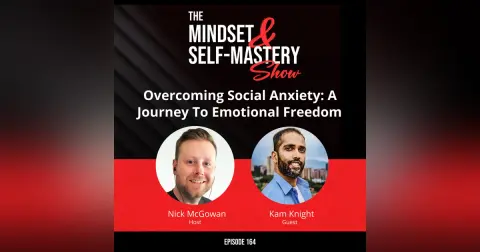
Overcoming Social Anxiety: A Journey To Emotional Freedom With Kam Knight


“I just allow the feelings to take over, and as long as I sit in it, they tend to subside.”
In this episode, Nick speaks with Kam Knight about the complexities of social anxiety, emotional intelligence, and the journey of self-discovery. Kam shares his personal experiences with social anxiety, the impact of his upbringing, and how he navigates emotions in various situations.
What to listen for:
- Social anxiety can stem from childhood experiences
- Sitting with emotions can lead to clarity and insights
- Vulnerability is key to overcoming personal struggles
- Expressing feelings can alleviate the pressure of holding them in
- The importance of finding supportive spaces to share experiences
- Self-mastery involves recognizing and overcoming mental blocks
- Desire alone is not enough; action is required to achieve goals
“The more I sit with my emotions instead of fighting them, the more they lose their hold on me.”
- The more you fight an emotion, the stronger it feels. Sitting with it allows it to pass naturally
- Feelings, no matter how overwhelming, always change. Letting them flow instead of suppressing them helps you move forward
- Observing emotions without reacting gives you power over them instead of letting them control you
- Facing emotions head-on, even the tough ones, builds resilience and self-awareness
“Healing comes from allowing yourself to feel, without fear, without judgment, and without running away.”
- True healing happens when you give yourself permission to experience emotions fully, rather than avoiding them
- Avoiding emotions out of fear only prolongs pain
- Being hard on yourself for feeling a certain way only adds to the struggle
- Distractions and numbing only delay the inevitable
- Every feeling has something to teach you
About Kam Knight
Kam Knight is a coach, international speaker, and bestselling author of a dozen books in the area of mental performance and personal mastery. He’s known for bringing fresh solutions and insights that are a rare departure from traditional ideas. Because of his fresh perspective, his books have become the gold standard for their respective topics, which have helped over 500,000 people. When he is not coaching or writing, he is traveling, having traveled to over 100 countries around the world.
Resources:
Interested in starting your own podcast or need help with one you already have? Send Nick an email or schedule a time to discuss your podcast today! nick@themindsetandselfmasteryshow.com
Thank you for listening!
Please subscribe on iTunes and give us a 5-Star review! https://podcasts.apple.com/us/podcast/the-mindset-and-self-mastery-show/id1604262089
Watch Clips and highlights: https://www.youtube.com/channel/UCk1tCM7KTe3hrq_-UAa6GHA
Guest Inquiries right here: podcasts@themindsetandselfmasteryshow.com
Your Friends at “The Mindset & Self-Mastery Show”
Nick McGowan (00:00.718)
Hello and welcome to the Mindset and Self Mastery Show. I’m your host, Nick McGowan. Today on the show we have Kam Knight. Kam, what’s going on man? How you doing?
Kam Knight (00:12.389)
Hey Nick, not much, we just finished 2024 and we’re in the new year so I’m happy to do my actual first podcast of the year with you. Yeah.
Nick McGowan (00:20.558)
the first one for the year? Yeah, that’s pretty awesome. Man, it’s crazy how sometimes time flies by. I’ve joked different people on the show too. Like I remember being a little kid in school and they’re like, yay, we had a hundred days. And I’m like, a hundred days? Are you kidding me? I feel like I’ve been here for like six years, but now a hundred days will fly by. And it’s like, shit, you remember last Tuesday? It was a hundred days ago. Wild.
Kam Knight (00:38.748)
Yeah.
Kam Knight (00:43.343)
Yeah. And I actually looking back at some of the events that have happened, or I was looking at some of the conversations I’ve had, whether through email and text. And I was surprised that some of my conversations were like from seven, eight, or nine months ago, and I haven’t been in touch with these people. But for me, just felt like it was, I talked to them a few days ago or a few weeks ago. So it’s really fascinating how that happened.
Nick McGowan (01:03.341)
Hmm.
Nick McGowan (01:08.758)
Yeah.
Nick McGowan (01:12.082)
yeah, it makes me think of like, I hope everybody has friends like this. But I think we all have some people it’s like you haven’t talked to you in a while and it could be 10 years. But you have a conversation with them and it’s like you talked to him a few weeks ago and you just kind of pick things back up.
Kam Knight (01:22.714)
Yes.
Kam Knight (01:27.985)
Yeah, I have had plenty of those. So my sister, one of the things that she jokes about with me is that Kam was ghosting people before that was even a thing. And it’s not that I was ghosting people, but you know, I do a lot of stuff. I like to be pretty active. And sometimes I’ll just lose touch with friends and family, some friends for years and some even decades.
But when we do chat, it’s just like that. It’s like it’s as if we haven’t skipped a beat and we’re like right back to where we were before. So it is kind of interesting.
Nick McGowan (02:03.629)
What a cool thing. And that’s a funny jab too. You’ve been ghosting people before ghosting people was a thing. I think some ways that just set boundaries and also just live in life. yeah.
Kam Knight (02:10.073)
Yeah.
Kam Knight (02:16.879)
Yeah, well, there’s a deeper part to it, too. This is something I don’t really share, and I don’t think I really share too much in my podcast, but or not in podcasts in general. But it is what kind of a part of the reason I got into the space that I did of learning about the mind and behavior and all of that is I had pretty intense social anxiety and I didn’t realize
How?
Out of the norm it was. I kind of knew it was like outside of the average how a normal social person experiences life. But yeah, it was very different. And I didn’t realize that one of the reasons I was ghosting people was because of that. Kind of interesting. Yeah.
Nick McGowan (03:08.94)
That is interesting. I mean, obviously this is a good space to able to talk through that. I want to take a little bit of a step back before we get into that. Tell us about yourself. What do you do for a living and what’s that one thing that most people don’t know about you that’s a little odd or bizarre?
Kam Knight (03:13.981)
Yeah, yeah.
Kam Knight (03:25.413)
All right. So my name is Kim Knight. I am an international speaker, author of a dozen books in the area of mental performance and personal mastery, such as speed reading, memory, concentration, as well as self-talk, visualization and ghost reading. And something that I don’t really talk about, but, you know, I do kind of bring it up, especially on podcasts is I have traveled to over a hundred countries around the world.
Though the one thing that a lot of people don’t know about me is what I kind of alluded to earlier is that I have had a bit of social anxiety in my life and a lot of what I was doing, especially with my travels, it wasn’t trying to get somewhere, but running away from something.
Halfway through my travels, I kind of realized that a lot of my travels was me running away, but I couldn’t really figure out what it was. Like, was it people? Was it like family? Was it work? Was it the real world? And I think, and what I realized is that when things start to get real in like relationships and friendships and interactions, a part of me freaks out and skips town.
So that’s one thing that I don’t really share a lot, it has been a big driver of who I’ve been and the decisions that I have made in life.
Nick McGowan (04:58.891)
That’s not a small thing. And to be self-aware of that must be kind of difficult sometimes to really understand like what you’re setting a boundary for or if you’re actually running away because we as humans are really good at being able to talk ourselves in and out of things and justify the hell out of all of it. So talk just a little bit more about where that came from.
Kam Knight (05:00.868)
Yeah.
Kam Knight (05:14.448)
Right.
Kam Knight (05:20.573)
Alright.
Nick McGowan (05:26.375)
and what you’ve done to be able to not only look at that, but perpetually to continue to work on it.
Kam Knight (05:30.13)
Yeah.
Yeah, it’s hard to know where it actually stems from. So I can’t say I’ve had the best childhood and I can’t say I had the worst parents, but they were far from great. And in addition to that, you know, just growing up with that, with in a very, I guess, hectic and violent environment, I think at a certain point, my brain came to the conclusion that people equals danger.
Nick McGowan (06:01.63)
Mmm.
Kam Knight (06:02.423)
Even if people are even if the people are nice and kind and generous. My body would respond to it as like something bad is going to happen if I stick around this too long or whatnot. And this programming of people equals danger has really been running my life for since I was young, but I didn’t realize that. when I was like.
doing different things like different sports and activities. Cause I’ve done a lot of stuff. I’ve snowboarded all over the world. I’ve scuba dove all over the world. I have hiked some of the most extreme places. And in terms of my career choices too, I’ve done various things. Like I was a CPA, I was an author. I do healing work. And when I look back at a lot of these things that I was doing and decisions I was making,
I thought it was because I wanted to do it, because it was exciting, because I enjoyed it. But when I really look back at it underneath, there was this like fear of like, okay, I’ve been comfortable in this place too long and now it’s time to move on and, you know, find new people, create new relationships and things like that. So that really, that programming really kind of drove me. And when I really, really, really
Nick McGowan (07:01.481)
Hmm.
Nick McGowan (07:17.641)
Hmm.
Kam Knight (07:27.527)
kind of dissected, like I did a lot of meditation and work around this. What I found is that
For me, the pain of rejection is really intense. So if someone rejects me or if my mind believes somebody has rejected me, so a lot of times, you know, a person will walk away and not because they didn’t like me, just because they had to go do something else. Or if I am pitching a client or pitching for a podcast and someone says, no, it’s because it isn’t personal, but my mind can take it personally and
Nick McGowan (07:41.353)
Hmm.
Kam Knight (08:06.267)
The pain of that is so strong that my protective mechanism goes to great lengths to protect me from that. And in order to do that, kind of keeps people at a distance, if that makes sense.
Nick McGowan (08:21.767)
makes a ton of sense. I’m sure there are people that are going to listen to this be like, my God, I get all of that.
Kam Knight (08:23.527)
Yeah.
Kam Knight (08:27.399)
Yeah, yeah, yeah. And so logically, people like us or myself, could logically look at the situation, be like, there’s no reason to feel bad or to feel hurt or to experience the response that I do at the deep and intense level I do. Like logically, it makes sense. But the response is outside of my logical control. And so.
it’ll still create the response if my brain perceives that I was wronged or judged or rejected more or less. And as a result, like I’m unconsciously avoiding situations that could put me in front of being judged and rejected. And so that’s what I mean, that this program has been kind of running or driving a lot of my decisions. And for a long time, I was unconscious. Like I said, it was, I thought
If I would go move on to a new thing or if I would go travel to another place, I thought it was because I wanted to do that. I thought it was because it was enjoyable, exciting. And yes, there was a lot of enjoyment and excitement there, but there was also something deeper going on, which was, you know, what I’m kind of talking about right now.
Nick McGowan (09:45.193)
Yeah, there’s, there’s really no black and white in this world. That’s there’s all layers and gray areas of things because, I’m glad that you brought that up. Like there were pieces of that, that you wanted to go do those things. And yes, those are probably really enjoyable and you can tell the stories and all of that. And it also tied into something else where once you see that, then it’s almost like.
Kam Knight (09:50.586)
No.
Kam Knight (10:00.125)
All
Kam Knight (10:06.983)
Yeah.
Nick McGowan (10:13.384)
I wish it was like, once you see it, go, great, now I got it and I can move along and I can do things differently. That’s not actually the case. It’s like the awareness steps in, you then get to do something with it. And then that journey is where you start to move along and go through. I learned a concept a couple of years ago that literally just rocked my world, which is similar to what we’re talking about. I think it’s in the same vein, at least the winning strategy, your subconscious winning strategy.
Kam Knight (10:17.245)
All right.
Kam Knight (10:26.801)
Yeah.
Nick McGowan (10:42.257)
In your formative years, between four and eight years old, your subconscious creates a strategy to say, this is how you win in life. And that’s about what you were doing where you’re saying, well, these people are dangerous. So this is how I win. This is how I stay safe. This is how I stay loved. And that typically will tie into whatever your attachment style is to whether it’s anxious or disorganized or what have you. But then we start to take that as humans and go,
Kam Knight (10:54.407)
Yeah.
Nick McGowan (11:08.22)
Well, this is what this looks like. And then we formulate our lives around that. But what a fucked up concept when you learn that the subconscious was doing this and you’re like, fuck, how do I get around this? What do I do differently? So that leads me to the question of like, what are you doing now? Now that you’re aware of these things to be able to not only continue to be aware of it, but to continue to work on it and show yourself grace as you bumble through it.
Kam Knight (11:13.165)
Right.
Kam Knight (11:18.461)
Okay, bye.
Kam Knight (11:34.193)
Yeah, I mean, it hasn’t completely gone away. It comes up, know, especially if I want, if I am going to be on a show, doing a podcast or if I’m going to go on stage, that’s when it shows up the most. And even though I’ve had plenty of successes and experiences where I know things are going to go well, it has gone well. And in fact, in previous podcasts, people have wanted to invite me back because they really enjoy my content and what I had to share.
Nick McGowan (11:38.065)
Of not.
Kam Knight (12:04.145)
that still comes up and I have to just kind of. Sometimes I kind of talk to myself like I’m talking to another person, like I do great, everything’s going to be OK, and that eases things. And other times I just have to. Act. Regardless of what’s going on, you regardless of what my unconscious is saying about it won’t work, things will fall apart and you’re going to.
Nick McGowan (12:05.351)
Hmm.
Kam Knight (12:31.655)
look like a fool and all of that. Like I just let that run as I’m still just doing my thing. So that’s been very helpful as well. And then when the when the intense responses do happen, they’re not as bad as they were in the past when they do happen. Instead of trying to fight it or resist it or talk to it or talk myself out of it, what I simply do is I just close my eyes and I just allow the feelings to come up.
Nick McGowan (12:34.8)
Hmm.
Kam Knight (13:01.309)
and almost take over. And a lot of times those feelings want me to do something to fix it, to rectify the situation or whatever, but I just don’t do that. I just allow the feelings to just kind of take over and essentially sometimes I’ll like, like fill my whole body. And as long as I sit in it,
they tend to subside and once they subside, I can go back to doing my normal thing. So that’s been the most helpful, like just allowing myself to feel the feelings and sit in and relax into it versus trying to fight, resist or fix it. And the more I’ve done that, the less the feelings come up the next time and the time after that. So it’s been a great way to not only manage it, but actually, I guess, heal from it.
Nick McGowan (13:42.885)
Hmm.
Nick McGowan (13:53.018)
Hmm. That’s interesting. We all, we can all go through similar things, but we all handle things differently. It’s a like, what a cool thing for you to go, I’m just going to sit and sit with it. Like, even as you’re talking about it, I, I experienced that stuff a lot of times, but my, my body wants to be able to take the thing and turn it into something. Like I want to go fix the fucking problem as soon as it comes up. And there’s like this.
Kam Knight (13:55.761)
Yeah.
Kam Knight (14:01.339)
Yeah.
Kam Knight (14:16.657)
Yeah.
Nick McGowan (14:21.042)
hold up energy where I’m like, hold up, this is what I’m gonna fucking do with this thing. We’re gonna take it and like, be proactive. And what a, what an interesting thing for you to say, let it basically wash over you. And for it to then say, well, I’ve tried to wash over you and knock you down before and you don’t seem to let me do that. So what do we do now? And you know, giving like a personality to the emotions with the emotions are just trying to tell us there’s something that’s there. So even in that moment, when you let it wash over you,
Kam Knight (14:27.079)
Yeah.
Kam Knight (14:33.383)
Yeah.
Nick McGowan (14:50.863)
Do you find that you have a bit of clarity or maybe even later down the road where you go, this is what the trigger or the emotion rather was trying to tell me.
Kam Knight (15:01.039)
Yeah, I think that doing this thing of just sitting with the emotions, relaxing into sinking in it without, like I said, fighting, resisting or trying to figure out how to fix it. At first, it’s kind of intense and it’s unpleasant, and it has this like it creates this need to want me to do something. And like how you said, like you want to do something. But if I just sit in it, you know that
pressure tends to go away and then I could just sit in the the yuckiness of those feelings and then once those feelings go away, I can get some insights as to why those feelings were coming up. I can’t think of a specific example, but it may have been like, well, I wanted this person to see me a certain way and he or she didn’t and that upset me because
you know, in my past when that happens, something bad happened. So I was really trying to make sure something bad didn’t happen. So there is a lot of insights that come when a person can sit or when I have been able to just sit in the feeling and allow the body to just run its course. Because afterwards there is a lot of clarity. But I will say in the beginning when we’re sitting with the feeling, it just wants to get louder and stronger and meaner.
or hourly, know, whatever, which creates a sense like, okay, I got to get out of this. I got to get out of this feeling. I got to break this feeling. And I fight through that. I just let it get louder and louder and louder and louder. And then at a certain point, it just stops and then it starts to kind of dissipate. So the reason I said that is I want people to know that it can feel overly intense to the point where you just don’t want to continue. But it’s usually that point.
where you don’t want to continue, you’re like right over the hump. And if you just sit in it just a little bit longer, you’ll get over it and get to the point that I’m talking about where the emotions start to subside, you start to calm down and realization starts kicking in.
Nick McGowan (17:18.255)
seems like a bit of a superpower where some people can do that so easily. Some people, I’ve brought up the emotional people and the thinker people over the course of the podcast itself. I’m very emotional, so I feel those things a lot more than somebody who’s more of a thinker, where like the emotions will come up and they go, cool, I’m gonna logic my way through it and they don’t get the emotions on them, like getting.
Kam Knight (17:22.225)
Yeah.
Kam Knight (17:31.549)
Hmm.
Kam Knight (17:39.184)
Right.
Kam Knight (17:47.097)
No. I know.
Nick McGowan (17:47.288)
ketchup or something on you, you know, where it seems like we’re similar in that sense where it’s like, are you fucking kidding me? It’s all over me. And they’re like, I’m just going to change my shirt. I’m like, but I love this shirt.
Kam Knight (17:53.757)
Yeah. Yeah. And I know a guy who does that really well. He can use logic to work through a lot of different emotions. And I don’t think for guys like us, I don’t want to speak for you. I’m going to speak for me. That logic always works. Yeah, it’s like, yes, we can see the logic behind it, but the emotions are still there and it’s still getting stronger. And unless
we do or act on it, then it’s not going to go away. Though I do want to say one thing is that although I know some people and some people do a good job of using logic to help them process emotions. Sometimes we can suppress emotions by using logic. Right. So we’re not allowing ourselves to completely feel it or to let the emotion complete itself because we’re using logic.
Nick McGowan (18:40.259)
Bypass it.
Kam Knight (18:50.513)
to keep it from actually fully coming up and fully doing what it’s wanting to do or it’s meant to do. So there is a kind of fine line between using logic and thinking. It can work and some people do a great job of it, but it’s important to be careful that you’re not shutting out or suppressing the emotions in doing that.
Nick McGowan (19:10.478)
Yeah, it’s like a razor’s edge. I feel like if so much, I mean, the best part about life is humans, but the worst part about life is typically humans. What an interesting thing because the people that can logic themselves through it, like there are probably times where they go logically, this makes sense. I’m gonna go this route.
Kam Knight (19:13.443)
Yeah, which is what makes us human so complex and…
Yep.
Nick McGowan (19:33.559)
they may bypass it. They may also look at people like us and go, you guys are just too emotional with these things. You let it come all over you and like, yeah, you’re like, what the fuck, I don’t know. But there is that, I love what you’re saying where you’re like, all right, well, I feel these things and I feel them and then I really feel them, but I hold steady. It’s like being rooted down while the storm is going on around you. And with what you’re saying where you can feel like,
Kam Knight (19:34.128)
Yeah.
Kam Knight (19:38.269)
You’re too dramatic.
Kam Knight (19:43.453)
Yeah.
Kam Knight (19:58.535)
Yeah.
Nick McGowan (20:04.289)
maybe somebody’s thinking ill of me or somebody’s gonna say something or whatever, to sit in that space with the emotions going all crazy and all around you, how do you then handle if you’re standing there in front of somebody while you’re going through that and they’re just looking at you? Like, what do you do, you know?
Kam Knight (20:14.215)
Yeah.
Kam Knight (20:24.277)
So obviously I’ve had a lot of experience. I’ve gotten a lot better at it where I can be processing intense emotions and a person not even realize it. But it’s because I’ve done this so much. But in the past, in the past, it was too intense where I had to walk away or I would, I don’t want to say the word explode, but I would, what’s the other word like? Lash out or.
you know, like I would lash out or yell or trigger or my emotions would be overly expressed just because I couldn’t sit in that situation. So, you know, those were kind of really the three patterns that I had. One was it would come out. The other was I had to put myself out of the situation. But now, you know, through practice and training, being able to sit in
hectic and a storm is a really good word because a lot of our emotions, it feels like a storm, like what a storm would feel like, just like wind moving and things coming up and all of that. And so now it’s because of the training, just like doing it on regular basis, it is possible for me to just sit in a situation, look at a person calmly, even though a lot stuff’s going on and do it in a way where they wouldn’t even know that
I’m just processing intense amounts of emotions and activity inside my mind and body.
Nick McGowan (21:54.774)
You mentioned about, being nervous or feeling some sort of way before you jump onto a podcast. And I, and I appreciate you being as vulnerable as you have been with this because here we are, on a podcast right now. Like, yes, it is just you and I have in this conversation. There are thousands of people listening to this podcast and that could
Kam Knight (22:08.689)
Yeah.
Nick McGowan (22:18.754)
upset somebody off, you know, to go, God, well, what if I say these different things? What do I do with this? What do I do with that? So I really appreciate you being honest and vulnerable to say that this is how you feel. And I don’t want to put you on the spot specifically yet here we are on the podcast, but how are you doing?
Kam Knight (22:23.493)
All right.
Kam Knight (22:34.909)
Yeah, I’m doing pretty good. So, you know, in the past, when I would get on podcasts, because of what I would go through prior to getting on the past podcast, and how my brain or mind would make me feel after I did the podcast, because in the past, it would be like, oh, you shouldn’t have said this, you should have said that. I think you had too many uhs and ums and this and that. my mind would just go on this trip.
And then, course, it would start releasing these negative feelings, like you didn’t do a good job. People are going to think that you suck and you’re not professional and things like that. So in the past, I would really prepare for the podcast. I would like I would write out questions that I thought that the interviewer would ask me or if they would send out questions like you had, I would I would actually.
right answers, the right possible answers, practice those answers and have that just as a baseline. So when I got on the podcast, I had some things to default to. So now I’m practicing not doing that where I’m like just trying to get on without too much preparation and things like that. So when you asked me before we got on, you’re like, hey, have you had a chance to review some of my episodes? So in the past, I would like I would listen to a few episodes of every
podcast I would go on just so I could understand. But right now I’m practicing trying to get on without too much preparation. So that’s why I didn’t. But I’m doing good. I’m doing good mainly because this is a very different format of a podcast than I’m used to. Like you, I mean, we were just trying to be open and honest about where we are and being genuine. So that’s just what I’m trying to do. And it feels nice, like I said, to just kind of like let your guard down.
Nick McGowan (24:23.669)
Hmm. I’m glad that you feel that way. my, as a host, want everybody to feel comfortable in the uncomfortable things that we talk about, you know, like this is some icky shit at times to be like, this is how I feel about this stuff and whatever. like, I think that’s on us as a host, you know, there are different people I help with their podcasts, either set it up, run it, or get guests or whatever. And it’s one of the main things I talk to people about. It’s just.
Kam Knight (24:29.031)
Thank you.
Kam Knight (24:35.153)
All right.
Kam Knight (24:41.436)
Yeah.
Nick McGowan (24:52.769)
It’s another human, so just be human. But we sometimes can be so deeply ingrained in our own shit, and I am the first in that line, which is part of the reason why I set up the podcast, to do my own healing, have these conversations, and help other people through all of that. And it’s people like you that actually can get on here and be vulnerable, talk about these things. But you also understand, like, you’ve been through a lot of this. It has not been pretty.
Kam Knight (24:55.036)
Yeah.
Kam Knight (25:01.243)
Yeah.
Kam Knight (25:18.971)
Yeah. No.
Nick McGowan (25:20.883)
It’s been probably pretty ugly at different times. And like, I think that’s where, that’s where actual healing can come from. The people that are listening to this episode, there’s, I’m sure a handful of people that go, yeah, I’ve heard all this shit before, but you guys don’t get what I’m going through. No, there’s that are probably sitting there yelling at their cars, or driving going preach. Like we’re just talking about the things that they’re going through. Because it’s often difficult to get.
Kam Knight (25:24.541)
Yeah.
Kam Knight (25:43.164)
Yeah.
Yeah.
Nick McGowan (25:48.71)
into these types of conversations unless it’s on a platform or medium that’s like this. But this is the shit that we go through every single day. We all have these things and for you to feel that you’re able to actually stand your ground and let the emotions do what they’re gonna do to then look for that clarity. There was a moment where you said that where I could almost, I suspected that there’s probably a time where you’re like, that.
Kam Knight (25:54.182)
Right.
Nick McGowan (26:17.375)
That’s that moment right there where you went over that little edge and you were like, well, if I can do it that one time, I can do it again. So break that down a little bit for us though. Like, what is that like? And maybe you can’t actually pinpoint the exact moment, but to think through when the emotions are going all crazy and all around you for you to just stand strong and then know that that clarity is coming. Is there any advice you can give to the listeners and myself?
for going through those things to then like not give up early enough and let it actually do its work.
Kam Knight (26:54.299)
Yeah, there’s two main things I can say. One thing I’ve learned and doing this work, expressing being vulnerable and again, just doing the work of healing and personal development and growth is what I’ve realized is that a lot of our issues aren’t issues. They’re only issues because we’re holding at it. We’re not expressing it we’re not telling anybody about it. And it’s because we don’t want anyone to know.
Nick McGowan (27:16.894)
Hmm.
Kam Knight (27:24.113)
But once we can just express it and let somebody know whether it’s a therapist or a good friend or a stranger.
that pressure that we’ve been carrying kind of goes away. And a lot of times the issue tends to go away. And when I am working with my clients and we tap and access these like really deep, embarrassing and dark things about themselves that they’ve never shared. And I taught them this and when they share it, it’s like it stops becoming an issue. So again, a lot of our issues aren’t issues because it’s an issue, it’s because we’re holding it in.
and not wanting anyone to know or we’re not talking about it. So just getting into whether it’s a men’s group or a woman’s group or into therapy or into some sort of setting where you can share it and it’s okay to share it, that can be, that can really help. It can be a huge breakthrough for a person. And unfortunately, we live in a society where just because you and I are having this deep conversation,
doesn’t mean you and I can have this exact conversation with somebody else because they might not be able, they’re not at a place to receive it and they might think you’re weird and they might get weirded out and that might create a really weird, awkward tension between two people. So I’m not saying just go share with anybody, but find a place where something like this is okay to be open and express and.
We are getting to a point in our human evolution where there are a lot of more spaces for these kinds of conversations. Like I said, there’s a lot of groups, there’s a of support groups, there’s men’s groups, there’s women’s groups and all of that. And if a person can like find that and share a lot of these things, they’ll find that this thing that they were holding onto wasn’t even a big deal. So that’s one thing. The other thing.
Nick McGowan (29:24.777)
Hmm.
Kam Knight (29:27.791)
is something I’ve just learned from experience and a person kind of has to either go through it and hopefully they can pick it up from what I’m saying is that for a lot of my life, especially when I was younger, I just had a lot of intense fear that was like, don’t do this. It’s going to be too much. Something bad is going to happen. And of course, a lot of it revolved around judgments, rejections and things like things of that nature. But.
When I did go ahead and do it and I found that that didn’t happen, that kind of gave me this glimmer of hope or this light at the end of the tunnel. Every time it would happen, that experience happened again. It’s like, okay, well, there was this one time where it went okay. So let’s see if it’ll go okay again. And there’ll be like five moments where it does go well, but then that one moment where it doesn’t and then
The old self is like, see, I told you it wasn’t going to go well. And it’s easy to fall back into that voice, but you just got to get back and have another five or six experiences where it goes well with a few experiences where it doesn’t go well. And it just becomes this kind of teeter totter where it’s like when it doesn’t go well, the brain is always going, hey, remember what happened last time? Don’t do this. And then
Nick McGowan (30:26.174)
Mm-hmm.
Nick McGowan (30:50.172)
Mm-hmm.
Kam Knight (30:51.301)
Logically got to think, yeah, but then there was these all these other moments where it did go well. OK, it did go OK. And so I’m just going to keep doing it. So hopefully the second part made a little bit more sense. And it felt like I kind of rambled there. But more or less, it’s just knowing that it’s not always going to work out. But don’t use those experiences to prevent yourself from going in the future.
Nick McGowan (31:00.157)
Hmm.
Kam Knight (31:18.973)
because there’s going to be plenty of experiences where it will work out.
Nick McGowan (31:21.757)
Sure. I don’t think you’re rambled with that. think that was a summation of it. This is, this happens at times, but it’s also the, the vulnerable thing that I think a lot of people can go through at times, no matter if you’re a logical thinker, if you’re an emotional person, whatever we all base situations to go, all right, well, how do I deal with this thing now? What do I do differently? there are sometimes I think like, do you remember the movie memento?
Kam Knight (31:45.981)
Alright.
Kam Knight (31:50.621)
Yeah, was Christopher Nolan’s first movie.
Nick McGowan (31:54.429)
and look at you with the Snapple facts. I think about that often where that guy was running. Like there was a moment where he was running and he was like, I think I’m chasing after this guy. he’s got a gun. He’s chasing after me. And then he turns and like runs the other way. And it was like a very goldfish brain sort of situation, but he’s just in those moments. And there are times where I think about that and go, man, there’s so much stuff that just comes up at different times where we can then say, well, this hasn’t worked before, but
Kam Knight (31:56.261)
Yeah.
Kam Knight (32:02.141)
Right.
Kam Knight (32:06.981)
Yeah.
Kam Knight (32:15.175)
Yeah.
Nick McGowan (32:24.337)
This has worked this different time, but this time’s different and we can make up all these things, but really just being present and being in the moment is really the only thing we can do at that point and be able to let it kind of work through it. I appreciate everything you’ve talked about and as vulnerable as you’ve been. As we start to wrap this thing up, what’s your advice for somebody that’s on their path towards self-mastery?
Kam Knight (32:34.258)
Yeah.
Kam Knight (32:47.549)
One of the things that I like to help people understand is that wanting doesn’t equate to having. Just because we want something doesn’t mean we’re going to take the necessary steps to get it. What’s more is that our brain will convince us that we will take the necessary steps. And in convincing us, it’ll tell us, oh, well, we’ll do it later or we’ll do it next time and we’ll just keep pushing it off. So I want people to know that
We all have wants and desires, but a lot of times we’re not going after them because our brain, we have some sort of blockage or that we’re stuck and our brain is really good at tricking us into thinking that those blockages aren’t there or that we’re actually going to go do the thing that we desire to do. And so I want people to understand that anytime they want something and they set out to do it, that a part of the brain is going to put up a fight.
you’re to put up a walls and some of them are going to be sneaky. Some of them are going to be tricky and some of them aren’t going to seem like there are that there are any walls. But if a person can understand that anytime they go after something, if there is going to be a bit of battle, they can be more prepared to to not necessarily fight, but to handle what comes their way. It’s usually the people who are too confident that end up
not getting far because they just think it’s a matter of just having a desire, but it’s really not. It’s having a desire and then being prepared to weave through the stuff, a lot of your inner stuff, it’s usually to get to that finish line.
Nick McGowan (34:33.5)
Great points, Gam. And I appreciate you being on today and for us getting into everything we’ve gotten into. Before I let you go, where can people find you and where can they connect with you?
Kam Knight (34:44.505)
Sure. So my name is Kam Knight, K-A-M-K-N-I-G-H-T. They can find my books and courses at kamknight.com, K-A-M-K-N-I-G-H-T.com. And I have developed a very powerful healing technique that can help people get over some severe PTSD, trauma, abuse, and the blockages, the emotional blockages that come with it very quickly.
So if anyone’s interested in that, they can email me at Kam, K-A-M, at kamnight.com.
Nick McGowan (35:20.092)
Awesome. I appreciate you being on with us today, going through everything and for that invite for people to reach out to you about that. Kim, it’s been a pleasure to have you on. Thank you so much.
Kam Knight (35:29.063)
Thank you very much, Nick. This is fantastic.