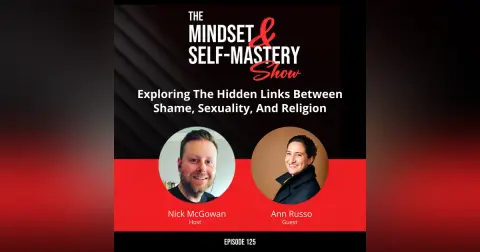
Shame, Sexuality, And Religion With Ann Russo


“We focus on queer community, non-monogamy, sexual health, and sexual positivity.”
In this episode, Nick speaks with Ann Russo, a psychotherapist and entrepreneur, about her work with diverse communities and her experience with religious shame and sexuality. They discuss the intersection of religion and LGBTQ+ issues, the harm caused by religious shame, and the importance of understanding different perspectives. Listen in as they unpack the impact of shame and the importance of empathy and communication in healing from trauma, as well as explore the intersection of sexual orientation and religiosity and the struggle faced by individuals who experience shame in these areas.
What to listen for:
- Religious shame and the rejection of LGBTQ+ individuals by some Christian communities can lead to higher rates of mental health issues and other challenges.
- Exploring childhood experiences and the messages received during that time can help uncover the roots of shame.
- Understanding the historical context of the Bible and the role of the church in shaping religious beliefs can help challenge harmful interpretations and promote empathy.
- The importance of conversations and empathy when addressing sexual shame and promoting understanding between different perspectives.
- How Shame can manifest in various ways and is often accompanied by anger, guilt, and denial. It is important to identify and understand the underlying emotions.
“I’ve always gone into spaces that might seem a little strange or intimidating to other people… I just allow myself to be in these spaces as long as people invite me into those spaces. I’m totally there to like, experience their life and what’s going on rather than have presuppositions.”
- Willingness to explore unfamiliar or intimidating spaces without preconceived notions is extremely beneficial to understanding ourselves and others
- By emphasizing with our intention to understand others’ lives and experiences, we can show empathy and respect toward those we connect with
- Exploring a willingness to embrace new opportunities for personal growth and understanding
- Understanding the desire to experience life as it is, without presuppositions, we can explore our own authenticity
“It’s a terrible feeling when you know that people really are trying their best… But you’re the only one that can make it better.”
- Despite recognizing others’ efforts, we can acknowledge that ultimately, we are responsible for improving our own circumstances.
- The importance of personal accountability and introspection in fostering positive change.
- How resilience plays into our learning and attempts to make life better
- People are trying their best, it is possible for us to understand and empathize with others’ struggles.
About Ann Russo
Ann specializes in LGBTQ+ issues, with a unique background in theology, ethical non-monogamy and mental health (she got her Masters Degree in Theology). She combines personal experience with professional expertise to provide accessible mental health care though her business AMR. She has done speaking engagements and has been hired to train and educate various groups on these topics, including hospitals, clergy, and other therapists.
- https://www.amrtherapy.com/
- https://www.linkedin.com/in/annrussolcsw/
- https://www.instagram.com/amr_therapy/
Resources:
Check out other conversations where we discuss shame and religiosity
- Ep.74 with Dawn DiMicco: “Your Faith Doesn’t Make Your Sexuality Wrong”
- Ep.116 with J.K. Emezi: “How To Stop Struggling With Secret Compulsions And Not Let Your Porn Habit Define You”
Interested in starting your own podcast or need help with one you already have? Send Nick an email or schedule a time to discuss your podcast today!
nick@themindsetandselfmasteryshow.com
Thank you for listening!
Please subscribe on iTunes and give us a 5-Star review! https://podcasts.apple.com/us/podcast/the-mindset-and-self-mastery-show/id1604262089
Watch Clips and highlights: www.youtube.com/channel/UCk1tCM7KTe3hrq_-UAa6GHA
Guest Inquiries right here: podcasts@themindsetandselfmasteryshow.com
Your Friends at “The Mindset & Self-Mastery Show”
Nick McGowan (00:01.714)
Hello and welcome to the Mindset and Self Mastery Show. I’m your host, Nick McGowan and today on the show I have Anne Russo. Anne, how you doing today?
Ann Russo (00:11.918)
Great, Nick, how are you?
Nick McGowan (00:14.002)
I’m good, I’m glad that you’re here. We were shooting the ship before we hit record and it’s kind of classic for me. I get further into this and I’m like, man, I just got to hit record. We need to just do the damn thing. So why don’t you start us off? Tell us what you do for a living and what’s one thing that most people don’t know about you that’s maybe a little odd or bizarre.
Ann Russo (00:32.206)
So I am a psychotherapist and I am a small private practice business owner. We’re actually online and we were online before COVID. So I was building a platform of diverse therapists to offer access barriers to care, finances, things like that, just trying to get rid of all of that.
And we focus on queer community, we focus on non -monogamy, we focus on sexual health, sexual positivity. So I run that over here. And then my other hat is I work with people working on religious shame and sexuality, because I have a master’s in theology as well. So I use that intersection. And I’m writing CE courses right now, Continuing Education for Mental Health Providers to…
talk about things that don’t normally get talked about like non -monogamy and religious intersection with queerness. And on top of that, I’m also the proud mom of a little doggie. And that’s what I do for work. And it’s awesome.
Nick McGowan (01:41.298)
That is awesome. I mean, everybody that’s listening, you can tell why I was just shooting the ship before we hit record. Plus, there’s there’s an immense amount of stuff that we want to get into that.
Ann Russo (01:42.062)
Yeah.
Nick McGowan (01:53.426)
the shame, even therapy, the length of time to get into therapy, all of that sort of stuff. But before we get into that, what’s that thing that most people don’t know about you that’s a little odd or bizarre?
Ann Russo (02:05.422)
There’s so many things. I would say, yeah, the strangest thing about me is I really love learning about people. So I’ve always gone into spaces that might seem a little strange or intimidating to other people. So I’ve spent time in brothels in Nevada, hanging out with the sex workers.
Nick McGowan (02:07.346)
Pick the strangest.
Ann Russo (02:31.63)
I’ve gone to a lot of different like sex clubs and hung out, Dominatrix, BDSM, Bear Week with queer guys. Like I’m just kind of just allow myself just to be in these spaces as long as people invite me into those spaces. I’m totally there to like experience their life and what’s going on rather than have presuppositions.
I even spent a lot of time in an evangelical church and went on a missions trip to Europe. A lot of people don’t know that about me, but yes.
Nick McGowan (03:06.322)
it to jump from one piece of that sentence to the other piece of that sentence is a large jump.
Ann Russo (03:09.71)
Yeah, I was at a club and then an admission area trip. Yeah. Yeah.
Nick McGowan (03:16.626)
Hey, but you know, some people are PKs, they’re pastors kids and they’ve done the same thing potentially in the same day. So I get it. Um, God, where, where to start with this stuff? Um, there’s, there’s a lot of, um, there’s a lot of similarities and, you know, truthfully, I look for the similarities when guests come through and they suggest that, Hey, I want to be on the show or whatever. And we do our own research. I really look for people that are.
Ann Russo (03:21.198)
Yeah, exactly. Yeah, yes. All about learning.
Ann Russo (03:30.19)
I’m sorry.
Nick McGowan (03:46.322)
vastly diverse, but also to see if there are any sort of similarities because then it’s an easy way to kind of start the conversation and kind of go from there. So everybody listening, give me a little bit of the background here. But there’s stuff that you’ve pointed out that I really think a lot of us have gone through, especially in this country, the amount of religious shame that we’ve had, the amount of sexuality being held back, we’re told that they’re wrong.
or not being able to experience it, or having things that were additionally shamed on top of that, like being molested or raped or anything that was sexual abuse and then still being part of the religious system. And I’ve experienced all of that. You’ve mentioned about being on mission trips. I’ve gone to Russia a handful of times. Well, you know, 10, 12 years ago, something like that. Did some great things.
I thought were great things helping orphanages and building some playgrounds, rebuilding floors and just helping these kids that just wanted to be loved. But then also being shamed about different things. And going through the experience of molestation as a child and being Catholic and all that sort of stuff. Now I know that your background is a bit of a, you were raised in a queer household, right?
Ann Russo (05:00.942)
Yes.
Ann Russo (05:05.998)
I was raised in a household with my father, his partner, my mother, and my younger sister. We lived altogether fairly harmoniously, I would say, until I was 14. Then at that point, I went to live with my dad and his partner, my sister, and then eventually with my mom. It was definitely a unique household.
During that time, it was like the 80s, you know, the 90s, that was a big time around the like religious right, religious fundamentalism, very anti LGBTQ at that time. And so I was always receiving this information about how the church hates us or Christianity hates us, you know, and, and I was so curious as to what that meant. Why did they hate us? And that’s actually what propelled me to like join a fundamentalist church.
Nick McGowan (05:43.538)
Mm -hmm.
Nick McGowan (05:58.034)
Yeah.
Nick McGowan (06:04.658)
So go on. That’s just, you’re kind of dangling it there at that point.
Ann Russo (06:05.966)
Yeah.
Ann Russo (06:11.054)
Yeah, so I joined a fundamentals church right out of high school. It was a cool church, nice people. They’d never really been exposed to gay people and they had a very small idea of what it meant to be a gay person, that it was all about sex, drugs, and rock and roll.
And so I kind of came in there and I was like, no, this is not all about sex, drugs and rock and roll. I’m a queer person. They invited me into their church and I really learned a lot about their theology and their belief system. And I went on a missions trip. I was really a believer in the idea of God, absolutely something more powerful than myself, but I could never really get down with the teachings.
So I felt like if this is people are telling me that I’m going to hell or they’re telling other people that they’re going to hell, this is so important to them. I need to understand what’s going on. So I got my bachelor’s in religious studies. And then from there, I went on to get my master’s in theology. Look, Nick, these were important questions. I don’t think people take it. So, you know, it’s like you’re telling someone that they’re going to spend eternity in hell and you’re receiving a message that you’re going to spend eternity in hell. Like,
Nick McGowan (07:24.722)
Yeah.
Nick McGowan (07:30.482)
to date.
Ann Russo (07:36.814)
Don’t you want to do a little more investigation around that? You know what I mean? So I investigated away for about 12 years and I have landed in a space of understanding that perspective, knowing where it comes from. But then I have a lot of the historical biblical pieces that a lot of these fundamentals folks simply just don’t have or maybe you’ve never really thought about.
Nick McGowan (07:40.53)
Hmm. Yeah.
Ann Russo (08:04.686)
So I’m able to use that at the right time to help my clients and also to communicate with the parents or the family that is having a hard time accepting. I can come at it in a way that’s very loving and understanding to their position and honoring their faith. It’s a tough road, you know, but…
But I’m confident that the more exposure and the more conversations and the less anger, we can get to a place of understanding.
Nick McGowan (08:44.722)
I love that you did a little bit of research.
Ann Russo (08:47.662)
Just a touch. Yeah, just, you know. Yeah, just.
Nick McGowan (08:49.394)
12 years, I mean, just a little bit. And you posing that question of, don’t you want to do some research with it? Um, I think for the most part, people feel some of that. Now we’re all different and we’re unique people. And some of us are more of the researcher types of people that really want to dive in. I think there are also times where people are asked a question and maybe it just didn’t land, but
on a Tuesday at two o ‘clock in the afternoon after all these other things hit, maybe it really lands and it could just be that timing. And I find it really interesting how that timing worked for you. But then also coupled with you’re the researcher type, you want it to actually go down and you want to find that out because it meant more to you. Like on the surface level, if somebody says you’re going to go to hell, you sinner, you’re going to die. People will be like, okay, whatever. Then just kind of move along like whatever. I’m just not going to listen. And that’s the end of it.
where they might think, really, is that a thing? Like, is that really gonna happen? And then I think the worst part of that is where people can just be like, well, this is just what we do. This is how it is. This is just what it is. And to be able to question those things, I really think this is where this episode needs to go because I’ve experienced that sort of stuff as well. I spent about 10 years, let’s say, better part of 10 years playing lead guitar in different worship bands in non -denominational churches.
Ann Russo (10:12.974)
Mm -hmm.
Nick McGowan (10:14.002)
being there for all of it, all the creasters, the Christmas Easter people, all the people that would come in that really needed some help and that were shamed and like the people that would try not to shame. But then there would be even times like I would get shamed about shit for literally saying the word shit or telling somebody I always smoke pot doing this, doing that. They’d be like, Oh, I can’t believe Jesus did. And I’m like, are you fucking kidding me? Like, let’s think about that for a minute. Jesus braided a rip, a whip in the middle of.
Ann Russo (10:28.206)
Sure.
Nick McGowan (10:43.89)
all these people and took his time to braid it and then went fucking bonkers to kick everybody out. And he, you don’t think he did things or said things like curse words or anything like that? Do you think he was like, Hey, all of you people, please hurry up, grab your things and get out of here gently and calmly. Of course he fucking didn’t know there was more to that. But then there’s also what happened in the 15th or 16th century when things changed in the Bible. What about the books that were omitted and
Ann Russo (10:59.118)
Totally.
Ann Russo (11:12.974)
Oh yeah.
Nick McGowan (11:13.138)
There are things of, like I think of, you know, God will speak to us in different ways. Somebody could speak to you and that could be a divine message. You can watch a movie and it’s a divine message. Reading the Bible, you can still get the thing out of it that you need. And maybe it’s not through the words, but it’s the act of and what comes to that. This is just from the little bit of research and the inquisitive things that I’ve had. So why don’t we talk about that? Let’s…
talk about the research that you’ve had, but also being able to actually get into those fundamentalist conversations or the people that are like, but this is what I’ve been raised in. I was Southern Baptist or I was whatever. And like, this is just how it is and everything needs to follow a law. And I don’t know where that law came from, but you know, here I am. I don’t want to burn.
Ann Russo (12:01.87)
for sure, and I understand that completely. So I wanna approach this with a lot of empathy and understanding because I think the one thing that we can never really argue is faith. You know, like no matter how much one studies or doesn’t study, can I ever prove or disprove the existence of God? No, I can’t. I can only look at.
Nick McGowan (12:14.482)
Hmm. Yeah.
Ann Russo (12:27.662)
what’s available to me in history to kind of deduce maybe what people’s experience of their God looked like. Not necessarily even who God is. Because how can we really even know that? We can only really know people’s experience of understanding God or something higher than themselves. So I kind of put that in its corner and I say, great, I don’t want to mess with anybody’s faith.
Nick McGowan (12:48.754)
Yeah.
Nick McGowan (12:56.402)
Mm -hmm.
Ann Russo (12:58.67)
Then when I turn the page, I go to the other side of that and I go, what does history show us? For me, what I’ve studied, history shows me that the Bible is a living document and it has books in it that were decided by a governing body, not God.
with the intent to control an empire. And some books were left out, many, many books were left out. And I think that there’s a specific narrative that they were looking for. And that’s why the books are the books that they are. And I think we could have many different Christianities depending on what books are were placed in something like a Bible. And we didn’t even have a cohesive religion until, you know, 322 when they put the book together.
And therefore to take it as the word of God and live by it is tough because there are so much contradictory messages just within the Bible itself because those books are actually written by different people. They’re coming out of different time periods, different languages. So it’s not, it can’t really be a cohesive flowing document. So I think when we’re human nature.
Nick McGowan (14:23.794)
I actually tried to read the Bible when I was younger from start to finish. And I figured this is how you read a book. It should. Oh, it was the strangest thing ever. Just totally strange. I remember I don’t know if I actually read through all of it because that was a lot, especially as like, I don’t know, I think I was like eight or nine or something like that. But I was starting to learn about and feel my intuition.
Ann Russo (14:29.582)
How did that go for you?
Nick McGowan (14:53.874)
And I could feel that there are different skills that I had, different thoughts and feelings. And I’m on the Enneagram side of my force. So I’m super feely. I feel all the things in the world. And I know that I’m, I’m, I’m very close to the void. I can kind of step on either side of that, but I started to really dive in. I remember reading the first Genesis of Adam and Eve and thinking like, this seems very fablesque. Like this is more of a story. And I remember talking to my grandparents that are
Ann Russo (15:18.702)
Mm -hmm.
Nick McGowan (15:24.082)
super Christians like war cape, basically. And they were like, this is true. This is exactly how it happened. I was like, so God peeled out a rib, and just like, I’m just gonna take your rib. And I’m gonna make a woman out of that. Like, yeah, absolutely. I was like, well, that’s strange. And I remember talking to my mom who was Catholic, and she was like, it’s all fable, but it’s all it’s supposed to have a meaning within the story. I was like, okay, cool. And then I think I skipped around and got to Revelation and my shit was fucked up at that.
Ann Russo (15:52.59)
Ha ha ha.
Nick McGowan (15:53.17)
because I remember being like, what, all of this and like picturing the heads and like all these crazy things and like going from Old Testament to New Testament and Revelation and trying to piece these things together and then learning, like there were things that were omitted and changed and understanding now that it was literally the government saying we want to control this, but it’s hard for people to separate that because it’s a systemic thing.
Ann Russo (16:15.886)
you.
Nick McGowan (16:20.69)
So how do you handle that when people come in and they’re like, I feel all this either sexual shame or just shame in me because this is how I was raised and this is, I’m trying to unpeel things from it. So how do you work with that?
Ann Russo (16:36.558)
So it’s very dependent upon whether or not the person is still a Christian. If they’re not, it really depends on where they’re at in their spiritual journey. Okay, so it’s very tailored to the individual and it also kind of like what their end goal is. Some people may say I’m trying to…
rectify these two things. I am a Christian, I’m a queer person, or I have sexual shame around this due to my religion, but I very much believe my religion, right? Or I hate my religion, this doesn’t make sense to me, and I want to move away from that. So that’s number one, because I’m going to tailor my approach to wherever they’re at. I’m not out to convince someone not to be a certain faith or to convince someone to be a faith. You know, so that’s gonna always shift my approach. So if it’s someone who…
Nick McGowan (17:23.954)
Mm -hmm.
Ann Russo (17:29.006)
let’s say still desires to be a Christian, or I would say, let’s look at, I’d like to go into Jesus. I like to look at the gospels, I like to understand, I like to look at Jesus, I like to have them tell me about where they learned the sexual shame from the Bible itself, or was that a message from their church? Like, where did that come from? You know, and kind of like start to…
peel back some of these layers and often times you’ll find that it’s really the church itself not so much the faith or Jesus, God or human, you know, whatever, however your perspective might be, right? So it’s really learning what it means to be connected to Jesus and have your spiritual experience, not your spiritual experience through a third party.
Nick McGowan (18:12.21)
Mm -hmm.
Ann Russo (18:26.318)
And this is a lot of work, Nick. I mean, it’s a lot of work, lifetimes of work for some folks.
Nick McGowan (18:26.546)
Yeah.
Nick McGowan (18:33.938)
Yeah. There’s a lot of trauma that’s heaped upon you in a sense. I think all trauma comes from your childhood, at least somewhere. There’s some genesis of that, some catalyst that happens when you were a little kid, whatever. Even if it was a great upbringing, there’s still trauma that happens with that. But within that system and being able to be part of that and have that
Ann Russo (18:55.982)
I wish.
Nick McGowan (19:01.522)
Want of I want to have that faith and we can’t be the only things here and there has to be something else but then being shamed and Told that you’re you can’t be who you really are One of the reasons why I love to be able to have people of other sexualities or gender fluid on the show is Because I don’t actually understand that from my perspective like I I want to understand that but I’ve never gone through
coming out of the closet and saying, well, this is who I am and this is how I am. I’ve asked myself and I’ve tried to see like, am I this way or am I different? And how does that relate to how I’ve been raised? But I’m not, so I can’t ever really experience that. So I couldn’t imagine what that would be like having those really difficult questions and then being told you can’t be you on a deeper level than like,
I was told, yeah, you have to get a job. You can’t be a rock star. And I was like, all right, well, fuck you, mom and dad. Let me go try something different, you know? But that’s different than being like, you can’t love the way that you love. And love is the core component of all this. Oh, and by the way, God is love, but not in that way. Like, are you fucking kidding me?
Ann Russo (20:17.006)
totally and I think that it comes down to a complete misunderstanding of what sexual orientation is. Through my experiences with the church and through my experience of working with many fundamentals Christian people,
Their arguments tend to line up that being gay is harmful. It creates a situation in which the studies do show like if you are a gay person have higher issues with suicide, mental health, drug use, sex abuse, but you know, like the litany, right? So these particular types of Christians will point to that research and say it’s because you’re gay.
Nick McGowan (20:57.234)
Sure.
Ann Russo (21:06.062)
But if you look closer at the research, it’s based in rejection. It’s not based on the sexual orientation itself. So while you think that you’re saving your child, for example, from a particular lifestyle, you’re actually creating the harm that could push them down the road to be one of those statistics. And I think that that’s really tragic because they don’t have the ability to really talk.
Nick McGowan (21:29.042)
Yeah.
Ann Russo (21:35.662)
deeply about what they’re feeling as the Christian who’s all of a sudden, my child has come out as gay, I don’t believe in this, I don’t want this for them. Someone like me who’s worked with folks like that, I can kind of stomach that and I can talk to them and talk through it and understand where they’re coming from. But I know that it’s gay folks in general are probably pretty damn tired of having to defend themselves, you know, against…
the Christian rhetoric. So I think that’s where someone like me can kind of step in and go, okay, let’s talk deeper. What’s going on here? What are the fears? Let’s discuss it. Let’s discuss the Bible. Let’s discuss Jesus. Let’s discuss what it actually means to be queer versus what you think it means to be queer. I remember when I went on the missions trip, I…
It took a bunch of the, we were in London and I was like scouting the scene during the day and I was like, oh, this is the gay section. That was, you know, the area where they wanted to pray for everybody. And I’m like, all right, I’m going to come back here later and go dancing. Well, some of the folks that were on the trip wanted to go with me out. I didn’t say where I was going, but I said, I was, you know, I’m going to go out and I’m like, okay, these folks go to a Christian university where they’re not even allowed to dance. Yeah. So.
Nick McGowan (22:45.49)
You
Ann Russo (23:03.278)
they ended up coming with me and I’m like, okay, I’m gonna go to the bar and like, they started to kind of dance. And I was just like, what’s happening to you because you’re dancing? Are you no longer a Christian? Do you no longer have faith in God? Like, I don’t understand, like how is devoiding yourself of any kind of joy anti -God? Don’t get it, right? Yeah.
Nick McGowan (23:13.682)
Yeah.
Nick McGowan (23:28.338)
control right you know like back to the I sometimes think about almost like the the comical personifying of situations like there was somebody back in the 15th century it was like these people are just fucking everybody and they’re just doing all these things and drinking all the things and putting all the shit in their systems and I’ve had enough of it is that because you’re not getting laid yes but fuck off
Ann Russo (23:53.038)
Yes!
Nick McGowan (23:54.13)
No, like, all right. Well, I was, um, you know, we need to change the way that this Bible reads. So it needs to be different. And like, what were those conversations? Yeah.
Ann Russo (24:01.134)
What’s what happened with priests and marriage? That’s exactly what happened. Like priests were allowed to get married, but the church didn’t like that the land was going to the family when the priest passed away. So then they said, no, priests can no longer be married. So that’s not a dog thing.
Nick McGowan (24:16.978)
Wasn’t there also something about marriages? Yeah. Didn’t they, weren’t early Christians anti -marriage?
And then they’re like, you guys just keep fucking each other, so you may as well just get married.
Ann Russo (24:27.533)
I don’t.
Yeah, I mean, we could go into a lot of debate around marriage in the first century for sure. But I don’t personally believe they were anti -marriage. Yeah.
Nick McGowan (24:37.234)
Yeah, yeah.
Nick McGowan (24:45.074)
Interesting. Okay, cool. I just I find it so interesting that there there are things that happen that then just become tradition, let’s say, like even within the family system, like everybody gets together on a Sunday and they have family dinner, they do the Thanksgiving thing, those are traditions, but some of that’s also based on historical and generational trauma. And you just call it tradition.
Ann Russo (24:55.598)
is.
Ann Russo (25:09.454)
Yes. Yes.
Nick McGowan (25:10.962)
And then you shame people around it. So same deal with all of this stuff where it’s you’re being shamed about that. Something you brought up that made me think of the systems thing too is how they’re like, well, if people are gay, there’s a higher percent that they’ll kill themselves or they’ll have drug use and all of that. That’s just like saying that people that are in really, really bad neighborhoods that aren’t given the resources to be able to not be a bad neighborhood, that they’re just going to kill everybody. Number show that this happens. You’re like, yes, it does.
but you need to look deeper.
Ann Russo (25:41.134)
Yes, yes, why is this happening?
Nick McGowan (25:43.89)
Yeah. Instead of going, look, they’re killing everybody. But yes, why? Give them the fucking resources to live or help them.
Ann Russo (25:49.006)
Yeah, exactly. And you know, it’s I think the best way to explain it to people, maybe, you know, like you’re talking about like being in the shoes of, you know, someone who’s gay, obviously, you’re not going to be able to be in those shoes. But just imagine like your innate sexual orientation is wrong. Like from, you know, because you you you know, like what you’re attracted to.
Imagine if you were told that that was not okay and you don’t, I mean, you don’t even know why, you just are who you are, right? And you just can’t be, and you have to hide it. And the whole world is telling you that that is not what’s normal, right? I mean, it’s easier now, I think it’s gotten better, but what a very difficult position and a painful position to be in. I was lucky in the sense that I wasn’t raised in the church, right? But for those that were raised in those situations, I really…
Nick McGowan (26:33.426)
Yeah.
Ann Russo (26:49.326)
I really feel for them. I have a lot of empathy for that struggle.
Nick McGowan (26:54.034)
Yeah, yeah, I, again, I brought up pastors kids, the saying is that they’re just crazy. There’s a, they just go kind of bonkers with things. I’ve witnessed it. I’ve partied with some of them, you know, because they were, I was like, cool, I can actually show my true colors here. Instead of just being the dude, the church that’s up on stage doing the things. And then it’s wild with all of that stuff and those system problems that then.
Ann Russo (27:14.286)
Yes.
Nick McGowan (27:23.09)
And it’s interesting. I appreciate that you brought up, like, what would that be like if I was told that how I feel and my sexuality was wrong? The part of the reason why I have diverse guests on the show is to make sure that they’re being heard and that their voice is out there. But I’ve also really understood that I was part of that patriarchy of it. Like I’m, I’m a very, very
I’m a five foot 10 average build white man who is straight and lives in America. So for the, for the most part, the world from my eyes as a little kid was built for me. And then seeing that things weren’t like that, um, it was just, it’s wild to experience that. And I wish that more people could empathize and try to understand, but.
It’s hard to do that. Or at least I think it’s hard to do that for people when they’re in such a system or they’re in such a groove, but this is how I’ve been told that this is. And if you fuck with that, you truly fuck with what’s at the core of their being. And the question I’m asked different times with other people that I’m coaching or just talking to, or even here on the show where they’re like, but what if I have to change everything? Like, yeah, what if you want to keep going down this path or do you want to.
Ann Russo (28:45.806)
Thank you.
Nick McGowan (28:48.53)
You want to actually live the truth of that. So what if, but that is, that’s like a cartoon where like they swallow that pill and you see it pop out their neck, you know, cause they’re like, goop.
Ann Russo (28:56.078)
Cheers!
Oh yeah.
You know, I even carry the empathy for the folks that this country was built for, as you described earlier, because how scary to start to have to question that reality too. Wait a minute, this isn’t other people’s experience. If that’s not other people’s experience, does that mean my experience is going to get worse if their experience gets better? Do I carry what because of their experience?
Nick McGowan (29:28.146)
Hmm.
Ann Russo (29:30.478)
So I can empathize with the fear around that. And I think that the problem is everyone’s yelling at each other, you know, rather than like trying to say, okay, well, what’s it like? What are the pressures that you’re feeling on your side? And I know not everybody’s ready to have those kinds of conversations, but we kind of have to have.
And we can’t yell at each other. People are trying and I think the yelling can come in all directions. You know what I mean? We can’t be afraid to speak and be authentic and share our experiences and try our best to empathize with other people’s experiences, even no matter what our preconceived notions might be about those experiences. And we all have them.
Nick McGowan (30:01.074)
Yeah.
Nick McGowan (30:19.506)
Yeah. Oh, it’s funny because I think of a conversation with somebody recently where I was like, well, if I say that I want to do this thing and you tell me no, or you want to do something different, I go, well, I believe I’m an intelligent human. I believe that I can make the right decision. Why, therefore, are you making the wrong decision compared to what I’m thinking? And like trying to be sort of very black and white with it. And that’s at least the step of going, OK, cool. Well, let me understand.
But each time that you said the noise, I think back to before I hit record, and none of you all knew that this was a thing, but we talked about social media. It’s just a bunch of noise when it comes to that. Like if you think of the physical realm of social media, you would be walking into a giant room where everybody’s just yelling or listing off all these top three things that you should do to do whatever the fuck you really don’t need to do or something different that’s not gonna actually help you process through your trauma or whatever.
Ann Russo (31:16.846)
Dude, so true. You know, Nick, I was never on Twitter and I was like, I better jump on Twitter. This seems to be the thing everybody’s using, you know, me and my old ass. And I go to look at it and I’m like, holy shit, people are so mean on here. Like they can somehow find an argument against.
Nick McGowan (31:18.226)
Um
Nick McGowan (31:36.018)
Yeah.
Ann Russo (31:40.814)
anything you could say my dog took a shit on the lawn and there will be people that will be able to argue that with you and try to make you be little it would make you feel horrible so i’m like i can’t play this game like this isn’t actually getting us anywhere at all like people are just like you said they’re just ranting to rant like well no one feels good about it i’ve never said someone i’ve never seen someone go you know social media has been so great for my mental health you know never no
Nick McGowan (31:47.378)
Yeah.
Nick McGowan (31:54.098)
Yeah.
Nick McGowan (32:06.93)
Yeah, I ever, ever. I mean.
Ann Russo (32:10.542)
No.
Nick McGowan (32:13.906)
trying to think if there’s anybody. And again, I had a social media marketing company for a number of years, but that the concept of social media makes sense to be able to be social. This is what I’m doing is what’s happening. And it’s not about just yelling, but it’s interesting because there’s a lot of just triggers that are being set off. Somebody’s like your dog, I don’t have a dog anymore. And they go crazy. It’s like, how the fuck were you supposed to know that? Like what doesn’t make any sense.
Ann Russo (32:38.606)
Yes, yes, yes, exactly. You’re not honoring my grief, right? Yeah, yeah.
Nick McGowan (32:44.626)
What? Yeah, I do. I have to admit, though, social media is just kind of trash. But there are certain comments on things that are just so ridiculous and so good, like so ridiculously good at times. Like I’m more on YouTube. And like I said to you, even YouTube and Pinterest, those are search engines. So people, if you’re doing anything, get off social media, promote your business through YouTube and Pinterest where it’s actually being searched and it’s an asset.
But looking at some of the comments of stuff, like I saw something the other day, like I’ll listen to binaural beats or just instrumental music while I’m working, instead of just having some metal just screaming in my head or whatever. And I was going through some of the comments of this one, just like jazz work sort of thing. And the guy was like, before I watched this video, my life was in shambles. It was terrible. After this, I’ve won three Nobel prizes.
Ann Russo (33:22.158)
Yeah.
Nick McGowan (33:43.794)
I’ve done like and rattle off like 15 ridiculous things and it’s only been three weeks. So good. I think somebody took the time to be able to think about that, pop that all out. And I hope it’s just in good humor of like, this is just the bullshit that people are just like pushing. Um, so I feel like there’s so many different avenues that we could go into and I’m glad that we started to go down or at least we’ve traveled a bit down the avenue of this. Um, let’s hone in a little bit more. We’re.
Ann Russo (33:48.782)
I’m out.
Ann Russo (34:12.398)
Sure.
Nick McGowan (34:13.586)
We’re about a half hour into this. I want to spend a little bit more time with you here, but let’s actually talk about for the people that are in the spot of the clients that you work with that have shame, that there’s so much shame that they’re unsure what to do next. Addictions brew out of shame. There’s so much stuff that comes out of that. Just speak to us a little bit about the work that you do and how you work with those people and what you’ve seen from that work.
Ann Russo (34:47.054)
It’s work. I just want to put that out right away because I think when people are experiencing shame, it takes a while to even understand that that’s the emotion that they’re experiencing because a lot of times there’s anger, there’s guilt, there’s denial, there’s so many other things going on, right? So just to hone into like, what are you actually feeling? Is it a journey within itself? Because we’re so disconnected from our feelings, you know, so.
Thinking to a specific situation, there’s a lot of shame around clients’ sexual orientation and their religiosity. So the work we’ve done first is first unpeeling the layers of like, what am I feeling?
What are some words I can use? We can start something as basic as worksheets of feelings and emotions and trying to like use those words to understand the thoughts and the feelings that are going on within somebody and that that can take a while just to be able to do that work, right? And then from that point what we’ll do is we’ll look at, okay so let’s talk about what is you’re talking about a lot of guilt around this situation. Well what does that mean?
And a lot of times we’ll kind of stumble into shame and then we’ll add. So let’s say shame about hiding my sexual orientation for my church. So they’re they’re not in a space where they’re feeling as one. You know, they’re like operating as two separate beings. Right. The gay person, the Christian person and then the shame person right here in the middle. Right. So the goal is to.
Nick McGowan (36:07.57)
Hmm.
Nick McGowan (36:21.778)
Hmm.
Ann Russo (36:33.07)
bring them all into one. So the work is really helping them explore what it means to have shame, where the shame came from. I like to dig deep into childhood because there’s so many messages that we receive in our childhood about how we’re supposed to be, what we’re supposed to be, how we’re supposed to relate to people, what our faith are supposed to be. So I do a lot of work around what’s going, what…
what you experienced in the child, who told you what as a child, where did you learn those messages from? Did those messages work for that person? So I mean, there’s a lot of work around, it encompasses the idea of shame. So it’s really just getting to know that person where they’re at and then like tailoring a plan with them to work through it. I hope that answered your question. Okay.
Nick McGowan (37:06.802)
Mm -hmm.
Nick McGowan (37:23.41)
Yeah, I, right off the bat saying that there’s a lot of work to it. There’s a lot of work to all of this. It’s so interesting. The, um, okay. I think at this point, you’re probably going to be episode one 24, one 25, something like that. So I’ve had that many conversations with people in various walks of life and different levels and layers and trauma stories and all that stuff. And there’s some major patterns that have really stood out to me.
Ann Russo (37:27.79)
Yeah.
Nick McGowan (37:52.882)
self awareness being kind of the primary one, because if you’re not aware of something, how the fuck can you do anything about anything because you’re not aware of it. But how shame shows up in different ways. And like you were saying, some people are just like, well, I’m just angry. You’re not. That’s a symptom of it. And being able to dive deeper into that and understand that and really going through all of that. But I’ve also realized on my own journey and with all the conversations, clients with
Ann Russo (37:58.062)
Totally. Totally. Yeah.
Nick McGowan (38:22.322)
all the things that there’s so much more work to do once you get into the work. Like, again, self awareness, you become self aware, then you’re self aware, and then you’re really self aware, then you’re absolutely fucking self aware. And you can’t not be self aware of things, just like you start to process something. And then you go through and you process it again, and you have to process it 15 more times on top of another hundred times. And being able to do that work isn’t for everybody.
Ann Russo (38:35.214)
Yes.
Ann Russo (38:44.366)
I’m going to go to bed.
Nick McGowan (38:51.922)
It is for everybody but not everybody has it in them to be able to do that and it’s almost like one of those situations if you’re like Well, look you want to be healed, right? Yeah, absolutely. I don’t want this anymore. Great We’re gonna need you to put in about 10 ,000 hours worth of work for this like I can’t I’m alright with my trauma And they’re just like that’s the end of that, but that’s not how this is, you know
Ann Russo (39:14.894)
No, and it’s tough too because it can be such a luxury to work on the trauma. If you’re someone who can’t have your basic needs met, or you’re working so hard to have your basic needs met, how do you even begin to unpack the trauma of your situation or your childhood? So it’s very complicated. So it…
Nick McGowan (39:21.49)
Hmm.
Ann Russo (39:42.99)
I would say that if someone’s going to start digging into these things, do it at a time in your life where other parts feel stable. Yeah. Because you don’t want to be out looking for a job, you know, moving to a new city and then you’re like, hey, I’m going to start working on my trauma. You know, like that’s not the ideal time to do that because you can feel worse before you feel better.
Nick McGowan (39:52.85)
I love that. That’s such a…
Nick McGowan (40:01.906)
Mm -hmm.
Nick McGowan (40:06.29)
Oh, you absolutely do. God, even doing certain, there’s certain subconscious processes that I’ve gone through that are like two, three hours long. And I just feel sick afterwards. There’s stuff that just moving through you and people are like, well, you know, it’s not actually a thing. It’s like there’s energy. There’s also toxins that have been broken down that are being released. There are things that have changed, but there’s still more work to do. But I’m really glad you brought up the luxury of it. There are oftentimes where I think.
Ann Russo (40:17.55)
Yeah.
Nick McGowan (40:35.986)
Like I couldn’t imagine having kids and working through the stuff that I have that I have to work through. Uh, and it makes me think of my parents. I learned a lot from my parents, mostly what not to do. Uh, and I love them for who they are and just where they’re at, whatever. Um, yeah, but there’s, there are certain pieces of like, I couldn’t imagine having to go through and do this work, be aware of it and trying to manage all these other things. But I.
Ann Russo (40:41.422)
Yes.
Ann Russo (40:46.766)
Totally. Totally. All kinds of things, right?
Nick McGowan (41:05.97)
I don’t know, and here’s where God enters stage left in a sense. I think that’s where we get to be able to look at the situation that we have with life and do the work that we can in this moment. Like anxiety will come from your future thoughts or your past thoughts. It’s never actually in the moment because the anxiety is somewhere else. But being able to do what we can do within those moments to be able to do that. Like I’ve actually taken precautions to make sure that I never have children. And
Ann Russo (41:24.782)
Yo.
Nick McGowan (41:36.018)
I’m good with that. That’s exactly where I want to be. But kids, there’s a big piece of the work that we as Chooser Calling, what we do, that we want to actually be able to help children to be able to better them. And I hope that it can ultimately help the parents. And it seems like you have some of that too, where you had said earlier that you have conversations and you can level with the parents, you can empathize. And I’m glad that you see that it can be a luxury. But how do you feel about that when you can see the struggle on?
Ann Russo (41:37.23)
Get it. Yeah.
Nick McGowan (42:05.522)
parents face and their kid or even them, they’re just trying to work through stuff.
Ann Russo (42:11.342)
fucking sucks, man. Yeah, and cut. But yeah, it’s, it’s, it’s a terrible feeling when you know that people really are trying their best. And it’s not quite reaching the other party. You know, and, and there’s, and there’s not,
Nick McGowan (42:12.786)
straight up. Alright, well, that’s the end of the episode everybody. Yeah.
Nick McGowan (42:27.346)
Hmm.
Nick McGowan (42:31.922)
Mm -hmm.
Ann Russo (42:37.87)
maybe a lot of empathy both ways or people haven’t learned how to communicate so they’re not really hearing each other either. So one of the main parts if I’m working with people, you know, whether it’s like family, couples, whomever, people coming together. Number one is communication. We have to be able to hear each other, right? And reflect back what we’re hearing with so much gets lost. I have a lot of exercises around communication and how our own perspectives can influence what we think we’re hearing. Our own traumas, our trauma puts on blurred glasses, you know, to different situations, circumstances, we get triggered. But I think one of the most important things when it comes to trauma is to know that like you didn’t do it.
But you’re the only one that can make it better.
And we can sit here all day and say you know this came from this or that and yeah like let’s have some empathy around that. This is the reason why this happened, yes. But you can’t live there because you’re the only one that can fix it and you’re the only one that’s going to suffer because of it too.
Nick McGowan (44:02.546)
heavy stuff. It’s such a difficult thing to wrap our heads around of, yes, that thing happened and I have to do something with it, but how do you do something with it when you’re still hurting from it? And again, maybe I feel a lot more or differently or whatever. And I also know that there are people that are out there that are just like me, people that are just like you and people that experience it differently. But I don’t think any of us should do what…
Ann Russo (44:03.502)
Yeah.
Nick McGowan (44:30.962)
What we were basically taught in the 80s and 90s of just put fucking dirt on it, get back in the game. Um, actually need to work through it. But so along those lines, uh, what sort of advice would you give to somebody on their path towards self mastery?
Ann Russo (44:35.246)
Yeah.
Ann Russo (44:46.51)
Be kind to yourself. Working with clients, I have more clients beating themselves up for where they think they should be, at what point and when and how come. Notice your language and notice how you’re speaking to yourself. Are you beating yourself up all day with your thoughts? I feel like I’m doing a commercial. Are you beating yourself up all day with your thoughts? But seriously, yeah, right? Like, but seriously, like we don’t notice how we’re talking.
Nick McGowan (45:08.818)
This is supported by Anne Russo.
Ann Russo (45:15.886)
ourselves. Oh stupid I can’t believe I did that. Why? You know like people have this monologue all day long. You might be surprised at how negative it is. So I’d say self mastery is know how you’re speaking to yourself, catch yourself, and try to change that around. Whether or not you even believe the positive right now is not the point. It’s creating new new neural pathways that will eventually start to feel like those things are the truth.
Nick McGowan (45:25.842)
Mm -hmm.
Ann Russo (45:46.254)
have empathy towards yourself in this process. You’re here on this earth for a short time, a long time, whatever, but this is the journey. You’re never going to get to the end. There’s not like the end, oh, I did it, I mastered it. That’s not gonna happen. Just see it as a journey and not a destination.
Nick McGowan (45:58.386)
Mm -hmm.
the
Nick McGowan (46:06.738)
Absolutely. That’s a great way to be able to put it. Even with self mastery, there have been different people that have told me it’s not a destination. It’s a journey. And it’s interesting when that’s brought up. It’s like, yeah, I believe that. I don’t consider this a thing. Like we’re not getting there. But for us as individuals to put our kind of flag in the ground and be like, this is what I believe. I’m so glad that that you’ve pointed out the journey of it, because it is truly the journey. And we can only do what we can do today.
Ann Russo (46:16.334)
Totally.
Ann Russo (46:32.558)
Thanks.
Nick McGowan (46:36.53)
We can’t worry about tomorrow. Tomorrow’s got its own problems. You can’t do a damn thing about what happened in the past. You can do something with it today and just enjoy. So, and I really appreciate you being on. Excuse me. Before I let you go, where can people find you and where can they connect with you?
Ann Russo (46:47.758)
in it.
Ann Russo (46:51.886)
So if they want to connect with me, they can go to, they can actually just email me at annannatamrtherapy .com. That’s my email. Just put in mindset in the headliner there. I’ll know where you found me. And I also have a great team of therapists at AMR Therapy too. So, you know, we’re here to support 100%. But yeah, email me, hit me up. Let me know what I can do for you.
Nick McGowan (47:19.314)
Awesome. Again, it’s been a pleasure to have you on. I appreciate your time.
Ann Russo (47:23.214)
Thanks. Thank you, Nick. Enjoyed it myself as well.