Strategies For Survival And Growth With Jimi Okubanjo
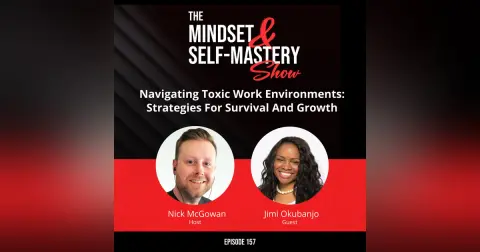


“You cannot pour from an empty jug. Taking care of yourself first is not selfish; it’s survival.”
In this episode, Nick speaks with Jimi Okubanjo, who shares her journey from the corporate world to becoming an advocate for BIPOC and women professionals. She discusses the challenges faced in the workplace, particularly regarding gender dynamics and mental health. They discuss the importance of self-awareness, compassion, and understanding generational perspectives on gender roles and the need for boundaries in professional settings, ultimately advocating for a more inclusive and supportive work environment.
What to listen for:
- Self-awareness is crucial in understanding one’s needs and boundaries.
- Mental health challenges are prevalent in professional environments.
- Compassion is essential when dealing with difficult interpersonal dynamics.
- Navigating workplace conflicts requires understanding and strategic thinking.
- Generational trauma affects how individuals perceive and react to gender roles.
- Creating supportive networks can help individuals escape toxic work environments. Compassion is essential, even for those who may dislike you.
- You cannot help others if you are not taking care of yourself.
“Self-compassion is recognizing your mistakes without letting them defeat you.”
- Acknowledge them without attaching your worth to them.
- Instead of self-criticism, see mistakes as learning opportunities.
- Self-compassion strengthens your ability to bounce back.
- It’s okay to stumble; it doesn’t mean you’ve failed completely.
- Treat yourself as you would a friend who made the same mistake.
“Self-compassion means saying, ‘This isn’t my fault,’ and giving yourself the space to heal.”
- Recognize when things are beyond your control.
- Give yourself time and grace to process and recover.
- Focus on what’s next, not what went wrong.
- Let go of guilt that isn’t serving you.
- Healing starts with treating yourself gently and with love.
About Jimi Okubanjo
Jimi Okubanjo is the founder of Arise Firebird Impactive and producer of ARISE FIREBIRD documentary. As a speaker and advocate, Jimi empowers high-achieving professionals—especially those from BIPOC and LGBTQ+ communities—by sharing strategies for building adaptive resilience, self-compassion, and career longevity in challenging environments. Her work, including her TEDx talk on workplace trauma, inspires others to find purpose and fulfillment despite systemic obstacles.
Resources:
Interested in starting your own podcast or need help with one you already have? Send Nick an email or schedule a time to discuss your podcast today! Nick@themindsetandselfmasteryshow.com
Thank you for listening!
Please subscribe on iTunes and give us a 5-Star review! https://podcasts.apple.com/us/podcast/the-mindset-and-self-mastery-show/id1604262089
Listen to other episodes here: https://themindsetandselfmasteryshow.com/
Watch Clips and highlights: www.youtube.com/channel/UCk1tCM7KTe3hrq_-UAa6GHA
Guest Inquiries right here: podcasts@infochooseyourcalling-com
Your Friends at “The Mindset & Self-Mastery Show”
Nick (00:01.421)
Hello and welcome to the mindset and self mastery show. I’m your host Nick McGowan today on the show We have Jimi Okubanjo Jimi. How you doing today?
Jimi Okubanjo (00:14.103)
I’m doing okay, Nick. I’m really good. Keeping out of trouble.
Nick (00:17.685)
That’s good. That’s the second time you’ve said that to me. So I wonder how much trouble you get into or that’s just kind of an easy thing for you to go to. Like, do you hang up at the end of this and like go out and destroy property? Is that what you mean?
Jimi Okubanjo (00:32.19)
This is being recorded, so I can’t really give you that kind of answer.
Nick (00:34.829)
I didn’t mean to try to incriminate you on that one. We could cut it in post, you know, then again, I could also just blast it through the interwebs and all over YouTube and all that. So why don’t you kick us off? Why don’t you tell us what you do for a living and what’s one thing most people don’t know about you that’s maybe a little odd or bizarre.
Jimi Okubanjo (00:53.519)
Okay, so I’m Jimmy Okubanjo. I’m the director, producer of a documentary called Arise Firebird, why women and BIPOC professionals are exiting the corporate world. I am also the CEO founder of the Arise Firebird Impactive and our vision to help traditionally overlooked professionals stay in their careers longer, even if their companies can’t or won’t currently change. But before that, I worked in management consulting in operations management engineering.
20 plus years. And something that people don’t really know about me is I am an introvert. I’m highly introverted, even though I am a talkative. I’m also a highly talkative person, but I do actually need an incredibly large amount of time to be by myself. And that could be like a weeks or months of just not seeing anybody and I’ll be okay with that.
And that kind of leads on to the fact that I’m very, very insecure and shy around people in person. If we’re not talking about work, if we’re talking about what I do, then I can talk about work, but anything really outside of that, it becomes quite difficult for me to function.
Nick (01:54.54)
Hmm.
Nick (02:06.572)
Well, I appreciate you kicking things off like that. mean, there are several different ways we can go with this and what a great level of awareness that I’m sure you didn’t have maybe a handful of years ago, 15, 20 years ago, but you can look and you can be mindful of it. You know, there are a lot of people that think, well, maybe I should be extroverted because the people I’m with or the situations are in or even being in a job.
where you’re like, seems like the people that are extroverted get more or they get further ahead. But for you to be honest with yourself and understand like sometimes I just need time away. You joked a little bit about that, because this is the last call of yours for the day. We’re in different countries. And I am, I’m kind of there with you. I’m an extrovert, but introverted as well. And I’ve figured out that more so over the course of time, I don’t need 800 billion friends like I thought I did when I was younger. In fact, that’s…
That cluster is so much smaller because oftentimes I’m good with just like everybody leaving the fuck alone. Let me do my own thing. But it takes a level of awareness to get to that point to understand that. And for you to be able to then couple that with what you do and the people that you work with to be able to stand up for them. I’m kind of assuming here, but I’m sure that takes a lot of strength and a lot of courage and also a lot of downtime to recharge your batteries.
There’s probably a lot of times where you go from thing to thing to thing to thing to thing and by the end of it you’re just lying on your back on the ground like, the fuck, let me just breathe for a minute. So I’d love to know how you got started with all of this because you said you were in management consulting. I would assume that some of this started from you just seeing things that were going on and kind of taking a stand, but there had to have been a journey with yourself to go through this to then also understand.
Not only is there the opportunity and the responsibility to do this, but you got to step outside of your comfort zone and big ways to be able to do this.
Jimi Okubanjo (04:03.055)
I think for me, Nick, I don’t really think I had a choice. I kind of felt into this work. I was never someone who advocated, was a big advocator or the way I saw it as I came up through my career, I wasn’t a troublemaker. I wasn’t one of those people who just, you know, were looking for excuses not to get their work done and agitating about wanting better things, you know. In essence, I was an ass. But I was a
able to progress in my career. And so I could just get on with the business of business. But at the same time, it took a lot to rise to where I got to as a consultant. But I just assumed that came with the territory. And eventually, when I got into the upper levels of management, it would be worth it. Somehow, it kind of all would click together.
And so I focused on the work. It didn’t really click together. I think as I got more, as I got more, quote unquote, competent, and I understood more about the technical work of consulting, I found that less and less people took me seriously. Believe, just recently on Sunday, a few days ago, I had a conversation in my area of expertise with somebody.
a lot less experienced than me. And he was, through humor, was probably the most abusive and problematic conversation I’ve had all year. it’s, it’s, I was volunteering with a nonprofit and I actually had to step away from that volunteering role because this person has been so difficult.
Nick (05:55.049)
Hmm.
Jimi Okubanjo (05:58.589)
and continues to be and goes on and it’s just quite quite an interesting experience. because in that conversation, I became quite aware in talking with him, nothing I was going to say was going to make him accept with it. I actually had to and this is on Sunday, I have to now work with another senior leader. The only difference was he was a man, he had no experience in the topic at all. To now basically be the go between.
you know, like the high school, know, Kelly, can you find it if Jeffrey likes me? So Kelly will check Jeffrey’s friend Gordon if he likes me and then that kind of thing for him to finally kind of back off and give some concessions. And he did with a whole bunch of things. So that’s still very much alive today. And it was very frustrating. I, but I, I, unlike, you know, when I was in the corporate world, I recognized I can recognize that for what that is.
This
Nick (07:06.269)
Yeah.
Jimi Okubanjo (07:25.991)
This was what my career was. And I just continued to fight through that as it being normal. But I got to a point where I couldn’t do that every single day. And I didn’t understand. I thought it was my fault. I had to keep going back. I realized how could I reframe this? How could I, how could I reframe this? How could I say this differently? And it got to a point where I ended up, I ended up feeling so
devastated with myself because I really believed I had failed because I couldn’t get him to understand what I was saying. It’s a different, this is years ago when I worked in industry that I felt I was a failure. I felt that I was human garbage. I felt that I had a life that was not worth living and I felt that I was truly incompetent. And some time after that, I left the corporate world and with no plan of what I was going to do next, but knowing I had nothing to contribute.
because of people like the guy, the person, the man I was working with on Sunday. And the messaging all around me was, you you’ve got to find a way to build a bridge, to extend the olive branch, to be, to know, you’ve got to figure out all the advice about what I need to do. There was very little discussion about, you know, just some people, there’s nothing you’re going to be able to do.
Nick (08:52.189)
Yeah.
Jimi Okubanjo (08:52.829)
to get them to come on side with you. And you have to figure out how you’re gonna work with them being who they are and build a strategy around who they are. And that reality may be, know, to accept that, to eat around it. You you don’t wanna eat this cream spinach, just eat around it or don’t eat it or, but they know you’ve got to find a way to get this person on side and get this guy to like you. And that’s just not always possible or healthy.
Nick (09:13.202)
the
Nick (09:21.388)
yeah, I’m glad the healthy side of it too. Like it sucks that people don’t also just add in or just set a boundary because some people have their own fucking problems that they can’t get through to then be able to listen to you. And for you to stop working at that nonprofit because of that, that sucks. There are other people you could be helping, but good on you for setting a boundary to be able to step aside from that. That idea of
Jimi Okubanjo (09:23.051)
Nick (09:47.613)
the olive branch or the bridge or whatever, like in theory, cool, got it. But for the most part, people are people and they’re gonna work through the things that they’re not gonna listen to or whatever. And you have to be able to set a boundary with yourself to go, well, you’re clearly, you don’t want this and you don’t want any parts of this. So I’m gonna step out now and that’s it. And that sucks that they’re still that thing where men specifically, and this is coming from a man who will not listen to women.
because of bullshit systems and things that are in their head or what they’ve been taught or what they’ve even seen at home growing up or what they’ve seen with other leaders. Like here we are, I don’t know how old you are and I’m not gonna be one of those dudes that’s like, how old are you? I’m 40 years old and I think of the people that are 40 and maybe right around the 40, 35, 45ish, something like that.
We have our generation of people that we are leaders, but they’re still the leaders that are before our time that are still in corporate America. They’re still in the business that they’ve run since the 70s or whatever it is. And I hope that our generation starts to change a lot of this. But I don’t know if that’s the case.
Jimi Okubanjo (11:04.049)
I’m gonna hate, hate disappoint you. The leader I’m talking about is probably in that younger generation you’re talking about. And a lot of the examples I’m running into are from that quote unquote millennials are very, even on the younger side of millennials. I run the conversations with young men and young women.
Nick (11:12.241)
Prime example. Shit.
Jimi Okubanjo (11:31.645)
that are even Gen Zs that are very, very, you know, very, very constrained because a lot of it is from our, I think a lot of it starts from home and from what we see. A lot of the messaging, whether we like it or not, we look at television, we look at cartoons, well, you know, it’s just a cartoon, yeah, but a lot of them, the roles are very defined. You know, there’s there’s something in, in what’s admirable for girls, what’s admirable for boys to watch in it.
Nick (11:52.486)
Mm-hmm.
Jimi Okubanjo (12:01.453)
It all comes, there’s a lot of unspokenness in this, but a lot of it is still spoken. It’s still set around the date. These things are still set around the dining table. I was having a chat with a young member of my family, and I asked him, and he was in his early 20s, I mean, very early 20s, would you ever date a woman who earned more than you? And he said that, no, he wouldn’t.
Nick (12:27.473)
Why? Why?
Jimi Okubanjo (12:28.253)
but no, okay. You know, unfortunately, because we’re related, could like, you know, force him to listen to me for example, 15 whole minutes, give him some context and you know, what that could mean, but he was like, you just feel weird about it, you know, or would you want to be the woman who has more education? So this is still, so I think the conversation around for younger men is, I think that.
is still quite embryonic in the sense of we still really need to start having that targeting the commerce and you guys. Because I think they’re also suffering from this, consequences of this, because they’re not, you know, the, I had a conversation with a woman who, one of the men in her, she works in this nonprofit and one of her volunteers confided to her.
that his wife is consistently violent with him.
And he doesn’t want to report it to the police. And part of the reason is because he’s a dude. You know, he can’t, you know, that’s the cost of that. That’s also the price of being trapped in that kind of very traditional unhealthy thinking is he is really suffering physically and he is too embarrassed. It’s not, I’m oversimplifying it. So I know it’s a lot more complicated than just he’s embarrassed as a guy, but that is one of the factors.
but he doesn’t want to really say anything about what’s been going on. I think, so, I think a lot of young men really suffer from the need, the compulsive needs to prove, but I think it does feed into this space where there’s a lot less movement. I don’t think that the openness to this is growing at the same rate as it is with men and women and non-binary individuals. And, but I do think that that’s-
Jimi Okubanjo (14:31.069)
So going to your point, it’s interestingly, when I was struggling, when I was in the space of reflecting on what to do with this particular thing that happened on Sunday, it got me thinking about the work, my actual day job, and I put together a newsletter reflecting on how easy it is even to get sucked into this. And I definitely have the privilege because I run my own business. And in this particular scenario, I can opt out. But if this was my employer,
And, you know, I bought a mortgage and I’m in the main employer in town. It’s very different in terms of how you put boundaries in place. And I called a friend of mine, an old minister. So he’s in his seventies. So talk about generational. And he was like, that’s just garbage. He’s not a swearing man. But he was like, no, you can’t. That’s not right. So he was like completely. So when they got 25 year old saying, I don’t think whatever he was the 70 year old was like, and that’s why it’s not right.
And no match ever do this. don’t you know how amazing you are, Jimmy? And you should be, and you know, don’t need to, you shouldn’t waste your time with people who don’t see, don’t even just very politely, you know, just say that you’re, and he, so you think like he would be the person that would be saying, maybe you should just try and misunderstand, but he is very progressive. And he’s a, and he’s a, a, he’s a, he’s a Pentecostal minister as well. So bet you.
Nick (15:45.113)
Hmm.
Nick (15:48.506)
Yeah.
Nick (15:54.211)
Hmm
Jimi Okubanjo (15:55.701)
very traditional African descent thinking and he was like didn’t have any time for any of the things that guy was doing. I think everything short of let me speak to him and tell him exactly what’s what. So I mean I I think statistically though I think the older one gets even women the more they hold on to these unhelpful behaviors but I do think what’s helped me
Nick (16:06.976)
Yeah
Jimi Okubanjo (16:23.858)
Especially where I am now was like, I do have this gentleman in my life, this older person I can talk to that gives me perspective. He’s always, he’d been in my life for most of my career. I’d never go to him with these kinds of issues. I went to people that were unhealthy for me and they kind of consolidated me into getting stuck when I was in my corporate world. And I feel that’s a big issue for a lot of us is when we are struggling in the workplace with abuse, with bullying, with harassment.
Sometimes what keeps us stuck is the network we have, maybe really lovely people, but they may not be the network and the community we need to get out of that situation.
Nick (17:06.694)
And a lot of this is also mostly dealing with symptoms. You know, people are like, well, there’s this thing, but then we make a justification, I’ve got a mortgage, or I’ve got this and like, this would be so difficult. But if we just take a step back, and yes, it’s easier said than done, and very easy to say in the context of the conversation, taking a step back and just looking at things for what they are, and what things that happened, and being able to make a move from there.
can be empowering, can open a lot of different doors, can also help with healing. It can also truthfully just be fucking hard because there’s a lot that goes into it and we have so many different stories that we tie into and say, this is how this is. And even from the experience side, you talked about a 25 year old man and a 70 year old man. Yes, on one hand, you could think that that 70 year old man grew up in a different time. He could have been different.
That 25-year-old man grew up in a different time, with the age of information, social media, all this stuff, but at the same time…
We are sort of that product of the system we’re in, the environment that we’re in. And then the things that we kind of grasp onto. That 25 year old may be really insecure and may not know how to have conversations and could have been hurt by women in the past and is trying to then show up in a different way where that 70 year old has been through some shit. No matter what you’ve been through and how long you’ve been around, there’s stuff that you’ve…
gone through more so than other people at 70 compared to 25. And that person could have gotten really jaded or, you know, calloused by all of it or more open to it. And if we remove the religious system from it, that is a cool thing that he’s not just like, well, women should be this way. But that’s, I know, I oftentimes think about how people say, well, what would Jesus do? And for the most part, it’s not the shit that they do. It’s certainly not.
Nick (19:12.028)
I read that brand brown man would have done things a lot differently than what most people look at is a blue, blue eyed blonde haired guy. It’s not the case. He wasn’t from Boston or something. But for people to be able to look at those things and understand difference, it it shows that they’ve gone through stuff. And that 25 year old kid, we can kind of look at. Maybe it’s tough for you to be able to look at. It’s tough for a man like myself to be able to look at but we can also
see that maybe they’ve been through some stuff that doesn’t allow it to be okay for what they had done. But we can understand that humans are humans and we’re all walking along this path that is our own path. But being able to see that there’s that space that we all go through, even when I started off with this, I would love to be able to say the 40 year olds of the world, we are going to make things different. Every fucking generation thinks that, every single one.
especially in their 20s, like I remember in my 20s, I was like, we’re gonna do these awesome things. And then you go through stuff and you’re like, I don’t know, I really don’t know. And you start to work through whatever. So every generation will do that, but there’s still that perpetuation of the shit that just keeps rolling through generations. There’s a generational trauma that just keeps getting passed down. That 25 year old kid, his dad may be great, his grandfather might be an asshole. It might be the vice versa of that. Or they may all be great.
and he’s got something inside of him that is really hurting by something else. And if we’re not using our words properly, we’re not actually being honest and truthful about what’s going on, then Jimmy, you could have said anything to him and you’re right. Charlie Brown’s parents just, wow, wow, wow. And he’s not gonna hear anything because he’s not allowing himself to. But at same time, it’s not like you can grab him by the head, shake him around and go fucking get it. Like I’m trying to deal with you with logic because that’s not what he’s looking for, you know?
Jimi Okubanjo (21:05.825)
You’re absolutely correct. think I think even think going back to this gentleman from a few days ago people have a lot of their own stuff going on and And I have a lot of my own stuff going on and I’m not and we’re engaged in a world where a lot of people a lot of us are damaged whether it’s whether it’s anxiety depression or full-blown no trauma it could even be undiagnosed mental illness like schizophrenia
depression, bipolar disorder. I mean, there’s so many psychiatric diagnoses that I think the vast majority of people just rather than have a diagnosis, they just rather be, they rather not ever get, ever have anyone say, right? So we have a lot of people who are walking wounded. I think of a degree that we can’t even fathom.
Nick (22:04.829)
Everyone. I mean, I don’t know anybody that isn’t.
Jimi Okubanjo (22:10.333)
But when I think about the more severe example, so I’ll an example of electroshock therapy. It still happens. It is still something prescribed.
by psychiatrists based, these are experts, based on today’s understanding of psychiatry, under certain circumstances, it could be prescribed for someone and it’s seen as good medicine. Now, you won’t know if the person driving the car next to you on the bus next to you or your boss is undergoing that kind of treatment.
or any other kind of treatment for their mental well-being. We just don’t know. And to be honest, it’s none of our business what kind of treatment they’re going through. what I’m trying to say is there are people in this population who really do need that support and are getting it. And there are those who need it and are not getting it. And they’re also part of the population. And then we have…
different degrees of, you know, right, going back to your point about, we all have some degree of anxiety and stress and trauma all mixed in. And this is the soup, the mental health and mental wellbeing soup in which we’re integrating. someone you could be talking to, to be fair, they probably should be on antipsychotics. You just don’t know. And I don’t know and they don’t know. And so we have to work, we have to navigate this world with people who just, who aren’t.
Nick (23:33.569)
Sure.
Jimi Okubanjo (23:43.518)
And again, am I fully treating myself? That’s always that question as well. And I hope that can create more compassion and respect for me, for people who have different perspectives and different viewpoints and for people who are unable to see me as a person, to still be able to have compassion for them, like Mr. Doodle on Sunday.
Nick (23:48.523)
Sure.
Nick (23:58.425)
yeah.
Nick (24:10.368)
Mr. Sunday.
Jimi Okubanjo (24:13.285)
No, have several friends called Mr. Sunday and they’re great guys. this guy’s name is not Sunday, but the guy from, but it’s important for me also to be able to have that compassion for them because I know when it comes to view things I don’t understand, like, you know, a lot of people who are advocating for men’s rights, people who are advocating for, you know, the
Nick (24:16.253)
okay.
All right. He’s not Mr. Sunday then, yeah.
Jimi Okubanjo (24:43.133)
They are real justifications of real stories and real concerns and more challenges and real, and that’s real as well. And I can’t just say, well, you it’s all just a bunch of hooky, who-eeks, I don’t understand it, and therefore I don’t have any interest in understanding it. And that’s not necessarily a helpful position to have either, or to think they’re stupid because you believe in this thing. Like, it’s just not a good space either. So I also have to…
Nick (24:55.946)
Yeah.
Jimi Okubanjo (25:09.231)
stretch myself and stretch my compassion for people who, you know, I would say one would consider they hate me. I still have to be able to have some compassion for where they’re coming from if my hope is to have a happy life on this earth or to be able to at least bridge the gap in some capacity.
Nick (25:18.88)
Mm.
Nick (25:31.711)
It’s a moment by moment situation too, you know, being able to actually see those. when you, when you step outside of that, you are literally stepping outside of your situation because we, as people can be hurt by the situation. Like somebody’s not listening. You’re here to be able to help. They don’t see you as a human or anything like that. Like that hurts no matter what’s going on. Nobody wants to be able to feel that. And people can be triggered by that. They can then be reactive to it. They can get really angry with that person.
But being able to step outside of that takes a lot of effort to be able to do it. And it’s kind of like a muscle. Like the more you work it, the more you can do it. I have a bit of a, and I’ll out myself with this, I have a bit of a struggle at times when I’m driving. Because growing up, I remember hearing my mom and even my dad saying like, I want to know what type of stupid I’m dealing with. And that got stuck in my head. Like somebody’s driving like an idiot or driving too slow and maybe they’re driving directly at the speed limit and I think we should be 15 or 25 over.
I just instantly look to see what type of stupid I’m dealing with. And I have to work through that every time I drive because I’m like, easy there, you calm down. You never know what’s going on. Even a big reason why I have the podcast is because you have no idea we as people have no idea what’s behind somebody’s eyes. Unless we have a conversation with them. If you think about the people you walk by in the grocery store or somebody that you’re driving past or whatever. There’s stuff that’s going on with the we’re just unaware of. They could be, you know,
Dazing off in the sunset of like, well tonight I’m gonna watch this on Netflix or I’m gonna do this or do that. Or they could be really upset about something that’s going on and we have no idea. So there is the compassion, that piece of it, but we need to be able to step ourselves out of the situation that we’re in to then be able to look at that. And that can be really difficult in those times, especially people that are in a workplace environment. At this point, because of the hybrid model, there are people that are back in an office. There are people that work in an office a few days and work at home.
a few days and there people that work fully remote and there are these different layers and levels to this. Like even the people that work in an office, they have to be badgered by people that are in the office with them. They maybe shut their door and like, leave me alone. Don’t, don’t even come in. Or they might be the people that go out and bother people or go have all these conversations. And then likewise, if the people that are home, having all these zoom calls and all these extra meetings that really just could have been an email or even a text or something like that.
Nick (28:00.191)
And there are a lot of disruptions that can then set us off, trigger us, make us feel a certain way, make us feel like we don’t fit. So no matter what the situation is, there’s something to it. So being able to work with those people, not only based on the experience that you’ve had, but the knowledge that you have of this stuff, how do you work with them to be able to understand where they’re at?
Jimi Okubanjo (28:21.277)
So here’s the challenge though. in terms of like, you there’s one, you spoke about scenarios of having people who are, I said the Gordons or the authors, bit crunchy, they’re, they’re, yeah, they’re they pester, they don’t want to cooperate. But then you have another group of people where this is where my clients typically end up working with, who are active, aggressive abusers, like the guy on Sunday. It’s not just not listening. They’re coming after, they’re gaslighting, they’re holding back resources, they’re holding back promotions. In some
cases from some years ago, physical intimidation, sexual harassment, sexual assault. This is the territory in which the people I’m working with, they’re dealing with, where you’re not able to do your job and you can end up for them as a real justification not to promote you or to give you a bonus or you do your job. And these Gordon’s and authors actually make the case why everything you’ve done does not matter.
And so this is what, so this is the reality. This was my reality in the corporate world. I really wish they would just shut the door and leave me alone. I’d be happy if they just had a straw and went away, but they made it impossible for me to do my job. And they, just, and they were happy. had one old woman. She went around campaigning on trying to get me fired. mean, she went on one of the, and I, and I had a couple,
senior leaders who were like, who came and said, what is her issue? mean, she came into my office and was like saying, this is why I need to go. Now that’s the reality for a lot of people who look like me, who work in the West or work for those kinds of companies. And my initial piece of advice for them really is you need to take care of yourself first. cannot, as the cliche is, you cannot pour from an empty jug.
Nick (30:16.445)
Hmm.
Jimi Okubanjo (30:18.077)
if you are empty yourself and the default for a lot of the women I work with, they’re, they’re classic overachievers. They are very high on the emotional intelligence scale. So they will pretend and they will pretend and they will action fake to try to get the person on side. They’ll meet them 80 % where they are. They’ll laugh it off. They’ll do all of those things and then they’ll come home and they’ll drink or they’re overeat or they’ll take drugs or they’re, you know, they yell and scream with their kids.
Nick (30:43.612)
Yeah.
Jimi Okubanjo (30:47.581)
Or like me, they will isolate, they will hyper isolate, or they will have heart attacks, high blood pressure, strokes, panic attacks. And in some cases, they will attempt to commit suicide. And this is the reality. So I want to be very clear. If someone is in that situation at work, I am not advocating for you to try to sit down and negotiate with the abuser as the first step.
I probably will go back and figure out how to build a bridge with that from the man on Sunday, but not right now. The first thing I have to do is to keep myself safe. The first thing I’ve got to do is I’ve gone to heal myself and to recognize there’s a lot of dysfunction in that nonprofit. And it’s just not a space that I can can operate in. But yeah, I can have compassion. I can have compassion for somebody on death row. Does that mean that person should live in my house and know where live?
Nick (31:24.444)
Mm-hmm.
Nick (31:45.501)
Sure. Yeah.
Jimi Okubanjo (31:47.067)
No, but I could definitely have compassion for that person.
Nick (31:50.753)
What a visual. Yeah, being able to go, all right, well, I can have compassion for that person, but they do not need to know where I live or live in my house, anything like that. And I appreciate that you that the main suggestion is to be able to step back and take care of yourself. We could probably extrapolate a lot of that and go into so many layers of that because the the idea of like treat yourself and self care, some people think is just eating
six pounds of ice cream and watching Netflix for 15 hours. I’m not totally opposed to that. And it’s not like I’ve never done some of that in life. You know, we all have those things where you’re like, this is a happy for me. This is what I want to do. But also being aware of like, are you trying to escape from something? Or is it, do you actually need to step back and re-regulate your nervous system and then be able to step forward again? And that can take a lot of effort, a lot of work and a lot of self-awareness to be able to do that.
Jimi Okubanjo (32:26.619)
I was like, what’s wrong with that?
Nick (32:49.306)
So along the lines with all that, for somebody that’s on their path towards self mastery, what’s that advice you give to somebody that’s walking?
Jimi Okubanjo (32:57.661)
Big thing for me, two, two, two, two kind of key things. One building adaptive resilience and adaptive resilience versus toxic or classic resilience. Adaptive resilience tells me that, you know, I, I’m walking down the street and a semi truck is coming right at me. I’m going to visit Nick to make him my world famous lemonade. We have lunch.
and the semi truck is coming on the sidewalk right toward me as I’m trying to get to the grocery store to buy the lemons. Toxic resilience says I’m gonna stay here, I’m not gonna be shaken, I’m gonna keep going, eyes on the prize, winners never quit, quitters never win, I’m gonna keep going and you know what? I may not make it but I’m gonna get even further. Adaptive resilience is okay, so I need to step back and let the truck.
drive by, which means going backwards, which means not making progress in the short term. Adaptive resilience might be, this truck is weaving on the sidewalk, maybe I’ve got to call the police. Maybe I go, maybe I took another, a longer route. Maybe I go to a different grocery store. Maybe I go and borrow lemons from my neighbor. Maybe I just don’t take lemons this time. And I just, you know, take a different route and go and see Nick and we just hang out and I just tell him the story about the truck.
because what’s most important is I get to hang out with my friend Nick. And that’s really the most important thing and not the lemonade. But it takes some rethinking. So being able to understand that, know, it’s not necessary. It’s not how important is it for you to be the youngest XYZ or to be the only female XYZ or to be the first black female XYZ or just to eventually get to be XYZ. You know,
Is it okay if you become the CSO at 47 and not 37? And it may take you a bit longer for sure, but you could get there with both your legs working, you know, and having not been hit by semi trucks or learning how to manage those things. And that’s something that we don’t for a lot of overachievers. It’s it’s it’s the reality that setbacks are going to happen and some of them can be devastating. It could be not being promoted. It could even be terminated, but you can come back.
Jimi Okubanjo (35:18.588)
but we’re not all often told that the second bit I would tell anybody in that situation is you talked about self care. I’m a big proponent of self compassion. Cause self compassion tells you that, you know, you can cry. Self compassion is I made a mistake. Maybe I, you know what? Maybe I even saw, I went down the, I knew those semi truck coming because every week they come up here and do madness. But I thought this time it’ll be different. I sneak past and I get stuck. Self compassion is not telling yourself you’re a loser.
Nick (35:26.575)
Mm-hmm.
Jimi Okubanjo (35:47.291)
recognizing you made a mistake, but not letting that defeat you. And even if you didn’t make a mistake, being able to recognize that, okay, this is a situation which I don’t have any control over. There is nothing I can do and to beat myself up and to tell myself a narrative is going to make me feel worse. Self-compassion means also recognizing that, you know, not everybody can support me. can, who, not everyone can. So going back to my scenario, what happened?
Nick (36:10.875)
Mm-hmm.
Jimi Okubanjo (36:16.365)
I, there were certain people in my life who I love, I did not go to about what happened. But I did go to, again, this older gentleman, I called some other people from all around the world, but there are people who lived, you know, in my, in my neighborhood who I didn’t reach out to about this because they can’t help me. They aren’t going to help reconnect me to self compassion. And
we can be very hard on ourselves. In fact, we’re probably harder on ourselves when we fail than anybody else because we may get the racial slur. For example, I was in a meeting a few years ago and someone told me that they could have hired a white man to do my job. And that was in open company as actionable feedback. I don’t know how I can action that feedback. And, I internalize that I internalize it because my self-compassion muscles are terrible, but being able to, and then
I replayed that for a long time. We’ve knew and I added soprano and some tenor and some bass and a whole orchestral section. And this kept on replaying. self-compassion over time allowed me to accept that that statement had nothing to do with me. It has nothing to do with me. And self-compassion helps recognize that this person’s response to me, he is sponsoring, he’s responding.
to penis optional anatomy or penis free anatomy. And as someone who is penis free by, I don’t know, by choice or by birth, both actually, by birth and also something by choice. I know that’s a problem. That’s the, he just can’t understand. And he may not be aware of that. Now I feel…
Nick (37:48.538)
You
Nick (38:05.871)
Yeah.
Jimi Okubanjo (38:11.367)
So I’m able to, I can laugh at it from the standpoint of it really hasn’t been doing me. And I also know that it may take me a while to get through the pain of that, of what happened. And to also recognize that it’s just going to take the time it’s going to take for me to do it. Self-compassion means I can do the things that can help me heal, which is separation, you know, asking people who I care about, I don’t want to talk about this with you right now.
Nick (38:25.796)
Yeah.
Nick (38:38.2)
Mm-hmm.
Jimi Okubanjo (38:38.525)
because you can’t hold that space to me in a healthy way. I will talk about it with other people, but not with you. And I won’t tell them all that stuff. And the final thing is being important to have an intentional community. I grew up thinking, well, if you have a friend, your friend’s your community. That’s true. My neighbor is a community. That’s great. My mom, my hairdresser, my siblings, my dad, my neighbor’s dog. But that’s not the same thing as having…
an intentional community. That’s not my generic legacy community. But just because, you know, two people came out of the same uterus over a course of, you know, like 10 years, that does not magically bestow me the ability to hold space for them in any particular way, that’s given the skill set. Just as the fact that we went to same high school together does not necessarily mean one…
Nick (39:31.832)
Mm-hmm.
Jimi Okubanjo (39:33.677)
the ability because we have we set it we have the same history teacher we sat next together next to each other mr mr gordon’s history class somehow you know magically you can therefore support me through navigating a problematic workspace in offshore oil and gas you know you don’t and so i feel like or yeah you’re my my company appointed mentor
Nick (39:54.201)
You
Jimi Okubanjo (40:02.237)
you still may not necessarily have the same understanding because you’re my mentor. You may be part of the problem. I can’t tell you not to mentor me because HR assigned you. You’re my boss’s boss. So you’re a great mentor and it’s fine. That’s just the game. You’re going to play the game. So it’s not like you’re a bad person, but I can’t come and tell you that you are the problem and you’re why I hate myself because you know, that’s just madness. So your intentional community is…
Nick (40:09.261)
Yeah.
Nick (40:15.469)
Yeah.
Nick (40:24.95)
Mm.
Jimi Okubanjo (40:32.217)
it’s really about cultivating people who are on a similar journey, who can relate to where you’re going to. they, they have the root, they can, they can relate. They’re, they’re either doing the work themselves or they’ve done the work or they’re further ahead. So they understand self compassion. They understand, understand being, being, being themselves up. that, and they’re available to you to go to when stuff happens, when
Nick (40:46.551)
Yeah.
Jimi Okubanjo (41:01.533)
these kind of proverbial semi trucks pop up, you can go to them and they can help you. They can help you step back. They can say, okay, just take a second. Let me help. Let me reframe this for you. Let me give you a different perspective of what you’re saying happened. I recently, I had a conversation with a person and they had been, they had had to, they were working on a project.
and they had to bring in a white man vendor to speak to another vendor because the vendor would not do the work and this person was the project manager. And had all the authority and this vendor said, nope, I will not do X, Y, and Z until this person comes and tells me it’s okay. And no email, no documentation, she had physically produced this guy. And she was now thinking to herself, saying, what could I have done? She felt like.
Maybe I could have made my case better. What could have, and she was really trying to figure out what was the lesson I’m learning here in terms of communication. said, hang on, let me help me reframe this. You are a project manager. Your job is to deliver the project, do all the yucky necessary stuff to make it happen. Right? You knew to get this guy to work, you have to make this person magic him there. And you made that happen, right? Yes, you did. You did what you need to do to move your project forward. Yes, I did.
Is your project on track? Absolutely. Well done, project manager. You project managed. I understand it still sucks. It still wasn’t fair, but give yourself the kudos, right? You solved that problem. So the project could go forward. And she was like, I didn’t think of it. Yeah. so we often don’t, so my role in that was to help her as her intentional community.
Nick (42:47.069)
Yeah, just moving pieces at that point.
Jimi Okubanjo (42:57.295)
Again, to kind of reframe that so she could step back and see the whole, the piece. The other question that had with her was, so what can you now do to advocate for yourself after this event? And so while it’s over now, yeah, it’s over, you’ve got it done, but it’s not, but this is still a vendor, right? And knowing, and again, having worked in engineering, you probably have a contracting and procurement team. Correct. So one of your choices, you can actually go back to the vendor and tell them you appreciate their behavior.
You can go to your boss and tell your boss to tell the vendor. You could even just go and have a chat with the person who owns that contract in the contract and procurement team and tell them the vendor misbehaved. What are you guys going to do with the contract and procurement team to let them know so that you even the, and you can look at all those options and decide to do nothing. And that’s still valid as well. But helping her see that she does have options.
Nick (43:49.931)
Mm-hmm.
Jimi Okubanjo (43:56.669)
She may not want to use them all and again, totally valid. But being able to have, so looking at what adaptive resiliency looks like, having that self-compassion to feel your feelings and to take care of yourself and having people who can pull you out of it. Because I will say, when things were worse, were at their worst for me, I did not pull myself out of it in the proper world. Interestingly, I was on the phone with my doctor in England and…
I started crying about something and he was like, what’s wrong? You shouldn’t be crying. I just thought about work and what’s terrible. shouldn’t go to work. And he called me back a few days later and I’m like, English doctors, they’re really calling back unless you’re like, you know, they’ve made a really bad mistake. They’re very busy. They’re over incredibly busy, you know, so they don’t have the time. And he called me back to find out what was going on.
Nick (44:32.993)
Hmm.
Jimi Okubanjo (44:54.389)
And had I, know, had I taken his advice and it was, was kind of the view that I realized that probably something was, there was something really wrong with my work situation because I needed someone outside of me to say, actually, this is really not good. And I think for a lot of us, the challenge may be that if you get into an abusive situation, abusive relationships, whatever they look like, it can be hard sometimes for the person being abused.
Nick (45:02.432)
Mm-hmm.
Nick (45:23.51)
Mm-hmm.
Jimi Okubanjo (45:24.445)
to recognize that, which is one of the benefits and the reasons I made the documentary Rise By a Bird, because I couldn’t see it and I wanted to make it easy for people who were stuck in there to be able to see that, okay, this is actually happening to me.
Nick (45:45.664)
Hmm. That’s powerful stuff. mean, the level of awareness and how length of time that you’d had to go through with all of that to be able to get to that point to then have all those situations happen to get to where you have the documentary and be able to get that information out there. This is an easy path. And it’s also not a quick path. It’s not like shit happened last week, Tuesday, you whipped up a documentary. That’s not how that works.
But for you to even be in a spot now where you’re like, even like a few days ago, you had a conversation with somebody and being able to see how this stuff is still working and still moving along the way it is. Everybody’s got their own stuff and there’s a level of compassion. There’s also a level of like, that’s not fucking cool and not gonna happen anymore. And us being able to step back. So I appreciate you really tying all that stuff together. And it’s been great having you on. I appreciate you getting as deep as you have. You started to talk about
bit about the documentary. Before I let you go, where can people find you? Where can they connect with you? And where can they find the documentary?
Jimi Okubanjo (46:51.559)
So I am, I’m sure I’m gonna show and then she’ll have my contact. So the best way to get ahold of me is email, info at arisefirebird.com. do have a free ebook if people are interested called How to Find Peace at Work, Even if Your Employer Can’t Change. And it goes into a bit more about intentional community adaptive resilience. And it’s a practical book, it’s really designed to, there will be a bit around if you wanna come work with me, the normal stuff at the end, but we really designed
the ebook to be one that even if you don’t feel you do want to work with me there are practical exercises in there that you can start doing you know right after you finish the book to hopefully take some of the pressure off.
in the workplace right away. So it’s a kind of subcontained. with the documentary, will at some point be doing a screening, a virtual screening of it. We haven’t set a date for that yet, but we also do private screenings of the film with organizations and associations. So you’re part of a company or nonprofit and you want to do a virtual screening of the film, again, info at arisefirebird.com. And if you’re an individual, then I guess hit us up on LinkedIn and we will…
Let you know when we’re going to be actually doing an open screening of the film for people.
Nick (48:11.7)
That’s awesome. Thank you, Jimmy. It’s been a pleasure having you on today. I appreciate your time.
Jimi Okubanjo (48:16.999)
Thank you so much, Nick. It has been really fun and it’s been really cool being here.