The Greatness Inside Of You Like A Superstar Athlete With Darlene Santore
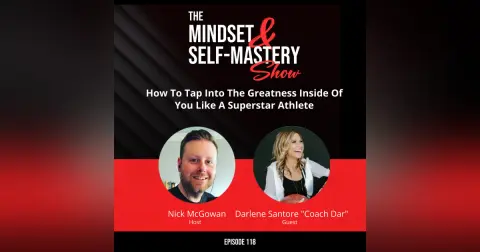


“Break the curse of it, take it, and use it for purpose… but you’ve got to do the work.”
In this episode, Nick speaks with Darlene Santore “Coach Dar”, an occupational therapist and mental skills coach for professional athletes in the NBA, NFL, MLB, NHL, MLS, etc.. shares insights on resilience, mindset, and overcoming challenges both in sports and in life. Despite being a short white female in the world of professional sports, Coach Dar has worked with athletes across various leagues, helping them harness their mental capital and achieve peak performance.
What to listen for:
- Lessons from her journey and experiences with professional athletes
- How Dar navigates conversations and facilitates healing
- Tips from the pros on how to best handle your mindset
“Your gifts and talents didn’t go away… accept it, embrace the suck of it, handle it, deal with it, emotionally feel it, and then go forward from it.”
- There’s a recipe for life, and tenacity is a major portion of the ingredients
- How our emotions tie into our decision-making
- We talk about doing the hard things in life and having a pro-athlete mindset in how we handle those tough situations
“People deserve second chances in this world… but it’s an absolute change in your behavior, in your patterns to show that you’ve learned from it and you’re moving on.”
- People often talk about showing others grace but find it difficult to show that to themselves and others
- We must learn and grow from our mistakes, and we discuss how she works with professional athletes to do this
- We get into the pressure professionals have each moment, and how the way they handle it can help the rest of us
“We have multiple roles to play in this life… don’t let the world lock you into one role.”
- Discussing the various roles we have in our lives
- Embracing our purpose and not letting the world lock us into something
- Understanding what we’re here to do and the ways we can dive deeper into our purpose
About Darlene Santore “Coach Dar”
A Board-certified occupational therapist, leadership advisor, and mental skills coach for some of the top CEOs in the country and professional athletes in the world from the NBA, NHL, NFL, MLB, and MLS, Coach Dar shares her proven methods that any business professional can use to bounce back from setbacks and thrive even in the toughest of times. Recently named Senior Fellow of PathNorth—an organization of world leaders and CEOs of Fortune 100 companies, her powerful message continues to reach a global audience. As a mental skills and leadership coach, she helps athletes, business leaders, career-minded professionals, and entrepreneurs up their game, overcome obstacles, gain a mental edge, get out of “slumps,” and become better leaders. The result? Individuals, corporate executives, and professional athletes & teams aim higher and achieve more. Additionally, Coach Dar is a trailblazer for Phoenix women and was awarded the Most Inspiring Woman from WNBA.
- https://www.coachdar.com/
- https://www.linkedin.com/in/darleensantore/
- https://www.facebook.com/DarleenSantore
- https://www.instagram.com/thecoachdar/
- https://twitter.com/thecoachdar
Resources:
Interested in starting your own podcast or need help with one you already have? Send Nick an email or schedule a time to discuss your podcast today!
nick@themindsetandselfmasteryshow.com
Thank you for listening!
Please subscribe on iTunes and give us a 5-Star review! https://podcasts.apple.com/us/podcast/the-mindset-and-self-mastery-show/id1604262089
Watch Clips and highlights: www.youtube.com/channel/UCk1tCM7KTe3hrq_-UAa6GHA
Guest Inquiries right here: podcasts@themindsetandselfmasteryshow.com
Your Friends at “The Mindset & Self-Mastery Show”
00:00
You know, sometimes it’s time to turn the page on a career or a position or a role we’ve played, all of us. Like there are seasons for everything. And what happens is we get so locked into one identity. And that’s why I try to tell people we have a gift that transcends past one role.
00:25
Hello and welcome to the Mindset and Self Mastery show. I’m your host, Nick McGowan, and today on the show I have coach Dar. Dar, how are you doing today? I’m doing awesome, Nick. Thanks for having me on. Absolutely. I’m glad that we finally actually get to be able to do this. So full transparency to everybody listening, we had a podcast episode scheduled almost like a year ago. And the whole point was to be for your book that was coming out, that book that those of you that are watching on YouTube, you can see in the background. ah And now your book’s actually been out.
00:55
It’s so good we weren’t able to do that episode before, but hey, here we are. Now we get to be able to do it. So, Dart, why don’t you kick us off? Tell us what you do for a living and what’s something that most people don’t know about you that’s maybe a little odd or bizarre? So, I’m an occupational therapist. I work in professional sports. I’m the mental skills coach for a lot of sick, sick and above guys.
01:18
oh No, I coach in all the leagues NFL, NHL, NBA, MLS, MLB, all the leagues. I’m the mental skills coach for them. And I also help CEOs and executives gain their mental capital. I am this funny five to white female in professional sports. So like the funny part of this is people don’t know when they’re watching this, but we have this height difference with a lot of people I work with, but it’s a lot of fun and I’m grateful to have the opportunity.
01:46
I’ve seen some of the pictures of you standing next to like Devin Booker or somebody like that. And Booker’s not even huge compared to like a Durant. Yeah. Or somebody else where you’re like, Hey, how’s it going up there? Oh yeah. One of my other guys, he’s six nine and the other one is seven one and I’m their armrest. uh Life’s got to be different at seven foot. I, I was really hopeful.
02:10
that I would get to the six foot mark and then like halfway through high school they were like, no kid, you’re not going to just stick to your arts. I’m like, okay. know, I wish I was a baller. wish it was a little bit taller. I wish I was five foot nine. I’m like, I would take five five literally. But that’s huge. Full pun intended that you’ve gotten into what you’ve done and what you’re doing. Um, so
02:36
You still need to tell us that thing that most people don’t know about you that’s odd or The whole dichotomy of where life goes, I coach right now in pro sports, but at one point, I’m from the East Coast, Connecticut, and I grew up listening to R &B, old school hip hop, Frank Sinatra, and at one point I was running a country music record label in Nashville, Tennessee. I didn’t know a thing.
03:04
about country music and we ran a recording studio and a record label and I sit next to George Jones and I’m like, George, I really don’t know much about country. He’s like, no, honey, you don’t. And he’s like, I go, but you’re like the godfather of it. So if there’s anyone I’m to learn from, it’s from you. And he goes, we got a lot of work to do. He goes, but you know what? You need to go eat something first. He’s like, you’re a little too small. It’s like in his world, it’s like, eat some fried food. Let’s sit down, let’s hear a meal.
03:33
I was like, it’s like being Italian. They want you to eat, he wants you to eat. But yeah, no, it was one of those times in my life. And ultimately there is a parallel. I help people with their mindset. I’m a therapist by background that helps people. I’m a visionary. I help them see where they can go and take away and help kind of curb the insecurities, help them lean into their confidence and step into what they’re called to.
03:59
So how did you get into that? Was there something when you were younger that maybe you had a really hard time with it or was it something that came to you really easily that you were like, look, I could put this to use? You know, when I look back, because with talking about the book, I’ve gotten this question before where since I was in sixth grade, I literally ran for student council. And it was really because like, if I saw that we could affect change, I’m like, let’s do it. I was.
04:26
And I wanted to help people that maybe were afraid and didn’t have a voice have a voice. I’m for the underdog. I was never one for clicks. Like I’m, I want everyone to come together. I don’t want anyone to feel less than. And so I just was always for like wanting people to win everyone to win. And I didn’t like when people would make fun of people because of whatever it was. So innately, there was something in me that just wanted people to win. So I was like, okay,
04:56
Well, if I ran for a student council, not necessarily because it was student council, but that was an avenue to help affect change so we can make things better. And you know, Nick, that became this like honestly, this parallel for my whole life. And I went on to be this type of therapist that I am that helps people. Occupational therapy helps people wherever they are in life. And I was in traumatic brain injury, helping people overcome the most extreme odds after having a severe car accident, brain injury. They were told they never walk again, to walk again. And
05:26
I that was like my passion. I was like that we’ve got to help people. I end up going back to school for business because along the way I ended up having my own health struggles with a stroke and it set me back a little bit and I had to bounce back from that. But there I was left with this blood clot that was left in my brain from a stroke. And the irony of this neck is that I was told that I could die any day and I was like well no first of all that’s not supposed to happen but let me flip this for a second and say
05:56
I was like, well, sugar, if I could die any day, then I want to go like fix the world. I want to, I want to affect change. And so that’s when I started getting more into business, trying to fix healthcare. And then in 2008, I started my own practice and was literally speaking for free, left a very lucrative career. Cause I’m like, you lose fear when you’re told you could die any day and you’re like,
06:18
I just want to go help people and that’s what’s grown my practice. I obviously the skill set, I studied neuroscience, my background and all of that. I have this skill set for it, but my heart and my passion started to match that even more where I was like, man, we gotta go help the world now. Like there’s a sense of urgency on my side and I just want people to win. Like I love the 30 for 30 stories. I love people. I love Rudy, you know, the movie.
06:49
everyone’s got a chance, like we all have this chance to win, like in whatever that is, we just, we block ourselves. We literally block ourselves from sometimes getting there. So I try to remove those. I don’t try to remove them. I try to give them the tools so they could remove them and go forward. What a great way to be able to put that too. I have to think about, and my partner says this a lot, that people aren’t actually broken. They’re just blocked. Yeah. It’s like, but we have that mental.
07:16
issue where we think we’re broken and some different personality types like I’m an enneagram four so I know I’m super emotional one and I think I’m broken nobody knows me no one loves me etc but there are things that tie back to our core wounding and how we actually relate to that it’s what we do with that stuff that actually allows us to either flourish or just flunk out of everything so with that stroke that you had and being told that you could die at any point
07:42
Some people would take that and be like, okay, well, I guess the couch is where I live from this point on until I die. But you spun that and you did something different. Now, did you have a support system to help you with that or is that just all on your own accord? I mean, definitely where I grew up and my family and everything, but I would say more, I have a strong faith and I just think like I was born wired to go. I mean, like I was the kid who my father, I’d be like, I have all this energy. What do I do? He’s like, do pushups, run around the house.
08:12
I’ve always had this like energy, but just innately, I mean, I’m like, I told you since a kid, I just was made to affect change. knew it from an early age. So when this happened to me, it was like, like I wasn’t thrown in the towel, but I’m kind of like, well, if any day I could go like let’s, I’m going to go on empty. I want to have like done everything I could before I go. So I have no regret. Yeah. What a, what a powerful thing. It sucks when something like that can happen to wake you up.
08:42
But you kind of need that in certain ways. I wonder with a lot of people that have problems or they’re like, look, I get that. I didn’t have a stroke. So I didn’t have that thing. And my life just kind of sucks. And what do I do with this? What do I do with that? It goes back to uh the blockage sort of thing. So if you take the normal run of the mill person who has a job and they go to nine to five and they have their wife and kids or whatever, that’s a bit different than somebody who has to play ball every single night.
09:09
have to be on, if not, they’re gonna get kicked off the 13-man roster or whatever it’s gonna look like. And they have a lot of stuff to deal with. Like something kind of timely right now, I saw what happened with Kevin Porter Jr. uh last night or two nights ago. He’s a what, two, three years into the league in NBA and just had a domestic violence situation. uh Julio Urias from the Dodgers, that situation.
09:36
could imagine that things get to a point where people have a really, really hard time just dealing with life. So how do you help them not only deal with life, but thrive from that? So depending on which scenario and who I’m helping at the time, you know, like anyone who’s listening right now that’s going through whatever challenge that’s happening. One, if it’s something that you didn’t bring on, like it just happened, you know, like I just said, some people, it’s a car accident.
10:05
you know, maybe our company downsized and they lost their position and something out of their control. there are things out of our circumstance that we cannot control. So I want to say to that person, things may feel like they’re being taken away from you, but your gifts and your talents didn’t go away. The scenario changed, but your gifts and talents did not change. Don’t forget that, because that’s where we start to like,
10:32
go backwards and we’re thinking, there something wrong with me? Now, if there’s certain things you could work on your skillset to change to get better, do it. It’s like what we talk in the pros all the time. We fix things in real time. So fix them in real time. But if it’s other things that just, hey, it’s the circumstances of life, then kind of accept it, embrace the suck of it, handle it, deal with it, emotionally feel it, and then go forward from it. But no, your gifts and talents didn’t get taken away from you.
11:01
So when you remember that, just go, okay, well, where else can I bring my talents and my gifts? Like there’s millions of businesses out there. Someone is going to need your service, whether you started on your own or you would join with someone else, someone is. But here’s the thing, they’re not coming to your door. You’ve got to get up and show up and let people know you’re looking or whatever’s going on. So.
11:27
That’s really important when I’m trying to get people to move from stuck to unstuck in that kind of scenario. And then by the way, if it’s something like you did something wrong, you’ve got to have extreme ownership. You’ve got to own it. And then it’s not just, I’m sorry, it’s a changed behavior. It’s an absolute change in your behavior, in your patterns to show that you’ve learned from it and you’re moving on. And listen, people deserve second chances in this world. And…
11:55
We should have a little grace and we can’t always be judgmental. We don’t always know what’s happened in all the scenarios. We don’t have all the facts often. So anyone who’s messed up and they take extreme ownership and they’re making the change, like give them a little bit grace to see what they’re doing and let them try to prove themselves on the comeback. Cause everyone has a comeback story. For those that continue to not make the change, well sugar, that’s on you. And we’re not feeling sorry about that.
12:25
Well, in that sort of sense, you know, the people that want to make the changes, but they have trauma. How do you actually work with them from their traumatic experiences? Because that lives within their cells. There are triggers that’ll come up, things that’ll happen to them where it’s an unconscious decision. just, they’re back right in it because trauma doesn’t look at time and space. It just says, it’s happening again right here and now. And how do you actually work with people through that? That’s a loaded question because there’s so many types of therapy and treatments that one could do for trauma.
12:55
and specialists that work specifically in certain areas of trauma, because there’s different kinds of trauma and there’s different kinds of treatments for trauma. So I would say like, look at where your trauma and then one seek help to work on it. So when people don’t work on their trauma and they just keep letting themselves get triggered, again, that’s on you. And you can’t then blame the world because you’re not working on it. And I know sometimes we don’t get dealt.
13:23
an easy hand, like we don’t ask for obviously stuff that happens in our childhood that might happen to us and man I feel so much for everyone that’s gone through anything. But then there gets to be a point when we’re old enough where we get to recognize we could either do something about this and move forward or we could stay victim to it. Break the curse of it. Take it and use it for purpose. Like let that adversity advance you. But you’ve got to do the work and when you do the work you’re free of it because then the triggers no longer trigger you.
13:53
And if you’re someone who constantly gets triggered and emotionally gets volatile, it’s going to be hard for you to hold on to something consistently. It’s hard to build trust. And if you think about when someone is a great leader, let’s take a great general in battle and they’re looking ahead and they know adversity is coming. They have to get everyone locked in, loaded and calm to go take the field of battle. Right? Now put that in the workplace.
14:23
If that’s to save someone’s life in the workplace, we don’t come in and we’re like set off going crazy as a leader. What are we going to do? No one’s going to be able to trust that leader. It sets off chaos and it creates like psychological unsafe environments. So I want people to start working on their own in ourself so that we can create more alert and aware.
14:49
leaders to create a calmness at work. And even if you feel something, you don’t get volatile because if people are volatile all the time to Nick, then people are walking on eggshells. And who wants to be around someone that we’re walking on eggshells all the time? Nobody. And I know personally, I’ve I’ve dealt with that from childhood and I have that come up at times. I’ve dealt with that in different partnerships, business, relationships, all of that. And the calmness is a big thing. Like I recently had a conversation where it’s like, I know that I need to stress.
15:18
a lot less and not be as tense. But those triggers that come up that I’m actively working through, those can still come through and you can still hold them off and go, look, it doesn’t need to be this way. But I think of even quarterbacks, some of the best quarterbacks in the world are the calmest ones. And you kind of want to just like, how are you so calm right now? But it’s a muscle because I work with quarterbacks and it’s emotional neutrality. We work on emotional neutrality. They’re moved, they literally
15:47
300 pound man is coming at them at lightning speed while they have to stay calm and assess it knowing it’s like a car accident coming and hitting them. And they have to stay calm and take the hit and make the play. I mean, it’s so much about that. But if they could do that, and by the way, they’ve gone through trauma in their life too, but it is a practice gift and talent and muscle that we all can get. It’s just, we willing to do it? And by the way, it’s okay.
16:15
It’s not that triggers are never gonna come up in your life. It’s just that they become less frequent, so you have more control. Yeah, what a beautiful thing. Now, by the time this episode comes out, it’s probably gonna be sometime in the beginning of the year, but right now as we’re recording it, football season just started. And as you were talking about that, I thought of Geno Smith having Aaron Donald run at him and he was literally caught on mic going, oh my God, and throwing the ball away. And everybody like, SportsCenter and everything’s like, dude, we feel you. We get that.
16:44
I get the 300 plus man coming at you wants to tear your head off. uh
16:57
You’re getting hammered. Football, you’re getting Constantly. Yeah. Especially hockey players. They’re just like, all right, well, I broke a leg. My arm’s hanging off. Put me back in. Let’s put tape on it. And they’re totally good.
17:10
So I know that we don’t have much time left with you because you’re super busy and you’ve got a lot going on. Is there a story that you can tell us and you can omit names if you need to? Any stories that really tie into what we’re talking about that you’ve seen a transformation with one of the players or athletes you’ve worked
17:29
There was a specific player that I was working with that came from a background and had a lot of aggression and his childhood had a lot of trauma and he had all this aggression. And when he came into the league, everyone just kept trying to say like, fix this guy, fix this guy. Everywhere he went, I was like, hold up, this isn’t a person that needs fixing. This is a person that needs love. This like, literally this person just needs love.
17:59
They also need the tools on how to handle emotion because there’s not something wrong with them. They just have never been shown the way. They’ve never been shown the skills. They’ve never even been shown the love consistently and they don’t have trust because everyone’s left them. So once that person and I got to work together and we were able to go through giving them the tools on how to handle the emotions, talking about love,
18:27
understanding what healthy love is and building trust, building relationship and building a bond where they felt for the first time seen, heard and loved, man, this person started to flourish and like the walls just started breaking away for him and it became, I have chills, it became way more than the sport because they actually were winning in life now and they had never felt that before.
18:55
For me, that was an ultimate win because it doesn’t, you know, I want them to obviously be a champion. I want them to reach their goals, but I want them to win at life. I don’t want them to win a trophy and then lose their life. That’s gotta be tough there. I’m sure there are a lot of people that do that. Like once they reach that pinnacle and they’re like, all right, well, I got the championship. Now what? And then just go straight down from there and others will kind of pick it up, move along. And do you talk about some of that within your book, Bouncing Back? I do.
19:25
I talk about transitions, I talk about turning the page when it’s time. know, sometimes it’s time to turn the page on a career or a position or a role we’ve played, all of us. Like there are seasons for everything. And what happens is we get so locked into one identity. And that’s why I try to tell people we have, we have a gift that transcends past one role. You know, you look at Richard Branson, he has so many companies and he’s amazing because he’s more than just
19:54
Virgin Airlines, you know? He’s more than just Virgin Music. He is an entrepreneur, but he takes this gift and he creates from it. So I was working with someone who was transitioning, one of the best athletes in one of the leagues, and he was transitioning, and we were talking about, what’s another dream you have? Where could you take your greatness and your gifts and bring it to the world now? Like, that was one role. You made an impact, now let’s use that impact that you made and the greatness of all that you are and let’s use it.
20:23
for someplace else. So take your talent somewhere else. It’s not that you’ve lost, you’re just bringing it somewhere else. And we have multiple roles to play in this life. So don’t forget that. And don’t let the world lock you into one role. We have multiple roles to play. Like almost like you’re acting in more than one movie, you will have more than one movie that you’re gonna be the star of. What a great way to put that. Along those lines, what’s that piece of advice you’d give somebody on their path towards self-mastering?
20:52
I would just say, here’s the thing, identify what those gifts and talents are in you and then write them down. Seek feedback from other people. What’s it like being around me? What are the things that you see that I show up the best as? Get as much info as you can, write it all down. So on those days that you start to feel like a hit or slide back, you go back to your Scouting Confidence Card that has everything about who you are right there as your reminder.
21:21
Because when you do, it gives you back the feedback that you need when you forget sometimes. That’s beautiful. And what a great way for you to be able to tap back into something that you’ve already said and that you know is true and to be able to understand that it’s there. So before I let you go, because I appreciate your time, appreciate you jumping on and talking about the book and all, and all that’s going to be in the show notes, where can people find you and where can they connect with you? Well, first, I appreciate you, Nick, so much for taking this time and
21:48
booking this out so early with me and that we could still do this because I love just having these great conversations that’s going to make a difference in people’s lives. And so if people want to hear more, they can go to coachdar.com. I have all my information there. I’m usually on the gram more than I’m anywhere else. So it’s the Coach Dar and I put up reels and videos that give people some mental fuel every day to help shift your mindset. I look at it as paying it forward, paying inspiration forward. So.
22:15
Follow me at coachdar.com, follow me at The Coach, at The Coach Dar, LinkedIn, it’s just Darlene Santor, but you can get my book anywhere, Amazon, Barnes and Noble, and it’s called The Art of Bouncing Back. And honestly, I just want to say about that is we’re not always taught the tools on how to handle life and how to build mental resiliency. And I put these nine principles in here to give people the tools so that when the hits come, they don’t stay down as long.
22:42
This is a book not to just read when the hits come, it’s to read now so you’re ready. And it’s also a book to pay it forward if someone’s hurting and you don’t know what to say, pay the book forward. That’s why I wrote it. Those are typically the best books. Something that not only you wanna read, but you wanna give out to people. And I know obviously the authors really enjoy that, because they sell more books, but the whole point is to be able to actually help people through it. So I’m looking forward to reading it at some point.
23:09
I really appreciate you being on. I know this has been almost a year in the making to be able to do it. So thank you so much for your time. Thanks, Nick.