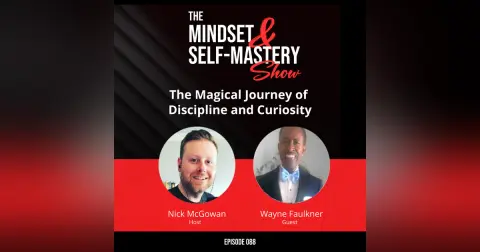
The Magical Journey of Discipline and Curiosity With Wayne Faulkner


“Joy only comes from within ourselves. It is not external. It’s not an external act, external job. It’s an inside job.”
Episode summary:
In this episode, Nick speaks with Wayne Faulkner, the author of 3 personal development books, to discuss the magical journey of discipline and curiosity. We travel through childhood into adulthood, career, being a musician, and going through heartbreak to discuss how we can manage our mindset and become stronger, clearer, and more on fire for life.
What to listen for:
- How our mindset plays a role in every aspect of our lives
- What we feel music does to our soul, psyche, and daily living
- How writing, like journaling, lyric writing, etc.. can help us process our lives and live more fulfilling lives
- We discuss the uphill feeling of writing a book and how we change as a person through the process.
“The main obstacle, in my view, that prevents people from writing is that they don’t think that they can do it. ”
- Like most things in life, it’s not easy to start a massive project if we’re controlled by fear around it
- The daily disciplines Wayne used to write each of his books that we can all use some variation of in our own lives
- Projects like books are similar to how we see celebrities… it’s not an overnight success that makes them
“Progress over perfection. You know, as long as you’re making progress, that’s what it’s all about.”
- How we view “success” in western culture
- We discuss the difference between progress and perfection and why it matters to our daily lives
- What happens when we let go of the outcome of our work
- Breaking down the daily disciplines that help write a book, start a company, or even just run a healthy life
“In daily life, you will experience whatever the inner you projects. ”
- Our minds and attitudes can make or break us in almost every situation
- How thinking and feeling are tied together and what that means for us
- Simple ways Wayne has found to control his mind and daily life
- How important speaking with love and listening with love are important not just in outward communication but also within ourselves.
About Wayne Faulkner
Wayne Faulkner is a multifaceted professional with writing, personal development, coaching, education, and content creation expertise. He has dedicated significant time and effort to studying the habits and practices of successful individuals, intending to inspire and empower others to cultivate a heightened level of consciousness and achievement. Currently based in Tennessee, Wayne is committed to leveraging his skills and knowledge to help individuals realize their full potential and live their best lives.
Resources:
Interested in starting your own podcast or need help with one you already have? Send Nick an email or schedule a time to discuss your podcast today!
nick@themindsetandselfmasteryshow.com
Thank you for listening!
Please subscribe on iTunes and give us a 5-Star review! https://podcasts.apple.com/us/podcast/the-mindset-and-self-mastery-show/id1604262089
Watch Clips and highlights: www.youtube.com/channel/UCk1tCM7KTe3hrq_-UAa6GHA
Guest Inquiries right here: podcasts@themindsetandselfmasteryshow.com
Your Friends at “The Mindset & Self-Mastery Show”
00:00
The main obstacle, I think, in my view, that prevents people from writing is they don’t think that they can do it. Number one, yeah, they just don’t believe they can do it because when you look at a book, it has X number of pages. Wow. How would I ever be able to write a complete book of 150, 200, 300 pages? Where is this information going? Where is the content going to come from? How is this done? I can’t do that. It’s impossible. But it is possible. If not, no one could do it.
00:35
Hello and welcome to the Mindset and Self Mastery show. I’m your host, Nick McGowan. Today on the show, I have Wayne Faulkner. Wayne, how are doing today? I’m doing great. Yeah, I appreciate you being on today. I’ve read through some of your website. I appreciate you sending the book over. Full honesty, I haven’t gotten through it. I have a stack of eight or nine other books that I’m actively working on. And I know that
00:58
There’s a lot that we’re gonna get into, but hey Wayne, why don’t you kick us off? Tell us what you do for a living and what’s one thing that most people don’t know about you that’s a little odd or bizarre? Okay, again, I’m Wayne Faulkner. I am an author and an authority and expert in the subject matter in which I write, which is personal development. I have three books under my belt and currently writing the fourth book. I’m about halfway done with it. And one of the things you’ll find interesting about me
01:26
I’m learning to play the piano. Nice. It’s very, very interesting and relaxing and therapeutic. And uh that goes back a ways in many different phases. So were you one of those kids that were forced by your parents to sit down at the piano and go through lessons at like a five or six year old or to pick it up later? No, I was raised by my grandparents and I had an uncle that I grew up with. He learned to play.
01:55
somewhat and we had a piano in the house, but he never taught anybody else how to do it. So we were sneaking there and just try to hammer out things, know, just playing around, having fun as a kid, you know. So we all sang in the choir and church and matter of fact, we started a gospel quartet group, myself and another uncle and some cousins. And we did a run with that for a while and just sort of got introduced to music. And I love music, all genres basically.
02:25
That’s awesome. And that’s cool to start the quartet. Did you guys go around to different churches or did you do it? We That’s cool. Yeah, you know, we felt like rock stars for many. We didn’t get any publicity or popularity out of it. But, you know, we were were sincere in what we were doing in that phase of time in our age, you know, we thought it was cool, you know, a little audience going here and there. Yeah, that is cool. I played in church bands for
02:53
I guess the better part of 10 years as a lead guitarist. And there’d be times where it of scratched that itch, almost that rock star itch. You’d have hundreds or thousands of people, but you’re doing it for a larger cause. ah And it’s interesting how that dynamic works, right? Yeah, it is. It really is because, you know, we just we just had fun doing it, you know, and somehow we never thought we would do it on any successful level, but we just had fun.
03:24
Yeah, that’s what it’s about. Now you’re back to it. You’re having fun. Did you did you buy a keyboard like an electronic keyboard? Did you get an acoustic piano? Yeah, I bought a keyboard, electronic keyboard and bought a guitar. And uh I had a guitar uh instructor for a while and they mysteriously disappeared. So I went into self taught mode. Seemed like this where I’ve been ever since. So started writing.
03:53
I started writing lyrics and uh wow, wrote a bunch of lyrics. said, hmm, I got all these lyrics here. So let’s try to put some harmonies, some arrangements, some melodies to these things. So I started hammering out my own melodies with my lyrics. And a few people that heard some things says, oh, that’s kind of interesting. Wow, keep that up. That’s pretty cool. Yeah. Isn’t it interesting how
04:20
I want to tie personal development and music together because we’re both musicians and working through things and how you piece things I found also helps you piece things together in your own life. Either situations, there are times where I’ll give an example, I was working on two songs that are going to be on my next EP yesterday and reworking a couple parts and trying to figure out something and something was a happy mistake that just popped up and I was like that, that needs to be in there. But it took
04:48
all the iterations to be able to get to that. And I thought about how many different times I’ve done that throughout just my own personal journey. So do you have any stories like that or anything that you can kind of relate back to with how that looks? Yeah, my song lyrics back in the day were always related to some type of relationship or something that was happening in my life that, you know, that gave me all the content, the title, the lyrics, you know, as a whole, it was something that I was dealing with, you know, emotionally or otherwise.
05:18
You know, just a song came out of that experience that I was having at the time, you know, so that was very interesting how that came about. And I think that led me to writing. oh I published about 10 or more essays on a platform called EZ Articles. And I was designated as a Diamond uh writer. And all of that seemed to tie together, you know, my lyrics and the writing of the essays. And somehow I just got this bug of writing has led to writing books.
05:48
No, writing a book isn’t easy. I know that as a fact, I haven’t written my first book yet, but I’ve started to work through some of the ideas for it. My partner has a number of books, we have clients that have books. uh We are in the process of going to be able to help people with their books and all of that. But why we talk a little bit about what that process looks like? Because I know there are people that listen to the show that are writers.
06:15
They’re like, look, I’ve written lyrics, I’ve written poems, or I just write in my journal, and I want to be able to tell a story or tell my story. And then there are other people that are like, I don’t know how to write, but I have something to tell. Can you tell us a little bit about what that journey looked like for you? Well, I would say to anyone, the main obstacle, I think, in my view, that prevents people from writing is they don’t think that they can do it. Number one. Yeah, they just don’t believe they can do it. Because when you look at a book, it has X number of pages. Wow.
06:44
How would I ever be able to write a complete book of 150, 200, 300 pages? Where is this information, where is the content gonna come from? How is this done? I can’t do that, it’s impossible. But it is possible. If not, no one could do it. So you start and when you start your first book or your first draft, that’s not where you’re gonna be after you write two, three, four, five, six books, whatever the case may be. Like in music, where you start, when we look at artists today,
07:14
That’s not how they started. What you see on tape, what you hear on tape, what you see on TV, on stage, that’s not where they started. Oh no, after many hours, days, weeks, months, and years, they developed into that. So that’s how it all goes. You start, and over time you will progress to whatever level you want to achieve. That’s a good point too. So not only just for musicians, but people in any sort of line of work.
07:43
You know, you’re not going to be good at what you first start off with and it’s okay. Like you’ve got to be terrible to be able to start certain things. Now, some people aren’t, they’re talented in certain ways and it might be a little easier to jump into something, but I think everybody could probably relate to, yeah, I wasn’t great at this thing, but I had to go through it. I think it, and I say often to people, you just got to put reps in. Sometimes it’s just a matter of doing the damn reps and it’s not practicing the wrong things, but it’s practicing the things that can actually help you and the solid reps that’ll help.
08:13
Absolutely. And back to writing books, you know, when you start, you start with a working title and that title may change two or three or five different times over the course of writing that book. Then you’re going to sketch out a rough outline, you know, which is going to determine your chapters within your book. And then you go from there. And as I often say to people, when you start with a chapter, you start. That’s the most important thing to start. You can get the first sentence.
08:40
The next sentence, you got a paragraph and you keep working it. Again, that’s not going to be your final go-to production product. You know, you got a rough draft and you’re going to polish it and hone it and get through it. And, you know, and then you’re going to work out what works for you as a writer, because the way I write and the steps and process I use, it may be totally different from 10 other people that you may talk to. And it probably will be because you got different styles, methodologies, processes and personalities at work.
09:12
And what a wild thing to think about how some people just really, they want the whole thing to be just finished. Like as soon as you do it, they want it to just, you pop it out and like, this is perfect. This is the best thing ever. This is the best book that’s ever been written. And we have this wild expectation to be able to do that. Now I’m sure that you work with people on that as well, where there’s that irritation at times to be able to work through it. And having written your own books, I’m sure you’ve gone through some of that. So what sort of advice would you give to somebody that
09:41
thinks, all right, this is a giant mountain. And we’re just using the book as an example audience. Like this is just one of the things that you could be doing. But for those giant mountain or those giant mountain projects where they’re like, how do I do this thing? And how do I do it in such a way that I can allow myself to fail and actually learn to be good at it? What sort of advice do you work with people on without that? Well, you know, I tell people often that, you know, in Western culture where we live, we have a obsession with perfection.
10:11
There’s no such thing as foolishness. There’s no perfection in this world, on this uh planet that we live on. So I would say progress over perfection. But as long as you’re making progress, that’s what it’s all about. Because as you make continuous progress, you’re going to get to the end point. You’re going to reach your goal. So don’t worry about trying to perfect whatever you’re doing.
10:39
You just run around in circles trying to be perfect. Yeah. That’s a good point. Think about playing piano. Think about writing. Are you familiar with just the concept of deliberate practice? Absolutely. What a beautiful thing. You when you can actually be deliberate in what you’re doing. Yeah. And being able to work through something. I can think from the music perspective of like, I’m going to work on this thing and when I allow myself to just kind of play jazz in a sense.
11:07
and kind of work through it, but have that deliberate practice of this is the thing that I’m working on. Now, do you find that helps with your writing or has helped with the clients you’ve worked with or is that something that you think is kind of different for different people? Absolutely. You know, I think you should be intentional about whatever you’re trying to achieve, whatever you’re doing, be very intentional about it. But however, one of the keys about practice is this. Those that really ascend to a great level in any career,
11:37
a profession is those that love to practice. Somehow it’s human nature to hate practice. We dread it. We don’t like it. So that’s going to impede your progression and your level of success that you want to obtain. But when you get to the point where you start to love practice, you’re going to see the magic happen. I got to be honest with you, Wayne, as a basketball fan, every time we say the word practice,
12:05
I keep thinking about Allen Iverson. Are you familiar with that? We’re talking about practice. We talk about practice, not the game. And I think about him and Kobe. Kobe Bryant was an addict when it came to practice. He would literally not go out and he’d be at the gym at 2, 3 in the morning while other guys, and there were tons of stories I’ve heard and read about people walking into the hotel at four or five o’clock in the morning off all night benders and Kobe’s walking out to go to the gym.
12:35
all about practicing. I think of, I’m a 76ers fan, so I wish the Sixers would have beaten the Lakers in the 0-1, 0-2 season, but they didn’t. They got their asses kicked and pretty much swept after the first game. But Iverson talks about not wanting to do practice, and he also never got a ring. Kobe practiced and practiced and practiced, and he got multiple rings in different jerseys in different eras.
13:04
It sucks that he’s no longer with us because I would love to have him on the show to be able to talk about that sort of stuff. But I think it is important to be able to point out that it’s not about the actual practice that you’re doing. Like when we think about what Kobe did, he was deliberate in all of his practice. He would go out and put up 100 plus, or if not hundreds of specific shots because he was deliberate in what he was doing. And it proved to be successful for him.
13:34
Well, in my view, I strongly believe practice rewards all those that do it. Yeah. Interesting thing. So you’ve practiced on your first few books and now you’re on your fourth book. And I’m sure you, as you pointed out, like you probably want to do the best that you could in the first book. And you’re like, all right, by the second book, I’m going to, I’ve learned a couple things by third book. You’ll learn some other things on the fourth book.
14:02
fifth, et cetera, et cetera, as you continue to go. But how does that tie into what you do in your own personal development, just in your own personal journey? How has that helped you on your journey? Well, know, discipline, you mentioned earlier, it teaches me to be disciplined, focused, resilience, never giving up. Because as you stated quite clearly before, writing a book is not easy. It’s possible, but it’s not easy.
14:30
And it can become easier the more you do it. You you develop your process and your technique, as I said before, but you learn things that you need to do when you sit at your writing environment. You say, OK, this is what’s required to get from point A to point B today. So you develop your routine and you go for it. Let’s take a little bit of a step back, because here we are right now talking about your book, your fourth book. But
14:59
We gotta have some context. You had mentioned as a kid, you grew up, you were raised by your grandparents and you had an uncle and that’s a little bit of context that we have as the childhood. But what did that path look like for you to get to where you’re at today and to do specifically what you’re doing today? Well, you know, growing up in my grandparents’ home, it was really just an incredible experience for me. And I always say, matter of fact, I was mentioning to my wife the other day, I said, you know,
15:29
growing up with my grandparents, they were like angels to me on earth. The love and nurturing and care that they provided for me was just, it was amazing. Something I’ll never forget. And my mother professionally was a educator and a librarian. So she introduced me to books and reading. I had an unlimited amount of access to books as you well can imagine. It’s on her profession. So the exposure to books early on has led me to be a
15:58
very avid reader, which I am right now, beyond probably something you can’t even imagine right now. So that has caused a great deal of curiosity within my mind about many, different things that led me to do a lot of constant, constant reading and research, which has been the catalyst for everything that I write up to this day. Reading and research, reading and research and learning.
16:28
many, many different things that I had, you know, curiosity about, many questions that I had, you know, throughout my life. You know, I began to connect the dots, so to speak, from gathering lots and lots of information. So compiling that information into a book is something that, you know, that I’m working on doing as we speak. Do you look at that as sort of your way of being able to give back from the information that you’ve been able to acquire? Absolutely, because, you know, I always stated
16:57
to myself and others as well. In my creative space, I’m doing all I can to help make this world a better place. That’s the whole point of my writing. My writing is not for me. I get some enjoyment out of it because when you start with a book that doesn’t exist and before long, one does exist, uh that’s a magical journey. Oh yes, and you don’t know what it’s like until you take that journey. It’s incredible. It’s the same as writing a song.
17:25
When you write a song where there was no song months, days, or weeks before, and you have a complete product, where did it come from? It didn’t exist some time ago. It’s here now. So that’s very unique from a creative person’s standpoint. And as I said before, all the writing that I do, I continue because I want to share it with the world. It’s written for the readers. Yes.
17:53
Yeah, it’s a good point. Like you’re not writing the book for yourself to go, oh, I wrote this book. I’m going to read through it every single day. It’s like, you know, the information now, some of it may be for yourself for the compilation of it all. Yes, I’ve compiled all this and putting all this together. But I also I look at the patterns. And I’m curious as well. And that’s where I’m pointing this out. I look at the patterns of how people, especially successful people or people that are epic failures, like what they’ve done to be able to get to those points.
18:23
And I think back to the different conversations I’ve had just over all the years that I’ve had many conversations. And I think curiosity is one of the biggest things that some of the most successful people are typically the most curious people. And they’re just insatiable. Like they just, they can’t quench that thirst. There’s always more and more and more. Now, was that something that you think that was kind of placed into you as a kid?
18:48
Or was that something that was just part of your genes where you just kind of came out of the womb and you’re like, got questions. What is he doing over there? What’s that thing? Why are you touching me? Don’t cut that. Yeah, I can say I was the kid that, you know, once you got your toys at some point playing with them was fun, but at some point you had to dissect them, take them apart, you know, see what makes them work, know, then you try to put it back together and stuff like that. So that was one I’m curious at a very young age. So I just been like,
19:16
curious, curious human being, I guess. It has led me down a path which I really enjoy now because learning so many things, you know, and my writing is an outlet for that. Yes. Yeah. What a huge outlet too. oh I’d mention to you before we hit record how some guests that I talk to will journal. I’ve gone back and forth with journaling. I’ve had different times where I’ve journaled a lot. I’ve written a lot. And other times where I’m
19:45
I just feel like I’m not getting anything out of it or like it’s not working for me and I’ll go back and forth with that. But I’m learning what my mediums are to be able to work through it. Sounds like writing is one of those major mediums for you to be able to work through. But how do you help people be able to figure out what’s the thing that works best for them to be able to kind of work through their own process and through the stuff that they have going on throughout each day? Well, you know, I’m a good listener as well. I listen to people, know, I’m empathetic, I listen.
20:16
I want to hear what their day is like and what’s going on inside of them. Then we have a discussion about lots of things. I can make suggestions of things you should do. And one of them is read. And then you need to find four disciplines within yourself. Physical discipline, nutritional discipline, emotional discipline, and discipline of balance. If you can start on step one, you need to get your mind and body in shape.
20:44
become more physically fit, then you’re going to have more energy. When you develop a better uh nutritional diet, then you’re going to become more healthier. And then the emotional part, which is probably the hardest part to deal with, when you learn about your emotions, because that’s what’s going to drive you throughout today. Your mood, your energy is going to dictate your emotional state. If you don’t understand why you feel the way you feel,
21:14
particularly related to anxiety or any type of depression, you’re going around in a circle because you don’t realize that when your energy and your mood drop, well, you go to a dark low level, but you need to come out of that. You need to start moving. You need to start working out, listen to some good music, go for a walk out in nature. You need to get moving, do something upbeat, you know, to get your energy back up. Then your mood is going to become more positive. Then you’re going to have what? A more productive and greater outlook on life.
21:44
and you’re gonna start to be more happier. I love how that all works. You the idea of you can shift your mood, you can shift your mindset by just getting up and doing something. Sometimes it’s even like if you’re upset or aggravated or whatever, you can just move the hell out of the space you’re in. Just stand up, walk away, go outside for a moment, take a breath, fresh air, just moving, physically actually moving, your physiological movement that can shift that. However,
22:14
trauma, when people have traumatic experiences, that doesn’t always do the trick for them. So there’s sort of the blanket of the people that don’t have crazy traumas or haven’t had any traumas and they can just go, you know what? All right, I’m just going to stand up, going to walk away and I’ll be all right and I’ll get get my mood right, get my mind right and all that. But how do you work with people that have traumas when it comes to that? Well, it really depends on what type of trauma an individual experience, because at some point you may need some professional therapy.
22:44
and that will be beyond the scope of what I can do for you. But aside from that, you know, I would say, first of all, you need to look within yourself. And it starts with unconditional love.
23:00
When you learn to love yourself, you’ll be able to love others. And above all, learn to stop, I completely stop judging yourself in others. It’s when we judge others, it really just throws a chaotic fit in everything that we try to realize in life. The judgmental mindset that we have, it creates all kinds of blockages.
23:26
Sure. Yeah, you can’t get going. It is so destructive, judging. So if you can learn to not be judgmental of yourself and others and learn to love yourself unconditionally first, then you’ll be able to love others. Because, you know, love and devotion, joy and serenity, peace, bliss and enlightenment, that’s what we all aspire to have, to have total peace in life.
23:56
So those are the type of things that try to get a person to become aware of. Yes, if you can get awareness of that into your consciousness, well, at some point, the light is going to come on. Yeah, I am a big believer of the self-awareness being the first step, if not one of the very first steps to understanding about anything that’s going on. You got to be aware of it. I also understand how the trauma affects your brain.
24:26
where it’s hard for people, even with shame and things of that sort, to be able to accept themselves and to love themselves unconditionally. But it’s interesting you bring up, and you didn’t say this specifically, but the way that I think about it is the interpretations, where people interpret and they judge people. Like, you shouldn’t do this this way, because they interpret it some way. It’s like, well, who the hell are you to think that? And where does that actually come from? So when you have conversations with people that are having a hard time stopping the judgment,
24:55
even within themselves or with family members or whatever, how do you work with them with their interpretations and the judgment? That’s an excellent question because in my new book that I’m writing now, I have a cure for that. I can’t divulge it right now in detail because the book is unpublished. That wouldn’t be smart. But really, I figured out a three-step method. I have a title. I’ll give you the title. The title is called Mastery of Observation. If you can learn
25:24
The art of mastery, of observation, wow, that’s gonna take you so far in life because you’re gonna learn the three points that will usually prevent you from being judgmental because we all do it, we all can do it. And if you don’t watch, it’s a slippery slope that we can fall into at any blink of an eye, know, being judgmental. But, you know, I describe in that particular chapter, the process.
25:53
how we so quickly and easily fall into being judgmental of anything, any person, any situation. And when you start going down the rabbit hole, you don’t understand that you’re really doing it because it feels somewhat natural. It’s not natural, but it’s so easy to do. It’s to be judgmental of others, including ourselves. So, you know,
26:22
And if you don’t watch, you can pass it on to your children. They hear you being overly judgmental about this. They’re going to learn that nasty habit themselves. I’m glad you bring that up. I was literally having a conversation maybe two hours ago, maybe less than that, about that, uh feeling a certain way and having a judgment and interpretation, but realizing that it wasn’t.
26:48
a natural thing for me, but it has become a natural thing that I’ve worked on because of my childhood. I wouldn’t say that it was a traumatic experience, but it was an experience over and over and over of judgment toward me and toward other people and how there are certain times it was a stupid little thing where somebody was like, hey, they miscommunicated with something then asked me, where are you 45 minutes later? I like, I don’t know what you mean. Like we’ve never communicated about this thing. And I
27:18
felt judgment from that and realized it’s not a thing that I felt. It’s a thing that has been part of my cells that I’ve had to kind of work through and figure out where that comes from. So it’s interesting you bring up even, you know, giving that to your kids. You can give that to your friends. You can give that to family members and you can sort of uh seep into other people. But awareness is the biggest part of that. How do you help people get to the point where they can be self aware?
27:47
to go, wait a minute, why am I feeling this right now? Why is this happening? Is this what I want? And is there, and I’m not trying to get you into talking about the chapter that hasn’t been released yet, but having the contextual space of like, how do people actually get to that point where they can be aware? Because I’ve talked to a lot of people that are like, well, I hadn’t really thought about it like that because I haven’t been aware of it. It’s just been the way that I’ve been for so long.
28:13
that I’m just used to this and not just judgment, just other things. uh But being aware is the first component to it. Well, again, we do it so easily. Yeah. It’s so sneaky and clever how it gets a hold of our uh mind because we do it so easily. It’s just as simple as if you go somewhere and see someone, you say, OK, uh well, he’s black and he’s what?
28:43
What does that got to do with anything? But see how easy it is for him. He’s white or he’s short or he’s overweight or she has short hair. You start making these judgements about this person. It has nothing to do of why you’re there. If you’re at a counter, you’re waiting for service. If you’re in a restaurant, wherever you are, the judgment that you start doing
29:12
and just going through your mind, it has nothing to do with anything. It’s so irrelevant and not important to anything that you’re doing. But because we do it so we will become programmed to do it, and we’re to have to unprogram ourselves to eliminate it. But like I say, I got a little step by step way that I explained in my book to have you to be able to recognize and be aware, as you said before, that you are doing it. That’s the first step.
29:41
And when you recognize very quickly, if my thoughts go there, I got to rewrite it very quickly to get myself out of that judgmental mold. Because if I don’t, down that rabbit hole I go. It’s going to start with, I don’t like the shape of his nose. Leave my nose alone. I don’t like tone of his voice, you know. It’s so unproductive. It really is.
30:10
Well, so let’s dig deeper into that too. I’ve been thinking a lot and doing some research on having conversations about systems, the systemic problems that we have, the educational system and the racist, the racism system. ah You talk about how there’s white, there’s black, there’s different races and how we all will look at things and people different ways. And sometimes it’s just the system that we were raised in.
30:38
Like I remember thinking before, like, I’m not racist. I don’t see color, but I understand that that’s basically racist because it’s not an anti-racism thing to look at people as equals and try to understand from an equality standpoint instead of going, well, I don’t see it like that. In fact, that shows a lot of my damn white privilege. And I’m not trying to take it down this path, but it feels like it’s kind of going here where there’s a lot of systemic problems.
31:06
where we all have those problems because of the systems we were raised in. The family system, the educational system, even how we’re forced to work. Like you go to college, you get a job, you sit there for 40 years, you retire and you hate life. And that’s like rinse and repeat for people, Mike, how there’s a problem there. So the systemic issue to it, but the judgment that comes along with that, ah that comes from those conversations even internally.
31:35
can be really difficult for people to actually see the system that they’re in and kind of step outside of that. Have you done any of that work or have you thought about any of that? Absolutely. Matter of fact, that is a lot of this mentioned in my second book, you know, the idea of that rather. We are, I don’t want to say victims, maybe we are victims because we didn’t do it to ourselves. You know, when we were born, we were born as a blank slate, you know.
32:02
and often describe it to people, if you go to your local store and you buy a CD, well, it’s nothing on it. It’s totally blank. Now you have the opportunity and the choice to put on that CD what you want on it. So we all get programmed by characters that didn’t get our permission to do it to us. did it all without our permission. They didn’t consult us and ask us, OK, I’m going to embed this into your subconscious mind.
32:32
program, these thoughts, these feelings, these emotions. And they do it to you when you have no control of it. You’re so very young until you wonder, says, well, where did I get this from? Yeah. I mean, what? And then you go around certain people and they say, you know, you’re different. Why don’t you feel the way you do? Because we don’t, as you mentioned racism. You’re the only person in this group.
33:00
who has racist thoughts or ideas. We do not. So tell us about yourself. What was your upbringing like? What was your home environment like? Because somehow along the way, your environment, your associations has shaped you to believe and think and feel the way you do. We don’t understand it because we are not racist. So help us to understand how you came to be as you are. Because if not,
33:29
There’s going to be some disassociation because you have a mindset that we don’t approve of and we don’t buy into. So you don’t have to change, but we’re going to change because we’re going to no longer associate with you. We’re going to make a choice because we can’t allow you to infect our mentality with your racist views and ideas and viewpoints. No, it’s unacceptable.
33:57
You know, until we examine who we are and how we became to be, you know, the great writer, oh Jim Rohn, wrote a book and he talks about your personal philosophy. It’s, I think the title of it is, The Missing Pieces to the Life’s Puzzle. I would recommend everybody read that book. It is incredible. Jim Rohn’s an incredible man. One of my mentors. And, you know, I can talk to a person for three minutes and I can get
34:26
a ballpark big picture view of their personal philosophy. Yeah, it will become apparent to me of who and what you are that I’m looking at and I’m speaking to. I can determine very quickly what’s driving you, your thought process, whether you’re real or unreal, fake, phony, or genuine or not, you know? And at the same time, not saying that you have to accept and become, you know,
34:56
in line with my point of view. No, you’re free to be and think as you want. I’m not going to judge you for it, but I understand why you believe and feel the way that you do about a wide variety of topics and issues and thoughts and points of view. You know, you don’t understand how you came to be like you are, but I do because it happened to me. We all are shaped by our environment. We’re programmed. We’re programmed.
35:25
you know, until you reassess your life and understand, getting some awareness of how you program, you will not seek out change or improvement for yourself. You think it’s okay and it’s acceptable, you know, but once you do some introspection within yourself and come to a realization says, wow, wow, I need to, man, I need to go in a different direction with my life.
35:54
thoughts, my mindset, my mentality, my views of life. I need to change. So you’re going to start, that’s what self-development is. You’re going to start reinventing yourself to be better, to be a better version of you. You want to grow and learn to be a better version of yourself. It’s interesting. are people that talk about you can’t manufacture that moment where people go, hold up.
36:22
something has to change. I need to do something different. You can’t manufacture it without some crazy traumatic experience or something that’s similar to that, that shakes somebody at their core because somebody has to get to the point where they go, hold up, I need to do something differently about this to not go down that path because I believe that you can manufacture that. believe that you can get deep inside there and help bring that up. But for people to be able to get to that point, it’s against self-awareness.
36:52
to go, hold up, I need to do something different. But it’s that what we were talking about earlier of the deliberate practice and being able to deliberately work on the things that you feel you need to work on. So tell me Wayne, what point in life when you had that moment where you like, all right, I need to do something different that you can look back at now 30, 40 years later, whatever it was and go the deliberate practice I did throughout that time.
37:20
was this sort of thing to be able to help you? Oh, I can very easily answer that question because I experienced a divorce a number of years ago. And I can tell you, if you hadn’t had one, don’t have it. It’s one of the most devastating things you will ever experience in your life. Yes, that for me, wow. Yeah, that was one of my catalysts. This started me on a road of oh self-improvement.
37:48
being aware that I need to make some changes to reinvent myself, I had to, you know, and to be better, to learn and grow. Yes, you know, sad to say, but it’s really true. I read a quote once that says, most humans fail to change without pain.
38:11
It’s sad to think that we have to have a traumatic experience and pain within our lives and say, I get it now. I get it. I get it. It’s about me. I need to change and fix me.
38:28
Sometimes divorce will do that for you. I’ve heard something recently people have said, well, sometimes you just got to go through a starter marriage. I had a starter marriage too. I’m just like, right. That’s great. I hope my ex-wife doesn’t listen to this, but if you do whatever, you can consider it to be a starter marriage as well. uh But there are things that you learn from those sort of situations. Like even with divorce, there are people…
38:56
I remember before, before I was even married and before I got a divorce where people would say, I recently got a divorce and I didn’t know to say congrats or I’m sorry or how are you. And there were people that I talked to when I went through my own divorce that were like, man, I was in such a terrible spot for years. And I remember telling them like even a handful of months and like a year after it’s like, I’m not, I’m great. Like things worked out the way they needed to and people
39:23
look at things differently, but it is one of those catalysts that makes you go, hold up, I need to do something a little differently here. So for those that haven’t gone through a divorce, don’t divorce your wife or husband. You don’t have to unless you really need to. And that takes a self-awareness to be able to figure out what the hell’s going on. uh But being able to have that catalyst, I think we can actually pull that out of ourselves or have somebody help us to be able to figure out what’s that thing that gets you to go, hold up, something has to change.
39:53
And I think there is pain. There’s a lot of pain that people struggle with and deal with that they don’t really talk about. I did some of that within my ex, well, ex marriage, where I abandoned myself at times and was like, you know, it’s fine. I just don’t know how to husband. What a bunch of bullshit. Like I, I didn’t know what to do in those situations. So I just abandoned myself and just shoved it deep into a box inside of me. And that wasn’t a smart move. So how did you get through all of that and be able to figure out?
40:23
All right, here are things that I’m going to do differently. Well, to be honest about it, I woke up every morning. Yeah, I was alone at the time, you know, because I was a non-custodial parent, as they say. And so I had a lot of me time available. So I found to myself. I would ask myself this question every day. What is it that I do not know?
40:49
That’s not open to any question. So to answer that question, it was, you don’t know anything. So you need to go into discovery mode. What am I discovering? Everything that you do not currently know. So once I started down that road of discovering, I started learning, devouring many different things that I may have had deficiencies in. Okay, so.
41:18
That went on and on and on and on and on, I began to learn and grow and improve in all aspects of my life. Mainly my consciousness, my mindset and my mentality. I became more success oriented. I became more diligent about learning, as you said, practicing, you know, just being focused on
41:46
making a brand new start. My second book is called Set Back a Stepping Stone. So I use that time in my life as a stepping stone. I didn’t have a pity party for long because I said, you got to snap out of this. And it’s up to you. If it is to be, it’s going to be because of you, You got to do the work. You got to spend the time. You got to focus on you and where you want your life to go now.
42:16
You can’t change the past, you can’t dwell in the past. All you have is now. And what’s beyond now is the future. And it’s slightly unknown. So get with it, get on with it. As I say, sometimes, grieve for a moment. Take some time and grieve. Yes, it’s natural, it’s healthy. Grieve for a while. And after that, it’s time.
42:47
to get on with the work of improving your life. Yeah, what an interesting thing because I think there are a lot of people and I’ve been in this spot before where I was like, I really wish somebody would just come along and help and just fix it or just do the work for me. In those really dark moments where you’re like, I just don’t want to, I don’t feel like I have the energy to, but that awareness of understanding that like it’s on you, it’s on you to do it.
43:14
We had the people that were our parents that force fed us whatever beliefs they had. And that it’s still on us to be able to figure out what we want to do and how we get to do it. Some people will take that as a, that sucks. I don’t want it to just be on me. Other people will take it as an empowerment. It’s on me. I get to be able to do something about it. And it’s too often that we get stuck in the past or we start thinking about the future and we just forget about the time right now and being grateful.
43:43
content in the moment that we have and being able to figure out like, cool, what am I doing right now? What does this look like? And kind of having that innocence of a child in a sense going, well, what’s going to happen from here? And how do I do things from here? So Wayne, along those lines, what sort of advice would you give to somebody that’s on their path towards self mastery? I would say, believe this, in daily life, you will experience whatever the inner you projects, whatever is inside of you.
44:14
you will project that into your outside reality. So think for sure. Do I want to think positive? Do I want to feel positive? I want to feel joy, happiness, success, hope, awareness, inspiration, motivation? Or do want the opposite? It’s going to be either or. And just know that whatever you feel on the inside in daily life, you will experience whatever you project.
44:44
So be sure when you look inside of you, if you don’t like what you see, you can change it, work on it. Because once you project out, that’s what you’re have. It’s coming from inside of you. Joy only comes from within ourselves. It is not external. It’s not an external act, external job. It’s an inside job.
45:12
Great way to be able to put that Wayne. Look, I appreciate you being on. I thought this is a great conversation. I hope you’ve enjoyed your time. uh Please tell us where can people find you? Where can they connect with you? And when does that next book come out? Oh, wow. The next book, like I said, I’m done with it and uh it’s going to be a little while longer. But go to my website, thinkcreatesuccess.com and go to any of these social media channels, Instagram.
45:41
Facebook, YouTube, just type in my name. I think Create Success or Wayne Faulkner, it should come up. Awesome. Again, Wayne, it’s been a pleasure. I appreciate you being on with us today. Thank you for your time. Thank you for having me.