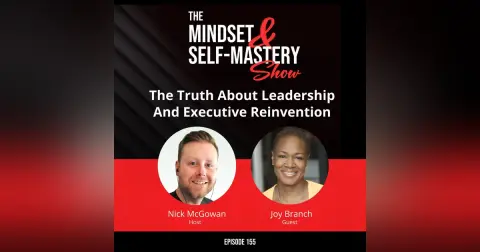
The Truth About Leadership And Executive Reinvention With Joy Branch


“The experiences that got you here won’t necessarily get you to the next stage. A reset is needed to figure out where to go”
In this episode, Nick speaks with executive coach Joy Branch about her journey, the importance of books in her life, and the concept of executive reinvention. Joy discusses her project, The Joy Project, aimed at bridging the gap in leadership and personal development. The conversation delves into the significance of self-awareness, understanding systems in leadership, and navigating organizational change. Joy offers valuable advice for aspiring leaders and emphasizes the importance of self-mastery in becoming effective leaders.
What to listen for:
- Books played a significant role in Joy’s early life and personal growth.
- Self-awareness is foundational for effective leadership.
- Leaders must understand the systems they operate within.
- Reinvention is a continuous process for leaders.
- Effective leadership involves listening and understanding team dynamics.
“Leaders often have no one to call and say, “I don’t know what I’m doing,” because transparency can be used against them”
- Leadership can feel isolating due to the fear of vulnerability being exploited.
- Admitting uncertainty requires a safe space for honesty and support.
- Leaders are often expected to have answers, even when they’re still figuring it out.
- Building a trusted circle is essential for authentic conversations and growth.
- Strength in leadership comes from balancing transparency with wise discretion.
“My acronym ART stands for awareness, reflection, and transformation. Transformation happens over time, but it starts with awareness”
- Awareness is the first step toward meaningful personal or professional growth.
- Reflection bridges the gap between self-awareness and actionable change.
- Transformation is a process, not an instant fix—it unfolds gradually.
- Small, consistent actions over time lead to big, lasting changes.
- ART is a simple yet powerful framework to guide progress in any area of life.
About Joy Branch
Joy Branch, Co-Founder and Managing Partner of Branch & Associates, is a multi-talented leader, renowned for her expertise in human capital, leadership coaching, organizational development, and behavioral consulting. With over two decades of experience, Joy has left an indelible mark on Fortune 500 and S&P 500 companies, driving transformative change. She holds a M.Ed., in Leadership, Learning, and Organization Development complimented by a Bachelor of Science Degree in Management at Pepperdine University, Graziadio Business School, and received Leadership Coaching Certifications from the University of Georgia and Harvard University’s Executive Education program.
Resources:
Interested in starting your own podcast or need help with one you already have? Send Nick an email or schedule a time to discuss your podcast today!
nick@themindsetandselfmasteryshow.com
Thank you for listening!
Please subscribe on iTunes and give us a 5-Star review! https://podcasts.apple.com/us/podcast/the-mindset-and-self-mastery-show/id1604262089
Watch Clips and highlights: www.youtube.com/channel/UCk1tCM7KTe3hrq_-UAa6GHA
Guest Inquiries right here: podcasts@themindsetandselfmasteryshow.com
Your Friends at “The Mindset & Self-Mastery Show”
00:00
Think of yourself as an organization. Think about how you want to show up in the world.
00:13
Hello and welcome to the Mindset and Self Mastery Show. I’m your host, Nick McGowan. Today on the show we have Joy Branch. Joy, how you doing? I’m great, Nick. How are you? I’m good. I’m really excited to get into this conversation. We’ve been talking for a little bit now, kind of going through some things, getting to know each other a little bit before we hit record. I think it’s going to be a great conversation. And I feel like we’re going to be able to be really blunt and direct on a lot of things and talk about a lot of different topics.
00:42
Why don’t you kick us off? Tell us what you do for a living and what’s one thing most people don’t know about you that’s maybe a little odd or bizarre. Well, I am a executive coach and I work with leaders, entrepreneurs in the space of leadership development. So the kind of short summary of that is I’m a leadership coach and absolutely love it. I’ve found my my joy.
01:11
pun intended and not intended. something that people don’t know about me, I guess I would say that I’m kind of a nerd. Like when I was a little girl, I turned my closet into a library. I I pushed all my clothes to the side and I got, I guess what we will call now Sharpie. And I wrote the numbers on the side of all my books and
01:41
I would sit in the closet and read my books. So there you have it. That sounds tranquil. It just sounds awesome. No, it was. was. And listen, when I think about it, when I kind of flashback into my life, I didn’t know things were going to get, you know, the way they turned out. Going in that closet was a cool place to go. It was just I was in a closet with my books and my clothes.
02:10
So what a cool thing. And you know what the truth is? You know, 50 some odd years later, nothing’s changed. I still have lots of closets and lots of books. That’s the way it should be. You know, I, I love that idea of being able to do that. I always want to know what was the motivation behind that or what was the intention behind that? And oftentimes it can be really pure of like, well, I love books and I wanted my own little space.
02:37
Sometimes it can also be, well, that was the safest space for me to be because the rest of life was tumultuous or there was just craziness going on. Well, what, I guess to pick a camp or pick a side with that, which side of that did you fall on? You know what? It’s interesting. I did it because I just wanted to be with my books. Like when I was a kid, every week when you would go to school, I went to a private Lutheran school. I’m from LA.
03:07
And my school was Trinity Lutheran in Hawthorne. So every week you would get an opportunity to purchase books from the weekly reader. So my mother knew that every week I was going come home because I had books I wanted her to buy. So I, you know, I collected a couple of books and in my mind I’m like, I have my own little library. So it was because I love my books. I can remember.
03:36
I can remember reading Little House on a Prairie and Pippi Longstocking and all that. just love my books. So, and I still do. Yeah. I do. Pippi Longstocking. God, I couldn’t even tell you last time. But as soon as you said that, the theme song kicked into my head. Yes. Charlotte’s Web. Yeah. All these. I remember my fifth grade teacher, Mr. Haynes, read
04:05
the hobbit to us. And like that was the best part. I didn’t want to go play. I wanted to sit and just go into the world of the, you know, that imaginary world. So. Yeah. Oh man. What a cool thing. It’s like a, it’s your mind palace at that point. You get to be able to create, you get to explore in there. Uh, my dad used to read the hobbit to me when I was little, like that’s what we’d read when I go to sleep. And I remember by the time I got into
04:31
think it was like ninth grade or something. He had summer reading. They were like, well, we need you to read The Hobbit, Fahrenheit 451 and something else. I didn’t like reading in high school because I wanted to go play music and go basically be an obnoxious teenager. But I remember being like, shit, that’s the one book I’m going to read. And I ate it up and I loved it because it tied back to some core memories as a child with my dad reading this and making the sounds and the different
05:01
noises and all that sort of stuff. But what a cool thing. Like you could have done different things, you know, you could have, you could have done things outside or whatever. But I think it’s a cool thing for us as people to be able to go do the thing that we want to do. It feels really sacral at that point. We’re like, I was led to go do this thing and what a beautiful thing. And that can be really, again, it can be one of those things that can be based on trauma or based off an escape because you’re just trying to escape.
05:31
can also be something that I think is kind of the seedling to what you then become later on down the road. And I’m really glad that you brought up books like right away, because one of the things that I thought about as soon as I saw that you’re an executive coach and you work with leaders is a book that has dramatically and in some ways fucked me up. A book called The Last Word on Power by Tracy Goss. Have you read that? No, I haven’t. I haven’t read that.
05:58
fucked me up in such an incredible way. It’s about executive reinvention. Not as much from like the executive side of it is a bit of a Trojan horse because it’s like you people that are in leadership and in some sort of business. We’re to talk to you from that angle, but really it’s about us as people changing based on this subconscious winning strategy that was created in our formative years.
06:26
that told us this is how you win in life. This is what you do to win. But the executive reinvention is that’s cool. You’ve done all those things and what you’ve done to this point will not get you any further. My partner had one friend who read literally the first sentence that was basically that she threw it against the wall and didn’t pick it up for three months. It was like, fuck you. And it went back and changed everything. That the author escapes me and hopefully the name will come to me for my, you know, brain fate doesn’t kind of kick back in.
06:55
But there’s a very famous book, What Got You There Won’t Get You Here. And I think you have to be able to reinvent yourself. Daily, we are reinventing ourselves. Or we should be. But we have to first think about, you which is you got to first begin with what are your thoughts and how do you move your thoughts?
07:22
How do you operationalize your thoughts into behaviors? How do you move yourself forward? And you can think your way in and out of anything. mean, the truth is it’s not easy. Just because you can say something quickly doesn’t mean it’s easy. And you can say one word like stop, but is that easy? No, it’s not easy. So it’s not, I think people get those two things confused because there are some things that
07:52
take a very long time to do, but they’re easy to do. then they’re quite the opposite is also true. So yeah, that’ll be, that’s a book I have to add to my library. Yeah, it’s incredible. I was actually gonna make an audio version of it, cause they hadn’t her and her team and she died last year, I believe. But I tell a lot of people about it, but a friend of mine is starting a new business. I told her and she texted me.
08:18
know, maybe a week or two ago, and was like, this is great. I’m listening to it. And she said, I was like, wait a minute, listening. Then we found out that it was on audible as of like a week ago. I’ve listened to it three times since. It’s it’s incredible. But it literally is reshaping reinventing, but understanding the stories, because subconscious is just here to save us and keep us alive. There are stories that are created. So one of the reasons why I wanted to have you on the show was to talk about leadership and executive reinvention, or just how
08:47
leaders are because one of things that’s really stood out to me is so many leaders think, well, I want to change the organization and I want it to be a certain way. Good for you. Yeah, exactly. It’s like, cool. That’s cool. But it’s the person needing to be able to be changed. I’ve seen so many times where leaders of businesses are just not good people or they’re pushing bad ideas and they may make a ton of money.
09:16
but all of that venom is just going through the rest of their organization. And likewise, on the opposite side of that, there are some leaders that really can’t lead and they’re too easy going almost it seems, but there’s a sweet spot. So what do you do to work with people to be able to figure out how they can reinvent themselves, heal their own stuff to then be able to work on their actual business? That’s like the perfect question for me and I’ll tell you why. I created the self-entitled project called The Joy Project.
09:46
Okay. And the joy project was born out of my identifying a gap in organizations and individuals, entrepreneurs, et cetera, between what people desire and what actually takes place. And foundational to that, the very first thing to me, like, is awareness. So what I do is I work with individuals.
10:13
organizations, entrepreneurs, or whomever decides that they think that they want to increase their awareness. And it is so important for you to increase your awareness because that’s when you get to make the change, right? I think about it sometimes, I have an acronym and it’s,
10:39
The acronym is ART. So it’s awareness, reflection and transformation. And a transformation piece is something that happens over time. But foundational to everything is your awareness. Like you can’t change what you don’t acknowledge. Like if you don’t know that it needs to be changed, you will never change it. So you’ve got to get that awareness. So when you talk about leaders who come into spaces or they’re appointed into roles and it’s
11:09
It’s kind of funny to me because everybody that comes in thinks they need to change something. OK, and they think they need to change it for a few reasons. I have my theories around why they think they need to change it. So most let’s just talk about the like the traditional executive who, in my opinion, in many cases are highly compensated, right? So when you come into an organization, they’ve courted you and you’ve, you know, promised that when you.
11:37
come in, you’re going to change the organization. So you got to come in and change something. You have to come in and make those people who identified you as top-tier talent, you have to make them feel like, A, that they made the right choice, and B, that they’re going to get their money’s worth. So you can’t just come in and say, oh, OK, well, this looks pretty good. I’ll leave it as is. Because that wasn’t part of the agreement. Both you and the organization,
12:05
had all these conversations about this is what the org needs. You’re the person who’s going to help the org meet their needs. And now we get into this psychological contract and we move forward and you’re going to come change the entire culture and everything’s going to be fine. OK, so you and I know that that’s not going to happen. And one of the reasons why it’s not going to happen.
12:30
The subtitle or the subtext of the JOY Project is that it is a systemic reflective leadership development program. And the reason why I started with systemic is because you are operating within a system and everybody needs to know that. If you are in the third grade and you go to a new elementary school, that playground has a system. There’s a boss, there’s a bully.
12:58
All that stuff is already on the playground. So you have to go in there and figure out where do you fit on the playground.
13:10
And whether it’s a playground or a corporation, you have to go and you have to assess the situation. You got to show up. You got to assess the situation. And that’s what happens in organizations. And it makes me happy to work with leaders who are in
13:39
very, very critical situations, whether it’s post merger environment or, you know, they work for an organization where the market has shifted and their product or service is not doing as well as it had before. This is this is the thing that my heart goes out to leaders and I’ll tell you why.
14:08
who they have to call to say, don’t know what I’m doing. Who can they call? They can’t tell their peers because at a certain level, some of the executive leaders, it’s such a competitive space that it’s really difficult for executives to be transparent around the areas that they need improvement.
14:37
because those things are used against them. So that’s where coaches like myself become very valuable to leaders because we are their support system. We’re there to help them understand first the systems that they’re operating in and then elevating their awareness around. OK, so you have strengths in this area.
15:02
But OK, you have strengths in areas where there are no needs. I don’t need you to be strong in that area. So you have to constantly self-assess, elevate your awareness so that your value proposition is what the org needs in that moment. Because it’s a very, what have you done for me lately situation in the world, period.
15:31
you bring up systems and the systems of that is a thing a lot of people miss out on. They don’t think about the system they’re in and even along the lines of not thinking about the system that they’ve created in themselves going, well, once I get in here, I have to show that I am the best. I’m the right choice. I always find that sadly funny when people get in and just fire a couple people. It’s like they just took them to the firing squad because they needed to do something. It’s like just time out.
16:00
Hold up for a minute, fucking ask questions, go around and talk to people, spend the first few weeks just getting to know people, understand what’s going on. And I see that as a huge thing when leaders can actually say, well, I’m here. I know the things that I know, but I don’t know anything else about you guys or what else you do here or how you do this. I like to think of myself when I go into stuff like that as the FNG, the fucking new guy. Fucking tell me things, help me understand this instead of being like, blah, blah, blah, blah, blah.
16:31
There’s no need for that. And you’re only going to fuck with the system that’s in place already. But if people don’t know that they’re in a system, like we even step, like you talked about the schoolyard school education system is a system. The family system is a system. All of these things are systems that then tie into how we act when we get into something to say, well, my ego tells me that I need to be a certain way where it’s like, you really don’t you’re in don’t be an asshole about it.
16:59
just go do things and figure out where you fit and how you can help and lead from there. I may be overstepping a boundary here, but I don’t think so. I think you like frame that up precisely. I encourage, I have clients that are newly appointed into roles or they within an organization that they currently work for, or they go into a new space. And what I encourage and coach to is,
17:28
to do a listening tour. Go in and find out what it is you can find out. And please don’t start at the top.
17:42
You need to go to the mail room. You need to go to the reception area. listen, if you go into an organization and you go to the mail room and you go to the receptionist, you can find out everything about the company. Everything. Now, listen, many of us, we’ve shifted the ways in which we work. There’s a huge remote population. There’s a huge work from home population. And then there’s that hybrid model. But.
18:11
The takeaway here is that you need to get more information. And so I, you know, use the header of awareness, but there’s so many levels to awareness. Your self-awareness, acknowledging those things that you don’t know, and then trying to identify if these are things that you don’t know, create a list of the possible people who may know, because now your job is to connect with them.
18:41
and make sure that you can extract some of that valuable information so that all of your decisions can be more informed. Because when you come in, you don’t know anything.
18:57
And you bring your experiences with you, which is what got you there. But now it’s the reset. Now you need to figure out, OK, where do we need to go? So that’s the beauty, I think, of the benefit to me of leaders getting a coach. And I don’t think you need to be at any particular
19:26
Position in the organization to get a coach because you need different things at different times. Okay. mean when you’re in little league, you needed a coach. But if you are going to go to like a D one school, you can have a coach. If you go into the NFL, you have a coach. Yeah. Please don’t let me try to fool anybody. Like I know anything about sports. Well, somebody, had somebody on the podcast maybe a year ago who was like, Michael Jordan needs needed coaches. He needed multiple coaches. Are you better than Michael Jordan?
19:55
I’m just like, what a solid point. Cause even if you’re not a sports person, everybody knows MJ. And you know what? I think there’s something else that I like to do with my clients. If you work for an organization, if you’re paying attention and if you’re vested in the organization, you know, the organization’s values, you know, the mission, you you know, the strategic initiatives, you know, how they show up in the market. You know how much market cap they have, you know, you know,
20:25
what their five year, 10 year, 15 year plan is, depending on where you’re situated in the org. You don’t know that much about yourself. You know your own value. You know the company’s core values, but what are your core values? Do you even know what a core value is?
20:45
So what I like, what I encourage my clients to do, think about yourself as an organization.
20:55
If you need to make a decision, who’s on your board? You don’t have a board, create a board. Think of yourself as an organization. Think about how you want to show up in the world, because that’s what businesses do. They think about how do they want to show up in the market? Are they going to show up in terms of price, quality, quantity?
21:23
That’s what they need to identify. How do we show up in the market? You have to do the same thing for yourself. How do I want to show up? Part of me is a little saddened by that. That makes total sense. But I’m also a little sad because it’s part of the system where people get so deep in their career or the thing they’re doing that we then have to say, all right, well, let’s take that thing that you’re really used to and let’s actually go back to the basics and who you are. And that’s kind of sad.
21:51
You know, cause most people don’t know who they are. They’re just kind of moving through life. And I get that there are people in the world that their purpose is to do whatever that small thing or whatever. And I don’t mean to minimize it, but whatever that little thing is that they do other people, it’s bigger things and there’s more work to be done internally to do that stuff. But I, it’s sad to think that we have to then go, all right, well, let’s put it in the construct of what you’re used to.
22:17
And for people to go, oh yeah, that makes sense. I have my own board and I am an organization. But if we actually were moved from that and go, well, why do you do the things that you do? What is the intention that’s behind it? And really what are the traumas or the situations that formed you when you were little to then be able to do these things to think that when you get into an organization, you have to fire a few people or you have to do whatever you do. Or even for the people that go, I know that I need to listen.
22:45
Some people, it’s an innate thing that they get that. Most people, that’s a small percentage, I believe. And I don’t know the exact numbers of that, but I’m sure you’ve had people where they’re like, yeah, I get in and I just listen, because that is who they are. And that is their way of being. So how do you help people to be able to step back, peel away from all of that, figure out who they are and what their way of being is, and then go back into the organization? The thing about coaching is they have to want it.
23:16
So, so there’s that that’s, you know, oversimplifying, but they have to want it. There have been times in the coaching industry and I’ll tell you a little bit about back into this a little bit. The way I got introduced to coaching is, you I mentioned that I started my career early in my twenties. I worked in the office of the president at what was then ticket master now live nation and the office of president was.
23:44
made up of the president, the vice president and the executive vice president. And I was executive assistant to the EVP. And so I got a front row seat to how business runs. And it sparked this desire in me to continue to understand how business runs. And more importantly, I had a front row seat to leadership and its impact on the broader organization. The other thing which I think is interesting and I didn’t really think about it until I was thinking about
24:13
you and I have in this conversation is that there were three very different leaders, three totally different styles.
24:23
Yeah, from really, really good to tyrannical. But that’s what you get. So the term leadership is used.
24:37
so very wildly and so nobody really knows what it is. And I even in some research that I did found a really interesting article where.
24:53
a source indicated that leadership is a system. And when I saw that, was like, oh my God, I’ve been looking. This leadership is a system. It actually is a system. So when you ask the question, how do you help a leader kind of determine what their needs are? They’ve got this, you know, probably multi-billion dollar assessment industry that helps you do that. But those assessments give you very high level
25:23
ideals around how these people show up in ordinary circumstances. But there’s no such thing. There’s no such thing as an ordinary circumstance. We are operating in very volatile, uncertain, complex, ambiguous environments. And that was an acronym that you will find in all of the leadership.
25:53
academic articles and such, and that was before COVID. Things have shifted even more. so the things that leaders need now are absolutely not what they needed before. They need agility and flexibility. They need to really ramp up their ability to connect with their people.
26:23
One of the things that flies in the face of that is that nobody wants to go back to the office. So it’s it’s there’s this tension between what the needs are and what the what the status quo has been. And. You know, I’ve just the other day I got on a call. And the other person’s camera wasn’t.
26:52
And I got to tell you that drives me insane. It drives me insane. And I don’t understand why the leaders of these organizations will not.
27:04
share with their broader population that this is a camera culture. Like if the camera’s not on, it’s a conference call. why have organizations invested in purchasing all these licenses for Zoom and nobody’s cameras on? Like it doesn’t make sense to me. But the camera’s not being on isn’t what doesn’t make sense to me. What doesn’t make sense to me is that the leaders of the company
27:34
have not shared the communication that this is what the expectation is. I love the idea of leadership being a system. I think there’s a lot that we can get in with that. But it also feels like because of COVID and because of the different situations that happened, people need to be more people with people. Need to be more empathetic. Oh, love the way you said that. People need to people? People need to people. Yeah.
28:02
I’m working on a contract right now and I go into a very large organization in the wealth management space. I’m there two days a week. The organization has a huge presence on this floor plate. They’ve got a couple of floors and. When you walk on the floor. There are people in the building, but it’s quiet.
28:29
And I sit and I watch people pass each other in the hallway and they deliberately don’t look at the other person. And I’m like, this is weird. I was in my car one day and I saw two guys walking.
28:45
And I’m sitting at the light and I said, I bet they’re not even going to acknowledge each other. They walked right past each other and they didn’t even, you know, they didn’t do the little head nod. They did none of that. They acted like the other person wasn’t there. And I’m like, this is, this is weird. It is weird, but it’s also not weird. It’s typical. It’s It is, is. No, and there are sometimes like, I know I do that at times. Like I’ll be in the grocery store.
29:13
thinking about the shit that I need to get or what I’m gonna make or what I’m gonna do. And I just keep moving along, walk past people. But it’s funny, because even as you said it, I was just like, a little not like even that just an acknowledgement, there’s another human around you. Oh my God. Yeah. So I think, you know, for leaders to be able to have someone that they can connect with to bounce these ideas off of and
29:43
Ask those questions that are vulnerable, that they don’t know the answers to. And more importantly, ask those questions that other people think they should know the answers to. Because that’s scary to say, know, I don’t know how we, I don’t know how we do this. How should we be doing this? Because the first thing people think is, well, you know,
30:10
That’s why they pay you the big bucks. And no, that’s not why they pay you the big bucks. That’s not why they pay you the big bucks. You know, I’ve recently, and I think over time, bumped into what I like to call highly compensated incompetence. Because, you know, when you do the kind of work that I’ve done and you have access to that information,
30:40
And then you have an exchange with this person. You’re like, I did something wrong. Cause you, what? Like, how did you do this? How did you successfully get more money and you can’t tie your shoes or whatever it is. Um, you bring up a good point too. I think there are times I’ve been in organizations with people where, um, the leaders will hire somebody because it was.
31:08
let’s take nepotism off the table, but there’s some favoritism, some friend of a friend or whatever. And it’s like, they connect with the person so they think they’re going to be a good fit. Then they bring people in. There was an organization I worked with a number of years ago that we were cruising along. I was leading the division. They brought somebody in who was nowhere close to what we were doing and then put them over top of me. I remember talking to the CEO of the company. I was like, I don’t know what
31:36
what your leaders are thinking here. This doesn’t make any sense. And we are literally oil and water. And within a few months, it was like, all right, well, I’ve got to tap out because this person is not going anywhere and it’s only making it worse. And that was one of the things like it hit me, but I have seen it in so many different ways. And I know that I had been that leader in different times of like, well, I need to come in and make these changes and do these things. And thankfully I’ve had other leaders go, calm down, sit the fuck down. Let’s talk about.
32:05
Relax yourself. Yeah, yeah, calm down. You’re good and and being able to actually get in and do the things that we feel we can do from a clean space. There’s a lot of uncleanliness just going on of just, I think I need to do this or I need to do that. And we’re just kind of making shit up. And really, if you need to get in and make some dramatic change, it’s probably not the right organization. And the leaders at the top.
32:32
probably have no fucking idea what’s going on. If they’re like, we need you to come in and blow everything up. Maybe there’s a little bit of caveat to that. Maybe there are certain organizations where they’re like, we need to blow everything up. And I recently had somebody on who’s built a few billion dollar companies and he’s like, there are levels where you just have to change people out. have an organization I’m working with now talking directly with their owner and I’m like, you’re in a regime change. Be excited about this. Like it sucks your buddies gone or whatever, but like.
33:01
You’re in a regime change. What a good thing. And those people might get you to this point and they’re great. You’ll have to get them to go find excellence somewhere else or whatever it looks like. But being able to understand like there are roles and pieces to be able to be played, but those leaders that you work with, how do you help them work through that on their own? And the question I’m really asking here is for the people that are going through this right now, that are leaders that are listening to this episode, who may not be ready to hire a coach.
33:31
or even reach out with questions or whatever, what’s that advice you’d give them as they’re kind of working through these sort of situations to be able to help them. That’s like, know, friendly advice you’d give somebody. You’re sitting at a bar and shoot the shit with them like, hey, next time try this. You know what I tell somebody? I would say, listen, this is what I need you to do. I need you to shift your focus and…
33:56
Figure out your value proposition.
34:00
Think about what value you bring, what value you, how does the room change when you enter the room? That’s a question. And then if there’s like dead silence in your mind, when you think about how does the value change when I walk in the room? Now you know what your marching orders are. Try to figure out.
34:31
If you are OK, walking into a room and not having any presence, not having any power, and not having any impact. And listen, sometimes your silence can be powerful and your presence. The fact that you are actually there and present in the room, that you are actually on the call with your camera on.
35:00
These things are, these are valuable ads that in this M &A environment that we work in, this, I remember you didn’t, there wasn’t this accounting exercise where, you you bought all these companies and then you decided, okay, now we have to make sure that we realize X number of dollars. And so,
35:28
the first response is to, you know, sort of take a look at the head count and see how you can, you know, energize the company, which is that happens all the time now. It’s normal now. No matter what industry you work in, it’s how can we do, how can we make more bricks with less straw? Like, how do we, how do we do this? How do we get more market share with, with fewer
35:58
reduced human capital, right? So then you think about what does that do to the, you’re the human capital. So what I say to people is shift the focus and make sure that you’re valuable because if you shift the focus and you make sure that you are valuable,
36:23
When there’s a notification that there’s a new wave of layoffs coming, you don’t know if you’re going to get caught in it or not. You really don’t.
36:34
Are these decisions thoughtful? Most of the time they are. I’m associated with organizations that, yes, it’s not arbitrary. There are strategies that are being executed from the senior leaders. But it still doesn’t give you any comfort to know whether or not you’ll be part of that. So the only comfort that I see for that is
37:03
Be confident in the value that you add because.
37:10
The skills that you acquire, they belong to you. Yeah, good point. They belong to you. They belong to you. And so what a lot of the data suggests now is because there’s been so much volatility and there’s the need to identify top tier talent, what can you do to make sure that you are top tier talent?
37:38
So that’s what I would tell someone. if you’re in, and be really honest with yourself. If you’re in an organization and you know that is just not where you need to be.
37:49
beautiful thing. It’s, a gift. Yeah. Now you know, now you know, okay, listen, I’m at this company and I don’t really like this place or what happened. What happens often is you get exactly what you described. You get a new leader. It happened to me once I got a new leader and I said to myself, yeah, I’m not working for this person. Yeah. It’s not, was taking at that point. I’m like, it’s just not going to happen.
38:19
Yeah. And the reason I was able to confidently make that decision is because I knew my value.
38:30
I’m like, yeah, I’m not, I don’t want to be associated with an organization or working in a company or even having a client that, you know, I think it goes both ways. Like I don’t, I won’t coach just anybody. Sure. Yeah. And that makes total sense to be able to qualify those things, but it starts with us. It starts with us being able to qualify that. I really love that answer to couple that along with
39:00
what advice would you give to somebody that’s on their path towards self mastery for themselves to then be able to be that better leader and not only just in the office or from their home office, but with themselves and with the people around them? I mean, we’ve said it a lot, but I think the awareness piece and spending time, anything that you master.
39:24
Mastery takes time. It takes repetition. It takes time. It takes attention. And it takes focus.
39:36
You mentioned Michael Jordan. We could think about Kobe Bryant. We could think about Venus and Serena. We could think about any athlete. I mean, it’s always a good analogy when you talk about coaching. But the amount of time that they focus to show themselves improved. Now, the flip side of that is when you focus on something,
40:05
The truth is you neglect a lot of other things. So you have to decide how important is this thing that you want to focus on? Because you will neglect other things. you know, I, um, many years ago, you know, the nerd, I’m always looking for a book, but I was many years ago, I was, um, taking an English class and
40:34
there’s this big popular Bartlett’s book of quotes, right? Everybody uses that or they used to use it. And I was like, well, I need another book of quotes. So I found this book and it was, my soul looks back lest I forget a collection of quotes from people of color. And I was like, oh, this is cool. So it’s a nice coffee table book. And I had it on my coffee table. And one day I’m
41:01
walking through the house and the music is playing. And something told me to pick the book up and I opened it up and randomly read one of the quotes. And it was a quote from Maya Angelou and it said, ask for what you want and be prepared to pay for what you get. And it sat me down. I sat on the sofa and I was like, that’s deep.
41:30
because I was at a moment in my life where I had recently asked for something that I wanted and I had no idea how much I had to pay for it. And I was like, I wish I had read this about two years ago because I’m still paying for this. so when you think about ask for what you want and be prepared to pay for what you get, if you want to master something,
41:58
it’s going to cost you something.
42:03
Mediocrity don’t cost that much. Mastery is mastery. That’s a luxury item.
42:12
So I think when you think about mastering things, you’ve got to know that it’s a cost to it. Yeah. And much deeper than you might want to just bite off from the onset. But getting through it, going through it, it can change us in so many beautiful ways if we allow ourselves to actually work through that. And I appreciate that you brought that up and you tied that together so nicely. It’s been a pleasure to have you on. I’m sure there are different things we could have gone much deeper into, but
42:41
I think we got to do a lot of great stuff today. Before I let you go, where can people find you and where can they connect with you? So I can be located via my website at www.branchandassociates.com. I’m also present on LinkedIn and this has been amazing. I’ve loved the time that we’ve shared talking about leadership and playgrounds and
43:12
And yeah, because really the corporation is is is a microcosm of that little playground that we used to be. Because all the things that went on on the playground, those are the things that go on in in in the. In the organizations large and small that we’re all a part of or aspire to be a part of great point with that. What a cool thing that you know, even as kids and as adults, there’s still stuff that we can tie back to, but us being able to peel ourselves out of it.
43:42
work within ourselves to be able to be better within the organization, better within ourselves and feel more aligned with everything. What a really awesome thing. Joy, I appreciate you being on with us today. Thank you so much. Thank you. Thank you. It was my pleasure.