Understanding Ourselves Better Over Forcing Change In Your Business with Ariffa Bevin
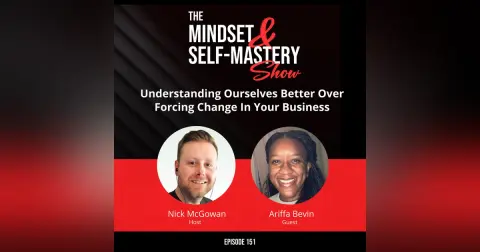


“There’s no end game or ceiling to self-mastery; it’s a journey”
In this episode, Nick speaks with executive coach Ariffa Bevin about mindfulness, self-empowerment, and the discipline found in martial arts. They explore the importance of emotional intelligence in leadership, the art of teaching, and how personal experiences shape our understanding of resilience and growth. Ariffa shares her journey in martial arts and how it intertwines with her coaching philosophy, emphasizing the need for personalized approaches in both teaching and leadership.
What to listen for:
- Mindfulness and self-empowerment are crucial for personal growth.
- Emotional intelligence is vital for effective leadership.
- Personal experiences shape our understanding of resilience.
- Art and mental wellness are interconnected.
- Discipline in martial arts translates to life skills.
- Struggles often lead to meaningful growth.
- Leadership starts with self-reflection and accountability.
- Empowerment involves setting and maintaining personal boundaries.
- Past traumas can shape leadership styles and expectations.
- Self-mastery is a continuous journey, not a destination.
- Responding to chaos is a key aspect of personal growth.
- Effective leadership requires clear communication and example-setting.
“Martial arts are a huge part of my life—they support my mindfulness practice and provide tremendous joy”
- Martial arts blend physical movement with mindfulness, creating a space for mental clarity and emotional balance.
- Finding joy in martial arts brings both excitement and personal fulfillment, highlighting the importance of enjoying the journey, not just the outcome.
- Practicing martial arts strengthens the mind-body connection, helping in stress relief and providing a mindful escape.
- Committing to regular practice fosters self-discipline and personal growth, reinforcing that consistency is key in any journey.
- Martial arts teach resilience and inner peace even in high-intensity moments—a skill that translates into everyday challenges.
“The discipline to train with others, showing compassion for those at different skill levels, is a core value for me”
- Training with others requires discipline, but it also builds camaraderie and mutual respect, which are key in any group environment.
- Showing compassion for people at different skill levels fosters a supportive space for learning and growth.
- Being open to others’ skill levels encourages shared progress, reminding us that everyone’s on their own journey.
- Supporting others reinforces that true mastery includes uplifting and encouraging those coming up behind you.
- Training with others helps develop patience, both with ourselves and those learning alongside us.
“The leadership journey requires adaptability; emotional intelligence must meet people’s varied needs in real time”
- Great leaders are adaptable, responding to changing situations and challenges with flexibility.
- Leaders need to understand and manage their emotions—and those of others—to make informed, empathetic decisions.
- Effective leadership happens in real time, meeting people where they are and responding to their needs in the moment.
- Leaders who value emotional intelligence recognize that understanding others is a strength, not a weakness.
- The best leaders stay open to learning, constantly refining their approach to better serve their teams and goals.
About Ariffa Bevin
Ariffa is an empowerment and executive coach specializing in guiding individuals and teams toward resilience, mindfulness, and unwavering confidence through personalized coaching. With a background in healthcare, nonprofit, and community wellness, Ariffa brings years of experience in helping clients achieve personal and professional goals. As a certified health coach, mindfulness expert, and diversity executive, Ariffa is dedicated to creating a safe and supportive space for her clients, drawing from her understanding of the complex layers of navigating resilience in both personal and professional spheres.
- https://www.empoweredmindfulpathways.com/
- https://www.linkedin.com/in/ariffa-bevin-cde%C2%AE-8a58ba79/
- https://www.instagram.com/mindful_pathways_coaching
Resources:
Check out these other episodes about leadership and emotional intelligence
- Episode 113: How To Manage Our Trauma, Triggers, And Interpretations With Nick McGowan
- Episode 124: How To Be Aligned And Authentically You With Marques Ogden
Interested in starting your own podcast or need help with one you already have? Send Nick an email or schedule a time to discuss your podcast today!
nick@themindsetandselfmasteryshow.com
Thank you for listening!
Please subscribe on iTunes and give us a 5-Star review! https://podcasts.apple.com/us/podcast/the-mindset-and-self-mastery-show/id1604262089
Watch Clips and highlights: www.youtube.com/channel/UCk1tCM7KTe3hrq_-UAa6GHA
Guest Inquiries right here: podcasts@themindsetandselfmasteryshow.com
Your Friends at “The Mindset & Self-Mastery Show”
Nick (00:01.031)
Hello and welcome to the Mindset and Self Mastery Show. I’m your host, Nick McGowan. Today on the show, we have Aretha Bevin. Aretha, how you doing today?
Ariffa Bevin (00:12.334)
I’m doing well, Nick, how’s it going on your side?
Nick (00:14.887)
It’s going well and I’m sorry that I have to bring this back up but I know you say you’re doing well but you are a Yankees fan and we are recording this on Halloween the day after the Yankees had a night of horrors. So I’m sorry for your loss but the Phillies fan in me is not too too sorry. So with that being said, know I’m.
Ariffa Bevin (00:20.056)
Yeah
Ariffa Bevin (00:27.174)
Yes. Mm-hmm. I feel it.
Ariffa Bevin (00:38.52)
Sorry. Uh-huh.
Nick (00:43.767)
We joked about this before we hit record, but, it’s gotta be really tough, especially, like anything where you think about, your team or your local community, or even your country. We’re a week away from two not very good options being put in front of people to vote, to be leader of this country. And, I think the world series is a thing that we can look at and go, well, that really sucked for the Yankees, but it was really great for the Dodgers.
Ariffa Bevin (00:52.255)
E.
Nick (01:12.517)
and fans on either side are upset or really ecstatic. And there are really tough things that we as people go through, especially people of marginalized communities, people that are just not able to be themselves. And then we start to look at that stuff, not only how it affects everything else in the country, but how it affects us, our mental wellness, our mental well-being, and everything that just holds us back from being who we are. So I really want to get into…
Ariffa Bevin (01:16.291)
Right.
Ariffa Bevin (01:24.686)
Mmm.
Ariffa Bevin (01:33.964)
Yeah.
Nick (01:39.099)
the nitty gritty of that sort of stuff. But why don’t you kick us off? Tell us what you do for a living. And what’s one thing most people don’t know about you that’s maybe a little odd or bizarre.
Ariffa Bevin (01:47.854)
Okay, all right. So what I do for a living is I am a executive coach. I work with individuals and businesses, particularly as it relates to mindfulness and self-empowerment resilience. So I do a lot of workshops and trainings for organizations looking to improve the work-life balance of their employees or simply just to have the conversation about it.
emotional intelligence, which is an interesting topic, but you know, we have a lot of leaders who need it, right? And so it’s a conversation that has to be had. So I do a lot of those as well. But my, what I get the most joy out of is these one-on-one conversations that I have with people who are looking for more of that self mastery and self empowerment. And a lot of them do tend to be leaders themselves. And a lot of them tend to be folks who really just want to learn a lot more about the self mastery piece, right? How to,
either start this journey or continue on this journey and learn more. And I always say that the journey doesn’t end. There is no ceiling, no end game, no end goal, but it’s a conversation I love to have with folks one-on-one. So I do a lot of that. And one, I would say it’s an odd thing about me because I don’t think many people expect it from me.
And you can tell me, if it’s a surprise to you concerning this is our first time having a conversation like this. But one thing that stands out that has come across as odd because it wasn’t expected by people is I fighting as it relates to martial arts. And I was a former kickboxing instructor. take martial arts right now, particularly samurai swordsmanship or kujutsu.
I love hand-to-hand combat. The instructor for one of my schools is a former Marine. And so we do a lot of military hand-to-hand combat, a lot of what he’s learned, knife fighting. And I enjoy that tremendously. It is one of the greatest joys in my life and has helped me in so many different ways, especially with the mindfulness piece.
Ariffa Bevin (04:06.162)
but, but yeah, you know, if, my camera was faced a different way, you would see swords on my wall that I use for my training. I eventually want to get back into, teaching kickboxing myself and then eventually be a Kenjitsu instructor and, and want to pass that knowledge on particularly to our youth and, and the self-defense that I’m learning to, to others as well. But I love it. I enjoy it. you know, I used to watch a lot of UFC as well. Could I do that?
Nick (04:11.865)
Nice.
Ariffa Bevin (04:36.78)
You know, no, no, I cannot be a UFC fighter, but if I were trained to do it, maybe I’ll have a good time, but something about it. And I think I know what the something is, but it’s just, I enjoy it. I love it. And it’s again, a big part of my life that I intend to keep going with for a long time.
Nick (04:53.873)
That’s awesome. Obviously I want to know like why, what was the thing about? But one of the things that I love about the platform of podcasting specifically, but just the overall idea of just having conversations with just anybody and people, especially people that aren’t part of your immediate circles is you never know what’s behind somebody’s eyes, either what they’re thinking, what they’re doing or what they like to do.
Ariffa Bevin (04:57.102)
Yeah.
Ariffa Bevin (05:07.726)
Hmm. Hmm.
Ariffa Bevin (05:12.334)
Yeah.
Absolutely.
Nick (05:20.795)
So it’s always awesome to me when I hear people say stuff that’s like, well, this may seem odd. And I mean, it shouldn’t because I don’t really know anything until I know the things, but we can pass judgment. And sometimes we start to go, well, that seems a little strange or whatever. And for the most part, why the fuck does that seem strange at all? Like who are we to say anything about this? God knows what happened at some point where you were like, cool, that could be it.
Ariffa Bevin (05:25.742)
Yeah.
Ariffa Bevin (05:30.883)
Right.
Ariffa Bevin (05:36.12)
Right.
Ariffa Bevin (05:40.074)
Exactly. Exactly.
Ariffa Bevin (05:48.108)
Yeah. Yeah.
Nick (05:49.935)
interesting when I think about UFC and I think about anything that has to do with martial arts, because for the most part, it feels like a lot of people will think, well, you have aggression, or you just want to be able to get that energy out. Or this was something that was passed down to you for so long, or you’re a huge Bruce Lee fan or whatever bullshit like that. But from what I understand, having conversations with people that are really deep into that,
Ariffa Bevin (05:52.717)
Hmm.
Ariffa Bevin (05:57.198)
Hmm.
Ariffa Bevin (06:03.0)
Mm-hmm.
Ariffa Bevin (06:12.524)
Right. Right.
Nick (06:19.927)
It is so entwined with discipline. There’s so much discipline with it. It’s not like you’re just a fucking Ninja Turtle wielding around a samurai sword. It’s got to be more than that. But what is it? Is it the discipline? Did something happen when you’re in third grade and you got jumped by somebody and you said, fuck this never again? Was it all of it?
Ariffa Bevin (06:22.541)
Yes.
Ariffa Bevin (06:29.646)
Absolutely.
Ariffa Bevin (06:41.284)
Yeah, yeah, totally valid, by the way. mean, you know, it’s a lot of things firstly to begin. The first is number one, absolutely it is the discipline. I’ll start there first. The discipline specifically as relates to training yourself and seeing yourself elevate and fail and having the discipline to keep going and succeed.
but then fail again and then keep going further, right? The discipline also to, and the compassion, I’m gonna say as well, to be able to train with others who are both better but not as good as you, to mean that like, I’m not gonna punch as hard with this person or throw them as hard with this person because, you know, they’re either a beginner or what have you or have an injury.
the discipline to not be an asshole and just to show brute strength and just throw this person just because I can, right? I never will do that, but you have people in the arts who do. And for me, that’s not what I’m there for, right? I want folks who encounter and come across me, whether in training or in my work and what I do, to feel welcomed, right? And to not be intimidated, right?
and, but underneath that surface, if it came to me having to defend myself or someone else, I sure hope I would be able to do that. And so there’s that discipline that’s there. and, and again, the discipline also with the fact that there will always be someone better than me. even when it comes to mindfulness with martial arts as well, there’s always something to learn. There was always someone who does it a different way that I can learn from. Right. and so I love learning from other arts and other schools and other systems.
Nick (08:28.709)
Mm.
Ariffa Bevin (08:29.408)
It’s amazing, it’s beautiful. And so that’s number one, it’s the discipline. I would say, you know, going back to my youth, I always had this love for things that were quote unquote, like not girly, right? Like, I wanted to not be in this box of just because I’m a girl doesn’t mean that I like pink things. Like I loved Zena, Warrior Princess. I don’t know if you remember from the 90s, she kicked ass, right?
Nick (08:56.218)
yeah.
Ariffa Bevin (08:58.614)
I was like, look, like she’s gorgeous, but she’s fucking beating the shit out of people. And I love that. And I want to do that. And so, you know, being able to break the mold was something that I was always interested in and not being the expectation or the stereotype that people expected me to be, whether it be from what I look like or who I represent or my background that always fascinated me. Right. And so, and I saw that in so many different forms throughout.
throughout my life with Enzina being a great example of that. And so, you know, there’s that piece to it. And then there’s the empowerment piece. know, one of the reasons why I love this whole journey of mindfulness is because it is indeed that self-empowerment that comes with it. And I see that with martial arts and I have that with martial arts as well. Being able to, again, going back to defending myself or other people.
being able to fight for something if it ever came to it, right? You know, I’m learning samurai martial arts and so one may easily say, there are no samurai, but you don’t really understand exactly what I’m learning, how it applies to the way I walk and move and how I just move my body and then apply that then to self-defense and other aspects of my life. It all relates and it all matters. so…
All of that is just why these arts just called to me so strongly.
Nick (10:24.276)
I’m really glad that you brought up arts, because that is an art. I had times we’ll think about how our school systems keep removing arts, like the actual arts, music, even art classes. And growing up, I was an art kid. I was kind of one of those kids where I was like, I don’t want to fucking be in your class anymore. I got a project and they’d be like, whatever. And I’d go down to the art room and live there. But that is a thing. Like it is an art form.
Ariffa Bevin (10:26.486)
Hmm. Yeah.
Ariffa Bevin (10:32.396)
Yeah.
Ariffa Bevin (10:47.287)
Yes.
Ariffa Bevin (10:51.054)
Thank you.
Nick (10:52.113)
There are so many different pieces to life that is an art form, even mental wellness and our own mental journeys. This is an art form that we get to shape, but it is a solo mission surrounded by other people who are on these solo missions, but it’s not just solo. Like even with what you’re doing with other people, like not tossing somebody just to be an asshole or to show your strength, that’s being mindful about it. But…
Ariffa Bevin (10:55.566)
you
Ariffa Bevin (11:03.905)
Mmm
Hmm
Yeah.
Nick (11:20.039)
Even as you brought that up, I was like, I wondered if maybe at some point you’ve judged somebody like, I don’t want to toss this something, toss this person or whatever. And then next thing you know, they can flip you on your ass and you’re like, what the fuck happened here? then tables turn in a way, but to his life almost, you know, like we, we get hit with things and it’s how we not only manage through it, but in something we talked about before we hit record on this, it’s not about perfection. And it is totally about us.
Ariffa Bevin (11:46.562)
Mmm.
Nick (11:50.203)
being able to continue to move along and work through our things. Something I think is really important and it’s something I’m sure you do with any of the martial arts is being able to go through and figure out how do you become a little less bad than you were. Not about getting better as much as how do you do things just a little differently. Is that about right?
Ariffa Bevin (11:52.888)
Yeah.
Ariffa Bevin (12:05.357)
Hmm.
Ariffa Bevin (12:11.22)
Yeah, definitely about right. It’s exactly that in terms of how do we…
How do we improve, right? How do we, what are, like, we don’t just want to do a particular kata or a movement, it’s called, or a particular form, just to simply do it, right? We wanna do it with the intention of what is the purpose of why I am swinging the sword this way, or why I am turning someone’s arm up instead of this way. Like, like, further understanding the reasoning behind it, and then,
through that understanding, seeing how our body then responds. Because there’s a difference between someone who’s just doing something just to do it and get it over with, or just because they think they’re doing it right, and someone who actually moves with intention, right, and execution. And that ties also to the mindfulness piece in terms of that intention. We all know how critical that intention is to our mindset and how we shift and see things in our lives.
And that absolutely plays a role in martial arts as well, because you can see it in the body and how we respond and how we move. It’s all related.
Nick (13:21.829)
Yeah. I wonder when it comes to, you know, everybody’s, everybody’s different, even if there’s a group of people that are really similar, their differences between them. and we all experience things differently. all either interpret things or we experience it, on our nervous system differently than somebody else may, but there is struggle through it. And I think that’s a part of it. I had read man search for meaning, a few years ago.
Ariffa Bevin (13:31.502)
Hmm.
Nick (13:51.459)
And there’s meaning and suffering was the main thing that I got out of that. And that there’s a struggle that we go through, but that struggle is often the thing that actually helps us get through it. I think about the people that don’t want to do martial arts. I’m sure you’ve mentioned to people you do this and they’re like, my God, I couldn’t, I never would, or I never could or anything like that. It’s like, there’s more stuff to get down to, but I’m sure some of that is also comfort. Like you wouldn’t want to do it.
Ariffa Bevin (14:01.678)
you
Ariffa Bevin (14:08.909)
Yeah.
Yeah.
Ariffa Bevin (14:17.474)
Yeah.
Nick (14:19.391)
And there’s that comfort to it, but we have to be And it sounds old and beaten like you have to be uncomfortable to go through these things But I think the more work that you do the more fucking uncomfortable that you get but the more comfortable you get and being uncomfortable So that you start to work through it, but being so fucking aware of this, especially as you work through things and go, okay How do I get through this and how do I actually do it in the way that
Ariffa Bevin (14:34.797)
Yes.
Ariffa Bevin (14:38.466)
Yeah.
Yes.
Nick (14:45.837)
isn’t pulling away your energy, but helping you. So how does that tie into the work that you do right now with people?
Ariffa Bevin (14:51.872)
Yeah, I want to respond to that real quick because you’re bringing up so many great points here, Nick. So thank you. But one of the important things that you just brought up is the fact that
When I was an a kid boxing instructor, quickly learned it and my instructors now say this all the time but I learned being an instructor myself that Teaching others is also teaching yourself like you were also learning and to exactly what you were saying about You know people receiving things differently like as you were talking I was going back to a student that I had Was her first day and you know as instructors we had like a set like day one
curriculum to go with folks just going over the basics and to just put it at a high level, this particular young lady really just didn’t, it was like she didn’t know how to use her body, right? Like what the standard curriculum was in terms of like jab, cross, know, roundhouse. Like it just, it was not, it just was not being received in the way that it typically was with our other students. And so I got rid of that curriculum for her and we just
broke it all the way down in a different way and she shined, right? And so like, and for me, it was learning for me, especially because in the beginning I was like, okay, holy shit, what am I not saying right? Or, you know, what, like, what is it? And then I was like, no, this is actually a challenge for me to, order to support this person with further understanding how to do this in a way that works for her and where she can process and understand what I’m asking her to do.
Nick (16:13.927)
you
Ariffa Bevin (16:29.494)
And I loved it, I loved that challenge, but most importantly was a learning for me on how do I shift this framework for someone that I have who’s not receiving it in the typical way, right? And so I just appreciate that you call that out because it’s so critical to this path of life. And it definitely relates to what I do on a regular basis because every person is different, like you said.
I may have a curriculum talking about self-empowerment, but at the end of the day, that is going to look totally different for the person I may see the following week, right? And that is going to look totally different when I do a group session or when I have a workshop with leaders talking about emotional intelligence, right? That’s all going to have to shift and be different depending on who I am working with. And mind you, we can totally be the type of people where we’re just like, nah, this is what it is. This is what you’re paying for. This is what you’re getting.
Nick (17:12.912)
Hmm.
Ariffa Bevin (17:25.28)
If it don’t work, that’s on you, right? Like it could, and that happens. That absolutely happens. And it could be that way. But for me and for what I do and for me to actually feel like I am fulfilling my mission in life, it just, can’t be that way. And I love the learning that I receive, right, from doing this work.
Nick (17:44.96)
Yeah, it shouldn’t. And should isn’t a real thing. Like there’s no should, there should not. But I think based on similar principles that it seems like we have, if you’re going to do something, fucking do it. Then don’t just do it to charge people money. Like there are lots of coaches out there that everything they produce is $10,000. Any student comes in, it’s $10,000 and you go through the same shit. And that doesn’t really make
Ariffa Bevin (17:57.57)
Mm-hmm.
Ariffa Bevin (18:10.594)
Yep. Yep.
Nick (18:12.653)
any sense at all. Everybody is different. Everybody comes in with their own things. Everybody has their own interpretations of things. Everybody has their own baggage, their own trauma, no matter what size. It’s a little T, big T, fucking ginormous T, whatever. There’s all these things that come into all of this and everybody does need to be treated a bit differently. And that’s, I think that’s a thing about people when they, when they don’t see that. Like I think about school.
Ariffa Bevin (18:21.4)
Yeah.
Yeah.
Ariffa Bevin (18:33.102)
Yeah.
Ariffa Bevin (18:41.134)
Mm.
Nick (18:41.391)
being in school as little kid, there were people that, some teachers that just couldn’t handle some of the kids because the kids just didn’t want to be there. And there was stuff, I’m sure it’s happening at home or whatever. But there was also like, this kid just needs to be handled a little differently. And I remember seeing teachers, a few of them handle those kids a little differently and it changed everything. But that’s from a personal perspective where that person goes, okay.
Ariffa Bevin (18:43.682)
you
Ariffa Bevin (18:49.646)
Yeah.
Ariffa Bevin (19:00.021)
Yeah.
Ariffa Bevin (19:04.94)
Yes. Yes.
Nick (19:10.671)
I see that this isn’t landing. You’re not broken. Let’s figure out how to actually have it land for you. And one of the things that you brought up just a few seconds ago and even before we hit record was about executives and the emotional.
Ariffa Bevin (19:12.822)
Hmm. Hmm.
Ariffa Bevin (19:17.688)
Hmm.
Ariffa Bevin (19:25.358)
Hmm.
Nick (19:28.743)
Stability, guess, handling of emotions and overall your EQ and everything that ties into that. There are a lot of business owners that I talk to and that I’ve talked to over the years, some that I’ve worked with, some that I’ve just had conversations with that try to fix their business. And it’s typically not your fucking business. It’s you. It’s you as the owner. It’s you as the leader in your organization or whatever.
Ariffa Bevin (19:48.312)
Mmm.
Mm.
Nick (19:58.287)
or where leaders will be a certain way and go, why the fuck isn’t everybody else like this? Cause you’re a monster or because of whatever. It’s like those people, the more that we can look at, really reevaluate how we are as leaders. It all starts with us. And we’ve heard it so many times, it could all start to leadership, but it’s such a rah rah bullshit session where people are like, that makes sense. Starts with leadership. I got to fucking change everything in this company and all these people need to go. Like you’re the asshole. Maybe you need to go.
Ariffa Bevin (20:02.38)
Yeah.
Ariffa Bevin (20:26.326)
exactly what is.
Nick (20:28.635)
But how do we help those people, two different camps here, how do we help the horse get to water and then drink? And how do you help the horse that’s already there trying to drink? And it’s like, this is just a fire hose that I’m learning from and just, I feel my teeth being rattled out. Like, how do you deal with both sides of that?
Ariffa Bevin (20:36.12)
Mm.
Ariffa Bevin (20:48.654)
You know, you’re breaking up something that I, it’s so interesting to me, right? Because on one hand, it is so obvious, at least to me, that leaders really are the key here, right? But then I will have these conversations and you’ve had these conversations with these leaders where it’s the like,
They don’t know why there’s issues. They don’t know why people are leaving. They don’t understand why the culture is ass and like why people don’t want to stay. And like it is, it is a conundrum. it, like it’s, and mind you, they are awful people, but to everyone else, it’s obvious what the issue is. But to them, truly to them, they like, they don’t understand what the problem is. Like they do not see it. And so, and I’m
I will continually be fascinated by that. I really, really will. So to your question about how do we help these people, think the first step or one of the steps I should say is understanding that, helping them to understand what being a leader actually means. Yes, you have this, this.
power and the visibility and the responsibility, but helping them to understand what that actually means. I’m not talking about you having the power to fire people or give raise, that’s not what we’re talking about here. We need to talk about what does it mean when you actually have responsibility and what does that look like in terms of how that impacts your team? For example, when your people who are burnt out,
And I’ve seen so many times, my goodness, people who are burnt out and they have unlimited PTO, but the leader doesn’t understand why people are not taking advantage of that, why they’re not taking time off. Well, have you set an example for them in terms of what that life looks like, work-life balance, or trying to maintain it? Have you set the expectation that people should be responding to emails on Sundays? Have you set the expectation that people should be on meetings outside their office hours?
Ariffa Bevin (23:06.646)
Like what type of example are you actually setting as individual responsible for this team? And so it really has to start with them truly understanding what that role as a leader means and how that ties to the impact that it has on their team. And that for a lot of folks that I’ve met with and executives that I met with has been mind blowing because again, it’s a lot of the conversation along, yeah, I’m responsible.
for writing the strategy for my organization or all of these responsibilities that yes, on paper they are, but at the end of the day, here is what actually matters when it comes to the culture of your team and the people who are working for you.
Nick (23:55.131)
I think there’s a lot of just unclean movements where people are doing things because they were taught that way by some leader in the 80s or 90s or early 2000s or wherever they are. And now they’re force feeding their team because they were force fed and this is how this should be. And this is what we do as leaders. And I think simultaneously we need to take into account that different energy types handle things differently.
Ariffa Bevin (24:00.014)
Hmm.
Ariffa Bevin (24:14.082)
Yes.
Ariffa Bevin (24:24.108)
Yes.
Nick (24:24.635)
Different people do different things. There are the leaders that’ll send out emails at dumb o’clock in the morning, and there are others that’ll send them out in the middle of the afternoon for specific purposes. And that’s part of the uncleanliness of it. I know for me, I typically don’t go to sleep till two, three o’clock in the morning, and I won’t wake up till nine, 10 o’clock. So I’ll sometimes send out an email at.
Ariffa Bevin (24:27.714)
Yes.
Ariffa Bevin (24:38.51)
Hmm.
Mm.
Nick (24:50.201)
noon or not noon, midnight, one, two o’clock in the morning. And there are times where I’m like, I should schedule this so that it goes out at a normal person time. Most times I’ll just send it out because that’s what I’m doing. I don’t have that expectation of anybody that works with me. But I can also talk about those sort of things. Like this is what my life looks like. This is what I do. When I send things out, don’t feel like you have to respond to me at dumb 30 in the morning. Like that’s just when I fucking thought about it. And I send it out to you. So
Ariffa Bevin (24:57.098)
in.
Ariffa Bevin (25:09.281)
Exactly.
Ariffa Bevin (25:13.272)
Exactly. Exactly.
Nick (25:18.149)
We all need to do our own things, but we need to be, we need to trust ourselves. And this is something that candidly that I’ve been struggling with at times and working a lot more on is how do we trust based on the bullshit that we’ve been force fed that has become just part of the norm, which is also tied into our subconscious winning strategy of like, this is how I win in the world. And then being able to break yourself out of that. So those executives that have a hard time going, well, I don’t get it. It fucking makes sense.
Ariffa Bevin (25:32.494)
Hmm
Ariffa Bevin (25:43.148)
Yes.
Ariffa Bevin (25:48.184)
Yeah.
Nick (25:48.475)
Because you’ve been force fed this, you’ve been told this is what success looks like. This is how you do it based on the mentors you worked with or the bosses you had or whatever bullshit you’ve watched or listened to. But what does it actually mean for you is such a tough question that even when we ask that, and I hope people will listen to this and just think that question and go, yeah, what does that mean for me?
Ariffa Bevin (25:53.059)
Yes.
Ariffa Bevin (25:57.902)
Yeah.
Ariffa Bevin (26:12.834)
Hmm.
Nick (26:13.531)
But I hope that they go deeper with that and keep asking and keep asking, because the first initial answer probably is bullshit. The second, third, fourth, 18th answer is a little less bullshit, but probably still smells the same. Because it’s so much shit and layers that we have to get through. So along that lines, what do you do with people to be able to get them to the point of processing through past traumas?
Ariffa Bevin (26:20.128)
Hmm.
Ariffa Bevin (26:26.264)
Hmm.
Ariffa Bevin (26:30.84)
Yeah. Yeah.
Ariffa Bevin (26:39.95)
Mmm.
Nick (26:40.173)
understanding that there was a system at play with this is how you do these things. And this is what success looks like, to be able to break free from that to just straight up be themselves in all the fucking weird, goofy, terrible glory that it is to then be able to mold themselves into what feels right for them to actually be the leader. Like, it makes me it makes me think of slowing down to speed up.
Ariffa Bevin (26:44.802)
Mm-hmm.
Mm-hmm.
Ariffa Bevin (26:51.47)
Mm-hmm.
Ariffa Bevin (26:55.491)
Yeah.
Ariffa Bevin (27:04.589)
Hmm.
Nick (27:04.807)
but not in a bullshit, corporaty way of like, well, we have to slow everything down, to clean everything up and inefficiencies and blah, blah, blah, blah, blah. Like, you actually go fucking time out. Let me take a step back, reorganize, and then kind of move forward. And that is a slow fucking grinding process. So I’m not asking for you to give me the secret sauce here or to tell everybody this, but those people that are going through that shit right now that are like, right?
Ariffa Bevin (27:16.376)
Mm-hmm. Mm-hmm. Mm-hmm.
Ariffa Bevin (27:23.968)
You’re answering it. You’re… Wow.
Nick (27:32.997)
Right? You know, like, what sort of advice do you give them? Is there like, all right, well, I can see that and I feel that, but fuck, this is difficult.
Ariffa Bevin (27:43.699)
So you’re mentioning so many amazing things here. My sticky note is full of things to respond to. You know, so for the people and the leaders, I’ll make a response for that. For the leaders, right, you’re calling out something so important that I think subconsciously a lot of leaders don’t even know that they’re doing, which is for many of the leaders, because they had struggled to get where they are.
Nick (27:49.391)
New sticky note.
Ariffa Bevin (28:10.626)
they feel like other people have to do the same. And I have heard that time and again, well, you know, I had to deal with X, Y, and Z, or, you know, you don’t know how long it took me to get here. That is totally valid. Like your experience is totally valid. However, exactly. However, that should not be the experience of someone else. Like if you had an option to not go through that, are you telling me that you wouldn’t take it? Like what?
Nick (28:34.385)
Yeah.
Nick (28:38.855)
Come on.
Ariffa Bevin (28:40.046)
What do you mean?
Nick (28:43.239)
the
Ariffa Bevin (28:43.97)
So having that conversation is really, really important to make sure that they’re aware because when you really understand some of them really do honestly, they have like great stories again, totally valid. Their experiences are totally valid, but you do not need to put that on someone else. You don’t need to put your trauma. like, again, you have, and you know, leaders tend to be sensitive. So I do very much validate what they went through. I’m not invalidating it, but
the people who are coming after you do not need to go through that as well. And so there needs to be a hard conversation about that, right? About that experience. Because at the end of the day, if you’re telling me that you don’t want to make these changes because you want, you’re literally telling me you want people to suffer, then there’s a deeper problem going on there. Because if you’re telling me that you want people to struggle, right? And have a difficult path,
then there’s a deeper problem that we need to really talk about here. And so I love having those types of hard conversations with leaders who tell me about their journey and how they got to where they are because a lot of the time it follows right up with, I felt like I had to struggle. So why shouldn’t someone else struggle like I did? So I hear that a lot. I really do. And then for the folks who are on the other side of it, really trying to manage it and deal with a lot of this,
I want to go back to what you mentioned earlier about solo mission, right? Because I resonate with that so strongly, especially when you mentioned that it’s not only a solo mission, but there are others around us who either help this journey or test this journey as well. But when I think of the workplace, especially when it comes to solo mission, it’s…
the empowerment that we have to recognize that we have, the power and empowerment. And yes, it’s important for leaders to have these conversations and talk about it, but using the exact example of emails, right? Just something simple as emails, yes, you may send them at 2 a.m. in the morning or 12 a.m. at night, but at the same time, individuals should really truly feel empowered to not respond.
Ariffa Bevin (31:01.046)
And unfortunately, a lot of people, whatever reason, may be up at that time. A lot of people feel the guilt that comes with that when they do not. And much of the time, and I have been in working environments myself, if you set that expectation of responding like that, then that is going to be the expectation moving forward. And so I talk a lot about how do you not only set up what your boundaries are, but how do you also maintain them moving forward? Because like everything else, this is a journey.
It’s not going to be perfect, but how do you work on defining what those boundaries are and keeping them? Because they will be tested. How do you keep them moving forward? Because you as a leader may have someone who absolutely can be like, listen, it’s not my fault. My leader sends me an email at 2 AM. How do I know? How do I know that it’s not OK to not respond? I feel so bad that, and I hear that a lot as well, but we have to talk a lot about that.
that empowerment, especially with the solo mission piece. So I appreciate you mentioning that because it’s a great way to summarize what this journey is. And of course the mastery piece is a part of it as well, but it does summarize it up really well.
Nick (32:00.359)
Hmm.
Nick (32:12.593)
take it a little further. If somebody feels that guilt or that shame, it’s not always, but it’s probably perpetuated from that leader, their boss. But I think most everything ties back to our formative years. Between four and seven or eight years old, you learned at some point, your subconscious specifically was like, this is what we do to stay safe. This is what we do to not be abandoned or kicked to the side or…
Ariffa Bevin (32:24.312)
Mm-hmm.
Ariffa Bevin (32:29.217)
Mmm.
Ariffa Bevin (32:38.414)
Hmm.
Hmm. Hmm.
Nick (32:42.023)
anything like that. So I, I question that. And I’ve had conversations with people at different points over the years of like, why the fuck? Why do they do this at two o’clock in the morning? Or like, why do feel like we have to respond? And why do they expect us to respond from these things? And granted, that was kind of younger years of me of like, I don’t fucking get why this is the thing. Why are you being a jerk? And that was about it.
Ariffa Bevin (32:56.514)
Hmm. No.
Ariffa Bevin (33:06.018)
Mm. Mm.
Nick (33:08.743)
But I do think that there is something that happened when we were younger that subconsciously we were like, this is how we stay safe. This is what we do. And then 25, 30 years later, you’re in a corporate environment or whatever role you’re in and something comes through and you go, my God, I need to get back to mom or dad. Or I need to get back to this person because that leadership, that authority that they have, instead of being able to understand like, I’m going to do what I want to do and what feels right for me, which gets back to the…
Ariffa Bevin (33:15.2)
Yeah.
Ariffa Bevin (33:25.955)
Hmm.
Nick (33:38.553)
unclean just being able to move through life cleanly but us getting deeper and deeper and deeper I see a lot of shit about people talking about quiet quitting or people taking naps at home or even and I’m gonna jump back to sports for a second there was the Anthony Richardson pulled himself out of the game the Colts game last week because he was tired he pulled himself out for a play
Ariffa Bevin (33:43.406)
Yeah.
Ariffa Bevin (33:52.174)
Mm-hmm.
Nick (34:05.765)
because he didn’t feel like he could be at his best to be able to do it. And now he’s actually benched. And that feels like a political move, where Joe Flacco gets tossed back in. My cousins grew up with Joe Flacco. So I kind of think that’s cool that he’s still playing in the NFL. But I feel for Anthony Richardson, where the dude was honest and was like, I’m not gonna lie, I was tired. So I pulled myself out. And now they’re all going, well, we can’t have this. We all need to have a, we need to show that we are this sort of way.
Ariffa Bevin (34:05.806)
Hmm.
you
wow.
Ariffa Bevin (34:16.366)
Mm.
Ariffa Bevin (34:20.558)
you
Ariffa Bevin (34:26.712)
Yeah. Yeah.
Nick (34:35.225)
or we are men or whatever it is. And that is such fucking bullshit. And we tie it back into leaders or people in office spaces or in any sort of organization that we’re in, volunteers even. You think you have to do all these things and sometimes people are just beating upon people or just using and abusing because they went through that. They thought it should be that way. And I think that’s fucking maddening. Look, I almost died a couple of times, overdosed on heroin.
Ariffa Bevin (34:40.974)
Yeah.
Ariffa Bevin (34:49.111)
Yeah.
Nick (35:05.691)
tried to kill myself a few times, have suicidal ideation, got divorced, had different businesses fail. I don’t want anybody to go through any of that. How the fuck? How does that make any sense? I do see how if somebody goes through things and they can be better from those things, that’s cool. I want people to be able to learn and grow, but how dare even subconsciously I go, you know what?
Well, you haven’t gone through the same shit I’ve gone through. So I want you to put a couple bags of heroin up your nose. And then I want you to try to live and then go through a divorce and close down a few businesses and try to jump off condo building. Go ahead, do all that because then after that you’ll be fine. Like what the fuck kind of madness is that? I don’t think anybody would really say that vocally because that’s ludicrous. There may be a handful of fucking monstrous people that could say things like that. But for the most part,
Ariffa Bevin (35:52.512)
Mm-hmm. Yep.
Ariffa Bevin (36:03.392)
in the
Nick (36:05.391)
even those leaders that you talk to, they’re probably like, No, no, no, no, that’s not what I mean at all. It’s like, but that is actively what you’re doing and what you’re saying. So along that lines, what’s that piece of advice you’d give to somebody that’s on their path towards self mastery trying to figure this stuff out.
Ariffa Bevin (36:10.51)
What it is.
That’s right.
Ariffa Bevin (36:23.03)
You said it right there. It’s, it’s, I don’t, hope this doesn’t come across as discouraging, but I want to, the first thing that comes to mind Nick is that it’s a path. Meaning that, when you, if this is the first time that you ever delving into, to self mastery and mindfulness, know that that number one, it’s, it’s what works for you, what resonates for you. It’s not going to be anything that is,
going to be immediately perfect or this path is not about perfection or if you forget to meditate for 20 minutes tomorrow that you failed. It’s not about that at all. is what you said, Nick, that the solo mission and what resonates and feels good for you and just supports you on what is truly a path. And it’s a path because…
We will always have stress. We will always have chaos and ridiculousness that happens in our lives. And some days and years and months is going to be better. But this path is about how do we respond to it, right? That solo mission. Like I’m going to keep using that because it’s beautiful, Nick. But just how do we ourselves respond to that? How do we react to it? How do we react to whatever is happening around the world? Or how do we protect ourselves even from it?
And so, you know, my advice is to start with what works for you, what resonates for you, and keep working at it, because this is something that is long-term, and things in life are going to change and shift, and, you know, again, we’re always going to have the chaos and the good things in our life, too, right? And so how do we respond to that always? And so that’s the main thing that I want to share with folks out there.
Nick (38:10.227)
I deeply appreciate that. And along with the solo mission thing, it’s kind of a mind fuck in some ways, but I do believe that purpose and our individual purpose isn’t just for our solo endeavors. It’s a community-based thing, but it does take us doing the things that we can do. And really, if you think about it, if you’re gonna be here, be here. And if you’re gonna do it, fucking do it.
Ariffa Bevin (38:25.27)
Mmm.
Ariffa Bevin (38:36.365)
Mm.
Yes. Yes.
Nick (38:39.427)
and enjoy the ride of it. Some people really love roller coasters and they love when things go up and down and their belly jumps into their throat and like everything else and we go through that on a daily basis at times and we can get better through that stuff but it is us actually come well what is this really what the fuck is this and why is this person doing this thing what do I do with it and that’s back to that at least solo start in a sense
Ariffa Bevin (38:57.975)
Yeah.
Nick (39:06.469)
And I think we could sit here and we could talk for hours and hours and hours and not bash upon your Yankees. one more little jab, why not for the Fills. On that note, where can people find you and where can they connect with you?
Ariffa Bevin (39:11.054)
Fuck!
Ariffa Bevin (39:15.244)
Yeah.
Ariffa Bevin (39:21.666)
They can find me at empoweredmindfulpathways.com. I have a contact page right on there that folks can reach out to me on. I’m on social media as well. So Instagram, Empowered Mindful Pathways as well. So folks can find me on there with my handle. Either way works.
Nick (39:41.778)
It was great talking with you today. appreciate your time. Thanks for being on.
Ariffa Bevin (39:44.844)
Thank you so much for having me.