Vibes And The Exchange Of Human Energy With Jason Del Gandio
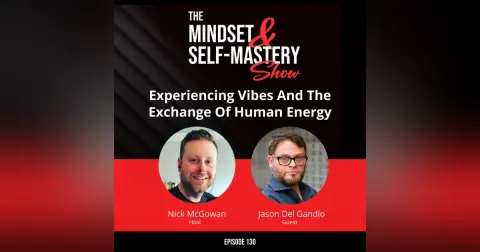


“Make room for the emotional, make room for the intuitive, make room for the vibrational.”
In this episode, Nick speaks with Jason Del Gandio, A Temple University Professor, about the concept of vibes and the exchange of energy between people. Jason shares his expertise in studying the theory and practice of social justice, as well as his passion for understanding the vibe, and explains how he got into studying vibes and the different contexts in which vibes are experienced, such as on a first date, during heated arguments, at sporting events, and at musical concerts. They discuss the importance of being aware of one’s body, surroundings, and other people in order to tune into the vibe and how vibes can affect relationships, leadership, and decision-making.
What to listen for:
- Vibes are the exchange of energy between people and can be experienced in various contexts, such as on a first date, during arguments, at sporting events, and at musical concerts.
- Being aware of one’s body, surroundings, and other people is important in tuning into the vibe.
- Distinguishing between intuition, emotions, and vibes can help in understanding and experiencing the vibe.
- Softening our perceptions and judgments can allow us to be more present and open to the vibes around us.
- Self-mastery involves understanding and controlling the vibes we give off and take in.
“The vibe is the exchange of energy between you and other people.”
- Vibes represent the transfer of energy that occurs when people interact, highlighting the dynamic and reciprocal nature of human connections.
- The concept of a vibe underscores the importance of interpersonal dynamics and the intangible aspects of social interactions.
- Vibes often encompass emotional and psychological elements, affecting how people feel and behave in each other’s presence.
- People may not always be consciously aware of the vibes they emit or receive, but these energy exchanges can significantly shape their relationships and interactions.
“How might I become more aware of the vibe and start playing with my vibe?”
- Awareness of the vibe involves heightened self-awareness, recognizing one’s energy and how it influences others.
- Developing observational skills to notice subtle cues in others’ reactions and behaviors can enhance understanding of the current vibe.
- Actively playing with one’s vibe suggests being intentional about the energy one projects, adjusting it based on desired outcomes or interactions.
- Mindfulness or reflective practices can help individuals tune into their emotional and energetic states more effectively.
“Our bodies are constantly vibing on one another, pointing to a certain kind of interconnection between human bodies.”
- The exchange of vibes is a continuous process, occurring constantly in all interactions.
- Vibes are not purely mental or emotional but also physical.
- The idea of bodies vibing on one another underscores the deep interconnection between individuals, pointing to a fundamental aspect of human relationships.
- A group’s collective energy can influence individual members, shaping the overall atmosphere and dynamics of the group.
About Jason Del Gandio
Jason Del Gandio has a PhD in Communication Studies and has been studying the vibe for 30 years. He is a published author, an award-winning teacher, and an engaged intellectual. For his doctoral work, he developed his own philosophy of the vibe referred to as “bodily emanation.” He has published essays on the topic in both scholarly and popular presses. His latest project is called 20MinuteVibe, which is an educational space for learning about the vibe, offering videos, essays, and self-paced video lectures for those who are intellectually curious and progressively minded.
Resources:
Interested in starting your own podcast or need help with one you already have? Send Nick an email or schedule a time to discuss your podcast today!
nick@themindsetandselfmasteryshow.com
Thank you for listening!
Please subscribe on iTunes and give us a 5-Star review! https://podcasts.apple.com/us/podcast/the-mindset-and-self-mastery-show/id1604262089
Watch Clips and highlights: www.youtube.com/channel/UCk1tCM7KTe3hrq_-UAa6GHA
Guest Inquiries right here: podcasts@themindsetandselfmasteryshow.com
Your Friends at “The Mindset & Self-Mastery Show”
Nick McGowan (00:02.479)
Hello and welcome to the mindset and self mastery show. I’m your host, Nick McGowan. And today on the show I have Jason Delgandio. Jason, how are you doing today?
Jason Del Gandio (00:14.222)
How are you?
Nick McGowan (00:15.503)
I’m good, man. I’m excited you’re on. You did share with me that thing that’s interesting. And I’m really excited for you to share with that the I’m not even going to go any further. So before we get into any of that stuff, why don’t you tell us what do you do for a living? And what’s one thing that most people don’t know about you? It’s a little odd or bizarre.
Jason Del Gandio (00:34.254)
Sure. So once again, my name is Jason Delgandio. I’m a college professor at Temple University in Philadelphia. And at Temple, my expertise is the theory and practice of social justice with a focus on activism and social movements. So I essentially study how human beings create social change. However, outside of Temple, my other expertise is the vibe or vibes in the plural. When I say vibe, in other words, the exchange of energy between you and other people. So again, the exchange of energy between you and other people. I know it sounds strange and whatnot to study the vibe.
but I’ve actually been studying since my late teens, so at this point it’s about 30 years ago, I started thinking about this, and I approached the vibe as a site of intellectual investigation, and I try to help people articulate their experience of the vibe into ideas, into words, into a language that makes sense to them. Then in terms of one strange thing about me that most people don’t know about. So I have a tattoo of a rival football team, so I’m a huge NFL fan.
And my team that I root for since I was a little kid, since I was 11 years old, is New York Giants. One of their rivals is the Philadelphia Eagles. So as I just said, I live in Philadelphia around Philly and I lost a bet a few years back. So I think it was 2017, I think the Eagles won the Super Bowl. One of my best friends is an Eagles fan and we had a bet on the game. And I said, if they win the Super Bowl, I’ll get a tattoo of the Eagles. Lo and behold, they win the game and now I am forever branded with a team that I hate and despise on my body, right?
Now I usually forget that I even have it. So it’s on my back, my upper right back. And I got it there on purpose so I don’t have to see it. But now it’s getting warm outs, go to the beach, you’re in the pool and down here, everyone’s an Eagles fan down here. So go birds, go Eagles, right. Exactly, right. And so I often, for real, I’m sitting at the beach for instance, I forget that I have this on me. So when he walks by, go birds. I’m like, God damn it. It’s like, now of course my buddy Michael, who I had the bet with, he thinks it’s hilarious. This, that and the other thing. He actually came to the…
Nick McGowan (02:14.547)
Go birds.
Nick McGowan (02:29.648)
Yeah.
Jason Del Gandio (02:31.978)
tattoo shop when I got the tattoo all these kinds of things but anyway that’s me that’s I got a tattoo of the rival football team that I hate on my body for life.
Nick McGowan (02:42.791)
Well, folks, thank you for listening to the podcast episode today. We appreciate your time.
Nick McGowan (02:51.283)
When you told me that before we hit record, I was like, fuck, that is gold. Thank God. So please, your buddy has no idea who I am, but just shake his hand for me. Just please from one fellow fan to another. That I mean, but at the same time, dude, like I totally understand where you’re like, fine. If they win the Super Bowl, which they hadn’t since it was a championship game in what 60.
Jason Del Gandio (03:03.051)
Okay.
Jason Del Gandio (03:16.706)
something like that.
Nick McGowan (03:17.552)
I could almost see that conversation of like, fine, fuck you. If they win the Super Bowl, I’ll get a fucking tattoo. Hello?
Jason Del Gandio (03:23.15)
And actually, I made the bet back in June. So like before training started, he’s talking all this kind of smack, the Eagles are gonna win the Super Bowl. Like, think about it, they’re not winning the Super Bowl. No one had the pick to win the division. Then I don’t know if you remember, they start the season, I think it was 10-0 or 11-0. And I’m like, I’m screwed, dude, I’m totally screwed. But then the starting quarterback gets hurt, tears his ACL. I’m like, I’m golden, I got nothing to worry about. Nick Foles comes in the back of the quarterback and then, and there I am. I mean, here I am, so.
Nick McGowan (03:27.419)
Hmm.
Nick McGowan (03:34.288)
Yeah.
Nick McGowan (03:38.564)
and then down.
Nick McGowan (03:46.523)
BDN
Jason Del Gandio (03:51.87)
It was a rock-a-bye.
Nick McGowan (03:54.521)
I mean, that was one hell of a run though. With that was like story, like a fairy tale for Nick falls to come back to do that and all that. That was almost like the Tyree catch. You know?
Jason Del Gandio (03:56.222)
Yeah, it was, it was, you know, yes.
Yeah, yeah.
Jason Del Gandio (04:06.474)
Oh, totally, yes, yeah. It shouldn’t have happened. It did happen though. And as a fan, you’re like, I don’t care if it’s supposed to happen. You know, my team won. What do I care? Yeah.
Nick McGowan (04:13.103)
Yeah, I did shit. Oh my god I so I had just moved to Florida at that time like maybe four months before that happened And I remember standing on my porch of my condo just screaming go birds and people being outside Like what the fuck is wrong with this guy? It’s like seven o’clock at night. I’m like Man so that’s
Jason Del Gandio (04:27.054)
for us.
Nick McGowan (04:42.311)
good on you for being, for being the guy that actually did it. Because I could see people being like, nah, man, I was only kidding. Like, I’m not going to do that. Whatever. And like, I, I think of it from like a cowboy’s perspective. If I, if I did that, had to have a star on me somewhere. I don’t know. I don’t know if I, it would be really hard to do that. Like, um, so good on you, man. I appreciate you bringing that up and that’s got.
Jason Del Gandio (04:57.214)
Yeah.
Nick McGowan (05:11.427)
Also good on you for putting it on your back so you don’t have to see it, but people walk by go Bert and you’re like, fucker. Like just reminding. Oh man. So.
Jason Del Gandio (05:21.002)
Yeah, I’m not happy about it, but I mean, I do pride myself on being honest, being truthful, being authentic, etc. And so I made the bet. I got to live with it. So it is what it is.
Nick McGowan (05:30.887)
That’s huge. I mean, that that’s huge. But I think enough of that. And you probably think the same thing like, all right, dude, let’s stop. Let’s stop. And now I want to talk football. Like, I want to know your thoughts on Daniel Jones and why you guys didn’t get panics of it. That’s all different conversation. Maybe that’s some other time that we have. One of the reasons why I accepted you as a guest was because of the vibes. And that’s one of the things that I really want to.
Jason Del Gandio (05:37.442)
Yeah, right.
Nick McGowan (05:59.683)
spend the time on this podcast episode talking about that. But it’s something I also want to call out kind of the shit with it. Because people can think like, oh, you just feel vibes. You feel energy. Like, I don’t believe that. I had a conversation with somebody recently where people talk shit about like crystals and things that have to do that are almost like woo woo. But at the same time, like just using crystals as the example, those actually have waves.
Jason Del Gandio (06:22.658)
Yeah.
Nick McGowan (06:28.787)
There are waves that are emitted in and through them. And you can ask somebody if you don’t believe in crystals, that’s fine. Do you believe in radio? Do you believe in microwaves? Like, oh, yeah. No one’s going to say no to that. Like, yeah, I tossed the hot dog in there for a minute. Thing explodes. Something must be happening. So same thing with the vibe. Once I read that and I saw that info come in, my first thought was the Spidey sense, how some people will feel like that little bit of tingle.
Jason Del Gandio (06:37.422)
All right.
Mm-hmm.
Jason Del Gandio (06:57.706)
Yeah, yeah, yeah. All right.
Nick McGowan (06:57.935)
but not know what to do. And you watch enough Criminal Minds or NCIS or anything like that. There’s always stuff that people are like, I had this weird feeling. Or if you watch things or talk to somebody of some situation that was about to happen, some people can call or tell when they’re about to get into a car accident or somebody’s going to die or something’s gonna happen. And I think we’re all connected. There’s that quantum subconscious kind of connection that’s there. But…
Start from the beginning of this. You said you got into this as a teenager. How did you get into this? Did you feel things and you started questioning or what happened?
Jason Del Gandio (07:34.786)
Yeah, sure. So, back in my early teens, so 18, 19, 20 years old around that time, I was involved with a bunch of different subcultures or countercultures. So, the early rave scene in New York City, jam bands like Fish, underground house parties, all these kinds of scenes, like wild and adventurous scenes. And all these scenes, all these subcultures, people were using the word vibe all the time.
So, vibing on the DJ last night, vibing on the band, the vibe of the crowd, the vibe of the dance floor, and it was also used as a way to evaluate the experience. Like, what was the vibe last night? So, if you missed the party last night, you would say, was it a good vibe? Right? And so, at some point, I realized everyone’s using this word vibe, but no one’s trying to define it or explain it. So, I intuitively just kind of took an intellectual interest in understanding this thing we call the vibe. Then I wrote my first paper on the vibe as a college student.
in an undergraduate class on nonverbal communication. I then went on to use my, I went on to grad school and used my master’s thesis and my doctoral dissertation to write about the vibe. And I reconceptualized the vibe as bodily emanation. In other words, the body emanates or radiates an actual, tangible feeling that is experienced and felt by other bodies, right? And once we break that open though, in terms of the philosophy of the vibe, it’s not just a good vibe here and a bad vibe there, but rather it’s like our bodies are constantly vibing on one another.
which kind of points to a certain kind of interconnection between human bodies, right? Now, when we talk about the vibe and I define it as the exchange of energy between you and other people, one of the questions I like to ask, like what do we mean by this energy, right? So is this energy physical or metaphysical? Is it material or immaterial? Is it spiritual or scientific or perhaps all of these things and then some? And the reason why I pose it as a question like that,
is that I don’t want to posit one paradigm to understand the vibes. Once you posit a paradigm, like a framework, that’s all we see. Right. So instead I try to invite people to think about their experience of the vibe and then try to help them to articulate their understanding of this thing. We call the vibe, right? I’m not trying to act like I’m some new age guru that has all the answers. I don’t, right. Um, but I do think the vibe is a real phenomenon, a real experience. And when the question then becomes, how do we investigate this, understand this, and then elevate the vibe to a conscious way of life?
Nick McGowan (09:41.095)
Hmm.
Nick McGowan (09:56.903)
What a cool thing for you to not only take that, be aware that people keep talking about this thing, but you took that and ran with it much further than I’m sure most other people would have. Because everybody’s kind of heard like, oh, that vibe or when the bass hits or when this happens or whatever, and like what that feel was. And I’ve been part of those conversations. What was the vibe like last night? Sorry, I missed the party or sorry, I missed the show. How was it? Well, the audience was great or whatever it was.
But what a cool thing for you to actually take that and run with that, because I do think that it can fit within so many different pieces. And I appreciate that you’re not just trying to create a framework to go, here’s a box that we should all live within, because that feeling can come from different things and different ways. So let’s expand upon that a bit. What does that look like? What have you come across? And sort of what are the patterns that you’ve seen with people?
of how they’ve interpreted it and how they’ve explained their vibe.
Jason Del Gandio (10:57.53)
Well, I’ll actually start with some examples here, some basic examples of where people might use the word. So, think of a first date. You’re on your first date with somebody, presumably a stranger or close to being a stranger. And one of the ways we try to evaluate that first date is whether or not there’s a connection between us. And then that connection, though, is often translated into some kind of vibe or an energy, like, was the vibe right between us? Now, in that situation, there could be all kinds of vibes. Maybe it was a good vibe, but it was more friendly, more platonic, not romantic.
Or maybe it was just a horrible vibe, you never wanna see each other again, that’s possible. Or maybe you guys did gel and you connected, but for some reason you kinda just know, well, it’s not gonna work out romantically, it’s just not there for us, right? So that’s one example. Another example might be a heated argument between you and friends or you and family members, right? So in our society, we tend to say things like, good vibes only, et cetera, but that’s not true, there are all kinds of vibes, right? And so think about the last time you and your best friend or you and your significant other,
got into a really heated conversation about something, or you disagreed. Well, that itself is its own vibe, it’s a bad vibe, it’s a negative vibe, and that vibe might affect you the rest of the day, the next week, couple of weeks, et cetera. Another example, think of a sporting event, which is talking about sports. And so you’re at a football game, a baseball game, a basketball game, and there are thousands, maybe tens of thousands, or even 80 or 90,000 people. Everyone’s cheering for their team.
And let’s say it’s end of the game, you’re down by a few points, everyone’s watching, everyone’s on their edge, all of a sudden you get those points, whether it’s touchdown, home run, and the entire stadium goes crazy. And you feel this electricity like literally running through your body. Well, that’s a vibe, right? Same kind of thing if you talk about musical concerts. You’re at a concert, you’re at a venue, there’s tens of thousands of people there, you’re all listening to the same music, the same songs, right, and then…
Nick McGowan (12:33.191)
Hmm.
Jason Del Gandio (12:49.066)
you kind of have a certain interconnection with people, a certain kind of rhythm starts to emerge throughout the entire crowd, right? And that embodied feeling, that embodied experience is itself a vibe. Then I use one more example here. So think of a work meeting, right? Let’s say it’s a very intense work meeting, everyone’s on edge, you kind of cut the tension with a knife, right? Well, that unspoken nonverbal phenomenon is what I call a vibe or the exchange of energy.
So there’s some basic examples I think most people can relate to and can understand.
Nick McGowan (13:25.019)
Hmm. So even if they can relate and understand, I think it’s then doing something with it. It’s hard to not put ourselves in those spots when you pose those questions or those situations. Something that I think that I thought about as you were talking about it. The day that we’re recording this last night, the Nuggets Denver Nuggets knocked out the LA Lakers and Jamal Mary hit basically the game winning shot within.
Jason Del Gandio (13:26.263)
Thank you.
Jason Del Gandio (13:50.654)
Right.
Nick McGowan (13:54.343)
four or five seconds. The camera crew really pointed out the entire arena, not just from that shot, not the perspective from Jamal or right there on the side or even a few rows back. They made sure to be able to point out that the entire crowd was standing on its feet and you could see them all just go crazy as soon as that shot was hit. And then as soon as, you know, five, six seconds later, when
Jason Del Gandio (14:10.222)
Thank you.
Nick McGowan (14:21.659)
The buzzer was over and like that was the end of the game and Lakers are out. They went crazy again. You feel that? I could feel that watching it through TV. I could feel it watching the game, but then I could also feel that shot, that distant shot from like the nosebleeds watching this entire stadium erupt. I could feel that vibe. So it’s not something we have to be there in that moment to be able to feel it. You can feel it from that. But what we as people do with those things, cause we’ve all been in spots
Jason Del Gandio (14:29.902)
Sure.
Nick McGowan (14:51.687)
You’ve either been in that game or you’ve seen it or, you know, your team loses or your team wins and your buddy has to get a tattoo and you know, there’s things that have to get that. Um, so what, what do we do with those? Like, how do we actually be self-aware in those moments to go, Oh, there’s a vibe here and then what to do with it.
Jason Del Gandio (15:09.746)
Mm-hmm. Sure. So one of the questions, or later your question is another question people often ask me. It’s like, well, how do I tune into the vibe? How do I feel it? Can I use it in certain kinds of ways? And the answer is yes to all of that, right? And so I try to begin with things that are concrete. So first, and this relates to the title of your show here, right? First, be aware of your body, right?
Nick McGowan (15:21.987)
Mm-hmm.
Jason Del Gandio (15:38.998)
then also be aware of your surroundings, and then be aware of the other people around you. And I say be aware of your body, surroundings, and other people is because if you’re just up here all the time in your head, and you have all that psychological noise going on, that kind of cuts you off to the rest of the world. So how do you open up your mind, open up your senses to be more engaged with the wider world? And I think that itself is one step towards feeling, experiencing this thing we call the vibe. Then additionally,
I would say try to distinguish between different modes or different levels of experience. So in this case, try to distinguish between intuition, emotions, and vibes. They’re all related but not inherently the same thing. If we say they’re all the same thing, then it’s a flat line, like everything flattens out. So when I say intuition, intuition is often talked about in terms of spirituality or New Age spirituality, which is fine, but that’s not true. I think we all have intuition. When I say intuition, in other words…
You have your subconscious mind and your conscious mind. Your conscious mind is what you’re focused on right here and right now. It’s like a little people that you look through. So I’m focused on this interview, I’m focused on my computer screen, my camera, etc. But the entire world still exists beyond my conscious awareness. And that’s where your subconscious mind comes into play. Your subconscious mind, because it is more expansive, is in touch with a larger environment. And then when you allow your subconscious mind to communicate with your conscious mind, that’s what we mean by intuition.
Your intuition is telling you something about the environment, about the situation, that your conscious mind is not fully aware of at the moment. So that’s intuition. For emotions, that’s basically a psychological response to a set of circumstances, either real or perceived. And then we have joy, we have fear, we have happiness, we have whatever the case may be, a whole range of emotions. Then we also have this thing we call the vibe, though. Again, it’s similar to emotions, similar to intuition, but not exactly the same. I…
envision the vibe as an actual phenomenon, like I said earlier, this kind of exchange of energy or in terms of bodily emanation that your body emanates or radiates this tangible energy that is experienced and felt by other bodies, right? And so learning to distinguish between those three forms of experience is important. And it’s not easy though. Even for myself that’s been studying this, you know, for 30 years now, sometimes you’re not sure is this my intuition? Is this my emotions? Am I experiencing someone else’s vibe? This is my vibe, so it does all get mixed up here, right?
Jason Del Gandio (18:05.078)
Then from there though, once you kind of have a greater awareness and understanding of these different modes of experience, right? You’re tapping into the vibe. Then back to your original question, what do we do with this? Well, I think of the vibe as not just this vibe or that vibe, a good vibe or a bad vibe, but rather as a mode of communication as well as a way of knowing, in other words, a way of moving through the world that we understand certain kinds of things.
A vibe is not neutral, but it carries with it a certain kind of information. So when you walk into a room, what’s the vibe of the room? Is it a good vibe, a bad vibe, a tense vibe, uplifting vibe, whatever it is? Then in terms of being, in terms of using it more, think of the star athlete and the intangibles as we were talking about sports. One of the ways to evaluate great athletes is do they have the intangibles to make the other people around them better?
Right? Yeah, they have the skill set of being an athlete, especially in pro sports. But the best players are able to exude a certain kind of vibe, a certain kind of energy that makes everyone around them better in that moment, especially in the big games, especially when it’s a clutch moment and things like that. One other example I’ll just use now before I toss it off here. Think about being a boss or a leader. Right? And then what kind of vibe do you give off?
Nick McGowan (19:11.868)
Hmm.
Jason Del Gandio (19:25.93)
with the right people at the right time. It’s not the same vibe all the time with all the same people, right? Some people you have to use a certain kind of vibe, other kinds of people do a different kind of vibe to get the most out of them in terms of your employees, your coworkers, et cetera. And so you can learn how to use the vibe for to achieve certain kinds of ends and goals in your life.
Nick McGowan (19:49.047)
It’s interesting about the, um, there’s a feeling within it to be able to feel that vibe. From my experience, it’s, uh, it’s not a feeling that you can really manufacture. It just, you feel it or you don’t feel it. Um, I guess you were talking about the manager perspective or something. I think everybody’s had a really great manager, hopefully, or somebody who was like at least okay, but everybody has had a really terrible manager.
They’ve had somebody who’s just been an asshole or they’ve been a micromanager or whatever. And I think a lot of that is probably a very vibey thing of like, I just don’t want to be in the same room with them. When in all reality, they may feel uncomfortable with where they’re at. They may have imposter syndrome. They may just have their boss on top of them saying, you need to produce or you need to do this or whatever. I’ve been in sales for a long, long time. And I’ve seen that with different people.
And I can smell that and almost feel that with other people that are trying to sell things. You can feel that vibe. Like a lot of people don’t like salespeople because of that vibe where they’re like, ooh, I’m gonna get you for something. But if you don’t have that vibe and you feel comfortable and somebody’s not trying to actively just sell you into something, they’re trying to help. It’s a whole different story, whole different feeling. And as you’re talking about all of this, I’m trying to figure out what’s kind of the takeaway for people to be able to say, all right, I get the vibe. And…
great job with the definitions and kind of how things work with the emotions and intuition and all that. I think it was really great to be able to help people separate them all, but then put them in to some sort of an order in a sense. And I wonder if that works differently for people. Because my thought is, well, I can feel that vibe. I naturally feel a vibe first and I’ll feel an emotion almost immediately after that. But I know that I’m hyper emotional and I lead with my emotions. I almost feel.
Jason Del Gandio (21:38.31)
Mm-hmm.
Nick McGowan (21:40.063)
act and then think whether people will do different versions of that and being able to feel that vibe like this just feels kind of weird and then my emotions will come up or something will happen I’ll be like this is really weird or this is great or whatever then being able to move through it so what have you seen not only in your research but working with people on this that is that something that there’s kind of a system or a process that people go through like look at your vibe burst and then
touch on the emotion and go with the intellect or what do you think?
Jason Del Gandio (22:13.154)
That’s a great question actually. I would assume that different people will have different orientations to these different modes of experience. So I think you just said a second ago that you feel first, then comes emotions, then comes thinking. And it’s safe to assume that’s not true for everyone. Other people might be much more intellectual, much more heady, much more thinking first and all the other things from a second. So I don’t want to inherently put an order to them for everyone.
Nick McGowan (22:27.262)
Mm-hmm.
Jason Del Gandio (22:43.778)
I’m trying to think of myself. I am a vibes first person, if that makes sense, right? Like I tend to feel the situation first and then think about and analyze what I should do, how I should respond, et cetera, right? And so for your listeners or for your viewers on YouTube, I would say don’t worry too much about in terms of which one should come first, but rather attain a certain kind of self-awareness, a certain form of self-reflection, right? What works best for you, right?
If you tend to overthink, that’s fine. I’m not gonna, we shouldn’t judge you for that. But like, you know, make room though for these other modes of the, in other words, make room for the emotional, make room for the intuitive, make room for the vibrational. Likewise, if you are a feel first person, whether it be intuition, vibes, or emotion, that’s fine as well. But also don’t exclude the analyticals, that’s also important, right? A lot of times in our society, with people who are just like totally into vibes, like, well, it’s all vibes, which is partially true. I agree with that.
But there’s more to the human experience than just vibes. There’s all kinds of modes of experience here. And so the question then for me is, how do we balance all these things out to develop a more well-rounded, a more grounded, more authentic human being, if that makes sense.
Nick McGowan (23:53.51)
Mm-hmm.
Nick McGowan (24:00.655)
makes total sense. I think that’s sort of the pursuit of all of us, even if it’s something we don’t actively consciously think about. You know, I, I had already mentioned I’m very emotional. I know that’s how I am. The people that listen to this and watch this know that as well. But I’ve leaned into that. I understand that that’s a thing. I have family members like, it’s just easy to use my dad as an example, because he was always telling me as a kid, like, think, use your brain, use your brain.
Jason Del Gandio (24:08.838)
Mm-hmm.
Nick McGowan (24:29.463)
And I have to feel, feel. And then I could possibly think, but I have to feel through it first. But that’s how people operate. And I do agree with you that there’s a balance that we should really look at. How do you be well-rounded and lean into the different things that you can? It’s almost like personality typing. Somebody will be like, oh, this is my personality type, and that’s just how I am. It’s like, yeah, but there’s also other attributes and other things that you can tap into. And
Jason Del Gandio (24:34.786)
Sure, sure.
Jason Del Gandio (24:48.439)
Sure.
Nick McGowan (24:58.975)
knowing the other aspects of it, you can then tie in and see like, Oh, I can use a little bit of this, I can use a little bit of that right now. And this is what makes sense for me. I like the idea of the vibe, because we all feel that even if you’re a thinker, you still feel that like I’ve heard thinkers say I felt the weird vibe with them. And part of me is like, Yes, welcome to my side. Yay, come over here, you know.
Jason Del Gandio (25:04.782)
Sure.
Jason Del Gandio (25:16.068)
Yeah.
Nick McGowan (25:27.227)
like I fucking get it. I’ve been telling you it’s a weird thing or it’s a great thing or whatever. But I would really like to be able to figure out what sort of way can we become self aware to be able to actually feel those vibes because sometimes and you and I both know this that there are times where it just goes under the radar, like you feel that thing and you’re just moving along. Almost like you don’t actually think about your breathing, but you’re breathing so many times throughout the day that it’s just happening. Now
Jason Del Gandio (25:53.442)
Yeah.
Nick McGowan (25:56.783)
You get used to it and that stuff will happen. But how do we then become self-aware? Because I believe self-awareness is probably the crux to most things. Like if you’re not aware that there’s a problem, you can’t do anything with it. If you’re not aware that there’s an opportunity, you also can’t do anything with it. If you’re not aware that there’s a vibe, you can’t do anything with it. So how does one become self-aware and aware of those vibes to then be able to kind of go through a checklist and say, well, all right, I feel this thing or this is happening. Is this an emotional thing?
an intuitive thing? Is it really I’m thinking about I want it to be this way? Like you get a vibe with somebody, you mentioned a first date, there are people that are like, oh, I felt this great vibe. And it’s like, did you or is she just really hot? Like, well, she’s really hot. Like, well, were you vibing with the wrong head? Or like, what was going on there? You know? So I don’t mean to take it down a crude path, but really thinking like, how do we, how do we then
Jason Del Gandio (26:40.605)
Yeah, strongly, right, yeah.
Nick McGowan (26:54.107)
feel that but be aware of it to then actually do something with it. And everybody’s process is going to be different. But what do you think?
Jason Del Gandio (27:02.094)
Again, another great question here. I would begin with something that might sound abstract, but I’ll try to explain it. So try to soften your perception and soften your judgments of other people, judgments of yourself, and judgments of the world. When I say soften, in other words, we’re all perceptual creatures. I mean, we can’t survive without our senses, right? This is how we’re built, right? And of course, we always evaluate and judge to one degree or another. But if you’re moving through the world, though…
and your experience in the world through pre-established social boxes of like, well, this person’s attractive, this person’s not attractive, well, I’m supposed to see it in this kind of way and interpret the world in this kind of way. I think that itself is very non-vibey, so to speak, right? So soften your perception, soften your judgment and allow other parts of your experience and other parts of your being to come to the surface, right? And if you can embody that kind of space, that kind of…
mental space, emotional space, existential space, you open yourself up to this thing we call the vibe, right? And then once you get to that place though, then it comes down to developing the ability to distinguish between different kinds of vibes, right? So think of a great musician or a great artist, right? So I love art, I love music, but I’m not an artist, I’m not a music. So when I see a painting, for instance, I say, oh, that’s really good. And I can make a few…
good comments about why I like it, right? But I’m not a trained artist. A trained artist instead though, has the training experience to explain exactly why this painting is well done, the tradition it comes from, right? Pointing out things I’ve never seen. Same thing with musicians or musical teachers, things like that, right? And so it’s about really an ongoing development of kind of your vibrational vocabulary, right? So how do you develop
a broader vocabulary to understand your experience of different kinds of vibes with different kinds of people in different kinds of situations. But I do think the first step though is kind of like I said earlier, softening your perception and your judgments and allowing this other kind of experience to come to the surface.
Nick McGowan (29:11.347)
Hmm. And that’s a really cool thought about softening because we do perceive, we do judge no matter what it just happens. That’s how we, it’s how we interpret like something happens and you go, Oh, I didn’t like that. Or I think this, or I feel this or whatever. And you start to judge. And I think whenever we bring that into a conversation, people will be like, Oh, you don’t want to judge. We don’t want to judge. And yes, we don’t. However, we naturally do.
because we have to experience like am I about to die or am I safe right now? And you have to judge the situation through that. So that’s cool. Being able to soften, I think really sets us out of the situation to then look at things from kind of a third party perspective. Like if you were a fly on a wall or a wallflower or whatever, you can look at it and go, huh, what’s really going on here?
without having your preconceived notions or any thoughts that are like based on patterns that things have happened before, what have you. So I’m glad that you brought that up and being able to soften. Um, once we actually soften and start to look at things, it sounds to me like we should then be able to feel those vibes easier. Is that about right?
Jason Del Gandio (30:23.482)
Yeah, crap. Yeah, yeah, yeah. So going back to the first date experience or example, I should say, if you go into that first date with a list of expectations of what this person’s supposed to be like, then I think you’re cutting yourself off to the possibility this might be the one for you. Because none of it’s going to live up to all the expectations you have. And so if you go into that first date, like here are my list of demands, my list of expectations, this person’s not meeting all of those, I’m walking out. First of all, you’re giving off a bad vibe.
Nick McGowan (30:39.857)
Mm-hmm.
Jason Del Gandio (30:51.522)
You’re giving off a lot of judgment, right? The other person probably won’t like you because of that. But you’re also missing out on being here in the moment, right? How can we be more present? I guess that’s another way of thinking about this too. Like, how can we be more present in the moment, more present in the world, right? And being open to what the world has to offer. Which is not to say you have to like everything and not judge anything. I’m not saying that at all. But again, if you’re living out in…
Nick McGowan (30:51.663)
Mm-hmm
Jason Del Gandio (31:15.214)
pre-established social boxes, if you’re living out in your psychological noise inside your mind, you’re really cutting yourself off to a lot of what happens around you. And I think about vibes and whatnot, it’s really about opening yourself up to this other realm of experience. And you don’t have to get all woo here or anything like that. It’s like, no, most people talk about the vibes, but know about the vibe. And so how do you open yourself up to this realm of experience about energy, vibes, vibrations, and so on?
Nick McGowan (31:44.219)
So on that note, in relating to that and being more open, even softer when it comes to how we judge things to be able to feel those vibes, what sort of advice would you give to somebody that’s on their path towards self-mastery?
Jason Del Gandio (31:59.386)
Hmm. Well, I mean, tie this back to the vibe and whatnot. All right. The question then would become, what is the relationship between self-mastery and vibes? And the one basic place to begin that journey or that exploration of that question is to keep note of, let’s say over the next week or so, keep track of how often either you use the word vibe
or how often you hear other people use the word vibe. And I would invite your listeners to do this. And I think in a week’s time, they’ll realize they either use it or hear it a lot more than they think. Then additionally from there, when you use it or when you hear it, how is the word being used? In other words, what’s it actually describe and what kind of experience? And then from there though, can you self-reflectively think about like a, well I just experienced X and I use this word to describe that.
Now, how might I experience that same thing again in the future? And how might this lens or this framework of the vibe help me to articulate that experience more fully, more deeply? Then in terms of self-master, like at a more advanced level…
Jason Del Gandio (33:11.362)
What I’m about to say, I’m still working. It’s a lifetime of work here. It doesn’t stop here. But how can I become a… How can I have more control over the vibes I give off? How can I have more control over the vibes that I take in? How can I have more control over not internalizing negative vibes? How can I have more control over understanding being self-aware of my baseline vibe? So I can give off a vibe for a certain kind of reason.
Nick McGowan (33:24.38)
Hmm
Jason Del Gandio (33:40.43)
But each person walks around giving off their basic vibes, like a personality. And so with that, one place to start is with experimentation. How might I become more aware of the vibe and start playing with my vibe? So next time I go to work, I’ll give off this vibe to see how people respond. The following, I’ll try to give off a different kind of vibe to see how people respond. So it’s a constant experimentation and playing with different kinds of vibes and seeing what kind of response you get in return. And from there, they’ll use that as information.
to help you develop a vibe that’s more authentic to you, that makes you happier, gives you more balance, more joy, and so on.
Nick McGowan (34:17.411)
I could feel myself getting excited about that. Like the cataloging of things or like tracking things doesn’t always work for people. And sometimes I hear that even and I’m like, ugh, like there’s just so many things to track and like work through and try to figure out. But that of like feeling the vibes and being able to understand and play with the vibe, you get to test different things out. And I’m glad you brought that up. There’s like different people think like, oh, my personality, I’m just constantly angry.
It’s like, well, not really, there’s actually trauma. You need to work through that. That’s why you’re angry. But there are certain vibes that people will give off that are symptoms of a problem. But I’m right there with you that there’s like a core vibe that we all have. Like I know at the core of who I am, I’m joyous and extroverted, but I’m really very introverted at times. But when I feel my own vibe, I’m like.
Jason Del Gandio (34:48.535)
Yeah, right.
Nick McGowan (35:11.687)
curious and I’m doing things and I’m asking questions and I’m excited about things and that vibe that I’m giving off and we all have that natural vibe So that what a cool thing to be able to say basically like take that vibe Understand what that is or at least see what it is and then test it out Try out different versions of it and try out different things It’s really also interesting to think about how many times people use the word vibe, but I also wonder is there
Jason Del Gandio (35:27.979)
Yeah, yeah, yeah.
Nick McGowan (35:38.751)
any other word or a synonymous word or something that people are using? Because if vibe isn’t part of what they say, is there something else that you have experienced that people say that isn’t really even coming to mind right now?
Jason Del Gandio (35:52.622)
Sure. Well, with the word vibe, there are plenty of variations. So vibe, vibes in the plural, vibrations, feel, energy, mood, atmosphere, right? All these kinds of things. I noticed one of those over in Germany. She’s originally from America, but it’s been in Germany for a long time. And I was talking to her about the vibe and said, do they use the word vibe over there? And she said, yes, but it usually translates into more of atmosphere. But it means the same kind of thing, right?
Nick McGowan (36:00.519)
feel.
Nick McGowan (36:04.603)
Mm.
Nick McGowan (36:19.708)
Okay
Jason Del Gandio (36:22.402)
than I know in Portugal. I’ve talked to people in Portugal about this. And in Portugal, at least in some places, they’ll speak Portuguese, French, English, Spanish, etc. But they will use the actual word vibe in Portugal, the English version. But they also use the word waves. So like something’s going through space and time, like a wave. So there are different, let’s say, cross-cultural translations of this word vibe.
Nick McGowan (36:45.148)
Mm.
Jason Del Gandio (36:52.254)
I know one of the words the younger kids are using nowadays is the Riz short for charisma. It’s almost charismatic, like that person’s got a lot of Riz. And I think that relates to the vibe. I mean, charisma and vibe go hand in hand, right? So the Riz I think works really well. I think it’s funny. I think it’s a funny way of describing the vibe. So yeah, they’re all kinds of ways of talking.
Nick McGowan (36:58.359)
Yeah. I got the Riz.
Nick McGowan (37:12.751)
Yeah. But we’re all still talking about the same thing, which that is so awesome. It’s just exciting that there’s just different ways of being able to language your way through it in a sense like this is what these people are saying and this is how other people think about it. But we’re all talking about the same thing makes me think of music. Music is a universal language. And the vibe is a universal feeling that we can all be privy to. And it sounds like we can work on that muscle as well.
Jason Del Gandio (37:34.498)
Sure, yeah, totally.
Nick McGowan (37:42.703)
Well, man, I appreciate you being on the show. I appreciate you actually sticking with being the integrist person you are and getting that tattoo on your back. But really, thank you for being here and talking about this and unearthing some of these, because we all have these feelings and these vibes, but we don’t always really know what to do with them or why they’re around or what we can do. So before I let you go, where can people find you and where can they connect with you?
Jason Del Gandio (38:09.842)
Yeah, sure. So my latest project on the vibe is called 20 Minute Vibe. So it’s 20minutevibe.com, my website. And so it’s the number two, the number zero, so 20minutevibe.com. And it’s really a space to help people understand the vibe, right? So it offers up vibe-related content for people who are intellectually curious, right? And so I have videos, essays, I have self-paced video courses. They can look up. They can look me up on Facebook, Instagram, YouTube, etc.
And again, though, it’s really just helping people understand the vibe. So most people aren’t gonna sit down for 10, 20, or 30 years and study the vibe, right? That’s not a reality, right? But I’ve done that, though, and I’m trying to share my knowledge with the people. And so it’s called 20-minute vibe because it offers up short chunks of information that are very accessible. So spend five minutes a day, 10 minutes a day, or 20 minutes a day thinking about the vibe, thinking about all these different kinds of experiences. And hopefully you too can have more of a mastery over this thing we call the vibe.
Nick McGowan (39:07.535)
Well put, man. Really, really. And thank you for putting the amount of time, effort and energy into it as you as you have. You’re right, not everybody will put 20 3040 years into something. But that’s where purpose comes into play. And you figuring out what your purpose is and being able to share that out. I appreciate that I have a platform to be able to share this knowledge, you know, where people can put that 20 minutes in but be able to have a lot of information from you. So
Again, Jason, thank you so much for being on the call today. I appreciate your time.
Jason Del Gandio (39:39.074)
Thank you, I appreciate it.