Hands On Hands Off: Manual Therapy & Orthopedic Physical Therapy (AAOMPT)
The Hands On Hands Off Podcast from the American Academy of Orthopaedic Manual Physical Therapists explores the debate at the heart of modern rehab:
How much treatment should be hands-on… and how much should empower patients to move independently?
Through conversations with leaders in manual thera...

Recent Episodes

Oct. 13, 2026
Primary Care PT and the Hard Part That Comes Next with Chris Bise
Physical therapy has been knocking on the primary care door for decades. But according to Chris Bise, the profession now has to answer a harder question: are we prepared to deliver what we are proposing? In this episode, host Nick Rainey talks with Chris Bise about the future of primary care physical therapy and the infrastructure needed to support it. Their conversation moves beyond first-contact access and into the realities of team-based care, payment models, outcomes measurement, coding, wo

Sept. 17, 2026
Environmental Physiotherapy: A New Lens for Patient Care
In this episode, Antigone Vesci, PT, DPT, ATC, SCS, FAAOMPT speaks with Filip Maric, PT, PhD and Emma Swardh, PT, PhD, as they introduce the field of environmental physiotherapy and invite clinicians to think beyond the walls of the clinic. Rather than limiting sustainability to recycling, energy use, or clinic operations, environmental physiotherapy asks a deeper question: What do health, environment, society, and physical therapy have to do with each other? The conversation explores how envi
Aug. 28, 2026
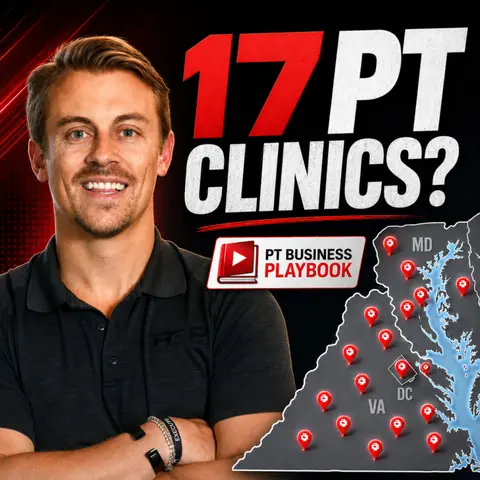
Josh Funk on Scaling Rehab 2 Perform and the Business Future of PT
In this episode, Seth Peterson talks with Josh Funk, founder of Rehab 2 Perform, about private practice ownership, business growth, staffing, reimbursement, clinical education, and the future of physical therapy. Josh shares how his own rehab experience at Ohio State inspired him to build a more active, performance-oriented community rehab model. He explains how early entrepreneurial experiments, side hustles, personal training, coaching, and customer service roles helped prepare him to launch

Aug. 21, 2026
Dr. Thomas Ibounig on Incidental Rotator Cuff Abnormalities and Shoulder MRI
In this episode, host Leda McDaniel speaks with Dr. Thomas Ibounig, shoulder and elbow surgeon at Helsinki University Hospital and researcher with the Finnish Centre for Evidence-Based Orthopaedics. Dr. Ibounig discusses his 2026 JAMA study, “Incidental Rotator Cuff Abnormalities on Magnetic Resonance Imaging.” The conversation explores how common rotator cuff abnormalities are on MRI, including in asymptomatic individuals, and what that means for clinicians interpreting imaging findings in pat
Aug. 14, 2026
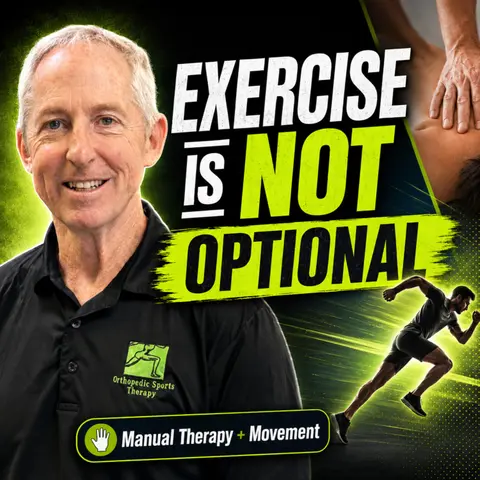
Tim Fearon on Exercise, Manual Therapy, and Patient Responsibility
In this episode, Seth speaks with Tim Fearon, a respected leader in orthopedic manual physical therapy, about the role of exercise in manual therapy practice. Tim reflects on retirement, mentorship, and the clinical evolution that led him to place exercise and patient responsibility at the center of care. He shares how early mentorship shaped his manual therapy skills, but how recurring patient problems forced him to ask a harder question: if symptoms improve but the problem returns, did we rea
Aug. 7, 2026
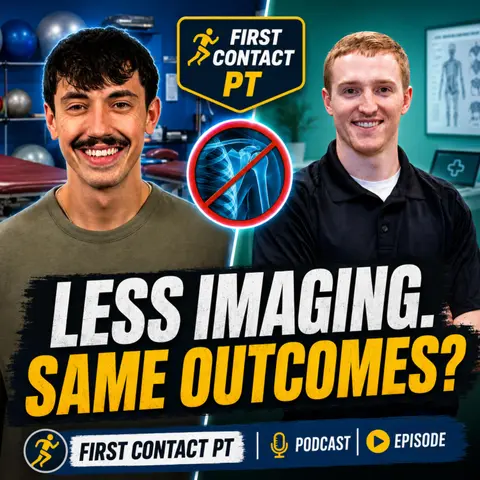
Should PTs Be the First Provider for Musculoskeletal Pain?
In this episode, host Dr. Nick Rainey is joined by Dr. Bremen Abuhl and Dr. Dallas Ehrmantraut to discuss their 2025 Physical Therapy Journal article, “First Contact Physical Therapy Compared to Usual Primary Care for Musculoskeletal Disorders: A Systematic Review and Meta-Analysis of RCTs.” The conversation explores whether physical therapists should serve as the first point of contact for patients with musculoskeletal disorders and how first contact PT compares with usual primary care. Dr. A