June 27, 2025
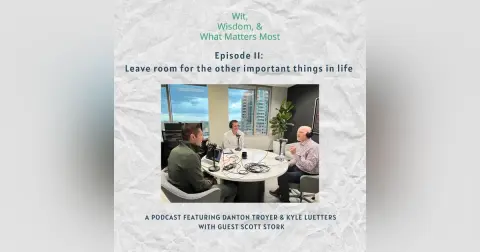
Episode 11 Leave room for the other important things in life

 Apple Podcasts
 Spotify
 Deezer
Wit, Wisdom, & What Matters Most podcast Episode 11 featuring Scott Stork Kyle: Welcome to another edition of Wit, Wisdom, and What Matters Most. It's a podcast with Moneta's Gast Freeman Troyer Racen Team. My name is Kyle Luetters; I am joined by Danton Troyer. And, Danton, on this episode, someone that we've gotten to know here as of late, we've been able to work together a bit, is Scott Stork, an estate planning attorney with Polaris Law Group here in the St. Louis area. And I thought a really interesting conversation with a key moment that folks will hear about, about how he decided to truly pursue estate planning. Danton: Yeah, it's one of the most chilling and maybe motivating "whys" out there, especially for a career and kind of getting that going as well. And then talking about how you balance that with family and just the day-to-day that is life. So, a great, great interview with Scott and just talking about how he's been able to achieve his success. Kyle: And here's our conversation with Scott Stork. And welcoming to Wit, Wisdom, and What Matters Most, it is Mr. Scott Stork. Scott, welcome to the podcast today. Scott: Thank you very much. I appreciate being here. Kyle: This has been a long time coming. We met each other here a while back, had a wonderful cup of coffee at Picasso's, talking shop. And then, kind of throughout our journeys together, we got to learn more about one another's businesses and our practices. So, you know, for everyone that is taking the time to listen to this, kind of describe your background, like where you came from, how did you get into estate planning, and how did basically, how did we get here? Scott: Okay, yeah, absolutely. So, I've been a lawyer for longer than I care to admit. So, since 2002, which I think makes me very officially middle-aged. So, I actually didn't start out my career doing this. I never had any idea I would be doing this. I spent the first half of my legal career as a prosecuting attorney between Virginia and here in Missouri, and did that for quite a long time and did a lot of trial work and litigation and things like that. And when I went into private practice, I had anticipated I was going to stay doing litigation and trials and all of the things that I really liked to do. But through kind of a confluence of events, I started to do, to dabble, I would say, in estate planning, which a lot of people in private general practice do. And I had a friend that got very sick. He was 35, so he was certainly not old. He got cancer. And kind of a long story short, we ended up signing some of his estate planning documents the day he passed away in the hospital. And that had an enormous effect on my complete outlook on everything. I realized that nothing that I had done up to that point with him made any difference as far as his family's future or anything like that. And so I made the decision basically right there that I wanted to focus on estate planning and not do litigation anymore. And that was pretty much the change in my practice and I've been doing estate planning as the only thing that I that I do ever since. Kyle: Yeah, that's incredible that you have that story. And for a lot of people that get into business, especially entrepreneurs, there's like a seminal moment that you really, that like a switch flips. And you may not become an entrepreneur right at that point, but there's usually something, an event you can tie back to that really kind of flips that switch into getting you on the path that you're on now. Scott: Yeah, absolutely. And it really was the kind of the moment where, again, my worldview changed. I also realized I didn't know enough to really do good estate planning for clients. And so it caused me to join some organizations where I basically got a post-secondary, so to speak, education in estate planning. And it's really changed the way that my partner and I practice and that our law firm practices. So yeah, that was kind of the, that's my background and that's my why of what I do. Danton: Yeah. So with that, that's a pretty big transition. And I know you have a family. How are they affected or how are they able to support you through that? Scott: Yeah, so it's actually, I didn't have kids when I started this. Danton: Makes it easier. Scott: Yeah, right. So like, hey, I can make a, make a shift and not a big deal. I think it's actually made a very positive transition. So when you're doing litigation and, and lawyers who do litigation and you're off to different courtrooms and in different municipalities or, you know, St. Charles or St. Louis County or the city or wherever you're at…it tends to just kind of be hair on fire, even though I don't have any. Kyle: That's where it went! Scott: Yeah, that's right. Yeah, exactly. So when you do that, it's really difficult to do a lot of the work-life balance. One of the things that being kind of full-time in estate planning and having a more steady clientele and a cadence to how we plan with people has actually been to make it easier to really have that work-life balance. And that was something that was really important to my partner, Ray, and I because we both have young kids now and families, is how can we make sure that not only we have work life balance, but everybody that we work with has the same. So it's really informed and shaped how we have developed our law firm. Kyle: You, you mentioned Ray and I want you to - we've been talking about you - now talk about Polaris as a firm, so describe, you've mentioned Ray…give us the lay of the land of the firm. I know you guys are growing. We were able to go to you guys' open house late last year, which was a wonderful thing. it's a beautiful facility. But tell us a little bit about the firm as it sits today and maybe a little bit where it started. Cause those are always a good story. Scott: Yeah, it started with me. 2013 it was basically me striking out on my own in about a 1,500 square feet office in St. Charles County. And it was kind of just trying to start getting clients. Right. And it's grown steadily over the years. So my partner and I both were in the St. Charles County prosecutor's office back in the mid two thousands, and we'd been friends for a long time. I started my estate planning firm and for the first four years or so it was me and an assistant. And then Ray and I complement each other very well, as hopefully lots of teams do. He's strong in areas that I'm weak in and vice versa. And so we joined up in 2017 after about a year of talking about whether or not it would make sense, and started Polaris in St. Charles off of I-70. And we have grown our practice over the years and brought on staff and things like that. Our practice is a little bit different than a lot of estate planning firms. We aren't kind of a transactional type of firm. So we have ongoing relationships just like you all do with, with clients where we keep their plans up-to-date and make sure that they still work. And so that's for us, we have about 350 ongoing clients on that program. And it also caused us at the beginning of this year, as you talked about, to open a second location in Creve Coeur so that we can increase the amount of people that we're able to help, and it's increased the amount of staff that we've got. So we've got about 10 people currently in our firm plus the two of us, so over the two locations, that's kind of our setup right now. Kyle: Very neat. Danton: Yeah. What would you say, I mean 2013 wasn't that long ago, and going from a one-man-show to 10 people to two locations…what would you say is the biggest driver of being able to do that? Scott: Um, the biggest driver…So most law firms aren't run like the businesses that they are. And so, lawyers tend to, we aren't trained - just like most other people - on how to run a business. I joined a coaching program a couple of years ago, three years ago now, we joined and that's been really instrumental in finding weak spots within the firm. You know, one of the reasons that we have so many staff is because we have so many different things we're helping clients with along their estate planning journey and after they're done. And so it's putting the right people in place to do that because when you get a lot of firms where it's just the lawyers who are doing the work, so to speak, you know, lawyers aren't good at managing time a lot of times. And so, Kyle: Really? Scott: Yeah, right? That there, there's your nugget for today. Danton: We didn't say it; wasn't us. Scott: Nope; nope. Kyle: And I just was inspired to dig deeper… Scott: Yeah, and so, you have lawyers who for whatever reason are in court or out of town or whatever, if they're the only ones with their fingers on a certain case, it's going to be weeks sometimes before they get back with clients. And we don't want that. That's not how we want the client experience to be. And it's really kind of driven a lot of our growth, by having so many loyal, ongoing clients. And I think we're able to give them a good product and a great experience -and we do that on an ongoing basis. And, and so between word of mouth and everything else, that's kind of allowed us to grow the way we have. Kyle: Sure. You mentioned when we were kind of chatting before this whole thing kicked off, like, you know, getting your marketing, it was, it was going, and then there were some changes, and then now you're getting going back again. It feels like in marketing, especially in small businesses, in professional services, it is so much about the day-to-day blocking and tackling and showing up. Scott: Absolutely. Kyle: Can you guys describe some of the ways that you all market to get the word out about your business in your chosen industry? Scott: Yeah, it can be difficult, as you all know, because what you really have to do is - people don't like to talk