Sept. 10, 2025
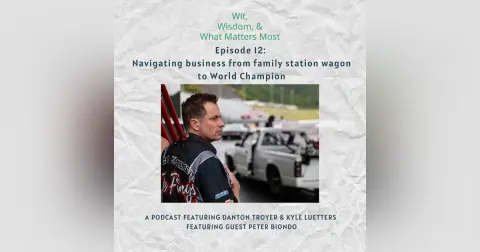
Episode 12: Navigating business from family station wagon to World Champion

 Apple Podcasts
 Spotify
 Deezer
Wit, Wisdom, & What Matters Most podcast Episode 12 featuring Peter Biondo Kyle: And welcome to another edition of Wit, Wisdom, and What Matters Most. It's a podcast with Moneta's Gast Freeman Troyer Racen Team. My name is Kyle Luetters. I'm joined by Danton Troyer. And Danton, a bit of a blast from the past for me on today's episode; someone that I used to get to work very closely with: a gentleman by the name of Peter Biondo. And Peter is a champion drag racer, family man, and wildly successful event promoter. And this conversation kind of went all over the place, like we talk about nicknames, we talk about economics, all sorts of stuff. It was fascinating. Danton: Yeah, I have no background in racing. So for me, it was just, you know, it's good to hear that side of things and just learn about a new area that I had no idea about. Kyle: So like I said, we'll cover how he got started in racing, the family background, his racing career, what has meant the most to him. And then the genesis of how one event back in 2010 has now led to arguably one of the most, if not THE most successful brand of bracket races out there. So without further ado, here's our conversation with Peter Biondo. And welcome to Wit, Wisdom, and What Matters Most, Peter Biondo. Peter, joining us from New York. How are you doing today, my friend? Peter: Doing good, doing good. Definitely can't complain. Kyle: Well, obviously not. It looks like it's a sunny day there, at least from what we can see, and we were catching up before we got started here - a lot of positives going on in life. But you and I have known each other for quite some time. We've worked together for a good chunk of that time. And then we were in a small group together and really did life together for a while. And I've always found your story, both in life and racing and business, to be very fascinating. So I wanted to see if you would kind of start at the beginning and talk about how you and your family got involved in drag racing and then kind of the genesis forward as you've now become a successful racer, a successful entrepreneur. And anyone nicknamed the Terminator has to be tops in what they do. Peter: Well, I appreciate that. So, yeah, guys, my father…I was born into it. My father in the late '60s was in a street gang, not really a gang, but street racers. And after the cops got them off the street in the early to mid-'70s, which I was born in the early '70s, my father started going to the racetrack and my mother passed away when I was born, so my father had a three year old, a two year old and a newborn. So we were forced to spend time together and that time was at the racetrack. Kyle: And then your dad, there's a real interesting story, too, I think, about the family station wagon, too. Talk about how dad got started with the racing and how Biondo Racing Products really got going too. Peter: Yeah, so that that's interesting you said that because the station wagon. And so basically, we grew up at the racetrack. Like I said, as a toddler, I had no choice. But as we grew up and got into our early teen years, my father gave us a choice and we played sports and did some other stuff, but we always gravitated to the track - we loved it - to the sport of drag racing. And so the way the business started, we would race the family station wagon. We would literally tow - the family station wagon would tow the race car on an open trailer. We would get there. Of course, the station wagon was 200 degrees by the time we got there, we'd unhook the trailer, and my brother or I would go race it when we were of age. First, my brother; my father would unload the race car, and that was our weekends. Now, to beyond the racing products part of it, my father, I didn't really know what he was doing. He was very, I mean, we spent a lot of time together, but he didn't tell me that much about business when I was 13 years old. But all of a sudden he writes "Practice trees for sale," on the side of the station wagon. And I'm racing. And he goes, yeah, if anyone asks you, just tell them we have practice trees for sale $299. And he really was the pioneer of that. And a practice tree, for those who don't know, are basically the starting line simulation of a drag race and which is very important to master. So we started selling them. His best friend was making them out of his bedroom and we started going to UPS from my one car garage, which I live in that house now, and as a team, my brother, as we were in our teen years we just stayed as a group, stayed together and worked together. And that's how the business started. Kyle: So your genesis to there's the family business you started talking about racing with your brother. How did your racing career progress from those days going with the family in the station wagon to really being like a multi-time NHRA (National Hot Rod Association) champion, getting the nickname that we referred earlier, and really being known as one of the IT guys for a long period in NHRA racing? Peter: Yes, so you know, I was very passionate about it. And whenever you're passionate about something, whenever I'm passionate about something, I tend to go all in, and I practiced a lot. I'd say right around the early 1990s, I was dominating locally. And I told my father, I said, "Dad, I want to try. I want to travel nationally and see how I can do." And right around the mid-'90s is when I made my mark in NHRA. Danton: It's kind of impressive. There's one thing that's to me is that, I think about my kids and I like to golf and do some things. And they seem to…anything I say that they should do like golf or other activities, they run away from. But seems like it had the opposite effect for you. So I was just curious how your dad was able to still keep racing, make it fun for you, even though it was maybe something you quote unquote, "had to do." Peter: That's a great question. And my father was very careful in not forcing us to do it and leaving the road wide open. And he told us that over and over. I mean, I started playing hockey. I started playing some sports. But as he just kept saying, "You want to come next weekend?" And I would just say, Yes, yes, yes." So it was totally my option. You're right, though, you've got to be careful as a parent myself, as we all are with young children, when they're in their early teenage years you don't want to hold them captive to one thing and you want to let them grow. And I just gravitated towards it, man. I'm a competitor. I love the competition aspect of it. I love the fact that it's not all about speed, although speed is definitely an adrenaline rush. But it's also about a lot of logic. It's a lot of figuring out the weather and how it's going to affect your car, and putting all the pieces together. Whoever can do that the best and then execute on the racetrack. That's what really drew me to it – it's very challenging. Kyle: Peter, you mentioned something that was pretty interesting there. All the elements that go in there. You meet folks that are not necessarily in the racing industry or they're not necessarily familiar as much with drag racing. How do you describe it to them all the work that goes into things? Like what if someone comes up to you and says, "Well, you guys are just going down a straight line when the light turns green." How do you describe all the intricacies that go into it in a short, compact way? Peter: The best way to describe it is just like I just did. It's basically there's a lot of elements, factors that come into play, and you have to mix them all together. And the big thing is, like anything else in life, you have to know what to listen to and what to put your effort toward and what not to. And what not to is more important because you could easily go down the trick-of-the-week avenue and you're wasting time and you're wasting your mental energy. So, yeah, I mean, I will say this…a good friend of mine who grew up in the neighborhood asked me to teach him how to race about 15 years ago. He was getting back into it; he never really raced on a high level. And I sat with him and I explained everything over a whole eight-hour period. But then we went to the track and I drove his car at a national event. And after the weekend, he said, "I cannot believe, like I would have never guessed all this goes into that." So to answer your question, guys, you'd have to kind of be on my arm for a weekend to really know everything that goes into it. Danton: Yeah, you already explained more than I would have ever known that goes into the car. I mean, I certainly knew it was more than meets the eye, but just the extra steps that go into it. I think most of us watching who don't know anything about it think it's push the pedal and go. But obviously it's a lot more. Kyle: Peter, as you look back on your driving career, there's obviously got to be a lot of highlights. Is there like a couple, two or three, that really just stand out to you? Big wins or weekends that really stand out that you're awfully proud of from a driving aspect? Peter: Yeah, I would say the two that stand out the most was in the mid '90s, I went to the U.S. Nationals for my first time. And that's the granddaddy - that's like the Daytona 500 or the PGA Tour. I don't know, everyone can relate to golf, so Danton, what's the biggest golf tournament? Danton: I mean, you might have the Open, it's coming up pretty soon, it's pretty big. Peter: Yeah. So, it's in Indianapolis, so it's like West Coast and East Coast. All the talk during the year. Who's the best? Who's who meets at this granddaddy race. And I won it in 1993 as a 21-year-old, a 22-year-old. And my father was there, and it was my first national - that win at that race. And him being there and there's a picture of him on the starting line, like with tears you could see in his eyes....