Dec. 9, 2024
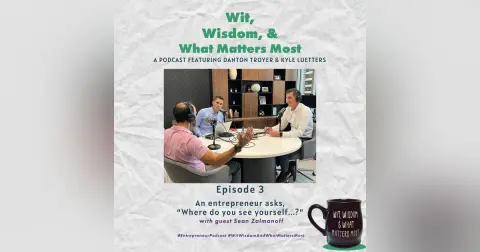
Episode 3: An entrepreneur asks, “Where do you see yourself…”

 Apple Podcasts
 Spotify
 Deezer
Wit, Wisdom, & What Matters Most podcast Episode 3 featuring Sean Zalmanoff An entrepreneur asks, "Where do you see yourself…" Kyle: And welcome to another episode of Wit, Wisdom, and What Matters Most. It's a podcast by Moneta's Gast Freeman Troyer Racen Team. My name is Kyle Luetters, joined by Danton Troyer. And Danton, on this episode of the podcast, the way we met this guest, or the way I met this guest, you met him when he came into the studio, but I met him at 5:30 in the morning in a park in Kirkwood about three years ago. So the gentleman's name here today is Sean Zalmanoff. And Sean owns a mortgage company, Better Rate Mortgage. And before we get into the mortgage industry, Sean and I do this thing, it's a men's workout group called F3, and you get together and you work out early in the morning. And you can tell a lot, I think, about someone's drive and their goal setting by whether or not they're going to show up at 5:30 in the morning, no matter rain or shine. And so in this episode, we kind of talk about how Sean got into this industry, the journey that he took to get to where he is today, because he was at one of the larger companies and won't give away the entire thing, but there was a bit of a hard right turn, and a few other things that he brought up in his conversation about the industry itself. Danton: Yeah, and I found it interesting just from his perspective and working through different firms, as you mentioned, and then hearing some of the stories of what to avoid, especially as a consumer in the mortgage industry, and those free lunches you hear on the radio or the TV sometimes aren't so free. And so it was good to hear how to avoid some of those pitfalls, as well as how he manages a business, but also works with his family and is able to take care of his kids and really have a good relationship with them and use that as a drive for his business as well. Kyle: It really was a story about an industry as well as entrepreneurship, but I think most importantly, and what I hope everyone takes away from this is the power of clear vision and what that means. And with that being said, here's our conversation with Sean Zalmanoff. And back on Wit, Wisdom, and What Matters Most with Sean Zalmanoff, Sean, welcome to the podcast. Sean: Thanks for having me today. Kyle: Perfect. So, Sean, very interesting type of a conversation you and I had here a while back over a cup of coffee. We've been, I guess you could call it workout buddies, for quite a while through an organization called F3, and it was really the first time you and I had the chance to sit down and talk about business and what we did and how we do the things that we do. So, you know, Better Rate Mortgage, your firm now. Describe the genesis. How did you get started in the mortgage industry? And then kind of take us through the steps, because I found it to be a very interesting story of entrepreneurship. Sean: So I graduated college in '00, and I wasn't quite ready to leave school yet. So played in Columbia, Missouri for another year. 9-11 happened, and I basically become a professional job interviewer. I think I interviewed for like 60 or 70 different jobs. And so during the course of that time, what I really realized that I wanted to do, I wanted to help people and I wanted to solve problems. And sales was just a natural fit, because I like to talk to people. And there was a gentleman who came into the bar that I managed all the time, who was very successful in the mortgage industry. And then after 9-11 happened, interest rates dropped a lot, so there was even more opportunity. But it was really interesting from the restaurant standpoint. You know, everybody's heard of Reagan and trickle-down economics. And so during the course of my entire college career, I mean, it was just faucet on economics. Kids had lots of money. Parents' stock portfolios were doing really good. They spent lots of money. 9-11 happened and portfolios got cut in half and nobody spent money anymore. So, I was like, oh, you know, I think it's time to go get a real job. Yeah. Kyle: And obviously, too, as we're recording this, just coming up on 23 years of that. Sean: January 2nd will be 23 years. Yeah. Kyle: For you inside. OK. Wow, all right. Sorry. Go ahead. Sean: So he had an office in O'Fallon, Missouri. I worked there for a few short months. It was probably seven or eight months. I learned everything that was wrong with the industry. If you imagine like a boiler room set up where kids in the back were ripping pages out of phone books. This was before the do not call lists, and we're just like calling people for refis and transferring up - that was what I was learning. I almost started a company that was just going to charge a flat fee and review people's - we called them good faith estimates at the time - where terms were laid out and just consult them and be like, pick this deal, because what they were doing was terrible. Bounced around to a couple of different companies over the next four years. And then in 2005, I opened my own mortgage brokerage company at that time; ran that for four years. But I had never worked in a big corporate environment. Kyle: Okay. Sean: And so I didn't have some of the experience that I felt that I really needed to grow and take my career to the next level. So, 2009 happens, great recession, end of days of our industry is upon us once again. And I had an opportunity from a company too, that didn't have a presence where my office was in St. Louis City at the time. And so they asked if I would open up an office for them. And I did and I ran that for the next 13 years. And it was a great place to work; it was a great ride. But the last nine years that I was there, I grew my region, we were doing a lot of loans. I don't need to share numbers, but we did a lot of loans, we helped a lot of people. But I was managing offices in five states, I was managing 70 plus people. And the interesting thing about loan officers is loan officers are typically sad when they're sad. And then they're sad when they're happy, too. Danton: I haven't heard that. Kyle: That's a wide range of emotion right there. Sean: And so it just, it grinded on me. And so a few years ago, I was on a vacation sitting on a dock and I was just like, what do I like about the industry? What do I not like about the industry? So, I just took out the old scientific sheet of paper and I wrote everything that I liked on one side, what I didn't like on the other. And what kept coming up was, you know, the same thing that I got me in the industry was helping people. And for a while, I was able to help a lot of loan officers. Maybe my time had just come. Maybe my message was a little bit dull, but I wasn't helping them in the same way that I felt I used to. Some of them were grinding on my soul a little bit as well, too. And then I wasn't forming any relationships. I hadn't originated in nine years, so I wasn't - an origination, that's actually helping the individuals who need mortgages get mortgages. I was just managing the team. Kyle: It's like boots on the ground, like meeting with actual clients. Sean: Meeting with actual people, yeah. And so I wasn't doing that and I wasn't forming relationships with financial planners, with realtors anymore. And it just kept coming up. These are the things that I like to do. So, I actually cut the vacation a little bit short and I went home and I wrote a business plan and then was like, well, what company fits this model that I want to do? And there really wasn't one out there. And just with being in the industry at that time, 20 years, I knew that I could open a company to help individuals at a cost - I could close loans at a cost that most other companies couldn't open their doors at. And one of the things that, I like listening to other successful people, and so something that Jeff Bezos said about a decade ago that I saw in an interview. Somebody asked him, Jeff, what do you do in your industry to prepare for the next 10 years? And what is changing and how are you adapting to those changes? And he said, great question. Very political answer, you know, great question. And then answered how he wanted to answer it. And he's like, well, we really ask ourselves is what's going to be the same five years from now? What are we doing better than everybody else? And how do we continue to do that better than everybody else? And in my industry, people like to call it something different, but we're a commodity. People say you got to be, if you're cheap and fast, you can't be easy. I mean, in the mortgage world, if you're not cheap, fast and easy, you're dead. And if you're not dead now, you will be in five years because technology helps us a lot. And when I coach other loan officers, one of the things that I often tell them is that there's going to be a time, and it's not in the very too distant future, where they measure the money that they make, not by how much they make a transaction, but by how much they make an hour. Because consulting people and then delivering AI and a lot of things takes a lot of work off of my plate. So I can close more loans now than I could 10 years ago in the same amount of time and in 10 years from now, I'll still close more loans, but I will within the same amount of time. And so I wanted to build a company that 10 years from then would still be relevant, competitive, and industry leading in rates, because that's what matters. And that's why I just led with Better Rate Mortgage and opened the company that way. Danton: Wow. So, outside of the office, what do you have family that supports you or what else is there for you? Sean: So, I have two amazing boys; they get the majority of my time. A lot of my community outreach and things that I did in the past, they're eight and ten, so it really revolves around them....