Feb. 12, 2025
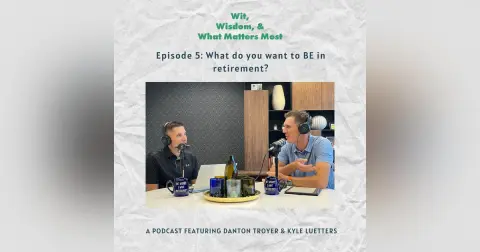
Episode 5: What do you want to BE in retirement?

 Apple Podcasts
 Spotify
 Deezer
Wit, Wisdom, & What Matters Most podcast Episode 5 featuring Steve Kyle: And welcome to another edition of Wit, Wisdom, and What Matters Most podcast with Moneta's Gast, Freeman Troyer Racen team. My name is Kyle Luetters, joined alongside Danton Troyer. And Danton, very special guest on today's show as we continue to talk about retirement and the conversations around this particular area and topic. Well, we have a wonderful guest; someone that you've known for a long time, his name is Steve, he works at Charles River and quite a unique story. I'll bring you in to chat about him a little bit. Danton: I have known Steve for several years now and really got to know him both as a client and I've gone on a couple golf trips with him. So, you know, it's quite a unique relationship as far as working with a client goes, but I'm definitely excited for this interview and to hear the stories that Steve will share with us. Kyle: And with no further ado, here's our conversation with Steve. And jumping in here to our conversation, we have Steve with us here. Steve, welcome to the Wit, Wisdom, and What Matters Most podcast. It's good to see you, good to talk to you today. Steve: Great, thanks for having me; appreciate it. Kyle: So, I know that I'm going to bring Danton in here on this one because you and Danton have had quite a relationship. I'll let Danton kind of take over from here because Danton and Steve, you've known each other here for quite a while. Danton: Yes, Steve and I have known each other for several years now. It's been a fun client relationship and even getting to go play some golf outside of the office, as well. So, we've definitely had some fun times over the last several years as well. And so hopefully today we just talk about as you approach retirement and what that feels like and looks like for you. And I'm sure we'll get some good stories out there as well. Steve: Oh, good, yeah. Perfect. Kyle: Right, so Steve, you're at your Charles River Labs. Steve: Yes. Kyle: How did you end up there because the fascinating stories are how do people end up in the situations and the places that they end up? So, give us the lay of the land, give us the journey, how did you get to where you are today? Steve: And it is kind of an interesting story. So, I've been working, I have a PhD in toxicology. I've been in the toxicology pharmaceutical business now for 25 plus years. I've worked at a number of major pharmaceutical companies throughout my tenure. And when I was at the last one, I was recruited to Charles River Labs. And they made me an offer to come and help set up a new facility and I took it. What's funny about it is years later my boss at that pharmaceutical, that last pharmaceutical company, is the one who gave the recruiters my name. I found that he really wanted me to come. And through some offers they made that I basically couldn't refuse, I took the job. Then I found out years later, he told me that, hey, I got you recruited here. Kyle: Oh, that's quite the story. So, you mentioned a PhD in toxicology -describe kind of how you get that degree, what goes into your day-to-day world and lifestyle because we talk to folks that come from all sorts of different walks of life. This is not necessarily your run of the mill accountant or engineer or dog catcher. I mean, this is, this is a bit different. So, what does your day actually look like? Steve: So, my day or how I got here? So let's start with how I got here. Like everybody else, I went to college and was one of those people who did very well in high school, graduated third my class in high school, knew I wanted to do more. At first, I wanted to do medical school, like many, many people do, but I spent time with my own physician. He allowed me to go in and see patients and I realized that medical school wasn't for me. So, I started doing research as an undergraduate and that clicked and I knew that I wanted to go on. And so I ended up getting my PhD actually in molecular and cell biology from the University of Connecticut. And back then, everyone did what they called the postdoc, which is kind of like a residency or internship for PhDs, which I did at a very well-known lab at the University of Wisconsin. And then was recruited to my, unless my wife says it, my first job at what used to be called Park Davis Research in Ann Arbor, Michigan, where I was brought in to do a variety of toxicology jobs. I was then recruited to another major pharmaceutical, and then ended up at Charles River, as I mentioned. My day today is, now my title is chief scientific officer for safety assessment. I spend a lot of time working with our clients, many of my major pharmaceutical clients. I work on strategy, direction for the organization, general problem solving, and a lot of harmonization and alignment of our sites throughout our organization. I answer a lot of questions on a day-to-day basis. Danton: So, this is right up your alley then. Steve, you were talking about kind of high school on, but what was the thing you wanted to be when you grow up? How far off is it, or was it in the ballpark? Steve: Well jokingly, I don't know if I should tell this story in my role, but when I was in graduate school, I always thought I wanted to go into an industry and do research and industries, discover new drugs and things of that nature. And we had a grant, we were a joint grant, basically my PhD is in biochemistry, molecular and cell biology, with a heavy emphasis on protein chemistry. And we shared a grant with a toxicology group, and I figured I would sit in on some tox courses just to see what that discipline is about. And I swore to myself, after just sitting in on the classes, that I would never be a toxicologist. And it's kind of funny now that I am the head of or the lead toxicologist for the largest non-clinical CRO in the world. It's kind of funny that I ended up in this role. So, you never know where life's going to take you. Danton: Yeah, I definitely agree. Kyle: You make good mention of how you've gotten to the point that you're at, it's this fascinating journey. This is one of the reasons why I love having these conversations is the pathways are always really interesting. But we've talked about the past a whole lot, and let's talk about the future a little bit, because part of what we're doing on this podcast, at least in this series, is talking about retirement. It's not just necessarily folks that have been in retirement for a while, or they've just gotten into retirement. Walk us through maybe a little bit, how much longer you potentially see yourself working, and would anything change that? Do you have an eye toward that? I mean, at a certain point, everybody's going to kind of be done. But describe where you're at these days. Steve: So last year, I turned 60, so I've reached that threshold. So, as you know, as you're getting to your 60s, and you're now in the age group and your peers and your friends and family are probably of similar age. They all either have or are looking at retirement as well. I'm in that same ballpark. When I exactly retire, Danton and I have kind of set a date on paper, but it's not written in stone. I really still like what I'm doing. I like contributing to the organization. But it is on the horizon, I'm not going to say how far. I'll say somewhere between four and seven years, right now. So what could change that? I think everybody who works, whether they just started or are in my shoes or a person a year from retirement wakes up every day and says, is today the day I retire? Danton: Yeah. Steve: You know, you open your first email and you're like, oh, gee, I think I should retire today. Kyle: Today's the day! Steve: But then there are successes and the things that work really well, and so you keep going. So, you know, that's for me, but I do think about it because I am getting closer. I have, as I said, peers and friends and family who are either looking at retirement in a very short amount of time. But as I said, I really like what I'm doing right now. What could change that? Of course, winning the lottery. I always think about my first phone call after winning would be to Danton. Like, okay, how do we take this money and what do we do? You know, the industry is always changing. That could have an impact. Either one way I stay longer, leave earlier, whatever. But right now, it's again, I really don't know what could change that. Those are the probably the biggest things is what's going on in the industry or if I don't like what I'm doing anymore. But I don't think I'm one of those people that can just stop. Danton: You mentioned a lot of people around you are contemplating retirement. Have you seen either family, friends, or co-workers who went into retirement and did it well, you thought? Or the other side of it, have you seen anybody who you were like, I'm not doing it that way; I think that was a big mistake? Steve: I've seen all of it. I've seen people who have retired and have walked away and never looked back. A friend of mine who I've known since my very early days at Parke-Davis retired. Said if he ever did go back, he would maybe join a biotech, but never in large pharma again. Within two weeks, he was back in large pharma. So, you know, I see people who, a friend of mine recently retired in the last year or two, retired, but now he's off consulting. I think it's just that most of the people I know and interact with are similar, similarly educated as I have, reached the same or similar levels or even higher in organizations, and they're not people who can probably just walk away automatically. There's always something; they're going to do something. They're not just going to sit and go play golf forever. Danton: How do you see that relating to you and your retirement then? Steve: Yeah, I'm thinking,...