Jan. 3, 2025
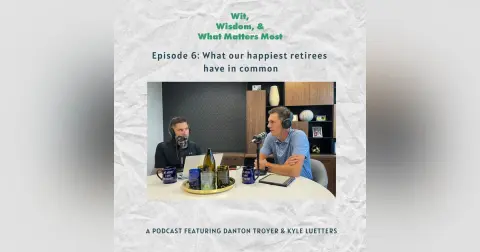
Episode 6: What our happiest retirees have in common

 Apple Podcasts
 Spotify
 Deezer
Kyle: Welcome to another edition of Wit, Wisdom, and What Matters Most, a podcast about the nuances of life. I'm Kyle Luetters, joined by Danton Troyer, and we're both on the Gast Freeman Troyer Racen Team at Moneta, a registered investment advisory firm. Danton, typically, we will have a guest on the show and we're talking to someone about their experiences in life, their stories. But today…no guest, but we're still sharing some of what I would say is the wisdom that you and I have gleaned over our time in the profession that we're in. And we're talking about retirement. We're talking about some of the best practices that we've observed in retirement. And again, everybody's story is different. Everybody's story is unique. But we've kind of been talking about the things that we've noticed that the folks that seem most happy, most fulfilled in retirement, what they kind of do. Danton: Yeah, I mean, we've heard stories from different individuals. But there's also stories that we just share from doing this over the last 17 years and seeing some folks have been more successful than others in their retirement; how they approach it matters. Kyle: And so that's what we're going to talk about today, just some of those stories. Yeah, and so we've kind of taken some of our observations here together and it will just kind of start rolling with those. But, you know, Danton, it's been very interesting. You mentioned the time that you've been doing this. I'll say that hasn't been quite as long, but it's now been long enough, I do have a few gray hairs to help mark the passage of time and I've had the privilege of working with a number of folks that were either retired when I started or have since retired. And one of the things I wanted to kind of toss out there was this idea of the folks that seem to be the most happy, most fulfilled in retirement…they have a good idea of the types of activities that they want to do when they get there. But they're also open to changing them. You know, we hear the story all the time of like, if I could retire and just play golf every day, that would be great. And I know that's probably right in your wheelhouse. Danton: It doesn't sound too bad. Kyle: Exactly. But sometimes what we hear is, is that folks will retire, they think they're going to do one thing, but then they end up doing other things and they kind of find themselves a little bit in retirement. Danton: Yeah. And we've seen folks that go in thinking, I'm going to have all this free time. I think that's the biggest thing people maybe are surprised about as they start to plan out their activities is that they don't have that much free time between, maybe volunteering and maybe golf and a couple other things. I mean, your schedule is pretty full. Hopefully it's doing things that are more enjoyable than going to the office every day, but people are a lot busier than I think they anticipate being when they head into retirement. Kyle: You know, that was one of the funniest things. We have a client down, down in the Mid-South, I would say. And he says, gosh, I don't know how I ever had the time to work! So, to your point, there is a lot that goes into the activities. And then we've seen, we've mentioned golf, so activity type stuff, taking more yoga classes or Pilates classes, volunteerism. Danton: Yeah. I think that's a big one that we've seen a lot and also contributes to maybe filling up calendars potentially a little bit faster because there's plenty of folks that need help out there and plenty of opportunities to volunteer. And so, if you are willing to volunteer for one of those organizations, they'll use you as much time as you'll let them. Kyle: Well, and also too, it does help fulfill this kind of innate human feeling of needing, or excuse me, wanting to feel needed, wanting to feel like you belong. And when you think about it, we work for the majority of our lifetime, we have a purpose when we get up in the morning and it's usually to go and do a vocation. When you get into retirement, sometimes that volunteering, that having a place to go, that sense of being needed is actually very, very powerful. Danton: Yeah. And we've heard that from even guests talking about not quite being ready to retire simply because they feel like they have more to give. And I've heard that from especially higher level executives and they just feel like there's more to give back into maybe the business world. And I think part of that is they haven't figured out how they can give back in retirement as well and maybe in a different way. Kyle: And one thing that we've heard too is that a lot of folks will say, I want to retire from something, but really it's retiring to something or somethings, so to speak. Danton: Absolutely. Well, I think one of the other ones that I've seen is folks trying to rely on their friends, family, coworkers, nowadays, social media, as they're going into retirement or really any financial decision. And I think those folks that are able to be secure and confident in their financial plan have less distractions as it comes to making these very important decisions. And, unfortunately, we've seen people make some pretty poor decisions in doing that, but also folks that have been able to kind of block that out. And then they bring the questions to us all the time and I think in a good way, versus some folks maybe don't bring them to us and just execute on them on their own. And a lot of times we end up cleaning up mistakes that they thought were a great idea, but potentially were not. Kyle: We call this brother-in-law at Thanksgiving dinner advice, and not to pick on brother-in-laws, I am a brother-in-law, and sometimes I do have bad ideas at Thanksgiving dinner. But, you bring up an excellent point in that one of the most beautiful things about what we do is each individual plan, each individual set of circumstances is customized to someone's retirement, to someone's goals and objectives. And frankly, selfishly, that's one of the most fun things about what we get to do is that no financial plan is exactly the same. No set of circumstances is exactly the same. So, each day, each year by year, it's different. Danton: Correct. Yeah. And I think my example, I won't say which family, but I was at Thanksgiving one year and there was an argument over basically what Medicare supplement someone's having. Someone said, I'm on a, well, they didn't say exactly, but I'm on a Medicare Advantage and it's free and you should definitely be on that one. And I always sit back quietly. I was like, well, they may have other health issues. I mean, you have no idea what their circumstances are to give them that advice, especially not at Thanksgiving dinner. So, I hope that person kind of went back and thought about it as it relates to themselves versus just taking blanket advice. And I may see that with social media, you know folks send us these -what seem like great ideas - but if you peel back a little bit, it doesn't work for them in any way. And in fact, could potentially hurt them if they would have tried that strategy just because it didn't work for them, but it may not have been necessarily wrong. Kyle: At times it's very difficult to paint with a very broad brush. There's a lot of little nuance and detail that some of those smaller brushes can help provide the color on. You know, one thing too, to bear in mind as well, that's different for each and every plan and client and family is, and this is I think a best practice, is having a good idea on monthly and or annual spending numbers. Because when we're working, we can continue to earn a paycheck. So, if we're spending money, we know that we're still going to work. Hopefully we're getting a raise or we're going to move to a different job and make additional money and that's going to take care of that when you get into retirement. It is really kind of interesting because you're no longer earning. You're now shifting gears to spending rather than accumulating at that point. So, the vast majority of the time, when we're taking a look at financial plans and projections and things like this and that, one of the biggest things that drives success is that expense and that spending number. Danton: Yeah. I feel like that's something we talk about almost every meeting with a client and it's either one or two ways where they have been a great saver their whole lives and they're actually struggling to spend the dollars versus the other side where they're calling up asking for more money every year. And they thought that they were only going to live on X amount of dollars, but it turned out to be quite a bit more and it was a surprise to them. And so I think having a good handle on that, going into retirement is one of the biggest keys, certainly for success. And obviously the goal is not running out of money. Kyle: Now, I think that's very important to notate that. And one thing that is kind of like a subset best practice I would say is, is that in the maybe two to three years before someone fully retires is, is going through some sort of a tracking exercise to really kind of get an idea. A ballpark is really what we're asking, like a ballpark because some years are going to be more expensive than others. Some months are more expensive than others. We both have kids so it seems to me like December's always usually more expensive than June, but then again, who knows, depends on when you take a vacation. So, that's definitely one I think we would like to share with everyone is just kind of having an idea of the spending amounts, just that way we can have confidence in the plan. Danton: Yeah, I agree. We see folks that have, like I said, done a good job saving on the flip side of that is allowing them to enjoy their retirement with the money that they're spending. And we see so often where someone's like, well,...