Sept. 24, 2024
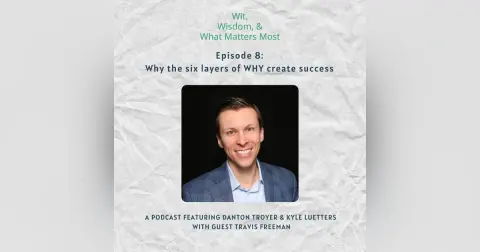
Episode 8: Why the six layers of WHY create success

 Apple Podcasts
 Spotify
 Deezer
Wit, Wisdom, & What Matters Most podcast Episode 8 featuring Travis Freeman Kyle: This episode includes a book recommendation, which is intended to be helpful or interesting to the listener/reader of this podcast. The book is not intended to be a source of financial or legal advice, please consult a qualified professional before making any financial or legal decision. This is not an endorsement or confirmation of any of the content, opinions, or recommendations within the book, or from the author. The author, Travis Freeman, earns compensation from sales of the book. As he is a Partner with Moneta, this can be a conflict of interest when the book is recommended to clients of Moneta. Please contact Travis if you have any questions about this relationship. Any trademarks and copyrights of materials presented herein are the property of their respective owners. Kyle: Welcome to another edition of Wit, Wisdom, and What Matters Most. It's a podcast with Moneta's Gast Freeman Troyer Racen Team. What Matters Most is different for everyone, and of course, you need to make wise decisions to be sure you and your family are financially secure, but that's only one aspect of your well-being. My name is Kyle Luetters, joined by Danton Troyer. And Danton, a guest on today's show that is actually very close to us physically, he's in the office next door. His name is Travis Freeman and he's one of the partners here on the team. We sat down with Travis because he has now written another book. Again, spoiler alert, it's about finance, but it goes much deeper than that. Kind of give us a little bit of a preview of what we ended up talking to Travis about. Danton: Yeah, it's a fun interview. I've known Travis since college. Just talking to him and understanding he's written one book, now he's writing a different book, still finance-related, but completely different, which we'll talk about in this podcast. But also just understanding his process, and how it was different from one book to the next, and the motivation was completely different as well. Really just understanding, why would you write another book? I had the, I don't know if privilege is the right word, but I saw him in the time he was writing the first book, and it certainly didn't create less stress in your life. It's a big commitment to write a book. Why would you do it again? There's obviously a good reason for that. Also, you see on TV, writer's block. I guess it's a real thing, apparently. Understanding how he was able to get through that quickly enough to keep the book on track without really just losing the entire book. Kyle: Exactly. The momentum thing, that was very interesting. He also gets into some of the nuances there of what's included in this book that's not included in your typical financial book, which I thought was really interesting. With that all being said in that primer, here's our conversation with Travis Freeman. At this time, we'd like to welcome a partner on the team, Travis Freeman to Wit, Wisdom, and What Matters Most. Travis is here today to talk about a new book that he has written, the second book that you have written in your career. Travis, number one, welcome, and then two, tell us a little bit about the new book, the title, what's the general gist of this new work? Travis: I appreciate you bringing up both books, but I will tell everybody don't go out and buy my first one. My wife told me it's boring and it was only about 92 pages long, but this one took me about four years, the new one, The Fortune of Youth. I've been told I cannot write a third one until the kids are grown because it took me four years of banging away at the computer for this one. Kyle: That's what your agent and your business manager said, correct? Travis: Yeah, yeah, there you go. Something like that. Kyle: Got it. Travis: Yeah. But this was, it was really written to help tell the story of what people have done, right? Because in this industry, we are blessed to talk to a lot of people and many people have found significant success, financial success. So, the book was about what have people done to reach the fortunes that they sought out to have? Not everybody wants to be a billionaire. Some people are really happy when they get to the enough threshold, right? And what could you do early in life to position yourself to get to that point? And if somebody is in their twenties, thirties, early forties that reads it and uses even half of what's in there, I think they'll do just fine. Kyle: Perfect. And so you mentioned that first book and you referenced it a little bit. How is this book - beyond just looking at it here on table, you're well beyond 90 pages - what's the major difference between the two books? Travis: So, the first book was more of a niche. You know, years ago, Danton and I were doing a lot of corporate presentations and trainings, right? And it got to the point where literally I could not travel and do more. So, I wrote a book on how folks could have their own training at a place of employment. So it was more for managers, HR folks, maybe a small business owner to have, right? This is completely different focus. Danton: Yeah, true. So, you know, maybe what was the difference? I mean, obviously between the two books, but you know, when you go into this, what was maybe a different mindset? Because, you know, you had your first book and you're like, I'm going to do this again. Why would you want to do this again? And what made it different? Travis: So, the first one I wrote in a year, this is BK, right? Before kids. Nice delineation there. Yeah, it was me at the computer pretty much every night after work. And I saw the first one as telling the story, but also just more of as a business card, frankly, to show that I have expertise in this area, to say I wrote the book on that. This one, I kept telling myself, okay, put together something that people are going to love and can practically use right away. And there were points where I had written an entire chapter and I'd go back over it and I'm like, this is silly. It's very technical, but I need to be able to have someone not fall asleep, right? I've got to have more stories in here and figure out how to take this technical thing and make it real simple to where they can just start using it, right? So, there were multiple times over the last four years where I would actually go back and just erase a ton of material. And it was hard, but that didn't answer your question, right? What was I thinking? I kept thinking, I have to make something that people are really going to appreciate and tell their friends about. And the hard part was having to hit backspace so many times and delete stuff, but it took some time and I think I got there. Kyle: I want to jump in here. So, four years of writing the book and you mentioned having to basically go back to maybe not a full blank page, but was there ever a point in that four-year period of time that you almost gave up on this pursuit? And maybe your wife had other words we can review later, but was there ever a time, did it mess with you mentally a little bit when you're going through that many revisions as to wanting to get the whole thing done? Travis: There was a point where I had, there was a lot going on in life and I hadn't touched the book in something like six or eight weeks. And then I went back down to the computer and had maybe an hour and I was just lost on where I stopped and had to go reread things. And I lost so much momentum that I ended up not even going back to it. I went back upstairs, got busy with the kids. I don't think I touched the thing for four or five months. Kyle: Wow. Travis: And the hardest part of writing a book is the momentum part. The first one was great because I just had a pattern. I did it in one year. The pattern, if I broke that, I just lost my momentum, had to go backtrack and read about what I wrote. And once I got back into the pattern, then I was able to go through that. So that's the one thing I'd recommend if anybody ever tries this is just carve out time and make sure you're always doing that. I probably deviated a little bit from your question there, Kyle, but that's something I learned a lot with the second one. Kyle: Yeah. Part of the reason why we ask the questions is we get the stories behind it once we get you talking. Danton: So yeah. I feel like you answered about six of my questions with that answer. But with the book, there were obviously different motivations for writing each of the books. What do you hope to get out of writing this book as compared to maybe the first one? But I mean, this is a completely different animal. Travis: What I hope to get out of this one is one of two things: One, let's say a younger person, right? Let's say someone just got out of college or high school. They read it. What would make me so happy is if I hear from them years or even a decade or so later and they go, hey, I read this book and I implemented these things and I can't believe I just hit a million dollar net worth or just bought my second home. Whatever their goal is, right? That milestone. Kyle: Yeah, some milestone. Travis: That would be so neat. And I really hope that happens. Or, someone reads this book and says, hey, and this has actually started to happen, I bought four of these, one for each of my kids and my niece and nephew because they absolutely need this, right? So that's started to happen. But I think the most fulfilling part will be when it comes full circle and people say, I did it; I followed it and it was life changing. Kyle: Yeah. There's something about like, here's the plan, follow the plan instead of trying to deviate too much. But if you actually work the plan, the result was what you were looking for. And that's got to be gratifying because you are kind of the person that's laying out the plan