June 11, 2025
Episode 9: Look at the emotional side of the ledger
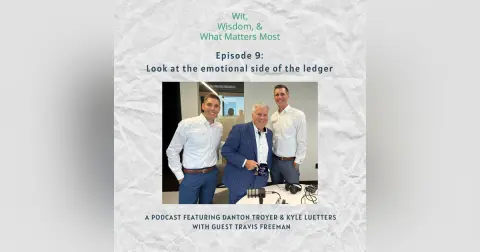

 Apple Podcasts
 Spotify
 Deezer
Wit, Wisdom, & What Matters Most podcast Episode 9 featuring Tim Hobart Kyle: The views expressed in this podcast are solely those of the hosts/guests and do not necessarily reflect the official policy or position of Moneta. Kyle: Welcome to another episode of Wit, Wisdom, and What Matters Most, a podcast with Moneta's Gast Freeman Troyer Racen team. My name is Kyle Luetters, joined by Danton Troyer. And Danton, very excited for today's guest, someone that you and your partner Travis Freeman have known for quite a while. It's Tim Hobart with H&H Health Associates. You want to tell us a bit about Tim? Danton: Yeah, gosh I can't remember when I first met Tim, but it had to have been at least 14 years ago. And I met him through Travis Freeman, our partner here. Tim has an employer assistance program. And so a lot of folks think about counseling services and he talks a little bit about flu shots, and there's certainly the typical employer assistance program. But also, he brought us in as a financial resource. And so, that's been our relationship for over the years. And now it's interesting to see, he's, you know, gotten older. We've all gotten older and transitioning to his kids, potentially, some of the duties. It's been a long time knowing Tim and he certainly helped me with my career and hopefully we provided some value for him as well. It's just great to see him doing so well. Kyle: Yeah, and so in this interview coming up, you guys are gonna hear about Tim, his business, how the business got started, whom he started a business with. And then probably the most interesting and unique thing to come out of the conversation was a class that Tim found after he went on a journey himself. And then it'll kind of wrap up with how he has transitioned his business and how he has started to embrace more of what he's going to do in retirement. So, it's a great conversation and with that being said, here's our conversation with Tim Hobart. And now joined by Tim Hobart. And Tim, you know, number one, thank you for coming here to visit with us today from HH Health Associates. Tim, if you could just describe what it is that you do. It's a fascinating service. Tim: Well, thanks to all of you for letting me crash your podcast today. It's good to be here. H&H Health Associates is a family-owned business. My wife and I started it about 39 years ago now. Donna, being a nurse by background, would go into companies and do such things as flu shots, OSHA reg screenings, blood work, and anything on the physical side of the ledger. Myself, having a background for almost 40 years in employee assistance services, counseling primarily, we decided to see if we could keep the marriage together and grow a company at the same time 38 years ago and decided let's give it a whirl. And the good news is the marriage has thrived and so has the business. So, employee assistance and on-site wellness to corporate America is what we've been doing for these many, many years. That's in a nutshell what we've been up to. Kyle: That's a very interesting thing when you talk about it and describe, if you will, what is your typical work week like because there's got to be some planning elements to this, there's got to be some on-site elements to it. Kind of walk us through what like a typical work week would be for you. Tim: So on balance, a typical work week for our nurses and for our counselors are, obviously counselors will be seeing employees of the companies we contract with for the issues that they're bringing to the table, whether it be family issues, kid issues, stress issues, trying to balance work and home issues. Nothing that you guys would be relatable to… Danton: Not at all (laughs) Tim: …but nonetheless the counselors are busy with helping folks get things back on track in their personal lives, their being the employees and family members. The nurses, lots of time spent on-site doing blood work, flu shots in the fall for example. Kyle: Okay. Tim: My typical work week has changed over the past five years because I've cut back from being the full-time CEO. And but it would be a lot around customer service, on-site presentations, management trainings, consulting with HRs on issues that come up in their world. Danton: So as you said, you started this business with your wife; how did you guys come to that conclusion to start a business together? I mean, I can't imagine starting a business with my wife. Tim: I can't either. And so you know that's what we jokingly say, can the marriage last? Because we're two different management styles, but we did talk about it long and thoroughly, and the good news is that we thought we were in both careers and our own work worlds, mine being employee assistance on the mental health side of the ledger and Donna being in the physical, the nursing side of the ledger, the physical - that these two had components and synergies that were helpful to companies. And so that's how we came to the decision. Danton: So what were you guys doing career-wise prior to starting H&H? Tim: My background's in sales and marketing, and I never wanted to be a counselor or a nurse. Danton: That's usually the case. The follow-up question is what did you want to be when you grew up? So how did you get the... Tim: Well since I wasn't gonna be a major league baseball player I guess, you know, I had not the skills. But in any event, I always liked marketing and sales, and management for that matter. You know I see what I do and what we do, is we're at the intersection of an owner, a CEO, a company's interest in the people that come in the door, employees, are okay. They're okay here and they're okay here. Well, what in the world could ever get in the way of that other than life? And so that cross street is labeled "issues," whether they be physical or mental health. And then how can we, the competitive side of enterprise, I love the marketing, sales, and management…the human side of our enterprise being, quite frankly, is helping people get things back on track regardless of where they are. Kyle: I'd like to ask this question. You've had a long and successful career. How have you seen the services and the issues evolve and change from when you and your wife started this business to where you all are today and what you're seeing today in the workplace? Tim: Well in one word, technology. And another word is COVID. That changed the game worldwide for how we go to work or don't go to work and work at home. And just the rethinking of everything transactional. A lot for the good, quite frankly. So for the most part of our careers, very hands-on and on-site. So if you think about it, an employee that is dealing with an issue and they want to get some help from a counselor, primarily before COVID, would pick up a phone, call our office and say, hey I got an issue with my teenager and I want to talk to a counselor. Fine. What office would you like to go to and what day do you want to come? So okay, thank you very much. Next Tuesday 7 p.m. at this office. I get in my car, I go there, I see a therapist, I make another appointment for the following week; do that for a number of sessions. Kyle: Okay. Tim: Post-COVID, well with technology and virtual links, employees can get services in their own home, in their own place, in their own space, at their own time, whenever, 24/7. So that really is a godsend for people who were locked up and we all know that now that virtual health care is becoming more of the standard. I would say about 80% of 90% of all of the people that we helped were in person, face-to-face prior to COVID. Post COVID, it's been flipped. Although we do find employees do appreciate a personal relationship, a one-on-one face-to-face. There's something about even in offices that have been virtual, people, we have found a number of people, have missed that connection, that community building, if you will. That gee whiz, I haven't seen Travis in six months and when I get in and I see Danton and there is something to be said about community building. And so now we're seeing much, much more of a hybrid. Kyle: Okay. You know, Tim, it's interesting that you mention that. Of course, Travis Freeman, Danton, one of your partners on the team, you all go way back, but speaking of our business, we have a lot of clients now that will request specifically virtual options. And then if they've been virtual for a little while and they come back in, I don't know about you, but the tone and the feel of the meeting is just completely different. Not necessarily wrong that it's virtual, but it's just a different tone. It's a different feel when we have clients that are typically virtual actually come into the office. Danton: Yeah, you definitely miss a little bit of that relationship building. As you said, that chit-chat before the meeting starts on Zoom or, you know, whatever you use, it's basically right to business. Which is great for a review meeting with the client, but you certainly miss out on just the chit-chat and catching up with kids. It's just not as robust. Tim: Exactly. Kyle: And I want to touch on something, Tim, that you had mentioned - that you have slowed down a little bit. You're no longer full-time CEO. Kind of walk us through what your glide path here is. Because it seems to me like there's a change coming or you're in process of a change. What does that look like? Tim: So, I really haven't slowed down, but I have made major adjustments. And then, like all of us, I mean, there's gonna be a time where you're gonna think, gee whiz, what's my next chapter gonna look like after I work? Retire? And the synonym for retirement is unemployment. Kyle: That's one of the best ways I've heard… Tim: Most of us haven't been unemployed since we were teenagers probably. Kyle: Certainly. Tim: But it did begin,...