MBFLP – Beginning Homeschooling
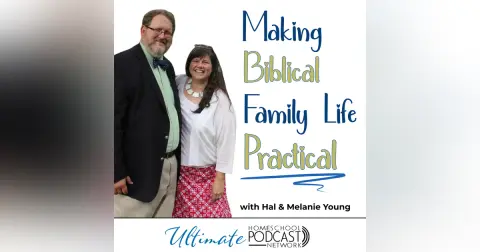


 News from the government and public schools has been disturbing recently, and homeschool organizations are reporting an increase in inquiries from families who are now considering moving away from the public school option. There are always questions though – is this legal here? Will my kids be able to get into college or a job one day? Will my family turn out weird?
This episode, we’ll share some of our own observations from over twenty years of homeschooling our own family – and maybe encourage you to take a serious look at homeschooling your own!
Thinking About Homeschooling? Every Question You’re Afraid to Ask (Sweet 13 Replay)
Thirteen years of this network, and some questions never change. Hal and Melanie Young sat down in 2015 to answer the four things every parent asks before they pull the trigger on homeschooling: Is this legal? Will my kids turn out weird? Will they get into college? And the quiet one underneath all of them — am I qualified to do this? Their answers have held up. We’re replaying it for the network’s 13th birthday.
Show notes
The question behind the question (01:10)
Families start asking about homeschooling when something in the headlines unsettles them. That was true in 2015 and it is true now. Hal and Melanie’s point: whatever drives you to look, the questions you ask next are the same ones every homeschool parent has asked.
“Is it even legal?”
Legal in all fifty states and most countries. Every state recognizes home education under some structure, and nobody is being asked to take a constitutional stand anymore — HSLDA’s attorneys already fought those cases. hslda.org → click your state → read exactly what your law requires.
“Will my kids turn out weird?”
Hal on what twelve years of classroom conformity did to him — the teasing, the pressure to not lift your head above the crowd, and how long it took in adult life to shake off. Melanie’s counter: homeschooled kids don’t get told that the way God made them is wrong.
The socialization answer
“The best kind of socialization is socialization for the adult world.”
Followed by the line that reframes the whole argument: you are preparing a young person for the grown-up world by sitting them in a room with twenty-five fourth graders exactly like themselves — and hoping they pick it up by osmosis. Homeschooled kids learn it the natural way, standing beside you at the town office and in the neighbor’s driveway.
“Will they get into college?”
The question dads ask when their child is three. The answer from the Youngs’ own house: three graduated, all admitted, all on academic scholarships. Many of the colleges they visited have an admissions officer specifically assigned to recruit homeschoolers.
“Am I qualified to teach?”
Teaching twenty unrelated fifth graders at twenty-two years old is a different job than teaching the child you have known since birth. Most of what happens in a classroom is crowd management. You are not doing that job.
“I don’t have the patience”
“There are days I feel like jerking myself baldheaded.”
And then: stop, take a break, go outside, go to the grocery store, start over. Every job has days you hate. This one just lets you reset.
The line that should be on a poster
“Potty training a child is way harder than teaching them to read.”
No PhD required. No teaching certificate. Either you learned it once yourself or you learn it a chapter ahead of your student — which, Hal points out, is what a scripted classroom curriculum has the teacher doing anyway.
“Can I afford it?”
One of the best phonics review programs available costs under $20 for a full year. Others cost hundreds. You choose what fits your budget and your teaching style. Plus: tutors, co-ops, video courses, online classes — you are not inventing this out of your own head.
“Where would I find the time?”
“Most homeschoolers can do most of their work before lunchtime.”
A couple of hours for second grade and under. Three to five in the middle years. Then it drops again in high school, because by then they are working largely on their own — which is the opposite of what most people fear.
No child left behind, actually
When you teach one child, you can see whether she got it. If she did, move on. If she didn’t, explain it another way. No child left behind and no child sitting around waiting.
Oxford, at the kitchen table
Their son called home from Oxford to say the tutorial system felt like homeschooling at the college level — small rooms, real conversation, no lecture hall with two hundred freshmen in it.
The biggest advantage, and it isn’t academic
“You are regaining hours and hours and hours of their lives every single week.”
Thirty or forty hours a week that would have gone somewhere institutional. The schoolwork gets done — probably better, certainly faster. What you actually bought is the hours around it.
When the hard questions come
The thirteen-year-old wrestling with her faith, the twelve-year-old asking who am I. Those questions are coming either way. They can surface between classes at the consolidated high school, or in health class, or they can surface in your kitchen while you’re there.
“The Bible doesn’t say a whole lot about academics, but it says reams about discipleship.”
Give it a year
“The reason you start homeschooling is often overwhelmed by the reasons you continue.”
Wondering whether to homeschool next year? Give it a full year. That’s the whole ask.
It’s our 13th birthday on the Ultimate Homeschool Podcast Network
More than $1,500 in prizes across four October drawings, and a free Sweet Treats resource bundle for everyone who enters. One entry puts you in all four.
Our Sweet 13 sponsors
This series is sponsored by Eden’s Table and the podcasters of the Ultimate Homeschool Podcast Network.
This episode’s sponsor is Eden’s Table — Biblical herbalism for the elementary grades. One plant a week, with science, history, art, reading and handwriting running through it as a single unit study. Open and go, no prep the night before. The first nine weeks are $39 at edeninstitute.health/homeschool.
This episode is sponsored. We only take sponsors we’d point our own families to.
 Loving Making Biblical Family Life Practical?
A rating and review in Apple Podcasts takes 20 seconds — and it helps another family find Hal and Melanie’s biblical wisdom for building a Christ-centered home. Leave a quick review on Apple PodcastsAlready reviewed? Share this episode with a family walking the same road.
The post MBFLP – Beginning Homeschooling appeared first on Ultimate Homeschool Podcast Network.


