Kayte Nunn – Desire Revenge & Courage


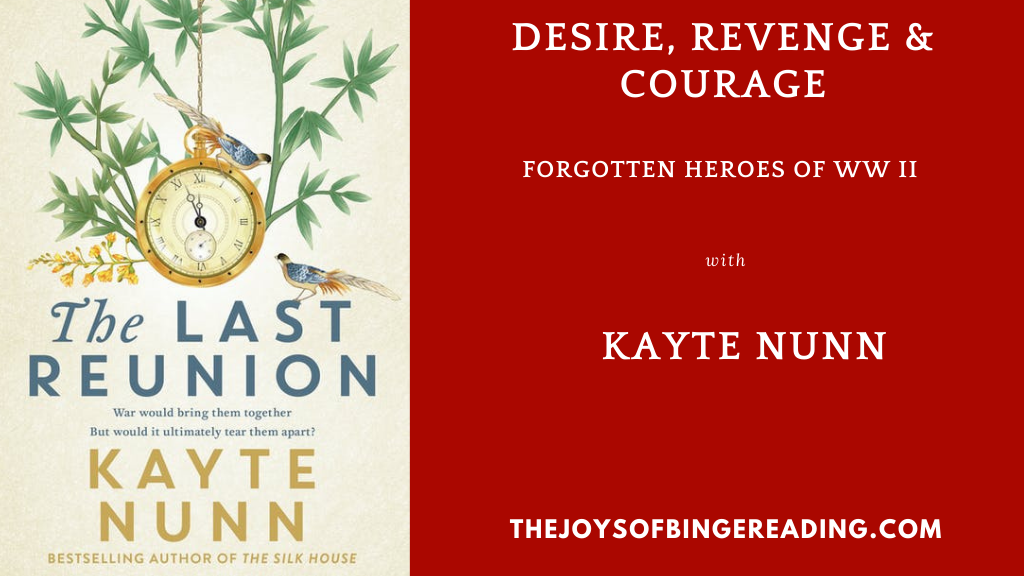
Kayte Nunn is an international bestselling author of historical fiction whose latest book, The Last Reunion, tells the story of five women buddies who served in the Australian Auxiliary Service in the Second World War in Burma. They meet up at a New Year’s Eve party after decades apart, and a thrilling tale of desire, revenge and courage unfolds.
This unit was a ‘forgotten’ women’s unit, attached to the Fourteenth Army, and serving closer to the front than any other women’s unit in the Second World War.
To mark Anzac Day in Australia and New Zealand, and to honor all women who served in World War II, we’ve got three E-Book copies of The Last Reunion to Giveaway to three lucky readers. (Enter below.)
Hi there, I’m your host Jenny Wheeler, and in Binge Reading today Kayte talks about inspiration and perspiration in the creative process – where each one fits – how fellow writers have encouraged her along the way, and how writing has a lot in common with running a marathon. Yes, if you don’t like the idea of running a marathon, maybe writing isn’t for you.
If you’d like to win a copy of The Last Reunion enter the draw on the link below. Offer closes April 30.
(Anzac Day – celebrated in Australia and New Zealand on April 25 – honors servicemen and women who served in wartime in the same way Memorial Day and Armistice Day do in other places.)
Six things you’ll learn from this Joys of Binge Reading episode:
- How Kayte moved from magazines to fiction
- Why she prefers historicals to romance
- Happy endings are important
- Why writing is similar to running a marathon
- The success of Aussie writers internationally
- How Jilly Cooper saved her as a teen
Where to find Kayte Nunn:
Website: http://kaytenunn.com/books/
Facebook: @kaytenunnauthor
Twitter: @KayteNunn
Instagram: @kaytenunn2
What follows is a “near as” transcript of our conversation, not word for word but pretty close to it, with links to important mentions.
But now, here’s Kayte.
Jenny Wheeler: Hello there Kayte and welcome to the show. It’s so good to have you with us.
Kayte Nunn: Thank you very much. It’s lovely to be here.
Introducing author Kayte Nunn
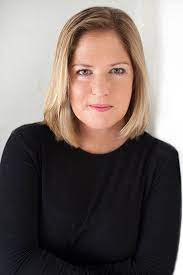
Jenny Wheeler: You have got a good back list that we will get into a little later, but the story we’re particularly focusing on today is the latest one you’ve published, The Last Reunion.
It’s a dual timeline story split roughly between the present day and 1940s Burma, and it highlights the bravery of a little-known war-time women’s unit in the Second World War. First of all, how did you come across this remarkable little slice of unknown history?
Kayte Nunn: Actually, it’s rather prosaic. On Google. I had never heard of them either until I started thinking about where I would set this novel. I knew I wanted to write about a friendship between a much younger woman and an older woman, and a friendship that doesn’t start off terribly well.
I also wanted to write about netsuke, which are these little Japanese toggles men used to wear on the sash of their kimono to hang little pouches from where they might keep their tobacco or their writing implements.
The magic of Japanese netsuke
They are now highly collectible, and years ago I was working in London as a temp in an art agency, art gallery. I was working in the Far Eastern Asian department and came across them.
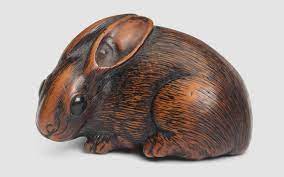
I was absolutely fascinated, so when I started to think about what I might write for my next book I knew I had that in the back of my head, and it was something I always wanted to write about somehow and include in a novel.
Then I started thinking about where, and how I could incorporate that. For a while I thought maybe I should set it in Japan in the 17th century, and then I thought, what about in a time of war?
The Second World War has been covered quite a lot in terms of the war in Europe but not so much the war in Asia and the Far East. That’s where I started to do some research and I happened to click on a link that talked about the Wasbies, the Women’s Auxiliary Service (Burma).
The Wasbies – lost in time
There is very little information about them. I’ve found one published diaries, which was invaluable in giving me a lot of detail, and a couple of small pamphlets. The Imperial War Museum site has some recorded oral histories of these women and what they got up to.
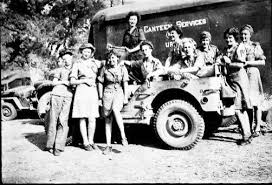
They were English and Australian women mainly, who had some experience of living in India. They drove mobile canteens and made endless cups of tea and sandwiches and served the men out on the front line, who would have been days or weeks from anywhere where they might have been able to buy a pack of cigarettes or some writing paper and a pen – that kind of thing.
They were often that little bit of comfort in a really awful situation, and they were incredibly courageous women. They were mentioned in dispatches for their bravery, and they served the closest to the front line of any women’s service in the Second World War, and yet so little is known about them. I knew immediately then that I had the setting for my story.
Jenny Wheeler: Yes, and although serving tea out of a canteen could sound remarkably normal, in fact the conditions under which they worked were absolutely diabolical, weren’t they?
Hardship and danger daily
Kayte Nunn: They were. They had to deal with monsoons and the roads being washed away and bridges being washed away. They operated under enemy gunfire with soldiers in the trees above them. That kind of thing really added to the danger and the hardship.
Jenny Wheeler: Yes. Perhaps we ought to clarify that you’re currently living in Australia, and so a lot of the readers of this book will be Australian women.
But even for the wider international audience, there are more and more books being written about the Asian aspect of the Second World War as well as the European war, aren’t there?
Kayte Nunn: I think so. It’s an area that is endlessly fascinating. I think now particularly women’s stories during the war are starting to be told, and that’s really interesting.
Jenny Wheeler: I was thinking about the timing of your book because the present-day part is probably set in the early 2000’s, but it’s coming to the point where living survivors of the Second World War – it’s more and more difficult. If you tried to set it in 2021, they would have to be 100 years old or more to still be alive.
Talking to the survivors
So it’s going to be a sub-genre. You’re going to have to continue to set your contemporary thing in the late 1990’s or early 2000’s to have any credibility, aren’t you?
Kayte Nunn: Yes, to make that work. I was lucky enough to speak to one surviving Wasbie, Elsa Hatfield, who lives in Melbourne and has absolutely incredible memories of her time serving in the Wasbies. Before that she was a Japanese prisoner of war, so that was quite extraordinary and something I hadn’t expected to be able to do.
Jenny Wheeler: That’s amazing. How did she get out of being a Japanese prisoner of war to get into service?
Kayte Nunn: I think at the very beginning of the war she was interned. Then she was sent on a ship back to Australia and volunteered for the Wasbies.
Jenny Wheeler: The whole area of the Second World War has become incredibly popular in the last decade or so, perhaps even longer. Once upon a time authors could hardly get publishing houses interested in this period, but it’s become incredibly interesting. This is your fourth historical, I think. Not all of them are Second World War, but what attracts you to historic fiction?
The attraction of Historical fiction
Kayte Nunn: I think the fact that long ago secrets can still resonate in the past and history is there in the objects we handle. Just delving into something in the past and doing all the research, I find absolutely fascinating.
Jenny Wheeler: Do you always have a real-life spark of some sort that acts as the catalyst for your imagination, or sometimes is it purely your own imagination that generates the story?
Kayte Nunn: For The Last Reunion I was reading the published diary of a Wasbie and in one small couple of sentences, she mentions that she found herself alone in a room with a soldier, and she became very frightened. She had to do some fast talking to get her way out of it, and when she told her friends afterwards, they didn’t take her seriously and they laughed at her and she was actually really frightened.
That was the spark for me, to the one of the threads in The Last Reunion. I thought, what if it hadn’t turned out as well? Which, as we know, can absolutely happen and does happen.
Jenny Wheeler: I would imagine in real life that happened more often than we might want to imagine.
Stories tap you on the shoulder
There was a lovely quote. I think I saw it either on an interview you did or on your website. You say that stories circulate in the ether and if you are receptive, they will tap you on the shoulder and start whispering in your ear. Absolutely gorgeous. I wonder if you could explain to us how you’ve experienced that particular thing.

Kayte Nunn: That happened for me the first time with The Botanist’s Daughter, which was my first historical novel. I was walking in the Botanic Gardens in Sydney with my young daughter who was nearly five then. We were looking for fairies, as you do, and we’d had a picnic and it was a nice day out for us before she started school.
It was a hot sultry day and we were wandering around and we went up to the rose garden, which I love, and the herb garden which is nearby. In that garden is a big bronze sculpture and it has a relief of different herbs all the way around it.
A warm bronze on a sunny day
I put my hand on the bronze and it was really warm from the sun. Immediately I could see in my mind’s eye a young girl in a walled garden with a similar sculpture in England somewhere.
I wandered around the rest of the day in a bit of a daze because I knew there was a story somewhere there. I just had to spend some time thinking about it.

So that really happened there. For my other books, it’s been more of a process of discovery and not one absolute moment, but I did experience a couple of days ago, as I was driving past somewhere, something that was like a snap of the fingers, and so there might be another idea brewing, I think.
Jenny Wheeler: That’s fantastic. I think the first two books you did were romances. Was that right?
Kayte Nunn: Yes. I started off by writing what I love to read, and when I was growing up, I really enjoyed the books of Jilly Cooper. I wanted to write a bit of a romp, a lovely rural romp. Rural romance was doing very well at the time, and I had worked as a magazine journalist on a wine magazine and so I’ve done quite a bit of traveling in wine regions as a part of that.
I thought, what better place to set a really nice story than in a wine region. That’s where I started with those two.
Rural romance set in wine country
Jenny Wheeler: You’ve got Rose’s Vintage and Angel’s Share and they’re both set in this imaginary town in wine country. It’s probably in Victoria, is it?
Kayte Nunn: Actually, I imagined it was somewhere like the Hunter Valley but smaller, purely because that was an area I knew better than any others.
Jenny Wheeler: That’s in New South Wales for those who might not be Australian listeners. Have you got any more of those coming? I really enjoyed Rose’s Vintage which is the one I read. I thought it was great.
Kayte Nunn: Unfortunately not. I think I’ve definitely now become known as a writer of historical fiction and I’m tending to write more historical mysteries.
I think that’s the area I’m going in and that’s because I enjoy the challenge. They are a bit more complex and there’s a lot more research involved. I enjoy writing those kinds of stories now.
Jenny Wheeler: I think the thing those two genres have in common – the romance and the historicals – is that you bring to them a really warm feeling. Somebody reviewed one of your romances saying that it was a warm feel-good love story, and even with The Last Reunion, with all the horrible stuff they face, it’s not depressing or dragging you down.
Inspiration of female friendship
It leaves you with some feeling of inspiration and hope, and I get the feeling that’s something you deliberately aim for. Would that be right?
Kayte Nunn: Yes. With The Last Reunion, I also really wanted to write about female friendship and female friendship in a time of war. There’s been a lot written about men’s mateship, but very little about female friendship.
It’s not perfect friendship. They do rub each other up the wrong way sometimes, but they really have each other’s backs. That was an aspect of female relationships I wanted to focus on. So often women are pitted against each other and have to take each other down. That seems to me so unnecessary.
Jenny Wheeler: You have got a great spread of international editions and I wondered if you had noticed any difference in the way different nationalities respond to your stories. Do you get different feedback from different countries?
The Botanist’s Daughter
Kayte Nunn: Mostly people tend to give me feedback if they like it, which is really nice. The feedback there has been kind of similar. The Botanist’s Daughter resonated with Italian readers for some reason, and I’m not entirely sure why.
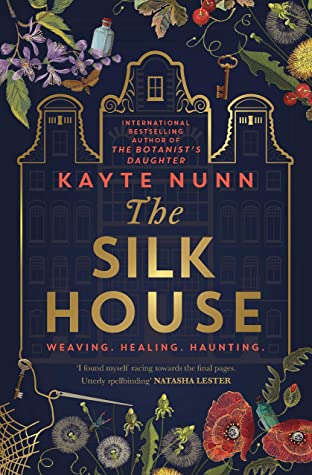
It was a top ten bestseller there when it came out, which was lovely, and my Italian publisher has taken on my subsequent books as a result of that and they’ve done quite well.
I think if you are telling a good story, it doesn’t matter where it’s set or where your reader might be from. They can still find things in that to identify with.
Jenny Wheeler: Turning from the specific books to your wider career, tell us about your life before you became a full-time writer and how has that fed into what you’re doing now?
Kayte Nunn: I started off working in book publishing as an editor for a very brief few years and then, ironically, I wanted to write more. I moved into magazines as a feature writer and it really honed my ability to tell a story in a very succinct way and to get to the heart of an issue.
It has also given me a great appreciation of deadlines. I hate to miss a deadline, so that keeps me focused. It taught me the nuts and bolts of writing and the experience of sitting at a blank page and having to get a story out.
Telling compelling stories
What I did have to learn though, when I first started writing fiction, was how to tell a story in a really compelling way. Fiction is different to nonfiction in the features I was writing.
It was a different skill I had to learn. I honestly didn’t know how much I didn’t know when I started, which is probably not a bad thing because if I’d known how hard it was, I might not have continued.
I think it’s been about six or seven years and when I first started writing fiction, I was working as a freelance editor and writer as well. I combined the two. Now I am lucky enough to write full-time, and I’m constantly learning how to be a better writer, how to express myself in a better way, how to craft a novel in a better way. That’s what keeps me really interested.
Jenny Wheeler: How have you done that? Have you attended workshops or just really closely read other people’s work?
Kayte Nunn: Yes, I have done workshops. I’ve done online workshops, and I still do some. I’ve done in-person ones that might be attached to a writer’s festival or something like that, and I’ve always found them incredibly useful. I talk to other writers about their process, I listen to a lot of writing podcasts.
The fascinating creative process
I’m fascinated by other writers and what their process is like. Every writer does things slightly differently and finds things that work for them. It might work for you, but you don’t have to follow.

And then I’ve read quite a few books on the craft. One of my favorite ones, and I always recommend this if you are thinking about wanting to write fiction, is Writing 21st Century Fiction by Donald J. Maass. It’s utterly brilliant. I re-read that at least once a year and still find things I can use to improve my manuscript.
Jenny Wheeler: What sort of process do you adopt? How do you structure your writing day?
Kayte Nunn: I try and write during school hours. I’ve got two daughters who are still at school, so once I’ve dropped them off or they’ve gone off to school, I have a coffee and then I sit down and I give myself – usually if I’m in the middle of a first draft – a word count for the day, and I don’t let myself stop until I’ve reached that.
Sometimes it might take me all day, sometimes it might take me three hours. It just depends on where I’m at.
Setting a work schedule
What happens then is often I’ll have to leave and go get in the car and pick up my daughters from school, and my mind will be churning over with the story, so I’ll come back from that trip with all sorts of other ideas that I will then work on the next day.
I try and think about the story I’m in the middle of before I go to sleep at night, and then when I wake up in the morning, before I’m really awake, when I’m half asleep, I’m still thinking about what might happen and who these characters are and getting to know the characters.
So although I might not always be sitting at my desk for eight hours a day, it’s constantly on my mind.
Jenny Wheeler: Do you have the same word count every day, or different word counts depending on where you’re at in the story?
Kayte Nunn: I try and write the same number of words every day. If I’m behind, I’ll try and up that word count. For The Last Reunion, I wrote 50,000 words of it during NaNoWriMo last year, in November, which is National Novel Writers Month. I think it was November, might be October, I can’t remember.
NaNoWriMo as an experiment
That was an effort for me because I don’t write particularly fast compared to some writers. I think it worked out to be about 1500 words a day, and that was quite a lot, 30 days in a row, but it really helped pushed the first draft of the story out, so I’m quite grateful I did that.
Jenny Wheeler: Did it have a permanent effect in terms of your continued production after you stopped NaNoWriMo?
Kayte Nunn: Yes, I think it did. I used that to finish the draft. I’d already got probably about 30,000 words before I started NaNoWriMo. You’re supposed to start a new project in NaNoWriMo, but I didn’t.
Yes, it definitely helped. I think for me, writing is a bit like exercise. If you do it regularly enough, the words come more easily, definitely, whereas if you haven’t written for a few weeks, it’s a bit like the first time you go for a run after a break. You’re like, oh, this is really uncomfortable, how did I ever do this? But you soon get back into the rhythm.
Is there a secret to your success?
Jenny Wheeler: A perennial question I do like to ask everyone is, is there one thing you’ve done in your writing career more than any other that you would see as the secret of your success?

Kayte Nunn: Not giving up, not giving in to that little voice on your shoulder that tells you you’re wasting your time or it’s all an absolute load of rubbish and who are you to think you can write a novel. You have to tuck that voice away and plow on regardless.
Interestingly, when I was writing Rose’s Vintage, I was also training for a marathon, my first and only ever marathon, but I could appreciate the two disciplines.
You don’t look too far ahead, you just do what you’ve got to do that day or that workout, you don’t worry about the future. You go, today I’m going to sit down and write 500 words, I’m going to sit down, I’m going to write a thousand words. That’s all I’m going to do. Or I’m going to write one scene.
If you do that every day, it really does add up, and before you know it, you’ve got something you can work with.
Silencing the inner critic
Jenny Wheeler: That’s probably the very best advice for anybody listening who is trying to write. It’s amazing to me – I was a journalist once and whenever you interviewed a woman, even if she was the most beautiful model, they always wanted to tell you about the things that were wrong with themselves.
We women seem to have this inner voice that is so critical often, and I think even the best writers doubt their own ability, don’t they? To have to overcome that little voice is something that absolutely everybody has to do.
Kayte Nunn: Yes, and it really is a bit of a roller coaster. There are times when it’s all going well, and you think it’s fantastic and you’ve got this great idea, and then there are other times, it might be the very next day, where you’re down in the doldrums and wondering why you’re bothering. You have to persevere. You have to be quite bloody-minded about it, I think, and just keep going.
Jenny Wheeler: The transition from writing for magazines to actual fiction – was there any kind of epiphany moment when you wanted to write the longer form, or did something happen that pushed you in that direction?
Transitioning from magazines
Kayte Nunn: A couple of things happened. A woman I knew, a friend of mine, another school mother, came up to me in the playground one day and said, I’ve written a book and I’ve got an agent. I was outwardly really happy for her, but inside I was like, oh my God, that was my dream. It was a case of now or never.
There was that, and then the fact that I had about a six-week gap between freelance projects and instead of casting around and looking for something to fill that, I was lucky enough to go, you know what, I’m going to sit and see if I can write some fiction.
I’d written a few short stories and actually when I looked back at it, I’d always written tiny little bits and pieces of fiction throughout my life, right from the age of eight. But I was like, no, I’m going to try and write a full-length book.
It was the combination of those two things that made me think, it’s now or never and if somebody else can do it, why can’t you. What are you waiting for?
Finding support from other writers
Jenny Wheeler: Has that person continued with their writing?
Kayte Nunn: Yes, they have. So that’s good.
Jenny Wheeler: That’s fantastic. You’ve got a local little writer’s club there.
Kayte Nunn: One of the most fantastic things I have learned from becoming a writer is the sense of collegiality. Other writers are incredibly generous. They all know how hard it is to put your work out there and to persevere and finish something.
I would say 99% of the time I’ve found other writers to be incredibly supportive and generous and lovely, and that’s been an absolute bonus I hadn’t expected.
Jenny Wheeler: I’m happy to mention on air that I heard of your work through Rachael Treasure, who has also been on the podcast. We’re getting to the point now where I’m going to ask you about your taste as a reader, and you were one of the people Rachael mentioned and recommended as a writer she loves to read, so that very much fits into what you’re saying.
Kayte Nunn: That’s lovely to hear.
Kayte’s tastes as a reader
Jenny Wheeler: Turning to that topic of your own tastes in reading, and because this is binge reading we tend to focus more on the books we choose to go to for entertainment or for escapism, but anything you like to read. Tell us about your taste in reading.

Kayte Nunn: I do read quite widely. I have very broad tastes and I love an absolute page turner more than anything. Those were the books that gave me such comfort in my teenage years. I really enjoy crime.
I love the books of Dervla McTiernan. I have recently discovered Tana French and I’m just ripping through her back list at the moment. She writes with such incredible detail and yet a really compelling plot line, so I’m very much loving her books.
I’m trying to think of the other crime novels I really like. Jane Harper, and there are some fantastic Australian crime writers emerging at the moment, which has been brilliant to see.
Jenny Wheeler: Yes, I think the Australian publishing scene is very lively and interesting at the moment. I noticed that myself.
Aussie authors go international
Kayte Nunn: Yes, and they are getting international recognition, which is fantastic. Megan Goldin is another Australian writer who is doing really well in the US, and I think her books are brilliant.
Jenny Wheeler: That’s one I haven’t heard of, so that’s interesting. I know that going back a few years, you were a great fan of Jilly Coopers, as you’ve already mentioned when you were a teenager.
Kayte Nunn: Oh yes. I went to boarding school and parts of that were really a bit grim. I read a lot of very grim dystopian fiction when I was there, but then Jilly Cooper saved me, being able to escape into Riders or Rivals.
Her early books all had women’s names – there was Bella and Prudence and Emily and Imogen. Honestly, my sister and I could quote each other the lines from them, and we regularly used to. I read them so often they were falling apart.
What Kayte would change – maybe
Jenny Wheeler: That’s gorgeous. We are starting to come to the end of our time together, so circling around and looking back down the tunnel of time, at this stage in your career, if you were doing it all over again, what would you change, if anything?
Kayte Nunn: I would start sooner, I think. I absolutely love writing and being able to do it and help support my family doing so. There’s nothing better. I would just start sooner.
Jenny Wheeler: You have mentioned that you’ve maybe had a little inspirational idea in the last week or so, but what is next for Kayte as writer? What does your next 12 months look like in terms of the projects you’ve got going?
Kayte Nunn: I’m just coming to the end of the second draft of a book I hope will be published next year, I don’t know yet. It is more of a crime mystery but with a historical fiction element and I hope to get a publishing offer for that, and then start working on the edits for that, interspersed with promoting The Last Reunion and beginning to have an idea of the following book.
What Kayte is working on now
I think writers who produce a book a year and a lot of commercial writers, that’s their schedule, often working on three books at once throughout a year. You might work on one book for a couple of months and then finish doing that and work on the next project for a couple of months. But you juggle three projects in any one year.
Jenny Wheeler: The historical one you’re doing – is that another dual timeline?
Kayte Nunn: Yes, definitely, and again a 1950s setting – late 1940s, early 1950s. That will be the third book I’ve written in that era, and I’m really finding it suits me. I enjoy that.
Jenny Wheeler: Marvelous. I imagine you enjoy hearing from your readers. Possibly the promotion of The Last Reunion has been a bit disrupted by the pandemic we’ve all been facing, but where can readers find you online?
Where to find Kayte online
Kayte Nunn: I am on Facebook @kaytenunnauthor and often readers send me messages there. I am on Instagram as kaytenunn2. That’s my favorite social media channel. I am on Twitter as well, but I don’t spend a lot of time on there. And I have a website, kaytenunn.com with a newsletter which you can sign up for, though I am afraid I don’t get round to sending it out very often, but it means I won’t bother you very often.
Jenny Wheeler: That’s great, and we will put links to all those sites in the show notes that we run with each episode, so they’re there as green content for evermore online once we’ve got this posted.
Kayte, it’s been great talking today. Thank you so much, and we will look for your coming books with a great deal of interest.
Kayte Nunn: Super. Thank you so much, Jenny. It’s lovely to talk to you.
Jenny Wheeler: Bye for now.
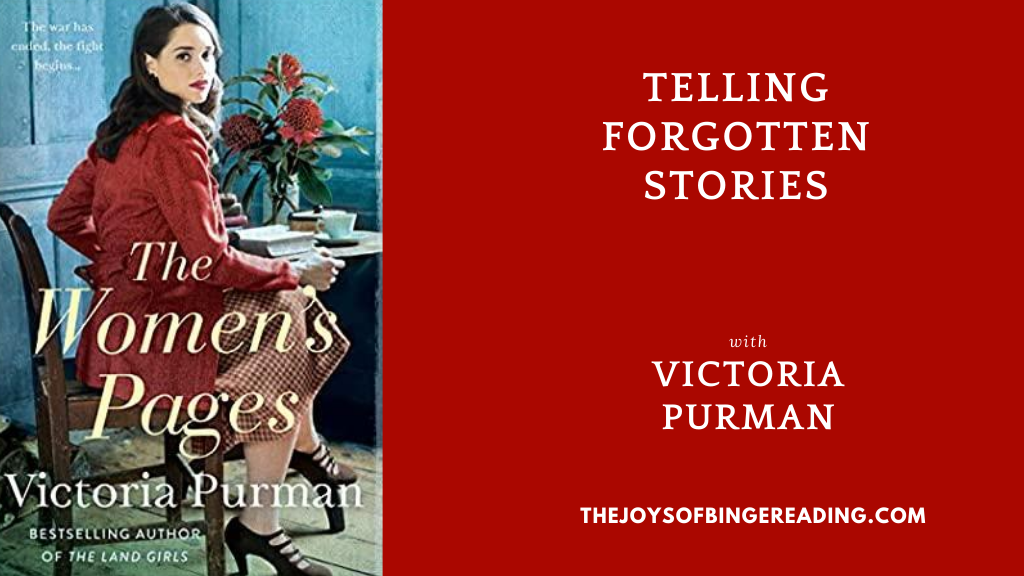
If you enjoyed Kayte Nunn’s dual time line stories you might also enjoy Victoria Purman’s historicals about other women overlooked by history… until now.
Thanks To Our Technical Support:
The Joys of Binge Reading podcast is put together with wonderful technical help from Dan Cotton at DC Audio Services. Dan is an experienced sound and video engineer who’s ready and available to help you with your next project… Seek him out at dcaudioservices@gmail.com or Phone + 64 – 21979539. He’s fast, takes pride in getting it right, and lovely to work with.
Our voice overs are done by Abe Raffills, and Abe’s another gem. He got 20 years of experience on both sides of the camera/microphone as a cameraman/director and also voice artist and television presenter. Abe’s vocal delivery is both light hearted and warm and he is super easy to work with no matter the job. You’ll find him at abe@pointandshoot.co.nz