Pip Drysdale – Love Kills


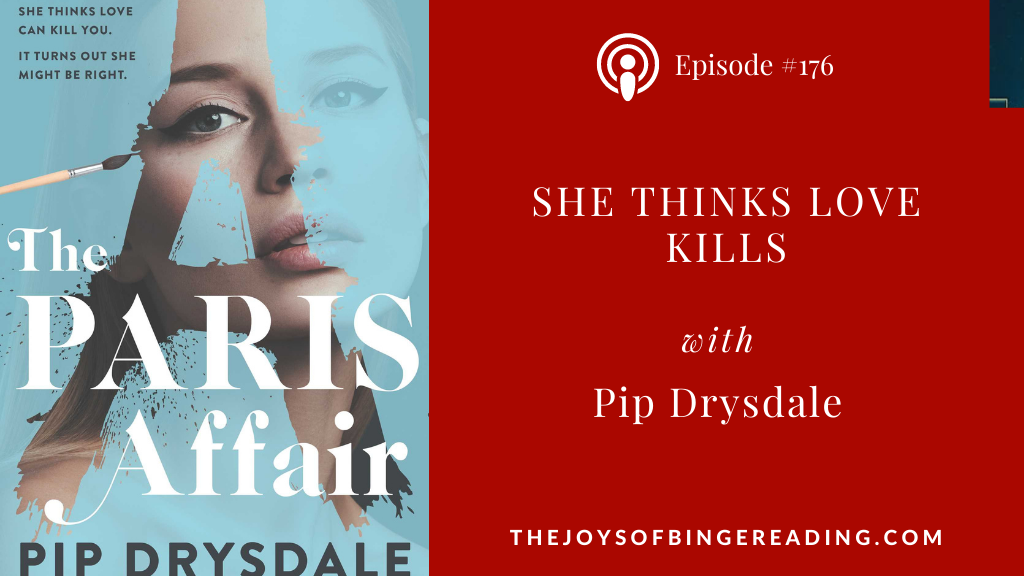
Pip Drysdale has three bestselling psychological thrillers to her credit. Her latest, The Paris Affair, features Harper, an online journalist who goes to the City of Love to get over a broken heart and finds herself on the trail of a murderer – and the scoop of a lifetime.
And as The Paris Affair’s tagline suggests: She thinks love can kill you. It turns out she might be right.
Hi there, I’m your host Jenny Wheeler and on Binge Reading today Pip talks about the passion she shares with Harper for murder podcasts, the deep level research she does for her edgy thrillers, and her earlier career as an actor, musician and song writer.
As part of our Armchair Traveler Giveaway we’ve got three E book copies of Pip’s thriller The Paris Affair to give away. Enter the draw today and be into win for the rest of the month!

Six things you’ll learn from this Joys of Binge Reading episode:
- Why writing mysteries is like composing songs
- How ‘writing what you know’ worked for her
- Her passion for all things French
- Why parity for women mystery authors is important
- The writers she admires most
- What she’d do differently second time around
Where to find Pip Drysdale:
Website: https://pipdrysdale.com/the-paris-affair/
Instagram: https://www.instagram.com/pipdrysdale/
Facebook: https://www.facebook.com/pipdrysdale/
What follows is a “near as” transcript of our conversation, not word for word but pretty close to it, with links to important mentions.
But now here’s Pip.
Introducing author Pip Drysdale
Jenny Wheeler: Hello there, Pip, and welcome to the show. It’s so good to have you with us.

Pip Drysdale: Thanks so much for having me.
Jenny Wheeler: The Paris Affair is your third psychological thriller. The two previous books have both been bestsellers, and in this one your protagonist, Harper, goes off to Paris to put a broken love affair behind her.
She is going to start a new life as an arts journalist, but very quickly finds herself on the trail of a murderer and the scoop of a lifetime. Tell us how you came to start writing this particular story.
Pip Drysdale: I wanted to write a book about a woman who didn’t believe in love and didn’t want love but moved to the City of Love. I wanted to incorporate the true crime podcast into it, because I feel so many of us listen to those, and there are deep reasons for that. I wanted to show a side of Paris that wasn’t necessarily always shown in film and TV, so I take a very postcard perfect part of Paris – Saint-Germain-des-Prés – and then flip it on its head.
Jenny Wheeler: We want to talk about the book without giving away any spoilers. There are so many great plot twists that we don’t want to spoil any of it for anybody, so let’s start by examining Harper’s state of mind at the book opening. There is this hilarious opening scene where she is exercising her superpower of getting rid of a man in three minutes. Tell us how she has perfected that particular superpower.
Superpower for getting rid of men
Pip Drysdale: Harper has learnt the hard way that it is not always the best move to bruise a guy’s ego, and so she has found a way to get rid of them by making them think that it’s their idea.
She acts super clingy and then they don’t want to see her anymore. She gets what she wants, which is never to see them again, but they think it was their idea, so they don’t get angry.
Jenny Wheeler: She gets what she wants because she hasn’t yet decided in her head that she doesn’t want to have a relationship, but there is a little struggle going on inside her when she does it as well, isn’t there?
Pip Drysdale: Of course, because she’s not a psychopath. She doesn’t want to harm anyone. She quite frightened of love. Deep down Harper is terrified of love and what it could do to her, mainly because her mother has gone through a string of relationships as she was growing up and she has seen her mother fall apart the whole time. She has always been the one there picking up the pieces.
And partly because she’s just come out of an eight-year relationship with someone who totally used her, and that broke her down, so to her, love is a very terrifying prospect. She is doing everything she can to keep herself safe.
Jenny Wheeler: She’s doing cultural and art journalism, but she has this hankering to get into the hard news end, which is why she’s drawn to try and solve this murder.
The depth of research for her books
When you are talking about the art scene in Paris, it is very convincing and intriguing. You sound very knowledgeable about art, and it did occur to me as I was reading the book that you had a deep personal interest in this area as well.
Pip Drysdale: Yes, I definitely do. I have wandered through many, many galleries in different cities and learned about lots of artists. I also studied quite a lot of fine art history at university, so I did have a grounding in it. But when I was writing Harper, I was keen to keep her knowledge and her interests quite mainstream in terms of art, because I wanted the reader to be able to visualize what work I was talking about.
I wanted them to know the works potentially already. I didn’t want to pick obscure, out of the way works that nobody would be able to latch onto, because it’s not really about art.
Jenny Wheeler: That brings us to the next obvious question, probably one that authors generally don’t like to answer, but how much of you is there in Harper? I mention it because you have already referred to the passion Harper has for murder podcasts, and it is obvious as soon as you go on your website, that is a passion you share as well, you are mad about murder podcasts. Tell us about that fascination.
Pip Drysdale: I am fascinated by murder podcasts because they help me keep safe. I know that sounds backward because it sounds like people would only care about true crime if they want to see what happens to other people.
Murder podcasts a fascination
But a lot of the time you pick up tips and tricks in it about what not to do, what people might do to lure you into a bad situation, or what kind of red flags you can look for.
I think on a deep level, that is why I am so interested in it, because I watch a lot of true crime documentaries as well. It is quite interesting because I was on Instagram the other day and I saw this post about a little girl over in the States.
She was playing with this blue slime, and through watching CSI she knew to leave some on the guy who attacked her. She was leaving evidence and I thought, that is the kind of thing we pick up from these shows and from podcasts.

Jenny Wheeler: I think I don’t listen to them because I don’t want to be aware of the potential dangers out there. I will get turned into one of those scary people who is always jumping at corners. It is two different ways of looking at it, isn’t it?
Pip Drysdale: Totally. It depends also what kind of situations you are in. If you are living in a pretty safe suburban area, which I am right now, you don’t feel the same need to be listening to them. But whenever I am living in big cities, there you are a bit more vigilant.
You’re a bit more hyper aware of your surroundings because you feel like you are in more danger. It is easier for people to be anonymous and go unnoticed. That is why it works so well for my books, but it’s a bit nerve wracking.
Jenny Wheeler: The book before this one, seeing we are talking about safety and trust, The Strangers We Know, was another best seller.
Trust challenged in relationships
It is being made for TV, I believe, at the present time, and it deals with a wife who thinks she’s got a perfect marriage until she finds a dating app on her husband’s phone. This raises a whole lot of questions and doubts in her life.
Your characters seem to generally live in a world where trust in others is constantly challenged. Would that be a fair comment?
Pip Drysdale: It probably would be quite fair, but that is also part of the psychological thriller genre, so it’s necessary. That is part of what makes a psychological thriller, a psychological thriller.
However, I do think most people have something they are hiding. Probably not quite as sinister as the things in my books, but it is interesting because what people hide from others says a lot about them.
It’s not even always bad things they hide from others. Sometimes they hide good things from others, and I find that a very interesting part of human nature.

Jenny Wheeler: Your first book, The Sunday Girl – and I want to draw all of these into the podcast because people could be interested in the plot lines of these other books as well – also a best seller, introduces Taylor, a woman left broken by “a bad, bad man” the blurb says, and she decides to seek revenge. I guess it is partly justifiable when he is a really bad man.
Do you sense this has resonance for a lot of women today? I have noticed there is quite a bit of revenge literature around at the moment. Do you think a lot of readers out there do feel as if they have been done wrong?
Pip Drysdale: Probably, because they probably have. We live in a world that doesn’t protect women and children the way that it should.
How far can you push good people?
In The Sunday Girl she is coming out of a very abusive relationship and the “bad, bad man” has uploaded a sex tape of her to the internet. It is not your average “he hurt my feelings, I’m going to go burn his house down” situation. He truly is quite awful. And she snaps.
It’s working around the premise of how far can you push someone who was essentially good when they got into the relationship? Really good people get into abusive relationships, and then it’s so slow and methodical that by the time they’re deep in the thick of it they can’t figure out how to get out.
It probably does resonate with women and that makes me sad, because I would love it if it didn’t. I would love it if we lived in a world where women weren’t controlled or harmed that way, or we didn’t snap, we didn’t get to the point where we wanted revenge. It would be great.
Jenny Wheeler: I did look up the definition of psychological thriller because I was trying to think what set them apart. What I discovered was that they say the psychological thriller, rather than being based on simply action and a tightly woven storyline, although you’ve got that very definitely, are centered around the characters – their thoughts, their emotions, and their behavior.
It’s not what the characters are doing that is so disturbing, it is their reasons for doing so. Do you think about that in a very conscious way when you are writing the books?
Pip Drysdale: Somewhat. However, I would add to that definition. When I think about the difference between them – and this is my personal version of it – I would say that a thriller usually centers around someone in law enforcement or some kind of authority role who is investigating a killer or someone who is doing very bad things, like a serial killer, and so they are on the trail.
Regular people living their lives
They think it is one person, then it’s another person and it follows that. Usually there is a dead body very early on in the piece, like on the first page or the first 10 pages.
In a psychological thriller, the dead body can come quite late in the piece, and like I said, this is just my personal reading of it, because you are setting up real people. When I say ‘real’, I mean that they are not in a position of authority, they’re regular people living their lives, and you are setting them up to have this thriller experience.
The things they have at their disposal are often not as easy to help them as if they were a police officer. They don’t have databases at their fingertips. They’ve got social media, which is why I use social media so extensively in my books. They’ve got their wits. In Taylor’s case she had The Art of War.
That’s how I define the difference between them, so when I say I write a psychological thriller, I do have tightly woven stories and plots, like you said, but it comes at it from a different angle.
Jenny Wheeler: They generally don’t have weapons either. They haven’t got a holster tjere they can draw on, do they?
Pip Drysdale: No. If they do have weapons, they tend to be different types of weapons. The women in my books tend to find ways to use other things as weapons, because that’s what you do. If you are being attacked, you grab for something.
Jenny Wheeler: That’s right. Your protagonists all have gender neutral names – Taylor, Charlie and Harper. I presume this was a very definite decision on your part. Why do you like these gender-neutral names?
Using gender neutral names
Pip Drysdale: For a couple of reasons. Firstly, I just like them, and if I’m going live with a character for a good year or so, I want to love the name and love the character in her own way, and so I named them the way people name their kids. They give them names that they love or mean something to them.
But also, all the female characters in my books are very feminine. However, they are stepping outside the lines of what we are told women have to do, so in their own ways, they are all giving the middle finger to the patriarchy. I try to give them names that have some level of edge to them, and gender-neutral names tend to be those names for me.
Jenny Wheeler: That leads us on quite nicely to the underlying feeling that they have the most amazingly open worlds before them, with a huge number of choices, and yet they still find it difficult to find happiness. I wondered if you thought this does reflect our female population at this stage in our history, whether the millennials and the ones coming up behind them are still finding it quite hard to realize themselves as satisfied human beings.
Pip Drysdale: In some ways, yes. I do think having too much choice can almost be crippling. I have found that myself. But I also think that human nature at its core is always going to be a bit unhappy. We are always going to be looking for other things.
The struggle to be happy
There are so many books written about how to be happy, and not just women. For men too, so I do think it is human nature to struggle to hold on to happiness on a day-to-day basis, whereas you can hang your hat on meaning. That will stick around, but happiness is a bit more fleeting.
However, if you are going to compare the two – if you are going to say, either you get to be a 1950s housewife and you’re stuck in your house and you have to down a ton of Valium and Quaaludes or whatever they were called so you don’t die of boredom, or you have to have current problems and too much choice – I am definitely choosing the second one.
Jenny Wheeler: I understand you do a lot of research on your characters, and I was fascinated to see somewhere that amongst that research is things like experiencing what they might experience, even to the extent of wearing their perfume. I wondered if you could tell us about researching The Paris Affair. How did you go about that?

Pip Drysdale: She actually does have a perfume. It’s called Fleur Narcotique and I’m wearing it right now to get me into Harper’s brain.
I went to over to Paris to do quite a lot of research, which is pretty important for my writing process. I spent time living in her flat and pretty much everything I describe is a real flat, including the stairs and the door codes and everything that struck me while I was there found its way into the book.
Research at the micro level
I traveled my way to her work, and I figured out what building I thought she should work in. Everything is very real for me, and I find that helps my process in terms of thinking about things that could happen. I don’t have to stick a door somewhere; I know there’s a door there.
I know someone could walk through that door. For me, it makes it very real and visceral, which translates well to the page. That is why I always try to base my books in places that I have in my bones – I have lived there for a period of time as opposed to places I’ve been for a week. It helps me create a more realistic picture of that place.
For example, Paris. It’s not even this one three-month period. I have spent three or four months there a couple of times over the last ten years, and always staying in the same area, so when I was writing about it, the version you got of Paris was not necessarily the postcard perfect version. You got the things that you pick up when you have been there for a while, when you start seeing the cracks. That’s the most beautiful stuff to me.
With scenery, I always try to make it fit with the character and the character’s way of viewing the world. For example, Harper is quite cynical, so to have her view Paris as this really wondrous miracle would not fit. If she was a different character, super optimistic and upbeat, she could have seen it that way, but you have to make it fit with the character.
Work affected by pandemic
Jenny Wheeler: How is that process going to be affected by the pandemic we are currently seeing in the world? Has your latest work been stymied by not being able to go somewhere to research it?
Pip Drysdale: Yes, I am not thrilled about that. It’s not my favorite, but I get that there are bigger problems in the world. On a selfish level, I’m not loving it, because it really is quite crippling. However, that said, I am basing my next one in New York, and I have lived in New York, so I do have a starting point. It’s just that it’s not very recent, and obviously New York has changed, and I will need to be there in order to get that information.
I’m spending a lot of time on YouTube and Instagram and asking questions of my friends who still live there, and I am hoping that they allow us to get vaccinated and go and do some kind of business trip, so that I can gather the information I need to, because I have a deadline.
Jenny Wheeler: I can imagine. I saw somewhere that you regarded London almost as your second home, so you have obviously spent a lot of time there too.
Pip Drysdale: Yes, I have spent a lot of time there. I think it’s really interesting because you can read lots of different versions of cities in books, and what that says to me is that everyone experiences a city slightly differently. It depends where you are living and who you’re hanging out with.
Pip’s career as actor and musician
My experience of London will be different to somebody else’s experience of London. My experience of New York will be so different to somebody else’s. That is always really wild to me, because there are so many different stories going on constantly right next to each other.
Jenny Wheeler: Moving away from the specific books to turning to your wider career. You have had a fascinating and varied career as a musician, an actor and a singer working in indie films in New York. You have written songs and you’ve recorded four albums. I’m so impressed. Tell us about those early years.
Pip Drysdale: What do you want to know?
Jenny Wheeler: What sort of albums were they? What sort of music did you like to sing?
Pip Drysdale: I wrote folk pop. I was right at the tail end of CDs going out. I could still sell CDs at shows, which was wonderful. There was streaming. I had all my stuff streaming as well, but people still bought CDs, so that was good, and I used to play at little cafés and festivals.
That was my dream back then. I think it’s very interesting how your dreams shift and change. It is a bit like when I was acting. My dreams were always around doing little indie guerrilla films. I don’t know why I never had great aspirations with those two things, I just didn’t. It was more the experience of creating the art that I was fascinated by.
It is still like that with books, but I think you get to a point where you realize that you are going to need a career and you need to make this happen. That is what happened with books.
Writing songs and writing books
Jenny Wheeler: How did that transition occur, and how similar is writing a book to writing songs?
Pip Drysdale: Very different. With a song you have essentially three verses, a chorus, and a bridge. You have got a lot to put across in that time. It is not the biggest story. You don’t have a ton of side plots going on, you don’t have a lot of mental acrobatics going on. You’re relying upon the melody to pull it all together, and you can put a ton of aphorisms.
I didn’t even know what an aphorism was until I started being a novelist. I was told by an early agent I submitted to that there were too many in my work. Then I googled it. I was like, that is because I’ve spent too much time writing choruses. It is basically a little saying. You have those epiphany moments and those little sayings and songs, so it took a while for me to work that out of my writing.
I feel like both other creative aspects have helped, like being able to get into someone’s head in order to play them is a hugely valuable asset when it comes to writing a novel, because you can get to the core of why something is so high stakes for a character. It is not just what they are doing. You can understand why, even though it might not look like a big deal to someone on the outside, this is do or die for them.
Love is a dangerous thing
To someone else, Harper doesn’t like commitment, but I can get in her head and understand that to her love is a very dangerous thing and it can kill her. It is a big deal for her. If I hadn’t spent that time acting, maybe I couldn’t get to that. I don’t know. Maybe I could, who knows?
The same for writing songs. I do feel like all of it works in, because there is a rhythm to a sentence when you’re writing it. Hopefully, it all helps. It made me who I am.
Jenny Wheeler: When you decided you were going to write books, how did that come about and why did you decide it would be the psychological thriller genre? Were you always certain that is where you wanted to go?
Pip Drysdale: It is what came naturally to me. I write the kind of books that I write. I don’t really think of them in terms of a genre. They are a genre, but I think of them more as stories. They are stories I find interesting – women who are trying to go their own way in this modern world, and bad things happen, and they have to deal with them.
How do they do that, and how do they get themselves out of problems? What do they truly want, and why is that a problem in the society we live in? That is all the stuff I’m dealing with, but it fits within the psychological thriller umbrella.
The secret of success
Jenny Wheeler: Is there a quality or a decision you’ve made that has led to your biggest breakthrough as a creative person? It might not necessarily be as a writer, but is there some turning point or breakthrough that you can see in your creative process over this period?
Pip Drysdale: I don’t know. I think you have to stick with it. I think you’re a creative and you keep doing the work, and you keep doing the work, and you keep doing the work. Eventually something breaks and you find your place in the world, and it’s pretty obvious when you do.
I think we try and we try and we try in lots of different ways, and then sometimes the stars line up and other people agree with us that this is the role we should be playing in the world, and it feels right. That is what being a novelist is for me.
Jenny Wheeler: Looking back over your professional life at this stage, is there anything you would change with the benefit of hindsight?
Pip Drysdale: For my ego’s sake – tons. But from my creative standpoint and from me as a human being, none of it, because I think one of the benefits of being a novelist is you learn to see a plot from the beginning to the end, and how each thing rolls on to the next. If I was to alter any aspect of my past, then I would be a different person now and I would be at a different spot, and I am cool with where I am.
Mistakes are how you grow
The other thing is I think we learn a lot from missteps and mistakes and things we wish we had done differently. I think that is how you grow and learn, and that stuff is gold when it comes to writing.
If you live this blessed life where you never step out of line and you never do things that you look back and go, God – then what the hell are you going to write a novel about? You will never be able to write characters that other people can identify with because we all have those things. You need to understand it. So, I would say no, even though I would kind of like to.

Jenny Wheeler: This is The Joys of Binge Reading, and we are coming to the end of our time together, so looking at binge reading or reading generally, passionate reading, bookaholic reading – what do you like to read and who would you recommend to the listeners?
Pip Drysdale: I read quite widely. When I am writing a novel, I will read things that I need to know for that novel. At the moment I am reading things that are based in New York, because I’m trying to get myself in that brain space.
When I was writing The Paris Affair, I read something called Alex, which I would highly recommend. It’s a thriller, not a psychological thriller, a straight thriller, but it is really twisty and really good. It is by a French author, Pierre Lemaitre.
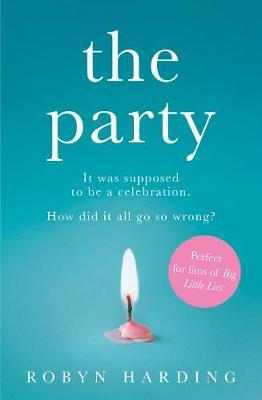
The other one I’ve read recently that I really loved was Raven Leilani’s Lustre. I love anything Robyn Harding writes. I find that I can read her books in literally half a day because they are so incredibly bingeable. For me, if a book is bingeable and easy to read, and you want to keep turning the page, it is well written because that kind of writing is hard to do.
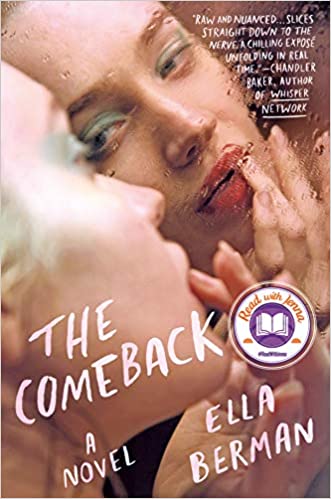
I loved The Comeback. That was by Ella Berman.
Books Pip is reading right now
Pierre Lemaitre has written a couple, but Alex is the one I read, and I found it very clever and twisty. Pretty gory, though, I am going to warn you. I’m not a big fan of gore, I prefer implied gore than real, but it genuinely was so good.
Jenny Wheeler: But it is an English translation?
Pip Drysdale: Totally.
Jenny Wheeler: Do you do speak French? You have spent quite a bit of time in Paris.
Pip Drysdale: I do. But when I go to Paris, literally I have no opportunities to use my French. They all speak English to me, and they speak it far better than I speak French. I struggle with confidence in my French skills, so I avoid it wherever I can. But yes, I do. I studied it at uni.
Jenny Wheeler: We are starting to run out of time, so circling around, looking back down the tunnel of time and considering where you are now, you are very happy with where you are at. What are you working on next?
Pip Drysdale: The next book is based in New York, and that is pretty much all I can tell you. A psychological thriller, female protagonist, based in New York.
Jenny Wheeler: When is that due out?
Pip Drysdale: End of 2022.
Jenny Wheeler: So you’ve got a nice little bit of breathing space there.
Pip Drysdale: I know. It doesn’t feel like it though.
Jenny Wheeler: No, I suppose not. You want to get to New York before then, don’t you?
Hoping the travel bubble will open
Pip Drysdale: Yes, I really need to get to New York at the end of the year or maybe early next year. Fingers crossed, hoping something happens and I can. That is a lot more time than I usually have, it’s usually about a year from first sentence to publication, so it will be great to have a little bit of extra time, but I think it’s necessary given the current state of events.
Jenny Wheeler: I think you’ve got a good chance of being able to get there by the end of this year or early next year.
Pip Drysdale: I really need to, so hopefully.
Jenny Wheeler: You are in Western Australia. How is the vaccine rollout happening there?
Pip Drysdale: I don’t know. I don’t hear an awful lot about it. My mum got one from the GP, but I haven’t been offered one. I am holding thumbs for Pfizer.
Jenny Wheeler: That’s right. I’m sure you do like to hear from your readers. Where can they find you online?
Pip Drysdale: Pip Drysdale. That is Instagram and also Facebook. Also keep in mind that Harper has her own Instagram account, which I have a ton of photos for. I have been very bad about uploading in the last week, but generally I upload pictures of Paris to it every couple of days. That is new.girlinparis, so it is the same Instagram account as she has in the book.
Jenny Wheeler: Fantastic. I didn’t know that. We will put all of those links into the show notes for this episode. We’ll make sure we include them. That is an awful lot of work to do that, but that’s great. It doubles the work you have to do, doesn’t it?
Pip signing off
Pip Drysdale: I know. You do what you do.
Jenny Wheeler: It has been wonderful talking. Thank you so much and all the very best with getting to New York.
Pip Drysdale: Thanks so much for having me.
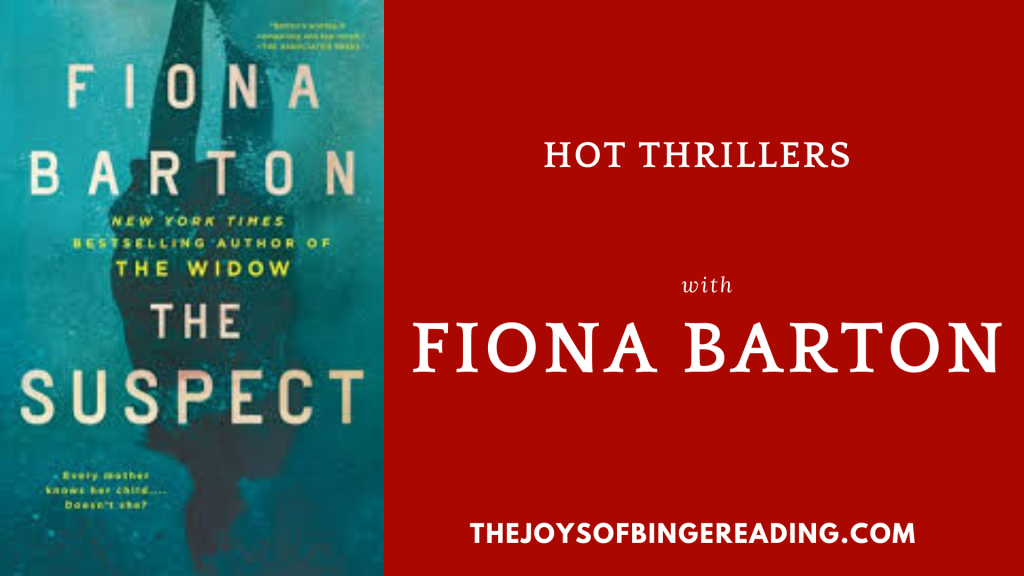
If you enjoyed Pip’s The Paris Affair you may also enjoy Fiona Barton’s Hot Thrillers.
Thanks To Our Technical Support:
The Joys of Binge Reading podcast is put together with wonderful technical help from Dan Cotton at DC Audio Services. Dan is an experienced sound and video engineer who’s ready and available to help you with your next project… Seek him out at dcaudioservices@gmail.com or Phone + 64 – 21979539. He’s fast, takes pride in getting it right, and lovely to work with.
Our voice overs are done by Abe Raffills, and Abe’s another gem. He got 20 years of experience on both sides of the camera/microphone as a cameraman/director and also voice artist and television presenter. Abe’s vocal delivery is both light hearted and warm and he is super easy to work with no matter the job. You’ll find him at abe@pointandshoot.co.nz