Better Podcast Audio: What AI Can and Cannot Fix | Owen Grover #697
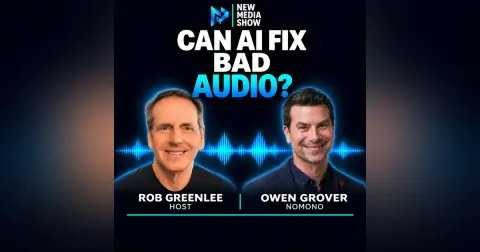


Watch episode 697 with Owen Grover on the New Media Show YouTube channel.
Better podcast audio starts with a practical question: can listeners follow the conversation comfortably, wherever it was recorded? On New Media Show episode 697, Rob Greenlee talks with Owen Grover, Nomono’s U.S. general manager, about portable recording, AI audio enhancement and why audio deserves attention even when the finished show includes video.
The conversation moves from Nomono’s Sound Capsule and phone-based Stellar Kit to audio-video synchronization, spatial audio and the company’s Platform API and MCP connector. Rob and Owen also explore the difference between using AI to support human production and generating an entire performance, plus what AI-assisted discovery could mean for open RSS distribution.
Build an audience. Earn trust. Grow a media business.
Three editorial takeaways
- Check the listening experience independently of the picture. Owen argues that audio remains essential even when someone discovers a podcast on a video platform. Review a section with the screen off: can you follow each voice, and does the conversation still make sense?
- Choose processing around the story you want to preserve. The field-recording discussion distinguishes unwanted noise from the atmosphere that places a listener inside a scene. Listen for intelligibility, natural voices and useful ambience before deciding how much enhancement to apply. The episode describes product capabilities; it does not provide an independently measured comparison.
- Keep human judgment in an AI-assisted workflow. Owen separates production tasks, creative ideation and fully generated content. Decide what AI is helping with, check the output and retain responsibility for what you publish. His preference for human hosts and performers is an editorial position, not a universal audience finding.
One practical action
Choose a 30-second passage from an interview you have permission to process. Keep the original, make one processed version and compare them at similar playback loudness, first without the picture and then with it. Spend no more than 30 minutes. Note unclear words, unnatural artifacts, lost ambience and any synchronization problem. Keep the processing only if it improves the listening experience without changing the intended meaning. This is an editorial exercise inspired by the discussion, not a test performed during the episode.
Why audio still matters in a video podcast
Rob opens with familiar recording problems: room echo, background noise and voices that are difficult to follow. Owen’s response centers on treating the audio track as a primary part of the audience experience. He distinguishes video used for discovery and promotion from a requirement that every podcast become a video-first production.
They discuss listening while driving, walking or doing household tasks, as well as the companionship a recurring human conversation can create. Their point for producers is to consider how the audience uses a show rather than assuming that the presence of a camera settles the format decision.
Portable recording and preserving a sense of place
Owen explains the thinking behind Nomono’s multi-person recording products. Rob describes his earlier experience sharing the Sound Capsule with creators and recording conversations in places such as restaurants. Owen offers examples of challenging recording locations and describes how enhancement can support storytelling outside a controlled studio.
The important distinction is between making speech easier to hear and removing every trace of the location. Owen argues that useful ambience can be part of the story. His examples and performance descriptions are company and guest claims, not independently verified benchmarks or a promise that every difficult recording can be repaired.
The Stellar Kit discussion focuses on a smaller two-microphone setup used with a phone. The speakers also discuss Nomono’s audio-video synchronization workflow, which Owen says matches recorded audio with camera audio. Creators evaluating that approach should still check the finished edit for synchronization and listening quality.
AI for production, ideas and human creativity
Owen describes three distinct uses of AI: production and repackaging workflows, developing ideas, and fully generated performances. He is enthusiastic about practical assistance with production and ideation while expressing a personal preference for human voices and human-created music.
Both speakers share examples of using AI-connected tools to update websites and move work forward with small teams. They also acknowledge tradeoffs involving jobs, dependence on platform providers and how services may be funded. Those examples describe their experiences and expectations; they do not establish a general cost saving or business result for other creators.
Spatial audio and Nomono’s API and MCP direction
Rob asks how spatial audio could give audio storytelling more depth. Owen discusses capturing voices together with information about their positions and surroundings, and why coordinating that material in post-production can be demanding.
Nomono’s November 5, 2026 Platform announcement describes an alpha API and MCP server for processing lavalier and ambisonic recordings, including recordings from supported third-party equipment. See the current Platform alpha information for the company’s stated scope and availability. These are primary product sources, not independent evaluations.
Owen predicts that 2027 could be an important year for immersive content. That is his forecast. This episode’s standard mono MP3 and 1080p video do not themselves constitute a spatial-audio demonstration.
Open RSS, discovery and who owns the listener relationship
The conversation broadens to what happens if AI agents become a common starting point for recommendations and playback. Rob raises the potential of open distribution and newer podcast capabilities. Owen asks who controls the relationship between a creator and a listener when an agent sits between them.
They consider whether an improved experience could change established platform habits, while acknowledging that the outcome is unsettled. The discussion is exploratory: it does not announce a new New Media Show distribution product or establish that existing platforms will be displaced.
Small teams, agencies and education
Owen identifies individual creators, small production teams, agencies and educational institutions as users he sees working with Nomono products. He describes possibilities such as lectures, student audio projects and oral histories, where a portable recording workflow may let people concentrate on the conversation. These are examples from the guest’s commercial perspective, not an endorsement that every school or team needs the same equipment.
Guest and episode resources
- Nomono: recording products and audio workflows
- Nomono Platform announcement — November 5, 2026
- Nomono Platform API alpha
- Owen Grover on LinkedIn
- Owen Grover on X
- Previous episode: creator burnout and sustainable publishing with Shira Lazar, #696
Support the show and sponsors
Show sponsor: StreamYard. Use the show’s partner link to learn about the service; no current discount is promised here.
Support New Media Show or explore sponsorship and partnership opportunities. Nomono is Owen’s employer and the product company discussed in this interview; that interview participation is not labeled a separate sponsorship.
Production and editorial disclosures
Rob Greenlee hosts the interview with Owen Grover. The supplied transcript identifies an AI-generated announcer voice and brief voice inserts. These notes were prepared with AI assistance from the final supplied transcript; the editorial takeaways are not presented as a separately reviewed personal assessment by Rob.
The episode was recorded November 25, 2026. Time-sensitive prices and promotions mentioned in the recording may change; check the linked provider’s current terms. No unverified chapter links have been added.
Find more episodes at NewMediaShow.com, more from Rob at RobGreenlee.com and practical creator resources at TrustFactorLab.com.
The post Better Podcast Audio: What AI Can and Cannot Fix | Owen Grover #697 first appeared on New Media Show.