Sept. 5, 2026
SGEM Xtra: If I Could Turn Back Time – 14 Seasons of Skepticism, Kindness & Evidence-Based EM

 Apple Podcasts
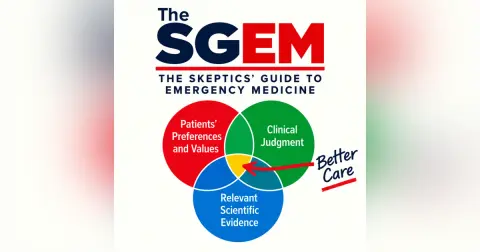
Date: September 4, 2026 This is an SGEM Xtra looking in the rearview mirror at 14 years of The SGEM and looking forward to Season#15. Season 15 is traditionally the crystal anniversary. Crystal is transparent; it can help us see things more clearly, and it can also shatter if you drop it. So, basically, a great metaphor for medical evidence. Cue some 80s music. Because if I could turn back time. Unfortunately, I don’t have a DeLorean, a flux capacitor, or 1.21 gigawatts. What I do have is a microphone, a large collection of papers, and what may be an unhealthy willingness to discuss p-values and confidence intervals. PICOT for this SGEM Xtra Episode: Population: SGEMers Intervention: 14 years of skeptical knowledge translation Comparison: Practising emergency medicine before the SGEM Outcome: Thinking better leading to better care Type of Study: Not really a study, but more of an unblinded observation, heavily confounded by nostalgia, that has been funded primarily by enthusiasm and coffee. When the SGEM began, the goal was straightforward but ambitious: to shorten the knowledge-translation window from more than 10 years to less than 1 year with the power of social media. We wanted to identify clinically relevant emergency medicine research, critically appraise it, and deliver that information to the front-line clinicians caring for patients. Medical education for anyone, anywhere, at any time. Very similar to the EM philosophy of seeing anyone, anytime, for anything. Listen to the podcast and turn your car into a classroom. That was the idea. I am very thankful to my evidence-based medicine (EBM) mentor, Dr. Andrew Worster from McMaster University. He started the BEEM project and took a chance on me about 20 years ago. Andrew also taught me the EBM answer of “it all depends”. I pitched the idea to him in ~2011 about doing a podcast while riding a ski lift at the Silver Star ski resort in BC. He said…what’s a podcast? Andrew also suggested I attend the University of Oxford and take a mini-fellowship course from the Centre for Evidence-Based Medicine (CEBM) on how to teach EBM. My idea was to create a blog and podcast to encourage skepticism, critical thinking and demonstrate how to review a publication. That is how this whole thing got started. There was no five-year strategic plan, no glossy prospectus and no venture-capital funding. There was a blog, a podcast, social media, a standardized critical-appraisal process adopted from the BEEM group, and a growing group of people who believed emergency clinicians deserved timely access to the best available evidence. It was fortunate that it happened at the same time as the Free Open Access to Medical Education (FOAMed) movement was launched in 2012. Not the newest evidence simply because it was new. Not the loudest evidence because someone had a good marketing department. And not the most prestigious evidence merely because it appeared in a high-impact journal. As I like to say, the only thing you can conclude when something is published in the NEJM is that it was published in the NEJM. All your work to determine its validity is still in front of you. The goal was to find and critically appraise the emergency medicine literature, interpret it in the context of clinical expertise and what matters to individual patients. Fourteen seasons later, the SGEM has more than 85,000 subscribers. It has been translated into five languages, and more than 100 SGEM critical appraisals have been published in peer-reviewed journals. Those numbers are wonderful, and I am very proud of them. But numbers can only tell part of the story. I don’t want this to be an argument from popularity. A download does not tell you whether someone reconsidered an old habit. A subscriber count cannot capture the moment a clinician paused before ordering a low-value test, questioned an impressive relative risk rather than considering the absolute risk reduction, or had a better shared decision-making conversation with a patient. The real outcome has always been what happens at the bedside. Did the episode help someone think more clearly? Did it help them recognize uncertainty? Did it help a patient receive better care? Those are the outcomes that matter. Especially the patient-oriented outcomes (POOs). One of the major developments over the years was the SGEM Hot Off the Press, or SGEMHOP, series. This was created with my BFF, Chris Carpenter. Chris has been a friend, mentor, collaborator and occasional enthusiastic supplier of methodological questions that require three cups of coffee to understand. I’m thankful that the editor-in-chief of Academic Emergency Medicine (AEM), Jeffery Kline, saw the value in the SGEMHOP and supported the initiative. The idea behind SGEMHOP was to take important new papers, appraise them while they were still hot off the press, speak directly with the authors, and have an open discussion with the wider emergency medicine community. Over the years, that series benefited from an outstanding group of co-hosts: Lauren Westafer, Chris Bond, Corey Heitz, Kirsty Challen, Justin Morgenstern, Neil Gupta & Suchi Datta. Each brought a different perspective, a different area of expertise and, importantly, a willingness to disagree. That matters. A panel in which everyone agrees may be comfortable, but it is not necessarily informative. The goal was never to build an echo chamber. It was to create a respectful space where methods could be challenged, conclusions could be examined, and uncertainty could be acknowledged. We invited authors onto the SGEM knowing we were going to ask difficult questions, but critical appraisal was never meant to be a gotcha exercise. Research is difficult; I know I’ve been doing it for 42 years. It involves designing the study, conducting the research, submitting it for peer review, and facing post-peer-review criticism from potentially thousands of skeptical emergency clinicians who aren’t shy about telling you what they think. The focus was always on the paper, the evidence, the logical arguments and not the person. Challenge the methods. Question the interpretation. Be curious about the choices that were made. Recognize the limitations. And be kind to the people who did the work. Dr. Dennis Ren Another terrific addition to the SGEM was Dr. Dennis Ren and the SGEMPeds episodes. He took over where PedsEM superhero Dr. Anthony Crocco (SketchyEBM) left off. Dennis brought expertise, enthusiasm and an important reminder that children are not simply small adults. He also shares my love of Batman. Pediatric emergency medicine has its own evidence base, uncertainties, and challenges in communicating risk to families. Dennis helped us explore those questions while keeping the episodes practical for anyone who cares for children in an emergency setting. Dr. Kirsty Challen Then there is Dr. Kirsty Challen and her wonderful Paper in a Pic summaries. Every Thursday, Kirsty takes an entire critical appraisal and turns it into something clear, memorable and visually engaging. A picture may be worth a thousand words. Kirsty’s pictures are also worth a thousand likes and shares on social media. Kirsty’s Paper in a Pic also allows SGEMers to revisit the clinical question, key results and bottom line in a format that can be understood quickly and shared easily. That is knowledge translation in its purest form: preserve the nuance but make the information accessible. The SGEM has also expanded beyond traditional journal club episodes. The SGEM Xtras let us explore popular culture and ask a different kind of question: Can movies and television help make us better clinicians? We looked at Star Trek, Buffy the Vampire Slayer, Batman, Ted Lasso, Top Gun, A League of Their Own, Mission: Impossible and others. From Star Trek, we considered the balance between logic, leadership and humanity (Spock, Kirk and McCoy). From Buffy, courage, teamwork and the family we choose. Batman taught us the value of preparation (although billionaire vigilante medicine may have limited external validity). Ted Lasso reminded us that kindness is not weakness, and we should be more curious and less judgmental Top Gun gave us teamwork, communication and the importance of not letting confidence become overconfidence. A League of Their Own reminded us that women have always belonged on the field, in the emergency department and in academic medicine. Mission: Impossible? That one mostly prepared us for Monday mornings during respiratory-virus season, which is right around the corner. The SGEM book reviews gave us another opportunity to slow down and think more deeply. We spoke with Timothy Caulfield about misinformation and celebrity culture, Brian Goldman about kindness, Steven Novella about skepticism, Darren McKee about AI superintelligence, and Mel Herbert about the extraordinary power of being average. We were also fortunate to welcome some extraordinary guests. Noah Wyle joined us to talk about The Pitt, emergency medicine, and why his portrayal of an emergency physician felt so authentic to people who do the actual job. Terry O’Reilly from Under the Influence helped us think about communication, storytelling and making an idea memorable without overselling it. Over the years, we have also worked to ensure that the SGEM reflects the full team caring for emergency patients. Emergency medicine is not practised by one profession in isolation. We should all be on Team Patient. Our patients are cared for by emergency physicians, other medical specialists, nurses, physician assistants, nurse practitioners, physiotherapists, pharmacists, paramedics, respiratory therapists and many others. No profession has exclusive ownership of a good idea. And bias does not check your credentials before influencing your judgment. Bringing different clinicians into the conversation made the appraisals better,...