The Maryland Declaration of Rights–November 3, 1776


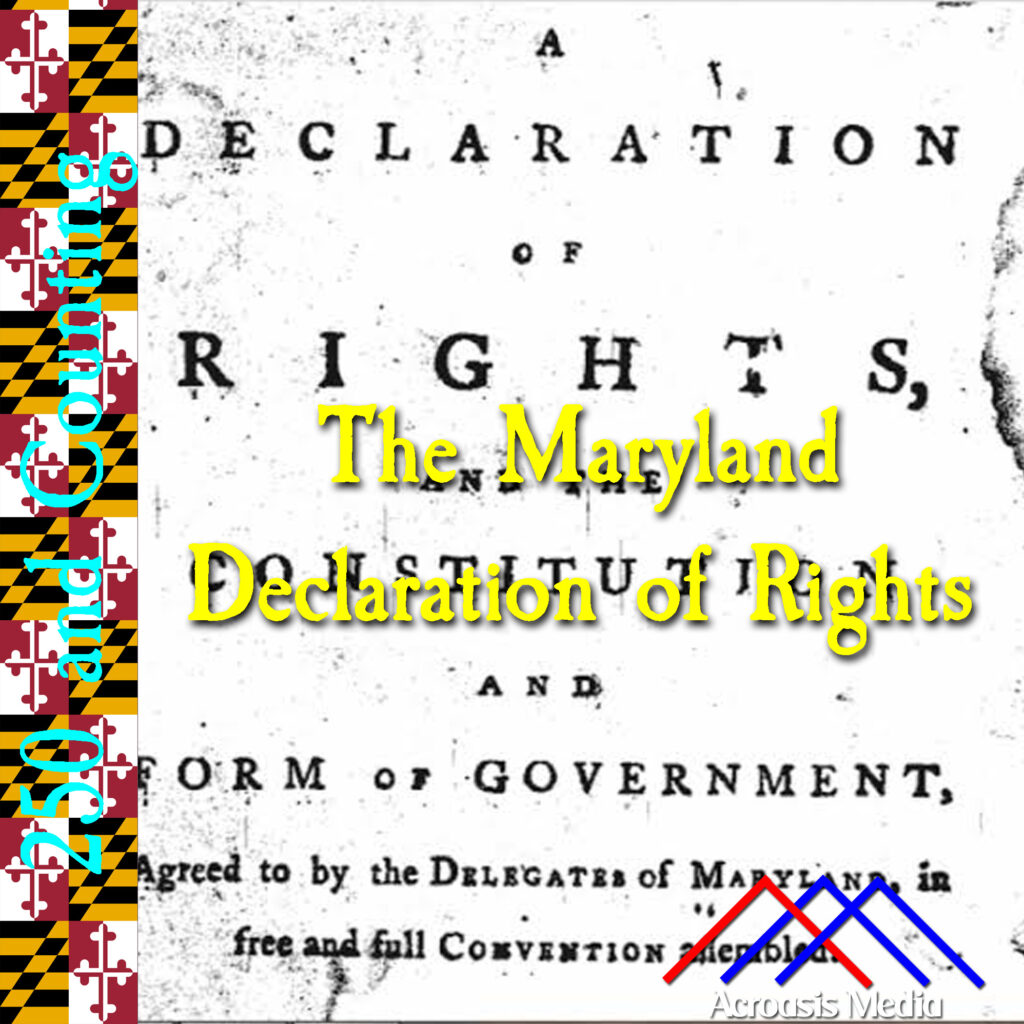
Before I get into the Maryland Declaration of Rights, can I please just note that the State Flag of Maryland is probably the coolest of all 50 state flags? And remember, I’m not native to this state. In fact, not only is it cool, it’s aggressively cool.
I should also mention that if you happen to notice that there appears to be Christmas music playing in the background of today’s episode, you’re not entirely wrong. It’s a recording of Maryland’s state song, which is set to the tune of “O Tannenbaum.” Cool flag, way uncool anthem.
The Maryland Declaration of Rights, which has a lot of DNA from Virginia’s Declaration of Rights, not to mention Pennsylvania’s, is actually more explicit than those documents (not to mention the US Constitution) when it comes to the enumeration of some of those rights.
For instance, there’s Article 40, which stipulates, “That the liberty of the press ought to be inviolably preserved; that every citizen of the State ought to be allowed to speak, write and publish his sentiments on all subjects, being responsible for the abuse of that privilege.”
Article 22 is the right against self-incrimination, but again it’s more explicit then the US Fifth Amendment, because it provides that exercising that right is unconditional and can’t be irrevocably waived for the duration of a trial. So if you didn’t exercise it earlier, you can still exercise it later on. Likewise, if you waived your right under the Fifth Amendment, it doesn’t mean you also waived your right under Article 22.
Over the years, the Maryland Constitution has been modified a few times, including: a couple of times in the late 1800s to eliminate slavery, certain race-related items were removed and women’s rights broadened in 1972, and reproductive rights were reinforced in 2024.
The post The Maryland Declaration of Rights–November 3, 1776 appeared first on 250 and Counting.