376: Become a Clear-Eyed Visionary Founder with Danielle Hayden
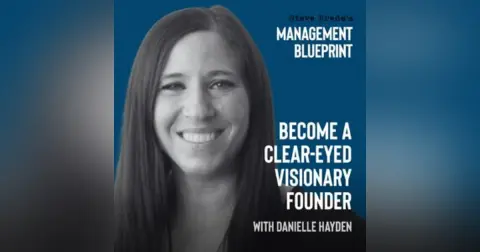



Danielle Hayden, CEO of Kickstart Accounting, shows business owners how to become a clear-eyed visionary founder by building financial literacy from the ground up. A former corporate CFO, Danielle created an education-first accounting firm that helps entrepreneurs understand their numbers, make confident decisions, and grow stronger businesses.
In this conversation, Danielle introduces The Financial Evolution Framework—The Foundations, The Empowered Business Owner, and The Visionary Business Owner. She explains how business owners progress from understanding sales, net income, and profit percentages to using financial IQ for hiring, tax strategy, and growth, then setting a 10-year vision, three-year plan, one-year budget, and quarterly KPIs. Danielle also shares why accurate bookkeeping must precede CFO strategy, how referrals and partnerships drive growth, and why developing middle managers remains essential as her 50-person firm scales.
—
Become a Clear-Eyed Visionary Founder with Danielle Hayden
Good day, listeners. Steve Preda here, and my guest today is Danielle Hayden, the CEO of Kickstart Accounting, a virtual accounting firm that delivers full-service bookkeeping, accounting, and CFO services designed to take accounting off small business owners’ plates and get the support they need to understand their numbers. Danielle, welcome to the show.
Thank you so much for having me. This is my favorite thing to do. Love talking about numbers and helping business owners.
Well, this is your lucky day because I’m also a CPA by training, although I don’t practice it anymore, and I didn’t qualify in this country. I was in the UK, but nevertheless, my wife is also a CPA, so we get to talk debits and credits over dinner.
You get the language. I love it.
So talking about which, Danielle, what is your personal why, and how are you manifesting it in your business?
Yeah. My personal why, I don’t think I realized it almost 12 years ago when I started the business, but it’s to help educate other people. Not everyone understands accounting. And I remember my Accounting Principles II professor, he kept on saying to me, “You get it. You have to be an accountant. You get it. People don’t always get it.” And I don’t think I understood what he meant at the time. But
it is a gift, and it's a gift to understand this language of business.
Share on X
And so my passion has been doing exactly this, helping business owners understand their numbers so that they can make more empowering, confident decisions in their business, which has this amazing effect in their community. So when I think about loving the community and small business, it’s because every single business owner,
when you finally understand your numbers, you can hire more people, you can serve more clients, you can make a bigger impact in your community.
Share on X
And it’s just like, oh my gosh, this is such an amazing mission to be on to spread small business.
Yeah. I couldn’t agree with you more. And actually, there are different levels to it. So you can understand big picture, maybe you understand your P&L first, income statement, balance sheet, and then your KPIs, and then your margins and all that stuff. So just a quick story. Our older son is the one that is following in our footsteps out of four children, who is starting working with PwC, and he didn’t want to be an accountant, but he loved this idea of this is the language of business, and he wants to be a businessperson. So that really resonated with me.
Yeah. Yeah. I love that.
So Danielle, this is a podcast of frameworks, so I wonder, do you have a framework that maybe you use to teach people accounting or teach them understand their numbers? Maybe there are levels of understanding numbers, something that can be explained in three to five steps that our audience would benefit from?
Yeah. So I’ll walk you through our framework of where we see business owners. So I’ve worked with thousands of business owners over the last 11 years. And what I find, people go through this trajectory in their financial education, and we start off with foundations. And when we are learning the foundations, and I don’t just mean as a brand-new business owner. This might be you’re three years in, five years in, and you might still be at the foundational level.
But what that means to me is that you are learning the basics of the language. What does a P&L mean? What does net income mean for me as a business owner and then for my tax return? How do I look at my percentage of income and how I’m spending my money, and how that benchmarks to other businesses in my industry? Where are my sales coming from? And how do I just start to think about using these numbers as a business owner? So we come in at this foundational stage.
And then usually, as our clients work with us at Kickstart, so we also build our business and SOPs, frameworks, and our product, what we call the Snapshot. So as our clients, they finally have bookkeeping in place. They’re for the first time looking at clean, organized financials. It allows them to start to learn the language, and then they start to move into empowered. So that empowered business owner, you are starting to embody a CEO seat. So you’re starting to think, “Ah, it’s my responsibility to know these numbers, to use them to make business decisions. I’m thinking about hiring.
Let me look at my numbers to make that business decision. I’m thinking about tax strategy as well as building a business of value.” So that empowered business owner, I think of it as starting to put that CEO hat on, where you’re no longer hiding from the numbers and you’re willing to open up your email from your money team every single month, really read it and ask yourself, “What happened? Why did it happen? And what am I going to do about it?” So that’s where our bookkeeping clients sit, from foundations into empowered.
Kind of the last tier that I see is that visionary business owner, where we’re moving from just being the CEO to being a visionary. That means that you are casting the vision for your business, and this is where we work with our CFO-level clients, looking at the 10-year goals. Where do I want to be at in my business and my personal life in 10 years? Call that the North Star. By creating a three-year plan. I can’t get to where I want to go in 10 years if I don’t know where I’m going in three.
But again, business and personal. And then creating a complete SWOT analysis: strengths, weaknesses, opportunities, threats. So then ground in a one-year budget where we are planning out the income and expenses of the business, and then from that visionary seat, we can cast the quarterly KPIs for true accountability. So to me, that’s kind of like the top of that pyramid where we can aspire to sit as that visionary who’s going to cast the vision for the business.
Wow. You got the whole picture. I love it.
Yes.
So what’s the timeline for people? So if someone maybe comes in as a newbie, and they have very rudimentary understanding, if at all. They’re just surviving. Just instinctively, they look at their bank balance beginning and end of the month, and as long as they are in the black, they can make decisions. So from that point, for somebody to be able to step up to the empowered business owner stage, how long does it take?
I’ll say it depends on you, right? It’s like asking, “How long is it going to take me to lose 50 pounds?” Well, it depends. Are you going for a walk every day? Do you go to the gym and lift weights? What are you eating? Do you eat healthy during the week and then eat pizza all weekend? It’s not going to be the same, right? So I use that as an analogy because if you lean in and educate yourself, you ask questions, and you let your money team support you, we actually see clients moving through this pretty quickly.
I would say about six months. So when our clients come to us, we put their QuickBooks into our chart of accounts, meaning that we’re going to put them in our strategic framework, which makes it easier to use the numbers moving forward. Once we clean up QuickBooks, we start sending our clients what we call the Snapshot, and the Snapshot’s an easy-to-read overview dashboard of their numbers. And we take an education-first approach with our clients. So for the first three months that they are with us, they get a weekly email educating them on one portion of their financial statements and how to read it.
So for somebody who’s like, “Yes, I’m going to read your email,” you’re going to move from foundations to empowered much faster. If you’re somebody who is not ready, you’re putting your head in the sand, and maybe you even sign up for bookkeeping and tax services, but you don’t answer the emails, you don’t book the calls, you don’t read the emails, and you’re still not ready to actually partner with your team, it’s going to take you much longer.
Okay. So when you say partner with your team, what do you mean by that?
So for our clients, we offer, depending on the package, monthly or quarterly financial review calls. So lean in and book the calls. Every month we theme our financial statements. So for instance, last month we talked about net income and what a healthy percentage of net income means. We provide a podcast episode, education, and how it compares to your financials.
This month, I’m really excited about this month, it’s the balance sheet and understanding your balance sheet trends, cash, debt, and equity. Where’s your cash hiding? And we’ll have, again, a podcast episode, content around that, and then we’ll show our clients their balance sheet. So if you are leaning in, reading the emails, watching the podcast episodes, booking the financial review calls, looking at your Snapshot every month, answering our questions and statement requests when we have them, to me, that’s a partnership.
And I’ll add one more thing to it. I think often we think, “Gosh, entrepreneurship feels lonely. I sure wish I had someone to ask this question or run this idea by them or bounce these ideas off of them.” Our team is here for that. And so I refer to the partnership as ask us the questions, shoot us the email, let us be there to celebrate with you, and there to pat you on the back when things aren’t going so well.
So when you talk about the team, you mentioned it several times. So how do you structure your team so that they can provide this advisory function?
So we have three different teams. We have our bookkeeping team, our CFO team, and our tax team. On our bookkeeping team, every single one of our clients has a bookkeeper and an account manager. Since you speak in frameworks, I’ll speak to this a little bit. Every single one of our bookkeepers follows Kickstart’s standard operating procedures.
So they’re not allowed to do the bookkeeping in whatever way they want. They have to follow our brand guidelines. And so we have an SOP for, I got to say, I think you’d be impressed, every single line of the income statement and balance sheet, we have a standard operating procedure for it. So our team knows exactly how to do the financials. Our account managers then review the financials and are there for strategic-level questions.
And so we structure each one of our clients to have a bookkeeper and account manager. If that client also is engaged with us for tax services, they would also have one of our tax team members assigned to their account, and then we have a CFO team as well.
Wow. So they can reach out to their account manager, I guess, or just you or their provider?
Yeah, bookkeeper and account manager, yeah.
Yeah. That’s very cool. So then I’m curious, what drives growth in your business, Danielle?
So a few things.
Our number one ways that our business grows, first and foremost, is referrals. Our clients, because they feel so empowered and supported by the team, they are usually the ones shouting our names from the rooftops.
Share on X
So referrals. And then we have our referral partners. We’ve partnered with other people in the industry that are coaches, different industries who are also serving small business owners. And so our referral partners, and then doing this, speaking, podcasting, and connecting with other people who are also servicing small business owners.
I love it. You’re very structured. I like how you answer questions. You don’t spread the fluff. You basically have a structure in your mind of how you’re going to answer this question. It’s like an SOP for answering questions almost.
My team will appreciate that because we do. We have an SOP and a structure for everything.
So okay. So you have a structure for everything, but no business is perfect. So what’s one thing that you’re actively trying to figure out in your business right now?
Yeah. We have really struggled with middle management. So we have about 50 team members right now, and just having a really strong team to be able to continue to grow, having that leadership structure for people to really own their departments and to be able to continue to grow and mentor and lead the team. So we have done a lot of hiring over the last year and actively training our middle-management team and really excited about what’s next for them.
So is this something that you figured out, or is this something that’s still a work in progress?
It’s still a work in progress. Isn’t all of business a work in progress?
Pretty much, yeah.
I tell my team all the time, “Yeah, we’re going to figure it out, and then it’s going to be, like, good for three to six months, and then we’re going to grow, and so we’re going to have to figure it out again. And so the SOP that we had six months ago is going to need to be updated, and then we’re going to do it again in another three to six months.”
Yeah. That is true. I love the Churchill quote that, “The definition of success is going from one failure to the next without losing enthusiasm,” which is not exactly what you’re saying, but it’s kind of some similar idea.
You’ve got to enjoy the journey. I think that’s been something that’s changed for me, that I used to think it was about these destinations. So got to hit a million dollars in revenue, and then you get there, and you’re like, “Okay. Let me celebrate for a moment. That’s exciting, and now I’m ready to reset the next goal and the next set of issues.” And I think for me, I stopped thinking… I care less about those specific destinations and more about, like, are we having fun this month? Does this feel good? Are we all growing? Do we want to keep doing this? And why? And how can we make this as exciting as possible?
So why is it… I mean, it sounds like you’re very organized. You’ve got these teams. You’ve got SOPs for every line in the P&L and the balance sheet. You’ve got your teams working together. You’ve got the experts. So how is middle management a challenge for you?
As we’ve continued to grow, having team members who can lead. We have a great group of team leads who have risen through the ranks, who have become managers. But they need to be trained, and they need to learn how to be leaders, and that takes time.
Yeah. Yeah, that’s true. That’s true. So who are the ideal customers for you?
Yeah, our ideal client for bookkeeping is somewhere around $150,000 a year in revenue and growing. So a business owner who is ready to say, “I can’t be the one to do everything on my own. I’m not the best person to do the bookkeeping. I need to understand my numbers.” So moving from that foundations to empowered, but has real revenue, has a real business that’s ready to grow and ready to see themselves as a business owner into CEO. So about $150,000 a year in revenue is where that starts. Our CFO clients, they stay a good fit for bookkeeping through about a million dollars in sales.
Usually around that million-dollar mark, that’s when we see people moving through empowered and ready to start moving into our CFO services. They’re ready to take the next step, create a budget, finally look at the goals, and really create the vision for where their business is going. So our CFO services are usually a best fit for somebody past the million-dollar mark. And then our tax services, our ideal client is somebody who wants a partnership and not a transaction.
We do what we call tax weeks, where every single one of our clients actually books a tax week. During their tax week, you actually get to speak to somebody on our team, like, live on Zoom, which is unheard of in the industry. We want to talk to you. We want to have a conversation with you. We send a Loom video to recap the tax return when it’s complete, and then we’re there for questions throughout the year. And then around the August, September timeframe, we do another tax planning call where, before the end of the year, right? Like, you still actually have time to do something about it.
We meet with our clients again, and we look at their estimated tax payments, how much they’ve paid, and any other tax strategies that they can implement before the end of the year. And so our ideal client is really somebody who wants to engage in that level of partnership and is not just looking for a transaction.
I love it. Especially the tax planning call. I’ve never heard anyone do it. It’s so obvious. I know. So obvious. Because January 1st is too late, right?
It’s too late.
You have to do whatever you need to do in the last couple of months of the year at the latest to not get burned, and almost nobody does it. So how did you develop this structure that you’re using? It sounds like maybe something that you kind of democratized. Maybe you saw something done by larger companies and you took it to the lower middle market, or was it completely organic, bottom-up?
I think it’s bottom-up. So when I left corporate as a CFO, and when I started the business, I thought that I was going to go and provide CFO services for business owners. I went to go build my first few budgets and have these strategy calls.
You cannot build a budget without bookkeeping. Like, if you don't know where you've been, you don't have a clue as to where you're going.
Share on X
And so I asked these business owners, I said, “Well, can you send me your P&L for the last 12 months? Let’s have this conversation.” And they couldn’t have the conversation.
And I said, “Okay. Hold on. I can’t provide CFO services. I have to start at the bottom. These are building blocks.” And so bookkeeping, it’s not the sexy one, right? Like, you don’t usually hear bookkeeping up on a pedestal. But for me, bookkeeping is everything. We start from the bottom up. And I want every single small business owner, no matter how small you are, to have access to accurate financials and education. Because right now, what happens is you have these larger CPA firms who’ll work with the big businesses. And I’ll never forget, I had a client who came to us and said, “Well, my tax accountant said to me, ‘Your little business.'” She’s like, “I’ve never been so embarrassed.”
And so I made a point my first year that I would never say, “You’re a little business.” Nobody would ever be too small, that we are going to make sure that everyone has access to this, and we’re going to do it in a way that works. So it’s really creating something that didn’t exist to really compete with the big firms because they don’t want to service our small business owners of the country.
Yeah. Yeah, I love this, and it’s so true. I come from investment banking. I had an investment banking firm for 10 years, and—
So you know. —
And that was the problem, that we went in there and then the numbers were all over the place. So we had to start by… We started calling it vendor due diligence, what the private equity calls it when you do your due diligence before the due diligence to make sure that you find where the bodies are buried. So that’s what we started doing so that we actually knew that if we said something, it was that way.
And it’s a huge problem. So it makes complete sense. By the way, you talk about CFO services. There are so many fractional CFOs, and that has been my impression, that it’s really not a CFO service. It’s more about handholding through the bookkeeping and getting people to a point where they could perhaps talk to a CFO. But it’s not really a CFO. It’s more of a financial babysitting.
Yes. And that’s why we start at foundations, right? All of our clients start at foundations. Let’s learn how just to read the financial statements. Once we get there and we’re feeling empowered, that’s when we can start to have a CFO conversation. We can set the vision for the business. We can create a budget. We can talk strategy. We can’t do any of that until we know where the business has been.
So what are you building here? It sounds like you’ve got a very solid foundation in terms of you have a structure, you have SOPs, you have a clear vision of the kind of service you’re providing. So what’s the big vision? Is this something that you’re sharing, or is it very private?
So we have a BHAG. Our BHAG is to help one million business owners understand their numbers. So we’ll do that through our podcast, CEO Numbers Network, through our social media platform, Kickstart Accounting, through speaking and connecting, and then through our services.
So our BHAG is one million business owners. When we celebrated our 11 years, when we had our anniversary, we actually went from Kickstart Accounting, where we provided all of our services under one brand, and we actually created three sister companies. So now we have Kickstart Accounting Group for our bookkeeping, then we have Envision CFO for our CFO services, and then KSA Tax Partners for our tax. And the reason we did that is it’s our recommitment to our clients for the next 10 years. We’re in it. We want to continue to grow this business. The mission, the passion, the vision, it’s still there. The energy from me as a CEO is here, and we want to commit to the next 10 years and to the next level of growth.
Amazing. Amazing. So who would you like to connect with you, and how can they engage with your firm? Can they reach out to you, or do you have resources that you can share? Of course. What’s the way to connect with you?
Yeah. If you go to kickstartaccountinginc.com/gift, we have some free resources there where you can download some of our resources. Kickstartaccountinginc.com is our website. Come and book a call. You’ll actually talk to myself, or we have a few other team members who take our discovery calls, where we can talk to you about your specific situation and where you’re at in your journey. You can share with us if you are in the foundation stage, empowered, or ready to sit in that visionary stage.
But our website’s going to be the best place. Come and book a call. We do have our podcast, CEO Numbers Network, so if you’re like, “Ah, just don’t know what the heck to do with all these numbers,” that’s where we talk every single week on how to use your numbers to make better business decisions.
Amazing. So this is very clear. I don’t think I have had anyone on this podcast, although we did have a few bookkeeping companies, CFOs, that described the stairstep structure so cleanly, so I really love it. You start with the bookkeeping and then you become the foundations. And then, as you explained, the next one is empowered, being empowered so that you can read your numbers and you know what to do, whom to hire, and how to build your business.
And then eventually you go to the visionary stage where you have budgets, you have 10-year, three-year, one-year plans, SWOT analysis, quarterly KPIs driving the business. So that’s very, very clear. If you engage with this vision and you like this vision, then just walk in, and whether it’s Kickstart or Empower or Visionary, wherever you are, go to… Is it kickstartaccounting.com/gifts?
Kickstartaccountinginc.com/gifts.
Inc.com/gifts.
Inc. It’s the important one.
Yeah, right.
Important three letters.
Yeah, I know being an Inc. and being a C corporation is important. Yes. You’re probably an S corp. I don’t know. But yeah, so inc.com and download your gifts. I’m going to do the same. And if you enjoyed this episode, then make sure that you follow us on YouTube, give us a review, and stay tuned because every week I bring a couple of amazing entrepreneurs like Danielle Hayden, the CEO of Kickstart Accounting and its sister companies, on the show. So thank you for coming, Danielle.
Thank you. Thank you for having me.
And thanks for listening.