375: Build a Supergroup of Retired Experts with Tom Pugh
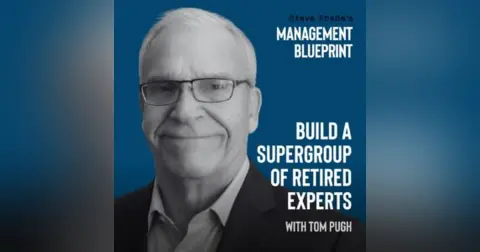


Tom Pugh, Founder and former CEO of Pugh Associates, shows experienced professionals how to build a supergroup of retired experts by staying in their swim lane, recruiting seasoned peers, and pursuing complex opportunities years in advance. After 35 years in Navy and defense engineering, Tom started his consulting business at 60 to use his expertise while staying home to support his wife.
In this conversation, Tom introduces The Supergroup of Experts Framework—Stick to Your Swim-lane, Keep Tabs on Talented Peers, Identify Opportunities, Nurture Decision Makers, and Eat What You Kill Together. He explains how he assembled experienced engineers, offered their expertise on a fractional basis, and paired them with younger professionals to transfer knowledge. Tom also shares why in-person presence drives growth, how shared-risk compensation helped launch the firm, and why complex contracts should be pursued years before an RFP appears.
—
Build a Supergroup of Retired Experts with Tom Pugh
Good day, listeners. Steve Preda here with the Management Blueprint Podcast. And my guest today is Thomas Pugh, the Founder and former CEO of Pugh Associates, a firm that supports the U.S. Navy, Army, and Coast Guard customers with combat system engineering, integration, test, and program management services. Thomas now consults and advises defense, maritime, and space organizations managing complex technical programs. Tom, welcome to the show.
Yeah. Well, hey, thank you for having me, and I’ve enjoyed chatting with you just before the show, and I look forward to getting on with it. Be good.
All right. Well, my first question is really my favorite question that I ask on this podcast. What is your personal why, and how have you manifested it through your business and perhaps your current consulting career?
Yeah. So it’s an interesting evolution. And I worked for the Navy. I got an engineering degree many, many years ago at Florida Tech, and in my first job, I ended up working for the Navy in their engineering system commands. And spent a bunch of years there. Got involved in the Aegis system, which is an air defense system, and along the way, spent a bunch of years with that.
Had a chance to go into private industry, worked for Northrop Grumman, and I was on a new ship class design, a Zumwalt class, as a systems engineer. And so, as we got to a critical design review, the tasking kind of ended for the systems engineering group. And I had to either get a new charge number, to quote my boss. If anybody who’s worked for a large corporation, you’ve probably heard that. I don’t know.
What’s a charge number? What’s a charge number? Is it like a salary?
Yeah. It’s a new project to work on where they’ll pay you. You couldn’t stay on overhead very long because you were making too much money as an engineer.
Okay. Got it. Yeah.
So they didn’t want you on overhead. So when I say get a new charge number, it’s a new project to work. And it coincided with my wife having some health problems. And so the why I started the business was I looked at what I was getting, what Northrop Grumman was charging for me versus how much they actually paid me. And I’m sitting there going, “I really need to help my wife out a little bit,” and going to work every day. Why don’t I print up some business cards?
And I got my son to build a website. And I said, “You know what, Northrop, I appreciate everything that you’ve done for me,” and we parted ways, and I started a consulting business. So that was the why. It was, “Hey, I have something to offer.”
At that point, I had 35 years' experience or so, and why not provide that as a consultant and be able to help stay at home?
Share on X
So that’s the why I started the business, and that pretty much sums it up.
So how old were you when you started, if I may ask?
Good question. I started the business, so I must have been 60.
Wow.
Yeah. Yeah, I was 60.
That’s very courageous to start a business at 60.
Yeah, well, so all you entrepreneurs out there, when you feel like you’re stepping off a cliff, you’re giving up. At that point, I had a six-figure salary, and I’m going into this abyss where there isn’t any salary. And then you’re sitting there going, “Okay, how am I going to do this?” Right?
Back in the day, Steve, I don’t know if you ever remember, you’re old enough to probably have seen it, but we had a guy who would come on an advertisement, and he was making believe he was selling whatever he was selling. And he said, “I can do that. I can do that.” And then as soon as he hung up with the person he was selling, he says, “How am I going to do that?”
Sell first and figure out later. Yeah.
It’s like you’re stepping off into an abyss and giving up a very comfortable salary, but it was worth it because I was able to stay home with my wife.
Yeah.
But it was scary. And any entrepreneur, I’m sure, has experienced something very similar. Yeah.
Yeah. I love that. And for years when I was younger, I thought that I heard the story of Ray Kroc when he started McDonald’s at the age of 53 or 54. Great example. And I thought that was a late age to start a business, and I thought that this is kind of the latest one. But I think Colonel Sanders, he started at 68.
Oh, yeah. Yeah.
So it’s absolutely doable. So this podcast, Tom, this is a frameworks podcast. So what I’m looking for in every episode is a framework that an entrepreneur has developed or figured out themselves or learned to understand, which allows you to simplify the world into a three- to five-step process, something important. Maybe it’s getting government contracts, maybe it’s designing something, maybe it’s satisfying a customer. I don’t know what it is, but does anything come to mind that can be explained in three to five elements? This is a framework that will allow our listeners to connect with your idea and perhaps try it in their own business.
Yeah. So it was an interesting evolution. Like I said, I had been providing my 35 years of experience through Northrop Grumman at the time and went out to start my own consulting business. I think the first thing is you’ve got to know what you’re selling and really want to do it. In other words, and I call it, stay in your swim lane. So my swim lane was two-pronged. One was systems engineering and project management. And so when I did start off, the first thing I did was contact folks that I knew and started to network for myself. It was just me.
And I got a small job from an engineer that I had worked for before. He knew what I knew. He knew he needed me for six months, and he threw me a few bucks, and that was it. It started it. Along the way, since I was at that age, it’s the retirement age a lot of people are looking at. And so a lot of the folks that I grew up with that had the same amount of experience as I did started trickling out as well. So I’d call them up, and Bob was my first recruit, a guy I had worked with for 20 years. And I said, “Hey, Bob, what do you want to be when you grow up?” And he said, “I might enjoy doing something consulting.” And I said, “Well, how about thinking about Pugh Associates?” And so that’s how it got started.
And it trickled along those lines. Matter of fact, it was a great conversation with Bob. So we’re making our first trip, and you were asking, so what’s the thing? First thing is stick with the swim lane that’s yours, that you’re an expert, you know it, and you like it. It’s not something that you dread, you hate it, you went to work every day and hated it. It’s something you really want to do. It could be a hobby. It could be something totally unrelated to what you’re doing. So anyway, stick to a swim lane and then network, sell yourself a little bit. Start small.
Don’t bite off too much. And then, like I said, as people that I knew, my goal was to corner the market of these guys coming out with the same experience that I had. And so every time I’d hear about a person that had experience in the business, the weapons and combat system business that I knew, I’d have the same conversation. And typically, one of them said no, he wasn’t interested. And guess what? Six months later, he’d call me. So I was able to build up a core of 11 engineers that had similar amounts of years of experience.
And so when we participated in an engineering project, we were experts in the room, and there was no doubt. And so what does that mean? I don’t care if you’re opening a bakery and you’re going to make cakes, you want to have the best cakes on the planet for a reasonable price. They don’t have to be the cheapest, but they certainly should be the best quality and a reasonable price. And I think that’s the same with what we did. We had some great engineers.
And then what we would sell, because we were expensive guys, is, hey, we’d go market and say, “Hey, you don’t want to hire my guys full-time. You want to hire us part-time and then glue a bright young engineer to us.” And in a year down the road, after you’ve got them pretty much oriented, they can drop back to part-time, and they get the benefit of your experience.
It’s kind of a fractional engineering service?
Yeah. That’s a good… I didn’t think of it that way, but that’s what it was. And so now, and it’s transitioned. If you go to Pugh Associates now, there’s a bunch of full-time employees. There’s still some very seasoned consultants, but there are also a lot of between entry-level and mid-level engineers. And Carol, you met Carol Wood, you mentioned that. Carol’s now the CEO. She took over for me a couple of years ago when I kind of throttled back. But it’s been great, and she’s done good. This past year, she’s managed to exceed our sales goals, and so the company is doing well. Doing well.
That’s great. That’s great. So what I’m curious about is, it sounds like you managed to hire these experienced engineers because they were also around the same age as you were, and they were kind of getting retiring or going part-time.
Yeah.
So that’s a very interesting business model. I’ve never heard about this idea of putting together, like, a supergroup of retired experts.
Yeah. And because of the demand, and now with President Trump, it’s gone crazy. So he’s really trying to revitalize the defense and the Navy, and of course, what we did was in the middle of all that. And so it’s been kind of interesting to watch how the politics shifted. Yeah, and just to finish the thoughts that I started, once you do that and you get… And I started with Bob, I just won’t mention his last name, but Bob came to me, and he asked me one day, he said, “Tom, how do I know if I’m succeeding?”
Because he’d been working for the same company for 30-some years, and he had no idea about marketing and business development like that. And I said, “Bob, all you got to do is follow me and show up. And then we’ll talk to people, and it may take six days and it might take six months, but guess what? You’re going to get a task, and people are going to want to pay for you.” Yeah. So it was funny having to explain to a guy, he was an engineer his whole life and never had to do any business development.
So basically, you brought these people on board, and it was kind of an eat-what-you-kill approach initially, that they would get paid when you found something for them.
Yeah. And so here’s the deal that I did for them. We shared it. So I said, “Look, you give me your rate, I will pay half of your rate for everything we do, and you just do sweat equity for the other half.” So if a guy was a $50-an-hour guy, I’d pay $25 an hour. He’d show up, and his sweat equity, because that way they didn’t have to put up money up front, and then I knew what would happen. We would get task orders, and sure enough, it didn’t take long at all for any of them.
Yeah. Yeah. I love it. This is great. This is brilliant. Actually, it’s 60 is the new 50.
Yeah.
So people at the age of 60, they might be exiting some company. I have a very good friend who is a partner at Pricewaterhouse, and they have a rule that at 60 you have to step down. And he is— Well, there you go. —he is kind of conflicted about it because he feels like he’s still in his element, and now he has to become a second-rate partner in the firm. And you actually tapped into this energy that, okay, you actually can bloom here and run with it. That’s amazing.
Yeah. And I would encourage him to do it. Because I’m sure, and I don’t know what kind of benefits they have, but I’m sure he’s been there a while. He’s going to have some good… He’ll have some sort of financial resources to be able to get started.
Oh, yeah.
Even if you start part-time. Take the secondary back job and start up at night and print up the business cards like I did, and put up a little website and market yourself. And if you’re scared, if you’re afraid to do that leap off the cliff, and I don’t blame people. That’s why a lot of people don’t do it.
Yeah.
They don’t want to give up the salary and stuff.
So Tom, are you still involved with the business, or are you completely moved out?
Yeah. And so I consult. Matter of fact, I talked to Carol here two weeks ago, and she’s got proposals she’s bidding, so I’ll probably help out on the next bids. Help them write the proposal. And if nothing else, critique, do the red teams. They do red teams to critique all the proposals before they go out.
So what drives growth in the business of Pugh Associates?
Yeah. Well, again, it’s like everything else. You have to be proactive, and you’ve got to be present. So with our business, we were on the coasts, being Navy, started out Navy-focused. And the Navy engineering for air defense is in California. Meanwhile, we’re in New Jersey, on the East Coast. And so how are we going to do that? You have to go. I mean, this online LinkedIn stuff, it’s good. You need to do that. As a matter of fact, that’s a way to sustain it, is to make sure that you’re actively engaged in something like LinkedIn.
Let people see who you are out there and then participate in conversations. If somebody puts something up, hey, comment on it. You don’t have to do a lot, but just, “Hey, I agree with you,” or, “Hey, here’s another spin on that.” And again, people start to see, hey, this person’s got some good background. But then your better thing is in person, and so presence is really everything. So that was a big thing. We had up-front plane tickets for the experts to get them out there, and it worked. We ended up teaching systems engineering at this engineering facility. It was a great run, and only because we were there.
The local guys could look us in the eye. We weren’t just something on a Zoom call. “Oh yeah, that’s a real person,” and “Yeah, I know him.” And all the body language that you miss on a Zoom call when you’re in person. Matter of fact,
the breaks are the most important part of going to a symposium or going to some sort of a meeting.
Share on X
Yeah, during the break is when you really get to know people. That’s the networking part.
Yeah. And you don’t get that if you’re doing it on the internet. Yeah. So yeah, do it in person. And then when you start up, you need to be face-to-face in the case of project management and engineering. And it’s probably the same if you’re opening a bakery and you’re going to have a new baker. You want to be with that baker for a little while, first face-to-face, and make sure the products are the quality you want and you understand each other before you let them go out on their own.
Same with engineering and project management. You want to be in the same place for a little while, and then you can go to remote effectively and do a good job of engineering and design. We did that on the Zumwalt well ahead of Zoom calls, too. We were collaborating literally across the country on the engineering for that. Yep.
Yeah. That’s amazing. So a business like Pugh Associates, or maybe Pugh Associates itself, what’s something that you guys are actively trying to figure out in this business to make it more successful?
Okay. So again, backing up, you’ve got to network. You’ve got to know where the opportunities are. And for instance, shipyard, we have people working in shipyards in Mississippi. But matter of fact, I was talking about the presence. Because we’re there and they understand that I have two engineers—Pugh Associates has two engineers there. They’re competent. They really are contributing a lot. And then President Trump is trying to do this big push, so guess what happened? This shipyard is going to get more work, and then these people will be a core to expand.
So again, it’s networking. Go to the symposia, participate online in conversations. Keep your contacts that you have from your career, and just touch base every once in a while, have a cup of coffee with them. And then presence. So get yourself started somewhere. If it’s only one person, take it. And as long as you’ve got that, like I said, the people that we put in there, they’re experts, and it’s obvious they know what they’re doing. So again, you have to identify that. So that new shipyard opportunity just came. They’re going to start building some Coast Guard ships, and they want us involved.
And then on top of that, the president wants to do Golden Dome, and of course, air defense is what that is. So that’s another opportunity for Pugh. So then you’ve got to figure out, okay, who are the people that actually are going to be sponsoring it within the Navy and the Army? And then contact them. Make sure you go to any… Because they typically, in the case of the services, they do have open houses where they’ll explain, “Hey, here’s what we’re doing for the next year, and here’s what we’re doing for the next three years.” Go to those, make a list.
And you’ve probably heard this before, you want to build a backlog. And if you’re going to bid on a job, a complex engineering job like we do, you need to start two years ahead at least to chase it. So that’s why you want to make sure you’re talking to these people. You’re actively engaged with them. And then you put it on your list, and you set aside funds, and you figure out how you’re going to do that and who’s the right person that should be assigned to track that. And then when there’s an RFP, or request for proposal, that comes out, you should already have it basically outlined of what you’re going to say.
I mean, you just get in front of it only because you’ve been engaged for two years. And that’s a key to success. And like I said, stick to your swim lane. I’ve heard the term chasing shiny objects. Oh, they’re great, and I’ve looked at them myself. “Oh boy, that looks like a great opportunity.” Well, okay, how are you going to do that? That’s like, as that commercial was, “I can do that. I can do that. How am I going to do that?”
Yeah. Yeah.
I’ve done that, and don’t bother. Stick to your swim lane.
Okay. So I find this very interesting. So as you’re saying, stick to your swim lane, so specialize. And when you get to 50, 60, and you work hard, you will have domain expertise that other people don’t have. The second one was picking up people, so keeping tabs on people. So keep tabs on good people, so when they become loose, either they leave or retire, whatever, you can pick them up because you’re top of mind with them. And then you also talked about this long-term orientation to think two years ahead and sow your seeds, so to say.
Yes.
Yes. Sow your seeds. And then be visible, basically. You said that, go to the conferences, keep connected with them, maybe on LinkedIn. And finally, you cultivate the decision-makers, you mentioned. Yes. And what was the last one? And you also talked about identifying opportunities. That was also a huge one.
Yeah. And that’s the key. And like I said, it’s not just something that’s… If you try, for what we do, you can’t successfully bid on a job unless it’s one person for six months. You can’t bid on a complex job and win if you haven’t started two years ahead. You just can’t. So don’t even entertain those ideas. You’ll see something pop up and say, “God, that’s perfect for me.
I can do that.” You might want to go ahead and find somebody that’s bidding it and offer your services up to them. Help them write the proposal and help them win. But don’t try to be the prime contractor. Don’t try to go after it and just say, “Okay, we’re going to win this.” It’s not going to work.
Is this because people only work with known quantities, people that they have learned about and learned to trust? Or is this because there’s so much complexity in the project that it’s not possible to pick up the pieces quickly?
It’s both. Yeah, because think about it now, and you hit on it. If you’re going to hire somebody, you’re going to want to hire somebody that you know can do the job, especially on a complex job. It’s not just fixing your faucet in the sink. And so you’re going to stick with people. And so part of that two years ahead is you start actually to get to know those people.
You drop in, “Hey, I’m in town next week. How about we have a cup of coffee?” And that way, they at least get to put a face to a name, and a proposal comes in and, “Oh yeah, I know this guy, and he seems like a pretty logical guy. He’s got a lot of good experience.” So that’s all part of it. Yeah, you start that far ahead, and you can build those relationships with the people that are going to be actually entertaining the business. Yeah.
So Tom, let me ask you, who is it that you would like to, when listening to this podcast, reach out to you and connect with you? Who are the people that you’re looking for?
Yeah. So again, I think I said it earlier. I think sticking to the swim lane, certainly people that are in the defense business. And then specifically, command and control is a discipline in systems engineering for defense. So command and control kind of things, as well as air defense. I think those are two swim lanes that we can help in.
Okay. So if you’re listening to this and you are connected to projects that are air defense or command and control related, then reach out to Tom. He is on LinkedIn, and he’s got a pretty good page there. Also Pugh Associates. You can Google Pugh Associates and check it out. Where else can people find you or find information about you?
Yeah. So matter of fact, I can provide it to you, but I would think the best thing would be my email address. Feel free to email me. It’s thomas_pugh@yahoo.com.
Okay. We’ll put this in the show notes. So Thomas Pugh, who was the founder of Pugh Associates, which is still a very prosperous company, a growing company, and Thomas is still active advising different projects, especially command and control and air defense projects. So if you would like… I think you work only in Florida right now, if I deduced it correctly.
Well, that’s where I’m based. That’s where I’m based. Yeah. But like I said, because of the nature of our business, we have Pugh people in Mississippi. I can go anywhere. I’m free to travel a little bit too. If I need to go to California for a week, I can do that.
Steve Preda: Yes.
So okay.
Wherever you are.
Yep.
Wherever you are hit up Tom, and you can tap into his experience, 50 years’ experience probably close to now. So that is amazing. Yeah. And contacts as well, which can be equally valuable. You can be a subcontractor on some big projects of Pugh Associates. So Tom, thanks for coming and sharing your experience and your amazing framework, how to start a company at 60 and make it successful and pick up all the talent.
And if you enjoyed this conversation, stay tuned because every week I bring a couple of amazing entrepreneurs who share their experience and frameworks with you. So thanks for coming, Tom, and thank you for listening.
Well, yeah, and thank you, Steve. I really appreciate the opportunity. Nice talking to you. Keep in touch.
Important Links:
- Tom’s LinkedIn
- Tom’s Website
- Tom’s Eamil: thomas_pugh@yahoo.com