373: Cure Your Speaking Blind Spots with David Goldberg
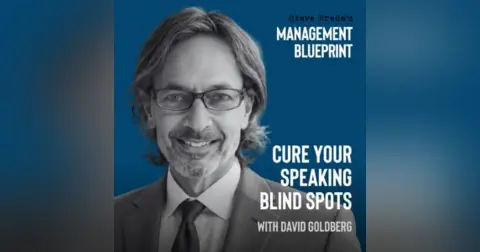



David Goldberg, CEO and Voice Director of Edge Studio, helps leaders cure their speaking blind spots by improving their words, speaking patterns, and nonverbal presence. Driven by a lifelong passion for the sound and nuance of language, David has recorded voice actors, celebrities, politicians, and media personalities while helping people communicate with greater credibility and authority.
In this conversation, David introduces The Speak with POWER Framework—Purge Hedges, Omit Fillers, Words That Empower, Express Positively, and Regulate Rhythm. He explains how removing uncertain language, replacing filler words with pauses, choosing empowering sentences, and framing messages positively can improve how others receive and respond to our ideas. David also discusses prosody, nonverbal communication, the six-second pause, and the growing value of authentic human voices in the age of AI. He shares how Edge Studio adapted from analog music recording to digital voice production and how Prosody Center helps people strengthen their interviews, presentations, pitches, and everyday conversations.
—
Cure Your Speaking Blind Spots with David Goldberg
Good day, dear listeners. It’s Steve Preda here with Management Blueprint. And today my guest is David Goldberg, the CEO and Voice Director of Edge Studio, an international voiceover casting and recording facility, advising, educating, and recording voice actors, celebrities, politicians, and media personalities. David is the author of five books, one with Tony Robbins, and the producer and engineer of 150 albums, including for Deep Purple. David, welcome to the show.
Steve, it is fabulous to be here. Thanks.
It’s great to have you, and I’m very curious about your personal why and how you are manifesting it in your business.
My personal why.
Yes.
Because I absolutely have a passion for words, the sound of words, the nuance of words.
Share on X
It’s really fascinating. Different languages, different accents, different dialects. For some reason, it’s been in my head since I was born.
That’s very interesting. Well, you certainly have followed your calling. And so tell me about how you got to record albums for people like Deep Purple. How did you get there?
Yeah. I’m a musician, and one of my earliest childhood memories was my mom being really mad at me because she would take piano lessons, and she would struggle to learn a song, and then the piano instructor would leave, and I would sit down and play it. And my mom used to say, “Why? Why can you just do it?” She couldn’t do it, and I just sat down and played. So I played piano, went to school for music as a pianist, and somewhere in college I realized it’s just not fun. I played a lot. I was on a good career path, perhaps, but it just wasn’t fun, and I got into rock bands instead.
And then, Steve, to show my age, in college I found a four-track cassette recorder. And I didn’t know what a four-track meant. Maybe some of the people who are listening don’t even know what a cassette is, but it’s an old recording device. It sounds archaic, but it was on tape, analog tape. And it was the coolest thing because I realized, oh my goodness, I could overdub myself. I could play piano or keyboards, as I had moved on to. I’m also a drummer, so I was able to add drums on top of the keyboards, and I could build my own songs, and that was cool.
And I realized that my passion, by far, more so than playing and playing in rock bands, was recording rock bands. And so I began recording my own band, and that went well, and then a bigger band, and I worked my way up.
Wow. This is fascinating. Actually, Paul McCartney has a YouTube video when he does that, and I didn’t know it was a thing. And he basically records every instrument, and then he plays it all together in front of an audience, a live audience in his studio, and this is fascinating. So David, this is a podcast of frameworks. It’s called Management Blueprint.
And I wonder, what is a framework that you have developed in your business that is helping you to serve your customers better or to understand things or to have and develop an insight or to innovate? Something that can be explained in three to five steps, and the audience members might get inspired by it and implement something in their business as a result.
Yeah. We have one framework which is so key to us. And is it okay, Steve, if I just give a little brief bit of context here?
Yeah, please.
It’s very weird, but for some reason, most of the world doesn’t think about how we speak. My kids, they went through grade school. They took reading, they took writing, but they didn’t take speaking. Yet speaking is equally as important. In business, it’s equally as important to how we look, right? Or how a company looks, how a brand looks. Companies allocate so many resources to making sure that they look amazing. Their logos, they do focus groups on their logos, what color, what font.
They make sure their website looks nice. They make sure the newsletters look nice. Everything should look nice, and it should. You always want to show attention to detail. But the corporations don’t allocate the same resources to make sure that their people speak well. So customer service representatives and sales and all these people on the phone, even leaders within the organization who lead team meetings, people who give pitches and presentations, leaders who give boardroom meetings and keynotes and toasts. There’s just not enough thought, or sometimes even no thought, on how they speak, which is really weird. It doesn’t make sense to me.
About two years ago, our older son was beginning to interview with college recruiters, and I said to him one day, I said, “Dude, did the guidance counselor at your school help you with interview training skills?” He said, “No.” And it all hit me at that point. I thought, “This is really weird.” So our public school has like 1,000-plus kids, four guidance counselors. It’s such a big school. There’s money in the town for school, for decent education. It’s a really good school, but they don’t teach kids how to interview well.
I’m sure everyone listening out there knows that some people interview really well and some people don’t. Now, to go back in time, my music studio did great, and then I ran it for about 18 to 19 years. I worked with bigger bands and finally top national, international bands, things that still play on the radio. I got to play with lots of bands, drums sometimes, piano, keyboards. And when my older son was born, I realized I want to change lifestyles because the lifestyle in the music world was just crazy. The drug scene was absurd. Oh my goodness, and I’m clean. I always was clean. I loved the work. I never fit with the people.
And so 19 years ago, when my older son was born, I changed my studio from recording music to recording voice. I went from recording music to recording radio commercial soundtracks and soundtracks for documentaries and audiobooks and cartoon soundtracks, and I have five studios now that do that in New York City. Now jumping back in time. So two years ago, my son is interviewing with college recruiters. I thought, “This is really weird. I need to teach my son how to interview because there are little things that you can do with your voice, things that I’ve learned in all of these years of voice recording that could apply to interviewing.” And so I gave him five or six little techniques.
Okay, like just take a second before you answer a question. It shows that you’re credible. It shows that you’re grounded. It gives your brain a moment to kind of catch itself, to organize the next thought. It doesn’t sound like you’re stepping on anyone’s toes. It really gives you so much more authority when you take a second to respond. And I gave my son five or six things, and we worked on it, and he got into every single college. And I know it’s not because of his grades.
His grades were good, but his interview skills are top-notch. And so I began applying these for, or offering training for interviews through my business. Now my business is predominantly voiceover, but now I started offering training for interviewing people who are going through a midlife crisis and changing careers or job promotions. And through that, we developed the framework. And for about two years now, we’ve focused on one framework. It’s three steps. I’ve learned that I know, I don’t believe, but I know that most of us in this world are missing three things when we communicate.
When we communicate, whether it’s interviewing or giving a customer sales pitch, we don’t think about strategizing or optimizing our words. We say whichever words just come out. We have our go-to words. So we have to optimize our words, number one. Number two, we should really think a lot about our speaking patterns, our pacing, our phrasing, the rhythm of our voice, the tone, the timbre, the emotion in our voice. All of the things that allow us to communicate differently, more effectively, yet we don’t learn those things.
So that’s the second thing. And the third thing are the nonverbals, the things that come along with when you speak. Those things are critical. And if you look at those three steps, essentially what it’s saying is that if you think about which words you say, how you say them, and what you look like when you say them, you really come across so much more credibly, so much more in control. Steve, it is outstanding.
When you focus on those three things, it is easy to make great first impressions.
Share on X
It is easy to get buy-in, as my son did when he interviewed. It is easy to get great receptivity.
Ultimately, truly, you shape the way you come across. You shape the way people respond to you. And that’s the cool thing. And so for two years now, I’ve been focused on that framework, and that’s what a lot of my books are about, that framework.
Love it. Love it. So just to kind of peel the onion a little bit, optimize your words. What does it take to optimize your words? Is it about trying to use the right words and skipping the ums and ahs, or is it a technique or is it an ability?
That’s an awesome question. This is great. Yes, all three. Seriously, you’ve nailed it. Optimizing your words, a lot of this is just… It should be common knowledge, but we just never learned it. Things like removing hedge words. I will explain what hedge words are because most people don’t know what they are because we never learn this stuff. Hedge words are words that make you appear less certain.
And there would be no reason to use words that make you appear less certain, yet we all use them every day. Words like “think,” “I think we could do something,” or “probably,” or “maybe,” or “could,” or “should.” I listen to people in corporations, and they perhaps, for example, bring an idea to a manager. They might say, “I think we should do this.” But when you say “think,” you’re discrediting yourself.
Yeah.
And there are different levels. You can take it up a notch by saying, “I believe we should do this.” That sounds more credible. But of course, if you just get rid of all the hedge words and just say, “We can do this,” it’s a lot more credible sounding. You carry a lot more authority with you. Now, I recognize that there are times and places for every word, so sometimes you need the word “think.” However, anyone listening to this podcast, catch yourself using the word “think.”
We use it a lot. In fact, we use a lot of hedge words in American English. We are brought up using them. I catch myself all the time going to use them, and I stop myself, and as quickly as I can, reframe what I was about to say so my words land with more credibility, with more authority. So removing hedge words is one.
Okay.
And there are five or six or seven basic things that we can do that really make you come through much more strongly. You said filler words, and let me explain what those are. Filler words are fake sounds that—not fake sounds. I take that back. They’re sounds, unnecessary sounds that we put in place of pauses. So if you’re in between two sentences and you’re not sure what to say next, most people say, “Uh,” “Oh, uh…” They do those kinds of things. Studies conclusively prove that when you use filler words, you appear 25% less credible. That’s a big hit to your credibility. There’s no need to do that to yourself.
Yeah.
And when you use hedge words—rather, when you use filler words, you take away the space between sentences, so then listeners get one run-on sentence. Your entire speech is one run-on sentence. You go from the first thing into the second thing, into the third thing, into the fourth thing. There are no breaks.
Is it draining to listen to?
Oh, terribly draining. And people can’t parse the information. Steve, if you if you take a book, your favorite book, and you remove all of the periods that separate the sentences, and you remove the commas that separate the phrases, and you even remove the blank line that’s between paragraphs, and you even remove the blank page that’s between chapters, you’re left with all of the same words, and they’re in the exact same sequence, but it’s one massive run-on sentence from the first word through the last word. It’s really hard to figure that out.
There actually are books like that.
I hope I never read one.
Yeah. Well, a guy, a Hungarian guy, he just won the Nobel Prize with a book like that, which I couldn’t finish, to be honest with you. It’s so hard to read. But anyhow, I digress.
No, no, that’s not a digression. I apologize for jumping in, but that’s exactly the point. You said it’s hard to read because there’s no break, there’s no organization of the words. Yet when people speak, they have so many filler words that the audience, the listener, doesn’t have breaks. And so for them, it’s like this Hungarian guy’s book. It’s endless.
When you speak with people, if you want to communicate knowledge, credibility, authority, if you want to be receptive, if you want them to give you buy-in, if you want them to agree with what you say, take breaks and don't use filler words.
Share on X
Yeah. I love it. So we talked about hedge words, we talked about filler words. So what are other ways to optimize speech?
A lot of it is thinking on the fly about how your words land. I’ll give you some examples. One of my employees last week missed a meeting. They missed a Zoom meeting with a customer, and they sent the customer, our customer, my customer, my business’s customer, I guess I should say. They sent my customer an email saying, “Sorry I couldn’t be there.” I said, “No, no, no.” I said to my employee, “No, no, no, don’t send that again.” And my employee said, “Why? I’m sorry I couldn’t be there.” I said, “Think how those words land with our customer. ‘Sorry I couldn’t be there.'”
The only way I think that those words could land with our customer is that my employee had something more important. Like if I emailed you this morning and said, “Sorry, Steve, I can’t be there today for the podcast,” you would think, “Well, something else came up that’s more important than the podcast.” So my employee said, “So what should I say?” I said, “Tell them you really want to be there next time. Empower them.” So think about the difference. If something happened today and I couldn’t be here, I could either say, “Sorry, I can’t be there. Sorry I couldn’t be there today,” or, “Steve, I really hope I’m there next time.”
So when you say it the latter way, the person, the audience, or your customer feels empowered. Another example is my son said to me… Oh, context first. My son is 15. On a Sunday night, right before school, late Sunday night with school the next morning, he said, “Dad, can you take me and my friends to the mall?” In our town, the mall is the big hangout place. I kind of wanted to say, “Dude, no. It’s like 9:00 on a Sunday. You have school the next morning. The mall’s closed anyway.”
And then I catch my words and I think, “Why do I want my son to feel rejected?” So I said, “I’d love to. However, let’s go tomorrow, earlier in the day when the mall’s open.” And so I was able to communicate the exact same thing and have my son feel empowered and excited rather than rejected.
Okay, so use empowering sentences. That’s a great one. So what else? Do you have a couple more that set down?
Positive words. Put things in the positive.
Is it the same as using empowering sentences?
No, not empowering. This is positive. It’s very different. A little context. So one of the things I do in our voiceover studios, in addition to owning the business, my favorite role is directing commercials. They’re short, they’re fast, I work with celebrities. It’s super cool. I really enjoy it. We’ve worked on 13,000… Roughly, we estimate 13,000 commercials.
Wow.
And my job has become two things. One is to look at the script that’s about to go on air and make suggestions. Which word would be better? Should we change this word for that word? Should we swap that word for this word? And so many of these commercials are tested, and they run through focus groups, and we A/B them and see which gets better results. And after a while, after 13,000 times, you find the common denominators. And at this point, I know that if you take out a particular word and put in a synonym, you might see a 2% increase in sales. And 2% is nice.
And then if you change another word or maybe contract two words that could be contracted that weren’t contracted, maybe you get another 1% boost. Or the reverse, maybe there’s a contraction, and you separate it, and now you get the 1% boost. And so part of my job is to look at scripts and decide or figure out what words make sense, what should be changed. And then the other thing I do is help the voice actors read those words. I’m directing the voice actors and celebrities or whoever’s reading a commercial.
Sometimes the CEO of a business reads their commercial. A politician reads a campaign. It’s telling them to slow down here or speed up there, add a dramatic pause, get rid of the dramatic pause, whatever it happens to be. And each thing, again, gives a slight bump up in sales, and you realize what works and what doesn’t work. One thing that really works well in advertisements, one thing that is a great way to influence customers and also to avoid misunderstandings, is to keep everything in the positive.
Begin with positive words. Give things positive spins. So some basic examples of that. In American English, we default to negative words, but anyone listening should switch it to positive words. So if someone walked out of my office right now, my inclination is to say, “Please don’t close the door.” However, I switch it and I’d say, “Please leave the door open.” When you say, “Don’t close the door,” it’s harder for people’s brains to figure out.
Yeah, close the door.
Yeah. “Leave the door open” is positive. It’s a really elementary example. However, it makes a big difference in terms of clarity, avoiding crossed wires and misunderstandings. It’s amazing. As you lead people, as you try to promote things, products or sales or services, whatever you offer, put everything in the positive. Yeah. But my goodness, we default to these negatives. People talk about their companies, and you ask them what they do, and they say, “Well, we not only do this, but we also do that.” And to me, that’s two negatives.
Instead of saying, “We not only…” I’m making this up. “We not only sell air conditioners, but we also maintain them.” The negatives are “we not only.” “Not” is a negative. Why would I want to begin with a negative? “We not only do something.” That doesn’t make sense. In advertisements, we say, “We sell advertising.” Or, sorry, “We sell air conditioning.” It’s not “We not only sell air conditioning.” It’s “We sell.” So yeah, keep things positive whenever possible.
So maybe this is a digression, but when I read on a cereal that “Now with more fruit,” is this a positive or a negative?
To me, that’s positive.
But as a skeptical customer, I would think, “Wow, so they’ve been actually giving me less fruit than I deserved previously?” Maybe that’s just— Possibly. Yeah, it was just skepticism. But no, definitely agree, and I love these five steps. I think it’s very clear. So remove hedge words is number one. Remove filler words, number two. Use empowering sentences, so that is very powerful.
Put things in the positive, and find the right rhythm and pace. Would that be a good way to express your framework? I know that you said it’s three elements, but if you open it up to five, then maybe it’s easier to action them.
Sure. Yeah. It is all positive. There are hundreds and hundreds of little small things that we help voice actors and celebrities with on a daily basis, and we’ve always sort of put them under these three pillars of word choice, or sometimes we call it strategizing or optimizing the words. We put them under the second pillar of the speaking pattern, the way you say the words. And then we use the third category as presence or nonverbals. That includes body language. It’s interesting.
Nonverbals include even the background when you Zoom. It’s the clothing you’re wearing. It’s the way you look at the camera. It’s your smile. It’s your gesticulations. It’s all the things that communicate outside of your words. Interestingly, the second pillar, which I call speaking patterns, there is a real word for that. In our dictionary, there is a word that describes how we speak. There is a word that describes our pacing, our spacing, the emotion in our voice, the tone of our voice, our dialect, our accent, the characteristics of our voice.
But basically, no one knows that word because we’re never taught how to speak. The word is prosody, P-R-O-S-O-D-Y, prosody. Prosody is defined as the characteristics of your speaking voice. I wish we all learned that word when we were young, but it’s just not something we were taught.
Yeah. I think it’s pretty nuanced, and we’ve been talking the last couple of days, and you’re helping me out with the narration of my book, which I really appreciate. And even these conversations, there are so many details that came up and so many nuances that I don’t think it’s a slam dunk, but it probably is for you because you’ve been immersed in it for the last 30 years.
So this is fascinating. So you’re in the business of recording all these ads for celebrities. You wrote a book. You wrote several books. You wrote five books, one with Tony Robbins. So what drives growth in your business?
Being flexible, dealing with changing times. Tell me more. Yeah, we’ve gone through a bunch of shifts. I began the business in 1989 in my college dorm. That’s when it was just strictly music recording. And at some point in the music recording, we went from analog recording, from that old four-track cassette, we went to digital recording. That was a huge shift. It was a defining moment in my business because at that point, with digital recording, anyone could buy a digital recording studio at home. The musicians didn’t need to travel to my studio, where I had these reel-to-reel tapes.
At that point, it was two-inch reel-to-reel, and big speakers, and big mixers and everything. No one needed to travel because you could record in your computer. It was so easy and so inexpensive compared to what I had that all of a sudden my business was just disappearing, and I realized at that point that I needed to advertise my experience rather than my equipment. Before then, I could advertise, “I have this model microphone, I have this model mixer, I have these big speakers.” That wasn’t necessary anymore, so that was a big shift. And now, more recently, it’s AI.
AI can narrate anything in a heartbeat, and it sounds really good. Definitely, it’s changed the way we market again. And so the way we see the… They’re called cloned voices or synthetic voices. The way we handle them is very comfortably. If a company doesn’t need to direct the celebrity or the voice actor, or if it doesn’t have to be the real live recording of a politician, for example, then you can go to AI, and you get whatever AI spits out. AI may take that script and put an emphasis on the first word, or maybe it puts emphasis on the second word. It kind of chooses, and it’s relatively hard to change that, where the emphasis is.
And unless you’re really trained at understanding where emphasis could go, it’s hard to get it to sound natural. So if you don’t need to direct the voice actor or the celebrity, then AI is great. That’s less work for my business. However, at the same time, the nuance of human speech, the authenticity that comes through human voice, the spontaneity in the way people speak, has never been more important. And so we’ve been busier than ever, by far, because a lot of people who record really want the human voice.
They want their voice. So we work with lots of authors who record their own audiobooks now, and politicians and celebrities who are recording their own commercials and documentaries, and it’s been great. It’s just been another shift in the market for us.
You know, maybe it’s counterintuitive, but I wonder, the more AI we get, the more starved we become for authenticity.
Could be.
Do you feel the same way? It becomes more important.
Yeah, I believe so. I’m a fairly good drummer for someone who’s not trained, meaning that if you put me next to someone who’s trained, they’re way, way better. For a self-made drummer, I’m okay. But that’s where I would fall, in the okay area. Yet I remember in bands way back, 25, 30 years ago, I saw a drum machine for the first time, and I remember thinking, “Okay, there goes any chance of drumming,” because being a drummer was a pain in the ass.
It still is a pain in the ass because you have these big drums you have to lug around with you, and all the microphones. So you need a separate microphone for every drum, and they’re loud to practice. As a kid growing up, my bedroom was so small I had cymbals hanging off of the ceiling because there wasn’t room for cymbal stands in my bedroom. And they’re loud and big, and they get messy and whatever. I saw this drum machine, and I thought, “That’s amazing.” Like, you have this little box, and it does everything perfectly timed. It’s not off by a hundredth of a second. It’s perfect.
And I really thought, “Yeah, there goes any chance of ever drumming.” Yet there are still drummers, and there’s a… I’m thinking out loud here. We found a really good place in our culture, in the world, where there are live drummers and there are still drum machines. And in fact, a lot of drummers even have drum machines. So we found a place to use, a way to use both. There’s a time and place for everything.
Yeah, that’s fascinating.
I think it’s happening with human voice versus synthetic or cloned voices. Time and place for everything. I hope people end up speaking. I hope that doesn’t go away one day.
Well, I’ve written some books, and my wife always talked me out of narrating myself because she said, “Ah, you have a terrible accent. Get the professional.” And then what I realized when I was listening to Arnold Schwarzenegger’s latest book, which he narrated in his own voice, it was probably halfway through the book in his voice, and how he expressed with his broken Austrian accent the passion and his trials and tribulations through his voice.
You could actually feel the emotion of how he went through those things, what he felt. And that’s not something that comes through an AI narration, or even a professional voice artist might not be able to narrate it that way. So I thought maybe there’s more to it. So that is pretty exciting. So tell me about your book. Why did you write the latest one, and what is it about, and why did you write it?
It’s called 6 Seconds to Say It Better. It’s because people are abrupt. We blurt out, and so often people can reflect back on what they said, and they wish they had said it differently. We don’t often get the opportunity to listen back to things. However, I’ll tell you, over the years, if 1,000 people have said to me, “I heard myself on a playback at a board meeting at work, giving a presentation, giving a sales pitch. I heard my voice back at a toast at a wedding, giving a toast, or at a keynote or something, or I heard my voice on a digital video or a podcast,” 99.9% of the time people say, “I didn’t realize I spoke…”
And then they fill in the blank. They didn’t realize they spoke so fast. They didn’t realize they spoke so high in pitch. They didn’t know they had no emotion when they spoke. They have something they wish they could go back. And it’s a shame that in written English, we have the chance to go back. When you write something that’s important, when you write a letter, you write it, you think about it. Sometimes you have AI help. If it’s really important, you say, “I won’t even send it. I’ll come back in the morning with fresh eyes, fresh brain.”
Deep breath. Yeah.
Have someone else review it. When we speak and it’s important, the words are out. Like our conversation now, it’s spontaneous, and it’s done. If you can take a six-second pause before you speak, neuroscientists say that you have enough time to figure out what you need to say, to organize your next thought. If you take six seconds before you speak, you have a chance to catch your breath.
You won’t get tongue-tied. You won’t speak in circles. However, six seconds is a real long time to wait. Six seconds would be crazy to wait. If you were conversing with someone and everyone took six seconds before they spoke, it would be weird. Really, really weird. While six seconds is optimal, what happens if you take just a second? As I talked about earlier, telling my son when being interviewed, take a second before you respond. It makes such a big difference. Maybe six seconds would make an even larger difference, but it’s just not practical. Six seconds, though, is what neuroscientists say we need to do the best we can.
Yeah.
Interestingly, if you are on the spot where what you say is super important, critical to your career, critical to your success, for example, you’re on a company podcast, you’re on a speaking panel, and you’re on stage in front of thousands of people, and you’re asked a big question, if you needed six seconds, that would be weird, as I mentioned, and it would be really bad to fill up those six seconds with filler words. In other words, it would be bad to do this: “Oh yeah, uh, uh.” That would be really bad also, right?
If you need six seconds, if you need some time, you can say, “That is an amazing question. Give me just a second. Let me think about that.” So if you need the time, take it. We are in this culture where we feel like we need to be fast. We need to blurt out. We need to jump to the next thing, and when you feel that the pressure’s on to do a good job, take your time. It’s worth it.
It's better to wait six seconds if you have to and say the right thing rather than not wait six seconds and say the wrong thing.
Share on X
That’s very interesting. You know, recently I started using an AI application for recording my writing. So when I write an email, I just press a button, and then I form the sentences. And what I noticed was that because I knew it was going to be written word, I am much more careful with how I phrase things, and I select my words more carefully.
And I actually think this is a good tool to practice this, what you’re talking about, this discipline. So I don’t know if you use Wispr Flow or anything like that, and if you have any experience with this, whether this is a good tool.
It’s an amazing tool to teach people how they speak. When you look back, you realize the number of differences between written English and spoken English. That’s something that I’ve had to work on for 13,000 commercials. Almost every commercial is written with someone sitting at their, I almost said typewriter, it’s weird, at their keyboard, and they type it out. And written English is different. In written English, we often don’t use contractions. In written English, we use lots of commas, lots of punctuation marks. In spoken English, we do use contractions, and we don’t have so many punctuation marks.
However, when you want someone to read a script, we tend to write it on a keyboard and then give it to someone to read, and then people say when they read scripts, they always sound stilted or stiff or robotic. It’s because they’re reading spoken English. And so my whole company, we specialize, truly, we specialize in being able to take written language and translate it to spoken language. It’s 99% the same.
It’s just removing some commas and contracting some words and getting rid of some… Just different things like that, just small things. And when you are using a transcription service, like you’re now using on your app, probably use it on your phone, yeah, you realize the differences. A lot of people tell me when they start transcribing their voice, they realize how often they say “gonna” or “wanna.” Yeah.
Yeah.
And then you look at your transcription and you think, “Do I really want to text or email someone the word ‘gonna’?” It doesn’t look good in written English, but it sounds good in spoken English.
Yeah. Yeah, love it.
So because more people now listen to audiobooks than read printed books, I always tell authors, and you’re an author, you have great stuff, amazing stuff. I’ve seen your work. I always tell authors to write in spoken English because more people listen to audiobooks than read written books.
That is so true. So audiobooks are selling much faster.
Yes.
So we are getting close to the end of our recording. I have so many more questions, but I won’t be able to ask, so I just want to ask you this. Who is your ideal customer, and how can they reach you? If they listen to this and they want to learn more, they want to talk to you, or they want to learn about your services, what should they do, and who are they? Ideal, thank you.
The ideal customer is anyone who wants to come across better when they speak. So as I mentioned, we can all focus on our hair in the morning and the clothes we wear to an interview, to a keynote, to a presentation, to a pitch, to a meeting. If you also want to sound good, then talk with us. We help people figure them out. Most people have… Almost everyone has blind spots. They just aren’t aware of the way they speak, whether it’s using filler words or lots of hedge words or one of I don’t know how many hundreds of different things that we focus on.
We really focus on the smallest details of how people speak, helping them find the blind spots that they're usually unaware of, and then we give adjustments.
Share on X
We are like a golfing instructor. Watch someone swing the golf club and then say, “Okay, you’ve got to tweak this, you’ve got to tweak that,” and each little tweak makes you a little bit better. And so collectively, if I can take a script that’s an advertisement on TV and change three or four words, each one gets a two or three percent bump in sales, and change two or three ways of the way people read the words, you get another two or three bumps, percentages up on each of those.
Collectively— they add up. They add up to a lot. And same thing with how you speak. So if you want to… I really don’t like the expression “command the room,” but it is the right expression. If you want to command the room, if you want to have more credibility, if you want people to be more receptive to your messages, really, if you want to shape the way people respond to you, then yeah, that’s my ideal customer. And my email address is david.goldberg, that is spelled G-O-L-D-B-E-R-G, @prosody, there’s that word, @prosody, which is P-R-O-S-O-D-Y.center. david.goldberg@prosody.center.
Okay. Well, we’ll put it in the show notes as well, just in case. And then you’re also, if someone visits Edge Studio, would they also learn about what you do?
Yeah, Edge Studio… Just, sorry, let me step back and say, as I’ve loved words for all of these years, I have two businesses that support words and human voice, and one is edgestudio.com. That was the music studio until it switched over about 19 years ago to recording voice instead of music. So edgestudio.com is for the soundtracks for documentaries.
We record thousands upon thousands of compliance videos, training videos, social media videos, soundtracks for cartoons and video games, and of course commercials and all sorts of stuff. Narrated apps are big for us right now. Talking books for kids are big for us right now. And so that’s one business, and then prosody.center is the other business for training people who want to just come across better when they speak.
Yeah. Well, who doesn’t want to come across better, right? We all want to have more influence in our lives, and we want to be a good speaker. So definitely check out David Goldberg, who is the CEO and Voice Director over at Edge Studio and prosody.center. And if you enjoyed this conversation, stay tuned because every week I bring you a couple of exciting entrepreneurs who are changing the world and who are bringing you their frameworks so that you can improve your business. Thanks, David, for coming and sharing your wisdom, and thank you for listening.
Steve, thank you so much for your questions. Your voice is great because you’re incredibly calm, and you a charisma in your voice that’s really nice. Your voice is very easy to listen to, yet you speak with credibility because you end your sentences downward with a period as opposed to upspeak, which is another technique we could talk about sometime. You speak great, and I really appreciate your questions. Thank you so much for having me on.
Thank you, David.
Thanks, Steve.
Important Links:
- David’s LinkedIn
- David’s Website
- David’s Email: david.goldberg@prosody.center