371: Make Your Crops Bigger, Healthier & Cheaper with Doug Kremer
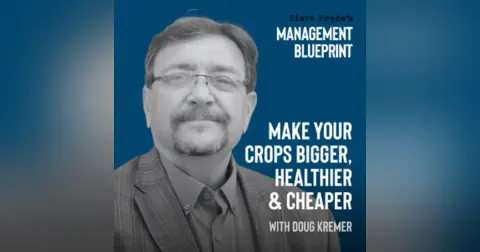


Doug Kremer, CEO of TerraMax, Inc., helps growers discover how to Make Your Crops Bigger, Healthier & Cheaper through scientifically validated microbial products for seeds, crops, lawns, and turf. Driven by scientific curiosity and a desire to reduce agriculture’s reliance on chemical inputs, Doug has spent more than 40 years exploring how beneficial bacteria can improve nutrient efficiency, promote plant growth, and support more environmentally responsible production.
In this conversation, Doug introduces The Crop Nutrition Framework—Proper Nutrient Addition, Pathogenic Control, Irrigation, Soil Health, and Soil Tilth. He explains why microbial products should complement conventional fertilizers rather than immediately replace them, how soil structure affects water drainage and oxygen transfer, and why field trials are essential for proving microbial performance. Doug also discusses expanding TerraMax beyond its science-led roots, communicating its value more effectively, and reaching growers through stronger sales and distribution networks.
—
Make Your Crops Bigger, Healthier & Cheaper with Doug Kremer
Good day, dear listeners. Steve Preda here with the Management Blueprint Podcast, and my guest today is Doug Kremer, the CEO of TerraMax, Inc., an agricultural manufacturer applying bacteria to produce powders and liquids for seeds, crops, lawns, and turf to naturally promote plant growth. Doug, welcome to the show.
Thank you very much, Steve. It’s a pleasure to be here and meet you.
Yeah, I’m very excited because you are running an agricultural production company, which is kind of a unique animal on this show. So I’d love to dig in more. But let me start with my favorite question. What is your personal why, and how are you manifesting it in TerraMax, Inc.?
First off, I found that to be a very interesting question. My background is more technical, genetic engineering, et cetera. I got into microbes. Literally, it was a fascinating subject to me, partly because most of what we’ve learned was, at the time, 30 years ago, academia, and there was very little successful use of microbes generally, other than other types of products that may not have performed up to the standards that people have gotten used to with chemistries, right? So I’ve been in science for 40-plus years.
I looked at that as an opportunity. So there is a piece of the committed or should-be-committed individual who said, “I think I can do this better.” So the why was really, if we’re going to complain about the impact of chemistries, yet we don’t develop products that can supplant them in the marketplace, that’s on us. You don’t cross your fingers and hope that nature is going to fool people. That’s why we do field trials, that’s why we do these things, but the onus is on us to develop those.
So I took that seriously and, like I said, as a challenge. And in the first two years of our company’s life, that’s what I was working on. It was a very small group back then. And so it was taking seriously what we’re doing, and that may sound funny to people, and I’m sure there are people that will disagree, but sending those products through their paces, or the bacteria in some instances. So scientifically generating the data was a big part of what I’ve done and what we’ve done. I really need to, these days, talk much more in plural. We’re still a very small company.
We’ve been around for 28-plus years, but we’re 29 people. And only a portion of that, a small portion of that, about five people, is dedicated to the research end. But we were lacking a lot of the data we needed in showing the responses. So I hate to get technical right away on this, but things like N-15 work, which is proving that the nitrogen in a plant came from your bacteria. That’s something that was really important to me. Quantifying nitrogen from microbes, while there has been a ton of work on it, is still very prey to the environmental conditions. So there’s always room for improvement, is I think what that comes down to.
Yeah. But the why, to be—I ramble, and I apologize—but the why was really the personal inquisitiveness to go after these questions, and can we make them? And I could share data with you or anyone who is interested, basically, on what that path has described to us. And I’m happy to tell you we have been fairly successful at the science portion of this. We’re still not where I would like to see us in a business sense. But I believe we’re well-known for our approach using the rigors of science where it’s applicable. Because believe me, when you go out in nature, there’s a lot of variables that you didn’t think about in terms of the expression that these things could have. But in a nutshell, it was a great challenge.
Yeah. No, I love it. I mean, it sounds like it’s a very visionary approach. You realize that we are… I mean, I’m interpreting it, reinterpreting. The way I hear this is that we are spoiling the environment with chemistry, and how can we use biology to achieve the same aims that we are achieving with chemistry in a less harmful way? Is that what you’re trying to do?
Yes, that is a very good interpretation. I have my own stilted viewpoints that the efforts to rely exclusively on BNF—biological nitrogen fixation is what BNF stands for. But for eons, nature has selected these things as slow-moving. Whereas with the hybrids of today, we’re spoiled in that we had the pricing allowed us to put luxury amounts on. And in fact, in phosphorus, for example, we were taught that you can build a phosphorus bank in your soils, which you can if you want to waste that money.
So a more on-time type of delivery system is something that we aim for, not to deplete soils, but to use soils and make the delivery more efficient and lower, okay? So there is a lot of misconception about what microbes can do, I think. And I think we can get closer in terms of turfgrass, so lawns, municipal fields, that sort of thing. That system might be a system that we can plug into and provide more of the nitrogen via microbes. But in our row crop agriculture, the corn and soybean, for example, the way corn is and the hybrids that are made, the use rates go up, right? So we’re not in some quaint old system of the farmer goes out and hoses his acreage. We’re in massive acreage in planting and harvesting.
Same is true, in my opinion, for how we treat these things. We’ve gotten spoiled by that use of chemistry, but now when the price crunch is on, that’s when farmers, producers are looking, “How do I save a buck? How do I do that?” That’s pretty much the description. There are always people out there willing to tell you that they can provide everything the plant needs. My voice is we can supplant, we can, as an adjunct, add to that picture. But in terms of our corn crop, we still have a lot of work to do. Okay,
Doug, so I just want to slow it down so that our audience, who may not be technicians of your field—definitely they are not—they also follow. Yeah. And they can relate it to themselves and their businesses. So my understanding is that it’s not just that it’s better for the ecology, the way you use the microbes as opposed to chemicals, but it’s also more cost-effective than what these artificial fertilizers can do?
Yes. And that is largely our message, that people come in with the, “I’m looking for something to replace my applied nitrogen.” And my personal advice to them is integrate the system, learn how it works, learn how it’s an additive product, if you will, not a replacement product. And I could cite some chapter and verse, but people who know the marketplace, there are companies that have tried to tell you that if you work the soil microbiome, then you don’t need fertilizer, and I don’t believe that’s true. You do need fertilizer. But the more we can reduce that reliance on… BNF is an opportunity for, what a fancy term, de novo synthesis.
So the synthesis of nitrogen from the air, the nitrogen in the air, N₂ gas, is a very energy-intensive operation. Phosphorus and potassium have to be delivered. A microbe doesn’t synthesize those two. We’ll just stay on the NPK, if you will, the major nutrients that are used. But the same thing may be true for some of the micros, micronutrients as well. So it becomes more of a nutrient use efficiency question, which is a buzz phrase in agriculture. It’s not about just having it, it’s about how well you are integrating those into your system.
So, Doug, if I wanted to understand big picture what it takes to cultivate crops healthy and efficiently, what are the three to five things that a farmer would have to keep in mind when they want to increase the crop yield and the crop health? What are the five main elements, let’s say, maximum five main elements, that will take care of 80% of the result that they’re seeking?
Proper addition of the right nutrients. So whether that, for us, that would be an integration of systems. That’s got to be one of the top ones. Pathogen control, and we’ve done a few things in biocontrol. We have something teed up for going into the EPA, but that’s what makes this question really difficult. The regulatory apparatus is not necessarily in sync with the production apparatus. And there’s a certain way you follow and you do that. So nutrition is up there.
Some of this you don’t have control over. Water, right? Why people irrigate. But the climate, especially focused on water, is a definite control agent. Look at the irrigation and some of the problems with climate change. That’s introducing another variable to farmers. Soil health is definitely in there. Understanding how the microbiome is integrated into that soil tilth question, I believe tilth and health are pretty much linked in the soil. So you’re talking about structural performance capability of the soil.
And please understand that we can grow plants in hydroponic systems completely with the right light, which is another variable. That’s why farms are there, but again, one that we don’t control necessarily. But while you can completely artificially grow these things, it’s the cost of production that is more in people’s minds. That’s kind of a scattered three to five, but that gives you a feel. Soil health and soil tilth are definitely going to be big topics in the coming years. There are some things that have been successful at some places. You’ve mentioned a couple of times the use of chemistry.
I would love to have microbial products perform at the same level that chemistry products do. In some cases, that may be true, but we have a lot of work to do on the microbial side of things. For example, nitrogen. How do you play with the systems internally in the microbe cell to produce nitrogen? And there’s limited ways to do that, particularly because of the energy that it takes to get there. But those are some examples.
So just to confirm my understanding. So the five things that you mentioned: proper nutrition addition. Yeah. Pathogen control, irrigation. Soil health and soil performance. You used a different word from performance. Did you say health?
Tilth. Tilth.
Tilth. What does it mean?
Tilth is the structure of the soil. So, in other words, a soil in good shape for growth, which is this lofty thing we’re after, is a good granular structure, has water-resistant granules in that soil, consortiums that are good for drainage by… And withstand those kinds of things. That also sets up oxygen transfer, which roots need to grow well. Compacted soils we’ll use as kind of the opposite of tilthy soils that can affect that and change that. There are some instances where chemistries, some of the applied nitrogens, will change pH in the soil and some things like that, that scientists like to prove things out, right?
So you don’t prove something by seeing it once in a field. You prove it by manipulating and seeing what those responses are. But soil tilth is literally describing the physical difference between a granular soil structure and what’s called prismatic, which is kind of a column kind of response. It’s the packing of soil. And platy, which happens all the time with our large equipment. In fact, it’s one of the areas that farmers will laugh at me when I go present to them because I’ll talk about the rules about generating good soil, and these guys have one overriding concern: plant the seed, harvest the plants.
They don’t want the details. Don’t give me the labor pains. Just give me the baby.
Yeah, exactly. Exactly.
So, Doug, I’m very curious about your business. I understand the technique—well, I don’t understand the technical side, but I understand the technical side is very important. What I’m curious about is what drives growth in TerraMax, Inc. as a business?
Well, that’s a very interesting question. Personally, I think we’ve been led by a scientist too long. I have a different viewpoint. I’m more interested in the techniques and getting the things done as opposed to going out and how do we expand markets. I’m very fortunate that a guy named Tom Proepper is on our staff, and he is the business side of the business. And we just in the last two years, I’ll say, expanded our sales force. Until that time, we had a very limited sales force.
And we would rely on working with middle people in the marketplace that would approach a particular segment. Yet technically, we are lauded for our understanding and our ability to make microbes work, okay? And that is making the farmer comfortable with inherent failure rates. This is a question that people would tell me not to talk about. But in nature, it doesn’t matter. Hybrids fail, fertilizer can fail, not on the merits of the product itself, but on the nature that we’re putting them in, right? So, for instance, if you plant a certain hybrid and your field gets flooded, it could be gone or a portion of it could be gone, right? There’s a certain set of acreage that, if the water pools there…
So that’s not the fault of the farmer. That’s certainly not the fault of the seed producer, and we have those kinds of examples in microbes. We don’t understand those systems well enough. Microbiome work really created a lot of excitement. Personally, I was very happy to see the application of those tools to, if you will, the understanding of how these are working. But I believe we’re probably at least a decade, if not several, away from understanding how we may manipulate that situation to the benefit of growers. In other words, skew the populations, those kinds of things that are easy to speculate about, much harder to prove.
Personally, one of the things we’ve done at TerraMax is we try to go that extra mile to describe the frequencies and the like of using our products beyond our formulation capacity, which, if what you’re doing is delivering dead microbes, you’re not delivering the factories that you should. I would dare say that is one of our fortes, that we know how to set those situations up. There’s proof of those kinds of things that I’m saying in our data sets, and others have worked our data sets, and I’m happy to say our response rate is good.
So, Doug, what’s one thing that you’re actively trying to figure out in your business right now?
Not technical? I mean, there’s the science. Not technical. This is the weird juxtaposition of these, right? It has everything to do with it’s time to focus on the market better than we have. Certainly on a non-technical basis, it’s how do we get our message out? Because this is big business. I mean, there are the bigs in our marketplace for a reason. Bayer, Corteva are two examples of large international companies and dictate, if you will, the kind of advertising you need to do to introduce yourself. While we’ve enjoyed being a backwater company, in fact, Tom was really disappointed when a person described us as a stealth company, because his job is exactly the opposite of that. We don’t want to be a stealth company.
We want people to know and use, if they choose, our products. So really, the non-technical aspects of our business are very close to anybody else’s business. Regardless of what, you have to communicate. You have to let people know you’re there. You have to be, in a sense, on call, particularly with farmers. When they work the weekends, they want to call somebody if they see a problem. And so you have to be ready for those kinds of situations, and a farmer can do some things.
Yeah, that’s fascinating. So who is your ideal customer that you’re trying to sell to?
Well, that is another very good question because it’s hard for me to answer. We started with a farmer-dealer network back 28-plus years ago. But there are constraints of that system, right? There’s limited reach, or they know their cousin 10 states over. Guess what? That’s not the market you should be focused on. Then we moved up to really where we’re at today, more middle-market service people, distributors of products, and they have their own kinds of niches that they do.
We do some overseas business. We’ve been working with Ukraine, for example. It’s just a blurb on Ukraine. I’m amazed that their government is still functioning to the point of we’ve had products registered during this war, with their war with Russia. And so that’s obviously a point of concern for us. They’ve expanded into Poland in the last two years. So they’re addressing their situation and their problems. We have some products that also go to Australia and New Zealand that are largely shepherded by the customer we have that is doing that. That is mainly turf-focused over there right now. So addressing those marketplaces, we’re in the middle of the Corn Belt.
We’re in the Corn Belt. We have millions of acres that are targets for us around here, and that’s a major focus for the team right now. And again, we try to tie technical how we do things. We field trial, and there’s a step in the field-trialing process. The beginning steps are to convince us. The other steps, geographical expansion, how unique may this be or not. And that’s certainly more specific to our business than other things.
But those, I think, are some of the business challenges that kind of muddy the waters between technical advances and business advances, if you will, and how to integrate them. That’s a large problem. Yeah. They’re very different people to go sell something than to come up with the formulation to make something.
Yeah. That’s very interesting. So you’re in a complex business. You’re very innovative. You are bringing microbes in to improve the efficiency of production as well as the environmental friendliness of production.
Correct.
And you need to get the word out because that’s why you’re in this podcast, I presume, to get the word out about this big thing. So if people would like to learn more, how can they find out more? How can they learn about how microbes improve crop production, turf production, corn crop production? And how can they potentially connect with you?
We have a website, www.terramaxag.com. But they can also contact us via that website or my own personal email, and I can’t promise I’ll get back to everybody, but I do try. My name, dougkremer@terramaxag.com. That’s my personal email here. And I can route the questions to the people who may be better at answering. I often get accused of being passionate, and while that’s a useful thing sometimes, yeah, you want to be steady when you build a company. You don’t want to be always the passionate one.
You want to… That helps. You mentioned environmental. While I’m not the world’s first tree hugger, I feel strongly that we have a responsibility to know what our products do and know that they work before we begin any conversation about the impact on the environment. Take, for example, the nitrogen and the dead zone in the Gulf, right? The chemistry. The Des Moines Water Works’ federal lawsuit attempting to pinpoint the source of pollution to the farmers. And they did that because every spring, when the runoff would occur, they didn’t know how to deal with the problem, so they were trying to push it, if you will, back upstream to the producer.
I’m all for cleaning up the environment, and I believe with the right product design and the right performance dynamics, we’ll do that. But I think we’re a long way from breaking that dependency on chemistry. And I don’t know that we… We’re not ready. Yeah. I know that for sure. We’re not ready with product design yet, so that will take time, and other people smarter than me. That’s just how it works.
Well, as long as we are pushing that boulder up the hill, someone is going to get there. So Doug Kremer, the CEO of TerraMax, Inc., that is revolutionizing how bacteria can help improve crop production and efficiency of production and environmental friendliness. Thanks for coming on the show. And if you enjoyed this conversation, stay tuned because every week I bring you a couple of exciting entrepreneurs that are bringing their own framework and sharing with you on this show. Thanks for coming, Doug, and thanks for listening.
Thank you very much.
Important Links:
- Doug’s LinkedIn
- Doug’s Website
- Doug’s Email: dougkremer@terramaxag.com