379: Unleash Moore’s Law for Biotech with Mark Emalfarb
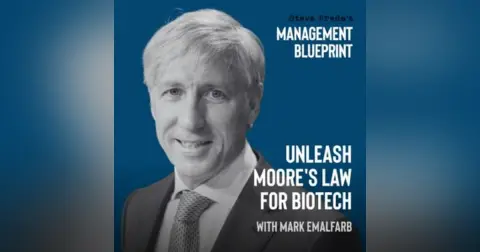


Mark Emalfarb, Founder and CEO of Dyadic International, shows entrepreneurs how to unleash Moore’s Law for biotech by producing biologics faster, at a larger scale, and at a lower cost. From stonewashed jeans to industrial enzymes and biopharmaceutical platforms, Mark has spent decades developing protein-production technology intended to make medicines, vaccines, food, and life-science products more accessible.
In this conversation, Mark introduces The Emalfarb Success Formula Framework—Develop Drive, Show Determination, Hire A-Players, and Overcome Challenges. He explains why persistence matters when disrupting a resistant industry, how the wrong professionals can delay progress, and why entrepreneurs must monitor the experts they hire. Mark also describes Dyadic’s C1 and Dapibus platforms, its outsourced R&D model, the path from research to commercialization, and the challenge of convincing pharmaceutical companies to adopt faster, scalable biomanufacturing.
—
Unleash Moore’s Law for Biotech with Mark Emalfarb
Good day, dear listeners. This is Steve Preda with the Management Blueprint Podcast, and my guest today is Mark Emalfarb, the founder and CEO of Dyadic International, a technology company utilizing its proprietary C1 platform to develop high-performing biologics for life sciences, food and nutrition, and biopharmaceuticals to reduce manufacturing costs and improve accessibility for patients and healthcare systems globally. Mark, welcome to the show.
Thanks, Steve. Happy to be here.
Now, the introduction was a mouthful, and I wonder if you can simplify it for our listeners. What is it that you’ve been working on for the last few decades? And then it will link into the question: What is your personal why, and how are you manifesting it through Dyadic International?
Right. So we started out pioneering the stonewashed blue jean business, selling pumice stone to soften and fade denim to make it more comfortable, more fashionable. And then we moved into the enzyme sales business to sell enzymes that would replace the pumice stone, and that was to be more environmentally friendly and come up with the same kind of look and feel and fashion and comfort. And then we decided to produce our own enzymes because we saw the future.
The future was in making proteins. And so we spent the next two decades making industrial enzymes for animal feed, food, textiles, pulp and paper, renewable energy, and licensed the technology to Shell Oil, BASF, Abengoa Bioenergy, Codexis, and Shell. And then we sold our industrial division to DuPont on December 31, 2015, for $75 million in cash, and had an idea that we could then transform the cost of biomanufacturing to bring healthcare costs down for these expensive medicines, things like recombinant protein antigens for vaccines, and then things like treatments for oncology, neurology, immunology, and, of course, pandemic preparedness by making treatments like monoclonal antibodies quicker, faster, and cheaper.
And so our vision has always been to find in nature or in humanity or in animal health the DNA sequences that encode for proteins and to make those more affordably, faster, quicker, and cheaper than the traditional methods that are, in many cases, very inefficient and are leaving everybody behind. So what I mean by leaving everybody behind, as a general statement, of course, some people have access to healthcare, but to be honest, it’s less than probably 2% of the world that has access to biologics. They’re not affordable. They’re not sustainable. So all the benefits that we have here in the United States and maybe in Western Europe and Japan and Korea, and even in our country, quite frankly, it’s not sustainable.
People are suffering and dying. They’re having pain or lethal outcomes because the pharmaceutical industry and the governments haven’t really moved with Moore’s Law like they did with tech in biomanufacturing. So we’ve created that sort of Moore’s tech version for biomanufacturing and are trying to get adoption and use on a global basis.
That’s fantastic. So biologics—is this the science of manufacturing proteins? What are biologics?
Yeah. Biologics is actually turning a DNA sequence into a protein, and you have to do that through cells. And our cell is a filamentous fungal cell that was engineered and developed over decades for mass quantity, large-scale production, low cost, versus pharma, whose cell lines have been developed for low yield, high cost, and more time. So these two worlds are clashing, and we’re bringing a transformation, kind of like what Elon Musk did in the electric car industry.
We’re actually bringing a transformation to the way biologics are produced and developed, and we can do it quicker, we can do it faster, we can do it cheaper, we can release it sooner. And the pandemic was just kind of like a prelude to the problems that exist in humanity in terms of not having access to the right medicines at the right time during a pandemic. And, of course, whether it be oncology, like cancer, or it be immunology, like arthritis, or neurology, like dementia and Alzheimer’s, these diseases need proteins, and they have to be made more efficiently. They have to be made at a lower cost.
They have to be made more accessible. And that seems counterintuitive to the pharmaceutical industry, apparently, and governments don’t really have either the wherewithal, the drive, or the determination or the understanding that this is a gaping hole for humanity, and it needs to be filled, and there need to be better systems. And Moore’s Law did that in tech. We clearly don’t use 386 microchips anymore. However, for the last 35 years, the biopharmaceutical industry has been using the same cell lines that they used and have tweaked over three and a half decades, like mammalian cells, Chinese hamster ovary cells that produce biologics like an antibody.
But as you saw during COVID, they couldn’t keep up with the demand. The virus shifted faster than they could keep up with it. The costs weren’t really affordable anyway, and that was in America. So if you lived in other countries, especially in places like Africa, you weren’t going to see one of these things because we weren’t even getting them at the right time, at the right cost. And so we need a better way of doing it, and we’ve developed a better way of doing it, and we’re hoping that that’ll get picked up and adopted by more and more people over time and will transform the cost of biomanufacturing. So we’ve been swimming upstream, fighting Big Pharma, which has resistance to change.
And they’re worried about regulatory agencies accepting new things. And quite frankly, regulatory agencies care about one thing: Prove it’s safe and effective, and they’ll approve it. If you don’t prove it’s safe and effective, they won’t approve it. So it’s an excuse that I think is really not there. It’s just more of their infrastructure, and their margins are so high that they don’t think that increasing access to a global population is important to them. We think it is.
So essentially, if I understand well, you are disrupting biomanufacturing. You’re bringing Moore’s Law into biotechnology, kind of the headline, and this will help manufacture medicines and cures for diseases in a scalable way. Is this what in layman’s terms, you’re doing?
Yeah. And I’ll give you an example that is quite frightening. So, and again, I’m using COVID rather than oncology, neurology, and immunology, which is potentially applicable for all those industries as well, or those applications and those diseases, not just infectious diseases. If you look at during COVID, again, COVID-19 was a 1% potentially deadly disease. The bird flu is a 10% to 20% deadly disease. Ebola is a 30% to 50% deadly disease. If one of those mutated in the way that they transformed like COVID did, society as we know it and civilization will not be here in the way that it is today.
It’s like the Spanish flu on steroids, and there’s no way of addressing it in the right quantities, at the right cost, at the right time.
And our technology can make three batches in the time you can make one batch with CHO cells.
Share on X
We can scale to larger levels, higher yields, larger vessels, lower cost, and we don’t have to remove viruses in the downstream processing, so we can release it faster. So a common-sense approach would be to use something that you can actually make in larger amounts for lower cost that can address the issue at hand.
And whether that be a pandemic or it be people dying of cancer or people dying of or suffering from arthritis or dementia or Alzheimer’s, it seems to be that there are solutions that are here today, and we’re one of those potential solutions, and it needs to be adopted. And I think society and the population, and I think people really need to understand that there’s this gaping hole that’s not being filled, and there are solutions to fill at least part of the hole, part of the gap, in a more efficient, more affordable, sustainable way.
Okay.
And that’s what we’ve developed. And that’s on the biopharmaceutical side. And then we have a whole other aspect of the technology that is driving more recurring revenues, near-term revenues. And that’s—we went back to what we started with in the industrial enzyme business that we sold off to DuPont and licensed to Shell and BASF before. We had a non-compete, which ended several years ago, and we reinvented ROAM.
And we now have what we call Dapibus, not C1, a filamentous fungal cell line that is being used to develop things for food, nutrition, and health. Things like alpha-lactalbumin, which is a dairy protein. Potentially casein, which is a dairy protein. We’re using it to make chymosin, which is used to manufacture cheese in a collaboration with a company called Inzymes, and they’ve already commercialized that. We’re producing recombinant human albumin in partnership with a company called Proliant Health and Biologicals.
They were making albumin from cow blood, from calves, bovine albumin, the second or third largest company in the world doing that. But again, people want non-animal proteins because they don’t carry along certain things in them that might be in the blood. So we’re making those now through biotech, biologics, or recombinant proteins. And Proliant’s launched a commercial recombinant human albumin. We’re now making transferrin, which is another protein that’s used in biopharmaceuticals, research, development, and other areas. And then we’re working on growth factors.
So there are enzymes, there are proteins for feeding the world, fueling the world, and healing the world. And we just have a technology that we’ve developed that came from industrial biotech. It’s, again, a high-yield, large-scale, low-cost, rapid way to make things, and we’re applying that in multiple applications, whether it be life sciences, food and nutrition, and, of course, ultimately healthcare for recombinant protein vaccines and antibody treatments that we think we can actually bring the cost of goods down to the point that even in Africa, people will have access to things that they never dreamed possible.
That’s amazing. That’s amazing. So Mark, I’d like to switch gears a little bit and talk about business because you’ve been running Dyadic for decades, and you’ve developed amazing technologies. And what I’m looking for is, is there a framework or process that is easy to explain? Maybe it’s a three- to five-step process that you could share with the audience. They might be able to apply it to their business following your logic. Is there anything that comes to mind?
Right. Well, I mean, what comes to mind is determination, persistence. If you don’t believe in what you’re doing and you don’t put the effort in, you’re not going to get to where you want to go.
And so you need the drive, you need the determination, you need the persistence, you need to be able to overcome challenges.
Share on X
We’ve obviously, over the past 47 years, had highs and lows, had to overcome challenges. I would say that the people you hire are critical to your success. I think in a lot of cases, as an entrepreneur, sometimes the people you hire may actually become jealous of what you’re doing and actually be counterproductive to what you’re trying to accomplish.
I’d say we ran into that at least once, if not twice. I think the professionals you hire, unfortunately, we don’t know these people. We hire these professionals. They represent that they have these skills, and in many cases, they let you down. And we hired some of the best and the biggest in the nation. We had a Big Four auditor. We believe that they miscued some things. They think differently, so we’ll just leave it there. But that caused us a lot of pain and anguish for a decade of, let’s say, delays and things that we would have otherwise brought forth sooner.
We had legal representation in the past that we felt didn’t do what they represented and failed to do things we asked them to do. And that led to, obviously, problems and delays. There are many things like that. So hiring the right professionals and monitoring them, and having the right, whether it be an auditor if you’re a public company or not a public company, or your lawyers or other professionals, many of them overpromise, underdeliver, and some actually do deliver, so you just don’t know.
So it’s a long road and a lot of ups and downs. It’s not all ups. I mean, even Elon Musk didn’t live at the high level he’s at today at the beginning. But his persistence, his drive, his belief, and determination have made him the wealthiest person on the planet, right? So we do think that with AI and all the new proteins being discovered and the new genes, these people have to find a way to make them into commercially viable products and to turn these genes into biologics.
And we have a way to do that, we think, equal to, if not better than, others, at a larger scale, lower cost, and more sustainably. So we’re working with people like the Gates Foundation because they recognize that the existing technologies aren’t going to suit the needs of the African population or developing countries at the cost that they can afford. So if they want to have access to things like RSV monoclonal antibodies or malaria, or in a pandemic, they better have a better way of doing it, or they’re going to suffer and maybe even die. And we’re trying to help solve that problem with the Gates Foundation funding.
We did receive a $3.1 million grant from them, and we’re working on two antibodies, and that program’s going very well. We’re working with an organization called the Coalition for Epidemic Preparedness Innovations, CEPI, which is another major funder of billions of dollars for vaccines. And they’ve funded a $4.5 million project in collaboration with Fondazione Biotecnopolo di Siena in Italy, which is run by Rino Rappuoli, who used to be at Novartis and GSK and Chiron as their chief scientific officer.
And he’s joined the journey because he believes that our technology can deliver on its promise. We’re part of the European Vaccines Hub, which is a €170 million project, and we’re working on an Ebola antibody with them today. We addressed an Ebola antigen for a vaccine with the Scripps Research Institute, and we’re trying to move that forward with Rino Rappuoli and his group, and the same thing with the antibody.
So I think if people would have paid attention to the inefficiencies that existed earlier, we wouldn’t have a lot of the problems we have today. And unfortunately, you have people in office and the White House who want to make changes, and they talk about making changes, but in some ways, they are. And whether you like them or you don’t, I think that we have a better mousetrap. And I think that we’re trying to get not only the U.S. government to join on board with what the Europeans have already recognized, which is that we do have a better mousetrap and a potential way to do things quicker.
We can reduce the time from months to weeks in preparing for pandemics today with our technology, with a non-mRNA approach.
Share on X
So not making it in your body, but we make the things outside your body and then introduce them to your body, and then your body reacts to them. It starts creating the antibodies that neutralize it. So whether the mRNA is safe or not, and people…
There are beliefs on both sides of the coin. I’m not going to judge either way. I just think that there’s more than one approach, and we’ve now reduced the timeline for the vaccine space so that we can compete in the timeframes of mRNA at a lower cost with a traditional protein-based vaccine technology platform. And we think that people need to start adopting transformative technology so that if you run the same fermenter and you make 50 times more, you can treat 50 times more people at the same cost.
It seems to be intuitively obvious, but these companies don’t want to change from what they’re doing. And I think the public needs to demand changes so that they actually get what they need. Otherwise, we’re going to be held accountable to what pharma wants to do or the inefficiencies of the government. Yeah. And it’s not that the people in the government aren’t smart and don’t know this. It’s just that their hands are tied. Congress and the Senate aren’t giving them the funding they need to do everything they want to do, so they have to make choices.
And I think they’d like to make a choice to do things faster, in larger volumes, at lower cost, more sustainably. It’ll reduce our federal budget as well as the whole global budget for healthcare, which is completely out of control. So I would say that you just need to have the drive and the determination as an entrepreneur to withstand all these hurdles that are thrown in your way to change.
I mean, it sounds like you have some big hurdles. So Mark, in terms of Dyadic, you mentioned the Gates Foundation, the grant. Are you still in the research phase, or are you already in the revenue phase, where you are already selling these products, and the R&D is just part of the process of evolving it further?
Well, we took a vaccine into a Phase 1 clinical study during COVID and demonstrated safety, efficacy, and tolerability of the platform for the first time ever. So that was a monumental milestone for us because it was always, “Have you been in the clinic? Have you been in the clinic? Have you been in the clinic? Have you put it in humans? Have you put it in humans?” And the answer now is yes.
We put a vaccine in human beings using this platform and showed it to be safe, effective, and protective. So now we’re working on, like you said, these are vaccines. I’m not talking about an antibody treatment, which is what we’re doing with Gates. But this is what we’re doing with CEPI and what we’re doing with Rino Rappuoli and Fondazione Biotecnopolo di Siena, with Scripps, with Oxford, and multiple other institutions, the Israeli government, the IIBR.
So these are things we’re moving towards clinical trials and ultimately, hopefully getting approved as products that are being sold to protect and prevent a disease. The Gates Foundation is still in R&D for the monoclonal antibodies. We’ve put it into non-human primates and shown in hamsters and non-human primates that it’s safe, effective, and protective. But we haven’t taken the antibody into humans, and we hope with the Gates Foundation that we will be able to do that with things like the RSV antibody or the malaria antibody or both, or the Ebola antibody, which is a new one that we’re developing.
And so once we get those into humans, that’ll open up the door for the antibody treatments and potentially lead to a pathway to saving tens, if not hundreds of millions of lives across the globe, and in a more affordable way.
So how much of your time is dedicated to building the business as opposed to doing the research?
Well, my time is more dedicated to building the business. We have other people who are in charge of the R&D and developing the technology, and we’re using some of the brightest, smartest people on the planet. We use an outsourced model, to be honest with you. We developed a platform, and now people who know how to engineer it, we pay them money to engineer the proteins and develop the cell lines and scale them up because they have that expertise, and they’ve developed that expertise over three decades.
So why reinvent the wheel? And then we also supplement that with people like the Gates Foundation’s funding and CEPI’s funding, the European Vaccines Hub’s funding, getting people like Scripps Research in La Jolla or Oxford and others who are spending their money on our platform. So we’re enabling them with the platform to allow them to develop pipelines of products and to continue to advance the skills needed to make these things at even higher levels, at lower cost, faster. For example, in the case of CEPI, we took it down from two to three months to now 15 days. We can develop a stable pool of transformants that produce, and we can purify the protein, all within 15 days for preclinical studies and potentially to go into GMP.
So your business is basically developing and monetizing this platform as opposed to doing the research, or does it go hand in hand?
Well, it goes hand in hand, but our ultimate goal is to monetize the platform, and we are monetizing the platform in different ways and across different industries. Remember, there are platforms with an S, plural, not singular. We have C1 for pharma and Dapibus for food, nutrition, health, and life sciences. And it’s the Dapibus platform that’s not as regulatory-sensitive as C1 for pharmaceuticals.
We’ve already commercially launched with Proliant, the recombinant human albumin, the chymosin with Inzymes, the cellulases with Fermbox. And we’re developing a slew of other proteins for ourselves. And we’re also then developing cell lines to produce proteins and enzymes for other people, multiple applications across diverse industries.
So Mark, what’s one thing that you’re actively trying to figure out in this business?
How to get the pharmaceutical industry to adopt a new, faster, quicker, cheaper way of making things. And we’ve addressed that problem. We’ve reached out, and we’re continuously reaching out to have some of the people test it. It’s just, how do we overcome, I would say, the resistance to change? And I think that’s what the Gates Foundation, CEPI, and the European Union are helping us do because they’re working on advancing things through regulatory processes, which will then make pharmaceutical companies more, let’s say, amenable to change.
And then, of course, when we have other people change in developing countries, it’s going to come home to roost that if they don’t change, they’re going to get put out of business.
So these technology platforms, are they software? Is this a software platform? And how did you develop it? How did you come up with the concept, and how did you manage to manifest it?
Well, it’s not software. It’s living biology. It’s a living cell, and in our case, it’s a filamentous fungal cell that, over three decades plus, we modified the way it grows. We enhanced the way it produces things. So it’s producing things at hundreds of times higher levels than it did in nature under a novel morphology or form that allows you to scale it up to 500,000 liters, which is massive scale, which we did for the industrial world. We’re scaling down for pharmaceuticals because in one 500,000-liter vessel, you can make more than enough antigens for vaccines for the entire world in a week.
So we don’t need to run at those scales. And it runs on very low-cost media. So we’ve engineered it. We did random mutagenesis to modify the cells in the past, back in the ’90s, okay? In 2000, we started using genetic engineering and synthetic biology, and even using CRISPR, things like CRISPR now, to target sites to improve not only the reliability and, let’s say, productivity levels, but to improve stability. So it’s been modified and engineered over decades with the most modern biological tools that we possess and have developed for this particular cell line, because it seems to be one of the world’s most prolific or productive cell lines to secrete proteins into the media.
Some cells, like E. coli, which are bacteria, can’t produce, let’s say, these more complex proteins that need glyco structures. E. coli doesn’t have glycans, so that eliminates them from making monoclonal antibodies and some of these very expensive drugs. And then when you use E. coli as a bacterium, it doesn’t come out of the cell. It’s stuck in the cell. Then you’ve got to crack it open. You lose a lot of it. You’ve got purification difficulties to get rid of the background noise. So we secrete the protein into the media, so it’s already out of the cell, which makes the downstream purification easier and lowers the cost.
And the yields are very high. So it depends on what you’re trying to make. Are you trying to make an antibody for human therapeutics? Are you trying to make a vaccine for, I don’t know, cancer, oncology, or HPV, for example, which is a very famous recombinant protein antigen vaccine? It’s a recombinant protein. We think that’s a great target for our technology to drive the cost of that down, and potentially we’re working with some of the smartest scientists in the world to bring us the code, kind of what you would say the software code.
The sequence of the gene determines the structure of the protein and the function. So we take that sequence and just insert it into our cell line, C1 for pharma, Dapibus for non-pharma, and then we optimize that cell line for productivity and stability, and then we scale it up. Or in the case of pharma, we scale it down because we’ve already scaled it up to way beyond what they need to make the protein of interest for the application that somebody wants to use it for.
So the platform is the cell line that you developed, and you’re leveraging that cell line for different applications? Yes. Or is it a patented process? What is the platform?
Yeah. Well, the platform contains the cell line that’s been improved and modified. And I can get into how and exactly why and what for pharma, for example. In industrial biotech, the morphology was changed, so it grows in a less viscous way. That allows you to scale it at much higher scales under low viscosity, which means you need less aeration, less agitation, and then you can get higher output or protein productivity. In the pharmaceutical industry, we modified the industrial workhorse, because remember, we started out in an industrial business and then brought that to pharma, not the other way around.
So we started off developing mass-quantity, low-cost production at large scale, and then we moved it into pharma. We had to modify it to meet the needs of the pharmaceutical industry, which means we had to remove some of the background proteins that were being produced in the cell, like proteases that would chew down the protein. So if we made an antibody and it chewed it down, then that result is zero or unusable. So we had to knock out 15 of the different genes, and we did that one by one by one so we could avoid paying a royalty to CRISPR, or we could have done it faster. But we did that.
So the cell line for pharma is a protease-reduced cell line, so you have more stable proteins. So the proteases that have been removed aren’t there chewing it down now when you make it. So when it secretes into the fermenter, again, it’s out of the cell. You don’t want the proteases in the background chewing it up, so we got rid of those through molecular biology and synthetic genetic engineering. And then for monoclonal antibodies, we modify the way that the cell puts these sugar patterns, or glycans, on the cells, and we glycoengineer it to make human-like glycans, because fungal-like glycans are different from human glycans. And if you’re going to put an antibody in a human body, you want it to kind of look like a protein it’s used to seeing so you don’t have any immunogenic response.
And so it took us quite a long time, seven to eight years, to knock out the proteases and do the glycoengineering, tens of millions of dollars. And that’s why the Gates Foundation and others are coming to us, because we actually have something that currently can bind and neutralize viruses equally as well as the way they’re being made today, but potentially at much higher yields, much lower cost, much faster, and that can be released sooner.
Awesome. So who is it that you would like to respond if they listen to this podcast and engage with you, and how can they engage? Is there a website they should visit, or can they reach out to you? What’s the best way to engage with you?
Well, to engage with us, go to www.dyadic.com, our website. And then it would be ir@dyadic.com to send an email. Who we’d like to, let’s say, respond? Number one, we’d like the President of the United States to actually fulfill his promise of lowering the cost of healthcare.
Steve Preda: I don’t know if he’s listening, but yeah.
Yeah. Well, I mean, you asked who. That’s a target. Actually, he, in 2019, issued an executive order, quite frankly, before the pandemic, saying that our technologies were antiquated and needed to be modernized. And then the next administration came in and kind of ignored it. So he’s back, and hopefully he can remember he actually issued that executive order and actually make sure they do something about it. And then, of course, the next person would be the controversial HHS Secretary Robert Kennedy.
That clearly doesn’t like mRNA vaccines, so we have an alternative to mRNA. So maybe you want to push that and see if you can actually do what they do at the same speed or relative speed, but at a much lower cost and much larger volume. And in much broader uses than just vaccines and, again, treatments. We can make albumin. Supply chain issues. We can fulfill a lot of needs that need to be fulfilled for proteins and enzymes.
And then, of course, anybody out in the world who’s in the pharmaceutical industry who actually wants to make a change and make a difference. Obviously, the CEOs of the major pharma companies, do you have the vision to actually transform the industry, or do you want to just keep doing the same thing over and over again, expecting different results? And it isn’t that they don’t do a great job. They do. They do wonderful things for humanity. But I think that, like all of us, there are improvements that need to be adopted and used. And I think they need to overcome the resistance to change.
And if they don’t, humanity is never going to have the cures for disease, the prevention or treatments that we need at a cost that’s sustainable for the global population, and quite frankly, even here in America. Former FDA Commissioner Scott Gottlieb, in 2018, you can look it up on the internet, said 2% of the American public has access to biologics with 40% of our prescription drug budget. No wonder why we’re out of control in our budgets, because we’re not really making the transformational changes in healthcare cost of goods that need to be done to actually bring the cost of healthcare down, not only to the people but to the governments that are actually paying the bill.
Okay. Well, if you’re listening, Mr. President, Mr. Health Secretary, if you guys are listening, or CEOs of Big Pharma, or people who have the ear of these people, if you’re listening and you are looking for ways to have higher-yield, more scalable, low-cost proteins and other ways to reduce the cost of vaccines and to be able to expand access to these to more people, then reach out to Mark Emalfarb, the CEO of Dyadic.
Connect with him on LinkedIn or on his website. And if you enjoyed this conversation, stay tuned because I have exciting entrepreneurs joining us every week. Mark, thank you for coming, and thank you for listening.
Steve, thank you. It’s been an exciting four-decade journey from jeans with a J to genes with a G, so thank you.
Important Links:
- Mark’s LinkedIn
- Dyadic International Website
- Mark’s Email: ir@dyadic.com