Two Depressions, One Cause? Michael Roberts on 1873, 1929, and the Rate of Profit

 Apple Podcasts
 Spotify
 Deezer
In this second of a three-part conversation, Marxist economist Michael Roberts takes the central claim from Part One — that the 2008 crash opened a long depression — back to the two historical cases on which his 2016 book The Long Depression rests. He begins with the 1870s, answering the Austrian-school argument that no depression took place and a rival monetary explanation tied to the gold standard; his reply draws on the data for Britain, the hegemonic economy of the period. He then sets out the mechanism he takes from the third volume of Marx’s Capital: capitalists invest only when it is profitable, and competition drives them to invest ever more in machinery relative to labor, which Roberts argues pulls the rate of profit down over time, held back for a while by counteracting tendencies. The same pattern, on his account, ran beneath the stock-market boom of the late 1920s and the slump of the 1930s. The episode closes on the rival crisis theories Roberts contests — policy error, unregulated finance, underconsumption, and overproduction — and on his case for profitability as the driver of booms and slumps alike.
About Our GuestMichael Roberts worked in the City of London as an economist for over 30 years before retiring. He is the author of several books: The Great Recession: A Marxist View (2009); The Long Depression (2016), the book at the center of this conversation; World in Crisis (joint editor, 2018); Marx 200: His Economics (2018); and Engels 200: His Economics (2020). With Guglielmo Carchedi, he co-authored Capitalism in the 21st Century (2023). His new book, Time Is Running Out: The World Economy in the 2020s and Beyond, is forthcoming in December 2026. He writes regularly at thenextrecession.wordpress.com.
Show Notes & Timestamps00:00 Profit Drives Capitalism
01:41 Setting Up Three Crises
02:38 1873 Depression Debates
05:22 Profitability Causes Slumps
07:22 Marx’s Law Explained
09:56 Organic Composition Basics
13:13 Counteracting Tendencies
15:07 Profit Waves Through History
18:32 From 1929 to War Economy
23:58 Competing Crisis Theories
28:06 Why Profit Matters Most
Key Concepts & TermsOrganic Composition of Capital — Roberts’s term, following Marx, for the growing weight of investment in machinery and plant relative to labor as capitalists compete. Roberts credits this process with making capitalism dynamic, and locates its weak point in Marx’s view that value can come only from human labor: machines help workers create more value but produce none themselves, so a rising share of investment in machines pulls the rate of profit down over time.
Counteracting Tendencies — The factors Roberts says Marx sets out in Volume 3 of Capital that slow the fall in the rate of profit: employing more workers, longer hours, more intense work, much cheaper machinery, and profit brought home through foreign trade and investment. On Roberts’s account each has limits, so the general law reasserts itself over a period of time.
Underconsumption — One of the rival crisis theories Roberts contests: that workers’ wages are too low to buy all the goods capitalists produce. Roberts answers, citing Engels, that this is always the case and so cannot explain why booms give way to slumps; he adds that most sales take place between capitalists.
Overproduction — The rival theory, as Roberts describes it, that capitalists keep producing without limit until the economy goes over a cliff. Roberts replies that a slump is overproduction, but that the theory does not say why growth runs smoothly and then suddenly collapses, or why booms return afterward.
Fascinating Historical InsightsA Depression Engels Feared Would Lead to War — Roberts notes that Marx died in 1883, in the middle of the first long depression, and that his close colleague Engels wrote about it at length. On Roberts’s account, Engels saw something different from another round of boom and slump: a depression that might last, and one that could set the capitalist powers fighting over the available profits. Roberts credits Engels with predicting the First World War on this basis.
Britain, the Hegemonic Economy — Roberts reminds listeners that in the late nineteenth century the leading economy was Britain, not the United States, with Germany and France rising. Against the claim that the 1870s saw no depression, he points to contemporaries in the 1870s and 1880s who were convinced one was under way, and to data showing Britain’s growth running at a lower trend than in the previous period, documented in detail by scholars he cites in the book.
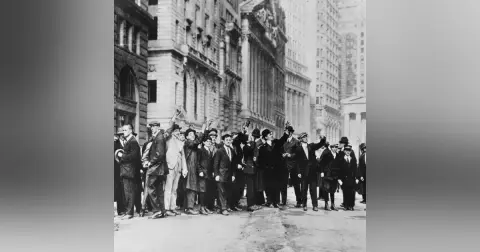
Euphoria on the Stock Market, Falling Profits Underneath — Roberts says the Roaring Twenties looked like an upswing, especially in the United States, while profitability was already falling beneath it. Investors borrowed heavily to buy stocks in a boom he likens to the present, and the mainstream economists of the time, by his account, expected no collapse. After the 1929 crash he describes a decade without recovery, with Steinbeck’s The Grapes of Wrath as a portrait of the period, ended only when governments built a war economy.
Engels’s Reply to Underconsumption — Roberts presents Engels’s answer to the argument that workers lack the wages to buy what capitalists produce: that is always the case, so it cannot explain booms and slumps. His illustration is the headphones used for the recording, tracing the separate capitalists who made the metal, the wires, and the sound system and sold to one another, to show that, on his account, most sales run between capitalists.
Resources & Further ReadingPrimary Sources
- Michael Roberts, The Long Depression (2016) — the book at the center of this conversation, in which Roberts says he sets out the figures on profitability behind his argument.
Works Discussed
- Karl Marx, Capital, Volume 3 — Roberts’s source for the law of the tendency of the rate of profit to fall and for the counteracting tendencies.
- John Steinbeck, The Grapes of Wrath — the novel Roberts cites as a portrait of the United States in the 1930s.
Roberts characterizes Marx’s and Engels’s arguments in his own words, and no specific edition or page of Capital is cited in this episode. He also refers, without naming specific works, to the Austrian-school economists of the 1870s, to scholars of British industrial production and trade, and to Engels’s writings on the depression; none of these are listed here.
Coming Up NextPart Three brings Roberts’s argument into the present: what it means for a generation earning less than their parents, what role AI might play going forward, and where he thinks capitalism goes from here. Part Three lands in two weeks.
Listen & SubscribeWebsite — notionsofprogress.com
Email: marshall@notionsofprogress.com
About the ShowNotions of Progress is a podcast tracing ideas of progress from antiquity to the age of artificial intelligence. Hosted by Marshall Madow — an independent researcher whose MA in History (Cambridge) examined Georges Sorel’s epistemology of myth, and whose MSc (Oxford, Saïd Business School) focused on Complexity Science and Leadership — the show surfaces the debates rather than settling them, tracing how thinkers from Hesiod to Hayek, Plato to Peter Haff, have understood what it means for humanity to move forward, at what cost, and for whom.