Episodes
224
Oct. 20, 2026
Ep 224 Vertigo Part 1: Approach to Episodic Vertigo
Vertigo is one of the most dreaded chief complaints in Emergency Medicine – for good reason! Symptoms can be vague, the assessment can be nuanced, and there are so many potential pitfalls along the way for accurately investigating and diagnosing dizzy patients. What do we actually need to know about risk stratifying these patients at the bedside? What red flags are most helpful to screen for? How do we tease out the useful parts of the history and physical exam to guide our diagnostic strategy? ...
223
Sept. 28, 2026
Ep 223 Epistaxis Management: A Step-Wise Approach
Epistaxis is usually straightforward—until it isn’t. How can you distinguish an anterior bleed from a dangerous posterior bleed? What’s the best sequence for compression, vasoconstrictors, TXA, cautery and packing? When should you reach for an anterior balloon tampon or posterior dual balloon? And how do you manage the airway when torrential bleeding fills the oropharynx? In this Epistaxis Management Deep Dive, Anton is joined by emergency physician Dr. Leeor Sommer and otolaryngologist Dr. Doro...
Sept. 8, 2026
EM Quick Hits 73 MedMal Case Peds Headache, Phenobarb in Alcohol Withdrawal, Peer Support Programs, Asymptomatic Bacteriuria, Mechanical Ventilation, Coaching the EM Mind Part 3
In this month’s EM Quick Hits Podcast, Mike Weinstock dissects a pediatric headache medical malpractice case, Zoe Polsky reviews the use of phenobarbital for alcohol withdrawal, and Kylie Booth and Nour Khatib discuss how a Peer-to-Peer program can support emergency clinicians. Plus, Matthew McArther clarifies when to treat asymptomatic bacteriuria in older adults, Shawn Segeren shares practical approaches to mechanical ventilation in the emergency department, and Sara Gray and Katie Lin return ...
222
Aug. 25, 2026
Ep 222 Imaging Decisions in Emergency Medicine
When to image, when to wait, and what to do when the ideal test isn’t available are often far more nuanced than they appear. In this EM Cases episode, Dr. Amit Shah joins Anton to tackle some of the toughest everyday imaging decisions: How much should cumulative radiation exposure influence our decision to order another CT? In suspected appendicitis, when is it safe to wait for ultrasound rather than obtain CT overnight? Can the emerging traumatic brain injury biomarkers GFAP and UCH-L1 help avo...

221
Aug. 11, 2026
Ep 221 EM-Primary Care Health Systems Strategies, Myths, Misperceptions and Solutions
There are few things more frustrating for an Emergency Physician than caring for patient after patient who lands in the ED not because it’s necessarily the best place for their care, but because every other door in the health care system was closed, confusing or impossible to find. Emergency Medicine and Primary Care often operate in different worlds—one built around rapid diagnosis and uncertainty, the other around continuity and prevention—but our patients move constantly between the two. In t...
July 21, 2026
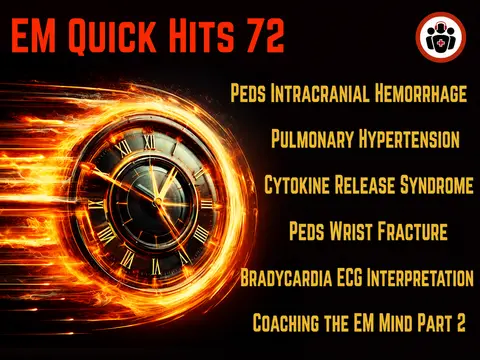
EM Quick Hits 72 EMC²: Peds Neurocritical Care, Pulmonary Hypertension, Cytokine Release Syndrome, Peds Wrist Fracture, Bradycardia ECG Interpretation, Coaching the EM Mind Part 2
In this month’s EM Quick Hits Podcast, Amna Karabegovic joins us for an EMC² case of pediatric altered LOA and neurocritical care, Anand Swaminathan simplifies the high-risk management of pulmonary hypertension and right ventricular failure, and Brit Long reviews how to recognize and treat Cytokine Release Syndrome. Plus, Andrew Tagg on whether uncomplicated pediatric distal radius fractures need reduction, Jesse McLaren on a systematic approach to ECG interpretation in the bradycardic patient, ...
220
June 30, 2026
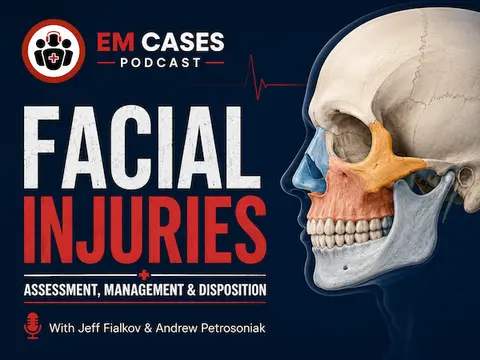
Ep 220 Facial Injuries: Assessment, Management and Disposition
Facial trauma is common in emergency medicine, but the biggest pitfalls are often not the fractures themselves—they're the threatened airway, vision-threatening ocular injuries, missed septal hematomas, and subtle soft tissue injuries hiding beneath the skin. Which facial fracture is most likely to cause delayed airway obstruction? Why does the physical examination often matter more than the CT scan? Which injuries require urgent consultation or transfer, and which can safely go home? In this ep...

219
June 16, 2026
Ep 219 Hip Emergencies: Recognition and Management
Hip complaints are bread-and-butter emergency medicine—but every so often they are anything but straightforward. The obvious shortened, externally rotated leg after a fall is one thing; the patient with acute hip pain, a normal x-ray, unremarkable blood work, and no clear diagnosis is another. Hip fractures are also far from benign, carrying a 30-day mortality of 6–7% and a 1-year mortality of about 20%, often triggering a cascade of pain, immobility, delirium, deconditioning, and death. But hip...

June 2, 2026
Journal Jam 24 Antibiotics for Strep Throat: Evidence, Myths and Misperceptions
Antibiotics for strep throat seem like a simple decision—but the evidence is anything but simple. In this Journal Jam podcast with Dr. Casey Parker and Dr. Justin Morgenstern, we critically appraise the literature behind one of the most common infections seen in emergency medicine. Do antibiotics meaningfully improve symptoms? Do they prevent peritonsillar abscess, post-streptococcal glomerulonephritis, or rheumatic fever? How reliable are the studies informing our practice? We explore publicati...
218
May 19, 2026
Ep 218 Substance Use Disorder in the ED – Stigma, Compassion and System Change
Emergency physicians pride themselves on recognizing and treating life-threatening illness under pressure. Yet one of the most lethal, common, and treatable conditions presenting to our EDs still often receives fragmented, stigmatized care: substance use disorder. The opioid crisis has evolved into an era of increasingly toxic and unpredictable drug supplies, including ultra-potent synthetic opioids such as nitazenes. Between 2016 and 2021, more than 27,000 Canadians died from opioid toxicity, w...
217
April 28, 2026
Ep 217 Pediatric Agitation: Assessment and Management
Pediatric agitation in the Emergency Department is one of those presentations that can escalate quickly and leave even experienced clinicians feeling on edge. It is high-risk, resource-intensive, and often unfolds in an already overstimulating environment where small missteps can make things worse. At the same time, agitation is not a diagnosis, it is a clinical presentation that may reflect anything from psychiatric illness to delirium, intoxication, trauma, or simply a child overwhelmed by the...
216
April 7, 2026
Ep 216 Cardiac Arrest Update: Beyond the 2025 ACLS Guidelines Part 2 – Medications, Airway, Termination and Post-ROSC Care
In this Part 2 or our 2-part EM Cases podcast series on Cardiac Arrest Update, Dr. Sheldon Cheskes and Dr. Rob Simard take us beyond the algorithms and into the real-world decision-making of cardiac arrest care. We answer questions like: Do vasopressin and steroids improve survival or just ROSC? Should we be giving amiodarone earlier—and is lidocaine just as good? When should we use calcium, bicarbonate, or magnesium, and when should we avoid them? What role does ketamine play in CPR-induced con...
215
March 25, 2026
Ep 215 Cardiac Arrest Update: Beyond the 2025 Guidelines Part 1: CPR, Defibrillation and Ventilation
In this EM Cases update on cardiac arrest management, Dr. Sheldon Cheskes and Dr. Rob Simard join Anton to walk us through the evolving science and bedside practicalities of cardiac arrest management in the wake of the 2025 ACLS Guidelines. They answer questions such as: What are the most common failures in CPR quality, and how can we recognize and correct them in real time? Should we employ head up CPR, and if so how? How should we interpret ETCO₂ during cardiac arrest, and why shouldn’t we cha...
March 10, 2026
EM Quick Hits 71 EMC²: Fever Without a Source, Coaching the EM Mind Part 1, Traumatic Pneumothorax Part 2, PECARN C-spine Rule, Medetomidine Withdrawal, EMS Handover
In this month's EM Quick Hits Podcast we introduce not one, but two new series! First, "EMC²" - EM Cases Cases (we know, horrible name ;) where Anton or Katie discuss a knowledge building case with a special guest. And second, "Coaching the EM Mind" with Dr. Sara Gray a professional coach for EM providers, where Katie discusses with her the science and best expert advice on how to perform your best in the ED. Plus, a withdrawal syndrome that is new EDs, life-threatening and requires specific tre...

214
Feb. 25, 2026
Ep 214 Bridging the Gap in Endometriosis Care: Recognition, Risk Stratification, and ED-Initiated Management
We walk you through what Emergency Physicians need to know to recognize, risk stratify, and manage endometriosis safely and pragmatically. We answer question such as: When should endometriosis rise to the top of the differential for pelvic pain? How do we distinguish an endometriosis flare from a dangerous endometriosis complication? from Pelvic Inflammatory Disease? Why hemorrhagic cyst the most common misdiagnosis for endometriosis and how can we tell the difference between hemorrhagic cyst an...
213
Feb. 10, 2026
Ep 213 Update in Management of Status Epilepticus
Convulsive status epilepticus is one of the most morbid neurologic emergencies we manage in the ED, and outcomes depend far more on speed than drug selection. Like ventricular fibrillation, each minute of ongoing convulsions worsens hypoxia, acidosis, cardiovascular instability, and neuronal injury, while making seizures progressively harder to terminate. Modern definitions are intentionally time-compressed to force early, parallel, clock-anchored action. Any patient still convulsing when you re...
212
Jan. 27, 2026
Ep 212 PECARN Febrile Young Infant Prediction Tool: When To Safely Forgo LP and Empiric Antibiotics
If you’ve been practicing EM for more than a decade, your approach to the febrile young infant has (appropriately) evolved. For years, the default was LP + empiric antibiotics + admission for almost everyone. That approach prevented missing meningitis, but at the cost of a lot of harm: invasive testing, unnecessary antibiotics, and hospitalization-related complications. The modern approach is a paradigm shift toward risk stratification, biomarkers, and shared decision-making, while still respect...
Jan. 13, 2026
EM Quick Hits 70 MedMal Cases Upper Back Pain, Traumatic Pneumothorax/Hemothorax Decision Making, Risk Stratification of ICH for Consultation, Post-Circumcision Bleeds, IV Contrast Allergy, Emotional Contagion
In this month's EM Quick Hits podcast: Mike Weinstock discusses with Anton a case of upper back pain in this month's Medmal Cases, Andrew Petrosoniak on traumatic pneumothorax and hemothorax decision making: risk stratification, imaging cutoffs and chest tube choices, Justin Morgenstern on brain injury guidelines risk stratification for neurosurgical consult, repeat imaging and admission, Andrew Tagg on management of post-circumcision bleeding and when to escalate care, Hans Rosenberg & Ariel He...
211
Dec. 30, 2025
Ep 211 Thyrotoxicosis and Thyroid Storm: Recognition and Management
In this Part 2 of our 2-part podcast series on thyroid emergencies Anton, Dr. George Willis and Dr. Alyssa Louis answer questions such as: When a patient presents with “sepsis without a source,” what bedside features should trigger you to prioritize thyrotoxicosis? How can PoCUS help you decide whether tachycardia is dangerous — or lifesaving — before starting β-blockade? Why can TSH and free T4 be falsely reassuring in a crashing patient, and what labs actually matter early? In which patients d...
210
Dec. 16, 2025
Ep 210 Decompensated Hypothyroidism Recognition and Management
In the ED, we regularly care for sick patients presenting acutely with abnormal vital signs, altered mental status, and end organ dysfunction. Oftentimes, the culprit ends up being sepsis, or overdose, or organ failure. But it is important that we consider rarer endocrine presentations like decompensated hypothyroidism. In this Part 1 of this two-part podcast with Dr George Willis and Dr Alyssa Louis, we answer questions like: Why is the term myxedema coma a misnomer and should be abandoned? How...
Dec. 2, 2025
EM Quick Hits 69 Pediatric Urinary Retention & Acute Transverse Myelitis, Post-Dural Puncture Headache, Med Mal Cases: Clenched Fist Injury, IV Thrombolysis for Minor Stroke, EM Leadership Spotlight #4
On this month's EM Quick Hits podcast: Deborah Schonfeld on the differential diagnosis and work up of pediatric urinary retention & acute transverse myelitis, Jesse McLaren on his Tryptic Approach to Occlusion MI Diagnosis, Matthew McArthur on recognition and management of post-dural puncture headache, Joseph Yasmeh on Med Mal Cases: Clenched fist injury, Brit Long on IV thrombolysis for minor strokes and Victoria Myers & Lauren Westafer on mentorship and what it means to be a physician leader.....
209
Nov. 11, 2025
Ep 209 Nondisabling Stroke Recognition and Management
In this Part 2 or our 2-part podcast update on ED stroke management with Dr. Katie Lin and Dr. Walter Himmel we explore non-disabling strokes, where symptoms are mild enough that patients can continue daily activities if deficits persist. Yet, non-disabling does not mean benign. Non-disabling strokes occupy the same ischemic continuum as TIAs and carry a substantial risk of early recurrence with disabling stroke. In this EM Cases podcast we answer questions such as: Which patients with non-disab...
208
Oct. 28, 2025
Ep 208 Paradigm Shift in Ischemic Stroke Management Part 1: Disabling Strokes
We are amidst a paradigm shift in the emergency management of acute ischemic stroke. The traditional way of categorizing ischemic strokes as 'minor' vs 'major' is no longer relevant to what we do in the ED. It's now about 'disabling' vs 'non-disabling' strokes. And this is no small change. This categorization dictates urgency of ED work-up and treatments, imaging choices, treatment decisions and goals of care. In this Part 1 or our 2-part main episodes EM Cases podcast series on management of is...
Oct. 7, 2025
EM Quick Hits 68 Osteomyelitis, Tourniquet Technique, Pediatric Distal Radius Buckle Fractures, DSI RCT, AMS in ESRD & Dialysis, EM Leadership Spotlight #3
On this month's EM Quick Hits podcast: Dr. Isaac Bogoch on recognition and management of osteomyelitis in the ED, Dr. Anand Swaminathan on tourniquet tips and tricks. Dr. Andrew Tagg on managing pediatric distal radius buckle fractures & the FORCE trial. Dr. Justin Morgenstern on Delayed Sequence Intubation (DSI): RCT Takeaways. Dr. Brit Long on ESRD & Dialysis in the ED: altered mental status. Dr. Lisa Thurgur & Victoria Myers on leadership and medical education. Please consider a donation to E...