Cleon Skousen’s Nephew: Surprising Story of BYU Troublemaker (Mark Skousen 1 of 4)
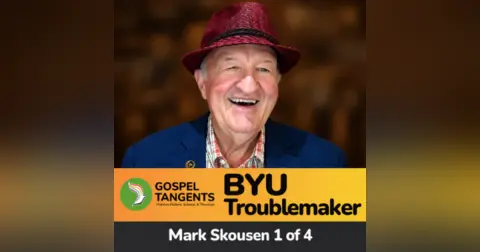

“Are you the famous Skousen?” Do they mean Cleon Skousen or Mark Skousen? Economist Mark Skousen has heard that question in nearly every ward he’s ever moved into. Usually the person means his uncle, W. Cleon Skousen, the FBI veteran, Salt Lake City police chief and best-selling author of The Naked Communist. When I first saw Mark at the John Whitmer Historical Association meetings, I had the same thought. Put a pair of glasses on him and the resemblance is striking. In Part 1 of my conversation with Mark, we talk about growing up a Skousen, and about his early years as a self-described troublemaker at BYU.
https://youtu.be/wQ4gJ9o5iIM
Don’t miss our other conversations with Mark Skousen: https://gospeltangents.com/people/mark-skousen
Copyright © 2026
Gospel Tangents
All Rights Reserved
Cleon Skousen or Mark?
Mark’s father, Leroy Skousen, lived a life that paralleled Cleon’s. Both were lawyers, FBI men and committed anti-communists who raised large families. When Leroy died of lung cancer at 46, Cleon became something like a father to Mark: he gave him a father’s blessing, visited the family’s home evenings in Provo, and later chose Mark as the only pallbearer from outside his immediate family.
Mark and his wife Jo Ann went on to compile There Were Giants in the Land: Episodes in the Life of W. Cleon Skousen from Cleon’s roughly 150 journals, letting Cleon tell his story in his own words. Mark also tells us he is consulting on historian Benjamin Park’s forthcoming biography of Cleon, and that Matthew Harris plans to include a surprisingly cordial meeting between Cleon and Hugh B. Brown in his upcoming book on Brown.
BYU Troublemaker
Mark arrived at BYU in the fall of 1965 planning to major in economics, raised on thrift, limited government and the books of Ludwig von Mises. What he found in his first class shocked him: Paul Samuelson’s Keynesian textbook, which taught that deficit spending was good policy during a recession and that thrift was not always a virtue. The supplementary reading was Robert Heilbroner’s The Worldly Philosophers. Mark didn’t stay quiet. He went on local radio to criticize how economics was being taught at “the Lord’s university,” then wrote an exposé for the Daily Universe. He still earned the highest grade in the class, though his professor admitted he had a hard time giving him that A.
We also talk about labels. Mark calls himself a liberal, though not in the way most Americans use the word, and explains why he’d rather discuss issues than sort people into camps. His example is a good one: Cleon and Salt Lake mayor J. Bracken Lee wanted to abolish the income tax, cut government spending and keep government out of the way, yet Lee fired Cleon as police chief and the two became bitter enemies. For Mark, that is what happens when labels end the conversation.
Part 1 is only the beginning. In Part 2, Mark explains where he and Uncle Cleon parted ways, from The Naked Communist to The Naked Capitalist, and tells the story of the day Cleon called Adam Smith’s invisible hand “inspired of God.” Part 3 turns to Mormon economics and the United Order, and Part 4 takes us inside the Daily Universe newsroom of the early 1970s. Members can watch the entire interview now at patreon.com/gospeltangents.
Listen to the full conversation wherever you get your podcasts.
Don’t miss our other conversations with Mark Skousen: https://gospeltangents.com/people/mark-skousen
Copyright © 2026
Gospel Tangents
All Rights Reserved
If you’re interested in using a clip, please send me an email.
0:00 Troublemaker at BYU
4:14 There Were Giants in the Land
6:58 Matt Harris and Hugh B. Brown
8:38 Pronouncing Cleon/Cleon at BYU
9:54 Keynesian Textbook at BYU
14:48 A 1966 Assignment/BYU Spy Ring
19:03 The Liberal Label
21:11 Cleon vs. J. Bracken Lee