Fundamentalist Mormon Temples: Amazing Nevada, Missouri & AUB (John Hamer 2 of 6)

We’re moving beyond LDS Temples and looking at Fundamentalist Mormon temples. Nauvoo gave Latter-day Saints a temple built around Old Testament ordinances, and then the pioneers left it behind. In this second conversation of the series, historian John Hamer and host Rick Bennett follow that inheritance west to Utah, where an Endowment House filled the gap until a real temple could be finished, and then to the more surprising places it landed: the temples of Mormon fundamentalist groups, including a pyramid in the Utah desert.
https://youtu.be/BGKMtxTGSQQ
John explains that the Endowment House, built on Temple Square, was a temporary but sacred place where the ordinances could be performed while the Salt Lake Temple took decades to complete. He suggests the wait was partly because the builders were aiming at something extraordinary for pioneers. We pause over a small mystery, whether the Endowment House had a baptismal font, before turning to the fundamentalist groups, who have built temples all over the place. John understands that the Apostolic United Brethren have an Endowment House in Draper and a temple in Mexico. The FLDS built a temple at the Yearning for Zion Ranch in Texas, though the church no longer holds it. John, an admitted architecture enthusiast, wants every group to have the nicest-looking temple it can, and confesses he was disappointed by how that one turned out.
Fundamentalist Mormon Temples
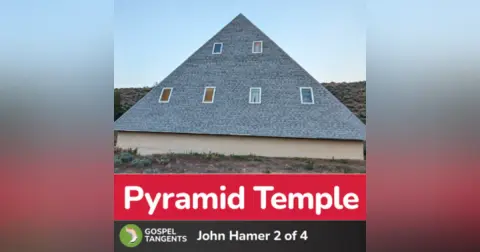
Then comes the pyramid. Rick describes a pyramid-shaped temple built by Christ’s Church near Modena, Utah, a place the group calls Paquin. Someone even gave him a 3D-printed model of it, and he told them it should be the church’s icon, since who else has a pyramid temple? After it was vandalized and closed, the church moved its temple work to a second temple in Nevada, about thirty miles from Tonopah down dirt roads. Rick, who visited and stayed with members of the church, says the outside is not pretty, but the inside is beautiful.
The most striking temple may be the one built by a Missouri fundamentalist group. Rick visited the week before its dedication and, after helping install mirrors and curtains, was jokingly told he was now a temple worker. The rooms, creation, garden, terrestrial, and celestial, are covered in murals, and the celestial room’s dome is painted as a daytime sky that becomes an accurate night sky, with fiber-optic stars, when the lights go out. John says this is exactly the kind of thought he wishes every group put into its temple. Any independent fundamentalist group can worship there by appointment, yet many will not. That leads to the 1978 priesthood revelation, which many fundamentalists saw as another sign of LDS apostasy, and to the question of Black members: Rick says the Missouri group is the only one that welcomes them.
Across all these buildings, John draws a simple conclusion. Most of them are familiar to LDS eyes, built on the Nauvoo model, and groups without a temple set aside what amounts to an Endowment House, a consecrated room where ordinances can be performed. Part 1 traced the temple idea from the Bible through Kirtland to Nauvoo. Part 2 shows how the Nauvoo version spread among the fundamentalists. Next, in part 3, John turns to two groups that broke from Brigham Young, the Cutlerites and Lyman Wight’s Wightites.
Don’t foget to check out John’s book, Scattering of the Saints.
Chapters
1:40 The Salt Lake Endowment House
2:04 Did the Endowment House Have a Baptismal Font?
5:44 Fundamentalist Temples Beyond the Brighamites
6:30 FLDS Temple at Yearning for Zion Ranch
8:13 Christ’s Church & the Pyramid Temple in Modena (Paquin), Utah
9:26 Nevada Temple: Plain Outside, Beautiful Inside
10:57 Missouri Temple: Murals, Creation Room & the Holy of Holies
12:46 The Dome of Stars, in Full
14:30 The 1978 Priesthood Revelation & Fundamentalist Temples
17:14 Only the Missouri Group Welcomes Black Members
17:52 Endowment Houses: Groups Without a Temple