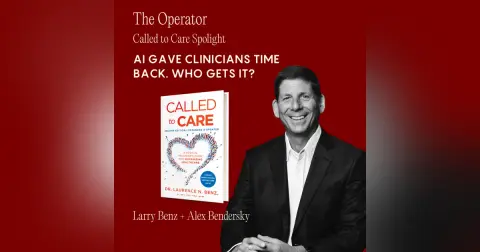
Called to Care Spotlight: AI Gave Clinicians Time Back. Who Gets It?



The efficiency isn’t the point.
AI can document faster, process more information, support clinical decisions, and remove work clinicians once had to do manually.
But Larry Benz raises the more important question: What happens to the time technology gives back?
In this episode, Larry talks with Alex Bendersky about the rapidly changing role of AI in physical therapy and rehabilitation. They move beyond the usual conversation about tools and features to examine how AI changes the actual clinical encounter, and why implementation may matter more than the technology itself.
Alex explains why AI is moving from novelty to infrastructure, why clinicians need a meaningful role in shaping these systems, and how ambient documentation and clinical intelligence could expand rather than replace clinical reasoning.
Larry pushes the conversation one step further: if a clinician saves fifteen minutes and leadership immediately fills those fifteen minutes with more productivity, has anything meaningful improved?
Key ideas:
- Why AI is becoming table stakes rather than a novelty
- The difference between optimal and suboptimal AI adoption
- How ambient documentation can capture more than a traditional clinical note
- Why AI could strengthen—or unintentionally weaken—clinical reasoning
- How smart systems can support evidence-guided care
- Why clinicians need to become active participants in healthcare technology
- How AI could reduce documentation burden and burnout
- Why efficiency does not automatically produce better care
- The leadership choice behind every minute AI gives back
- How healthcare can avoid “automating the calcification”
The opportunity isn’t simply to make clinicians faster. It’s to decide what becomes possible when clinicians finally have some capacity back.
Subscribe to The Operator on Substack.