Called to Care Spotlight: You Don't Need More Patients. You Need to Stop Losing Them.
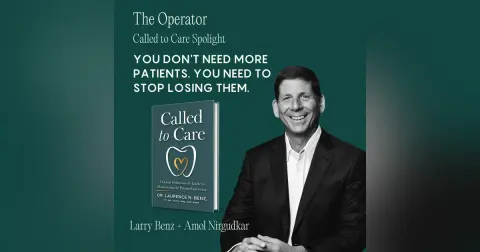


You Don't Need More Patients. You Need to Stop Losing Them.
What if your healthcare organization doesn't have a patient acquisition problem? What if it has a patient experience problem?
Healthcare organizations invest heavily in marketing, lead generation, and patient acquisition. But what happens when someone finally picks up the phone?
In this episode of The Operator, Larry Benz sits down with Amol, founder and CEO of Patient Prism, to explore one of healthcare's most overlooked growth opportunities: the conversations that happen before a patient ever walks through the door.
Drawing on insights from millions of patient conversations, Amol explains why missed calls, scheduling barriers, financial anxiety, and inconsistent front-desk experiences can undermine even the best marketing strategy.
Together, Larry and Amol explore how behavioral psychology, employee coaching, and AI can help healthcare organizations build trust, improve access, and create better patient experiences without losing the human connection.
They also tackle a question every healthcare operator should be asking: Should AI replace the person answering the phone, or help that person become better?
The conversation closes with a broader leadership lesson from Larry on navigating uncertainty, developing people, and returning to operational fundamentals when the market gets difficult.
In This Episode- Why healthcare's biggest growth opportunity may already be calling your practice.
- How empathy, affordability, and appointment availability influence patient decisions.
- Why the front desk should be treated as a critical part of patient care, not just an administrative function.
- How AI-driven feedback can help employees improve without creating a culture of surveillance.
- What behavioral psychology reveals about the beginning and end of patient conversations.
- Why better scheduling can improve access to care and practice productivity.
- Where AI voice agents can help today—and why human connection still matters.
- Three operational behaviors that distinguish stronger healthcare organizations.
- Larry's approach to leading healthcare organizations through economic uncertainty.
Are we using technology to replace human interaction, or to make human interaction better?
For healthcare leaders, that distinction may determine what sustainable growth looks like.
Subscribe to The Operator on Substack.