Episodes

Sept. 7, 2021
Audio Article: Crowds can wise up to fake news
In the face of grave concerns about misinformation, social media networks and news organizations often employ fact-checkers to sort the real from the false. But fact-checkers can only assess a small portion of the stories floating around online. A new study by MIT researchers suggests an alternate approach: Crowdsourced accuracy judgements from groups of normal readers can be virtually as effective as the work of professional fact-checkers. Read the article: https://news.mit.edu/2021/crowd-sourc...
April 20, 2021
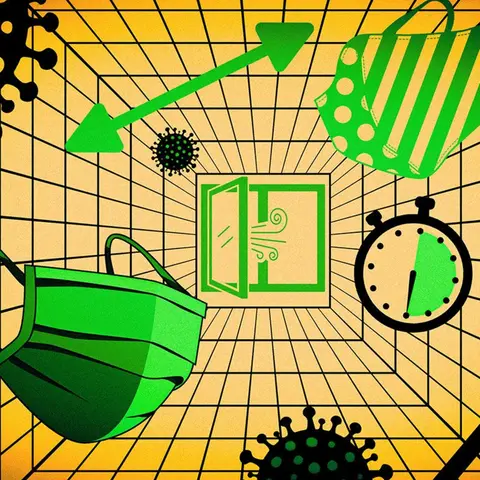
Audio Article: A method to assess Covid-19 transmission risks in indoor settings
Two MIT professors have proposed a new approach to estimating the risks of exposure to Covid-19 under different indoor settings based on the number of people, the size of the space, the kinds of activity, whether masks are worn, and the ventilation and filtration rates. Read the article: https://news.mit.edu/2021/covid-19-risks-indoor-0415
April 15, 2021
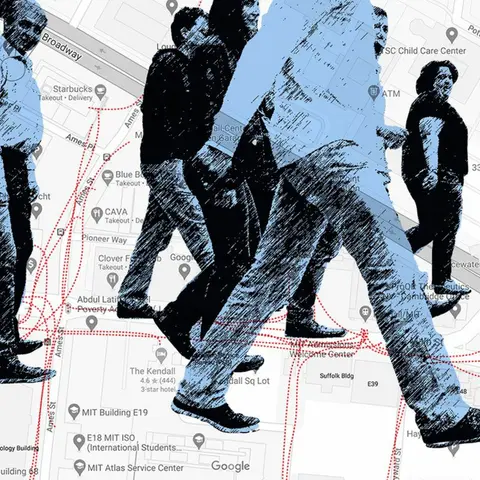
Audio Article: Counting pedestrians to make pedestrians count
MIT Associate Professor Andrews Sevtsuk has developed a model of pedestrian movement that could help planners and developers better grasp the flow of foot traffic in all cities. His work emphasizes the functionality of a neighborhood's elements, above and beyond its physical form, making the model one that could be used from Cambridge to Cape Town. Read the article: https://news.mit.edu/2021/counting-pedestrian-traffic-0415
April 5, 2021
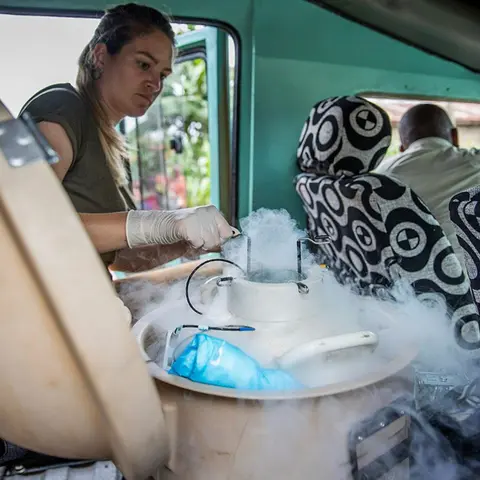
Audio Article: How industrialized life remodels the microbiome
Thousands of different bacterial species live within the human gut. Most are beneficial, while others can be harmful. A new study from an MIT-led team has revealed that these bacterial populations can remake themselves within the lifetime of their host, by passing genes back and forth. They also found for people in industrialized societies this happens at much higher rates. Read the article: https://news.mit.edu/2021/microbiome-industrialized-gene-transfer-0331

March 17, 2021
Audio Article: A remedy for the spread of false news?
Stopping the spread of political misinformation on social media may seem like an impossible task. But a new study co-authored by MIT scholars finds that most people who share false news stories online do so unintentionally, and that their sharing habits can be modified through reminders about accuracy. Read the article: https://news.mit.edu/2021/social-media-false-news-reminders-0317

March 15, 2021
Audio Article: Study predicts the oceans will start emitting ozone-depleting CFCs
The world’s oceans are a vast repository for gases including ozone-depleting chlorofluorocarbons, or CFCs. They absorb these gases from the atmosphere and draw them down to the deep, where they can remain sequestered for centuries and more. Marine CFCs have long been used as tracers to study ocean currents, but their impact on atmospheric concentrations was assumed to be negligible. Now, MIT researchers have found the oceanic fluxes of at least one type of CFC, known as CFC-11, do in fact affect...
March 15, 2021
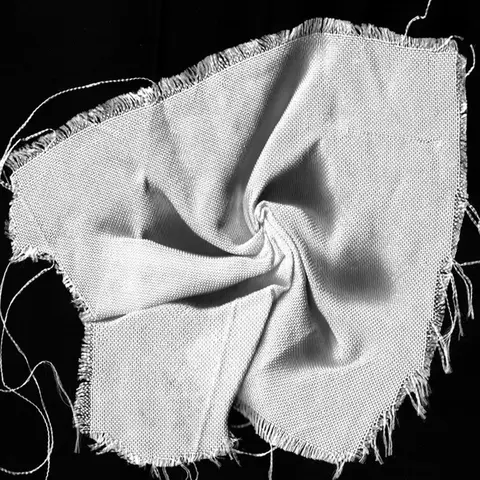
Audio Article: Could we recycle plastic bags into fabrics of the future?
MIT engineers have spun polyethylene into fibers and yarns designed to wick away moisture. They wove the yarns into silky, lightweight fabrics that absorb and evaporate water more quickly than common textiles such as cotton, nylon, and polyester. Read the article: https://news.mit.edu/2021/plastic-bags-recycle-fabrics-0315

Sept. 5, 2019
Audio Article: New science blooms after star researchers die, study finds
A new study co-authored by MIT economist Pierre Azoulay, an expert on the dynamics of scientific research, finds deaths of prominent life scientists tend to be followed by a surge in highly cited research by newcomers. Read the story: http://news.mit.edu/2019/life-science-funding-researchers-die-0829