Episodes
Feb. 24, 2025
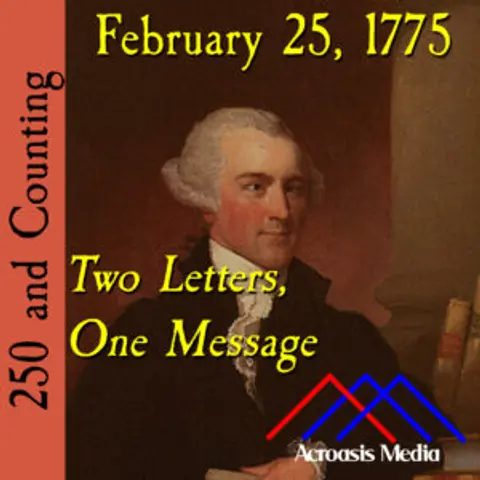
February 25, 1775
Today we review two different pieces of correspondence—one local, the other trans-Atlantic—in which the letter writers are clearly coming to the conclusion that things are not going well between the British and the Colonies, and that preparing for war is probably inevitable at this point. And that’s interesting on its own, but we also wanted to call your attention to the cover art for today’s episode. The person in the picture is Josiah Quincy II, who is discussed in the episode as a “side” cha...
Feb. 23, 2025
February 24, 1775
The interesting thing about surveillance in the 18th century is that, when you’re dealing with trans-Atlantic distances, the information moves slowly, and errors can be costly. We told you not long ago about someone who’d heard about the Minutemen, but had their numbers wrong by a factor of thousands. Fortunately in that case, it was just casual gossip rather than actual spycraft. But today in history, a bit of information about Colonial artillery that was reported to the Provincial Congress in...
Feb. 22, 2025
February 23, 1775
Alexander Hamilton isn’t really considered one of the Founding Fathers, largely because he’d only arrived in America from Scotland around the same time that things started getting ugly between the Colonies and the Crown. But he quickly took up the cause, and it’s clear from his writing that he was of a similar mind as Jefferson, Franklin and the rest. When he joined the Continental Army, he rose quickly through the ranks, becoming Washington’s staff aide and entered politics shortly after the w...
Feb. 21, 2025
February 22, 1775
Back when Mike and Claude were kids, February 22 was celebrated as a national holiday, the 22nd being recognized as George Washington’s birthday. Lincoln’s Birthday was February 12, so we had two Federal holidays close together. (To be fair, Lincoln’s was always unofficially recognized.) Until, that is, 1968, when the Uniform Monday Holiday Act came along, and many holidays were moved to the Monday of that week. Not every state complied right away, but eventually Lincoln’s Birthday disappeared ...
Feb. 20, 2025
February 21, 1775
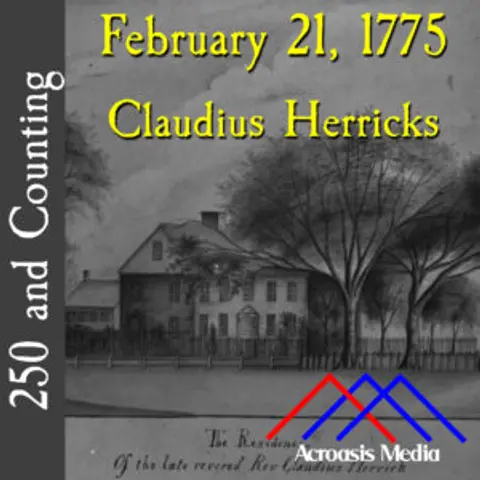
Of all the indignities we laid upon Claudius Herrick in this episode (okay, there weren’t that many), the worst is that we misspelled his name in the cover art. The post February 21, 1775 appeared first on 250 and Counting.
Feb. 19, 2025
February 20, 1775
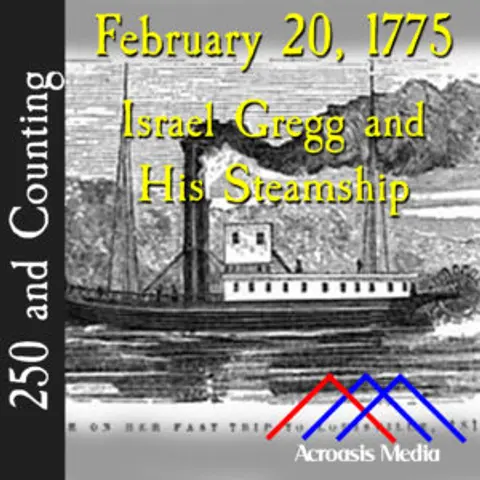
Until Israel Gregg came along, steamboat commerce on the Ohio river was considered impractical, largely because the currents were so strong. But Gregg had an interesting approach to demonstrate that it was, in fact, possible. In some portions of the river, there was a confluence with another river, which meant that there were multiple currents in the river for some distance. This is what made it hazardous in the first place. Gregg made a point of seeking out the currents of a specific river in...
Feb. 18, 2025
February 19, 1775
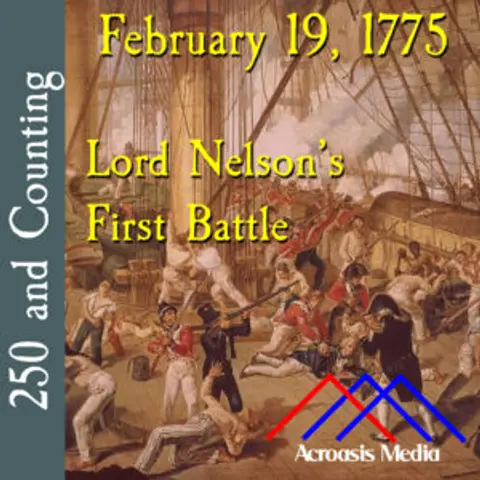
When I (Claude) was younger, I read a Star Trek novel titled The Final Reflection by John M. Ford. Trek novels weren’t considered canon, and later events in the films and subsequent series kind of wiped out some of the concepts put forth in the book, but what I found fascinating was that it was told entirely from the Klingons’ point of view. (It also provided an interesting explanation regarding why Federation transporters give off a high-pitched whine.) Before you think I’ve digressed before I...
Feb. 17, 2025
February 18, 1775
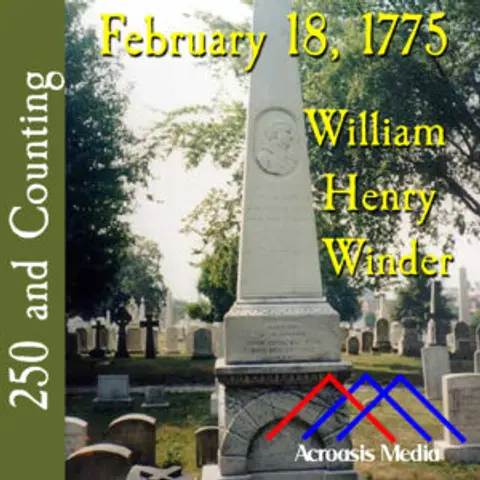
Maryland has a peculiar place in most of America’s major events. During the Revolution, the Continental Congress hid out there for a while. During the Civil War, the state mostly sat out the war because it was a “Southern” state occupied by the Union throughout. But the War of 1812? Well, that was Maryland’s time to shine, and today we meet one of the military men who fought in that war, though he wasn’t especially successful in the Battle of Bladensburg. We did have a portrait of Winder we we...
Feb. 16, 2025
February 17, 1775
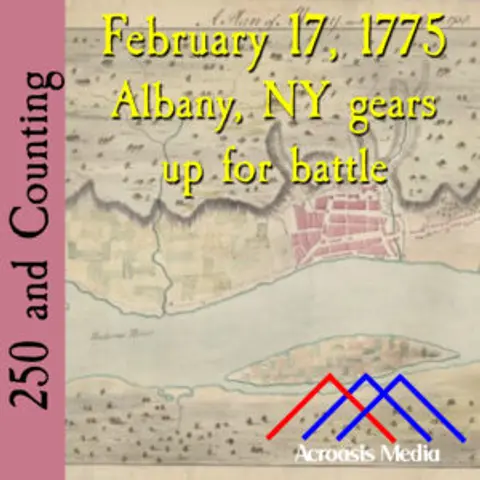
We’ve mentioned in the past that the intent of most of the Intolerable Acts and the Coercive Acts were designed to punish the Massachusetts Province, but it had some effect on the other colonies as well. What’s more, there was a growing worry that, if Parliament could do things like this to Massachusetts, what’s going to stop them from doing it to us? To that end, the city of Albany, NY, began making plans just in case war broke out. It was against the law, but their reasoning was that it was b...
Feb. 15, 2025
February 16, 1775
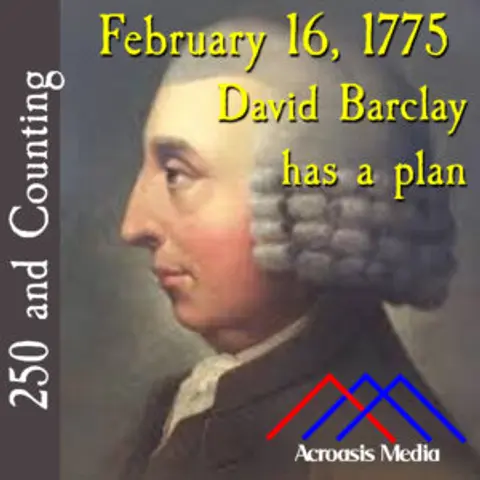
David Barclay was a British merchant who frequently plied his trade with other merchants in the Colonies. Such trade was quite lucrative for him, so when the Stamp Act was enacted, he stood to lose a lot of money because the Colonists would simply look elsewhere for the goods he sold. Likewise, when the Intolerable Acts, and the Coercive Acts were enacted, Barclay stood to suffer even more. So Barclay came up with a plan that would allow everyone to save face and bring these acts to an end. T...
Feb. 14, 2025
February 15, 1775
Only a few people had figured it out, and it’s not clear whether they were just guessing, but by this point in time both England and the Colonies were locked into a path that would lead inevitably to a shooting war. To that end, Parliament approved sending over four thousand soldiers and sailors to the Colonies to help keep them in line. But it wasn’t as simple as that; there were still some people protesting the action, not that anyone listened to them. Today we also peek in on someone who’s ...
Feb. 13, 2025
February 14, 1775
When it comes to Black people and their role in the American Revolution, the one name that most people appear to remember is that of Crispus Attucks, largely because he was the first person killed in the Boston Massacre, and that event is thought of as the beginning of the Revolutionary War, therefore it’s significant that the first person to die in the name of American freedom was a person of color. Other people, more fussy about events, would say that Lexington & Concord was the beginning of ...
Feb. 12, 2025
February 13, 1775
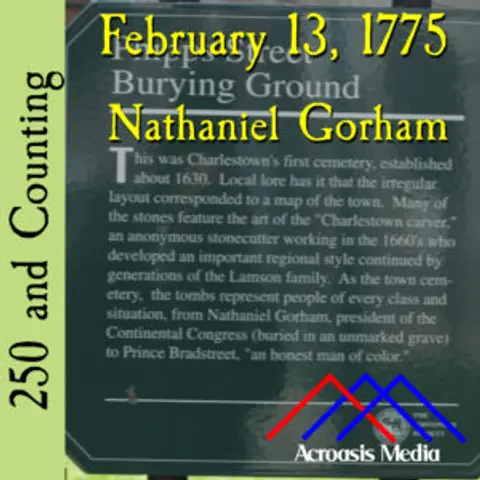
Here’s a peek behind the curtain: Mike and Claude do their own research for the individual shows, though Mike did the initial setups for the dates. So he’s the one who figured out what happened when, and then they each do the deeper research for the episodes they record. So Mike probably had no idea that there was a familial connection to this episode for Claude. For what it’s worth, neither did Claude, until he started looking into the story of Nathaniel Gorham. So if Mike had been recording t...

Feb. 11, 2025
February 12, 1775
We realize that this is going to come as a huge surprise to you, but when the future Louisa Catherine Adams met her future mother-in-law, it was not an auspicious occasion. This delayed—but did not prevent—Louisa from marrying John Quincy Adams, but Abigail Adams didn’t have a lot of respect for Catherine for many years. In the meantime, she and John Quincy had some ups and downs in their marriage, but in the end it appears that they were able to reconcile all the rough patches until the very ...
Feb. 10, 2025
February 11, 1775
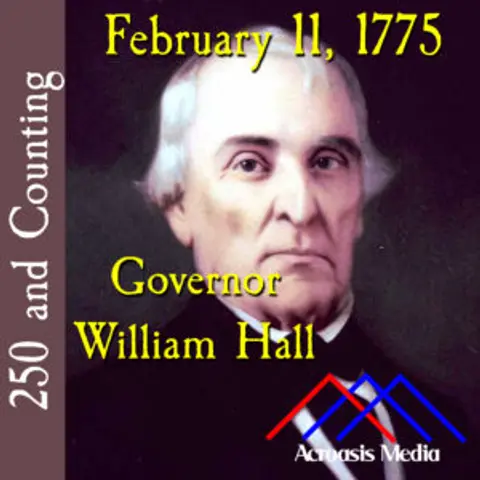
There are many events in the life of William Hall that could be ascribed to just plain luck on his part, and others which could conceivably tied to some shrewd timing on his part. But in the end, we think we’re going with luck. If he hadn’t survived two Cherokee ambushes, if he hadn’t been an officeholder previously, if he hadn’t been the Speaker of the Senate when a scandal broke out…things could have turned out very differently for our friend William. But William was also smart enough to wal...
Feb. 9, 2025
February 10, 1775
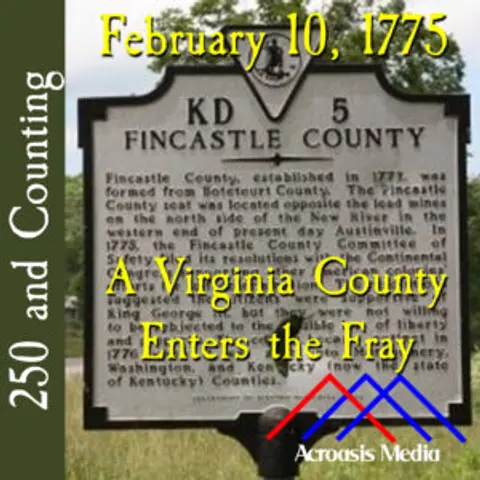
(N.B. We apologize that we initally uploaded this episode in the wrong format. We have no idea whether it made your podcast player cry, or anything else. At any rate, that’s fixed. Again, apologies.) While Massachusetts, and Boston in particular, were getting a lot of attention from the British, it’s not as though the other colonies sat back and watched everything happening from afar. To a certain extent they did do that, but they also had problems of their own to deal with. In some of the more...
Feb. 8, 2025
February 9, 1775
The first week or two of February 1775 could best be described as a series of misunderstandings and communication breakdowns. Any attempts on both sides to reach out with some form of conciliation managed to fail for various reasons. And during all these breakdowns, the situation on the American side of the pond only got worse as time went on, largely because each side thought that the other wasn’t being responsive. In the end, however, it didn’t really matter, because as we’ve discussed with ...
Feb. 7, 2025
February 8, 1775
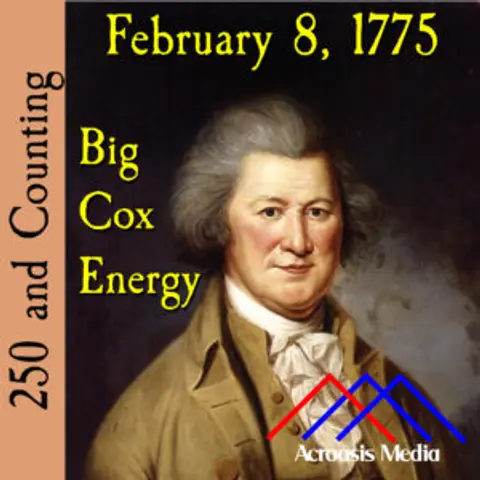
(Forgive us the jokey headline–sometimes it’s late at night when we post this stuff and we get punchy.) Over the course of a single year—and beginning with this day in 1775—John Cox experienced what any reasonable person would call a “meteoric rise” in his personal and professional fortunes. He started out adjudicating British laws in the Colonies, but moved quickly into assisting with the Colonial resistance effort and subsequently to assisting with the actual war. He did this both materially ...
Feb. 6, 2025
February 7, 1775
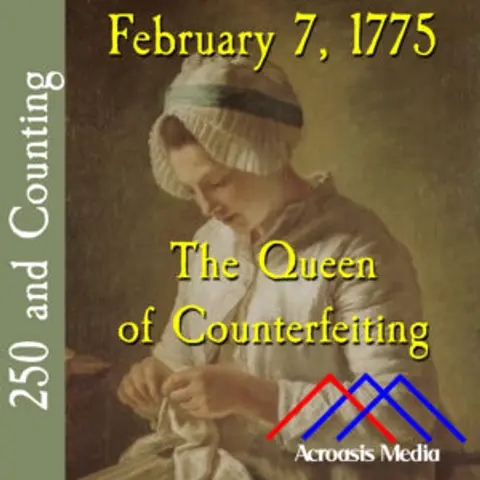
In today’s episode, guest voice Lorene Childs tells us the story of Mary Peck Butterworth. Mary was a member of the First Families of Rehoboth, Massachusetts, and a very respected member of the society there. But for a few years, and for reasons unknown to modern-day people, Mary enjoyed a rather peculiar hobby, one that perhaps should have made her a more famous person than she is. It wasn’t so much in the realm of John Adams and George Washington so much as it is in the realm of, say, Frank A...
Feb. 5, 2025
February 6, 1775
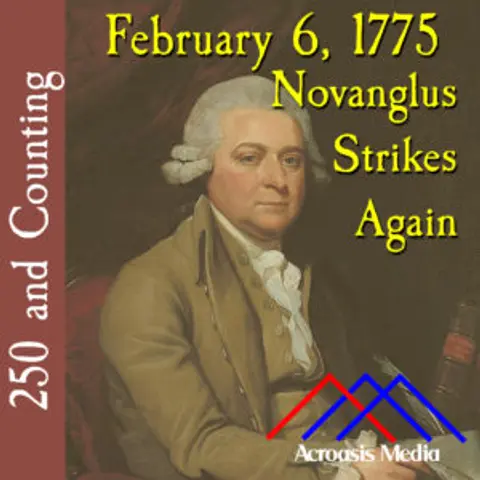
John Adams and Daniel Leonard had an interesting relationship. They were great friends at first, until the British started cracking down on the Colonies. Adams chafed under the Crown’s pressure, while Leonard remained loyal. Ultimately it created a rift between the two men which never quite healed, and it broke Adams’ heart. When Leonard began submitting essays to the Boston Gazette under the pen name “Massachusettensis,” Adams felt compelled to respond in kind, choosing a pen name of his own, ...
Feb. 4, 2025
February 5, 1775
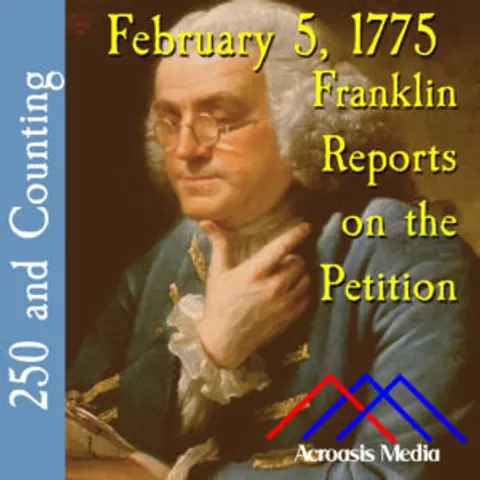
As noted previously, the First Continental Congress composed a Petition to the King asking him for some relief from the Intolerable Acts. The petition arrived in London in mid-December, which turned out to be some bad timing for a number of reasons. Benjamin Franklin was in town for diplomatic purposes, and he composed a letter to Charles Thomson, the Secretary of the Continental Congress, which summed up the problem: not only was the Petition but one among many, many other documents, it appear...
Feb. 3, 2025
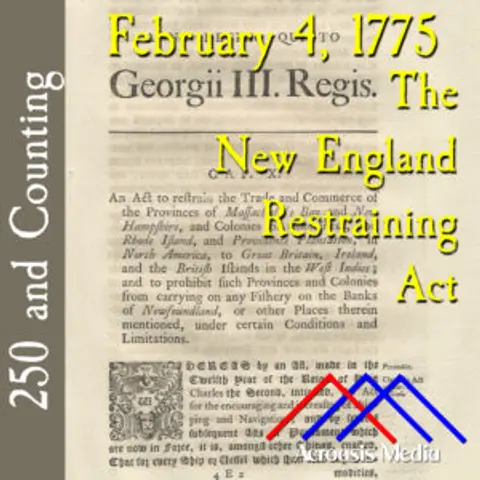
250 and Counting: February 4, 1775
After the Boston Tea Party, Parliament enacted what they called the Coercive Acts and the Colonies called the Intolerable Acts. The Colonists were neither coerced, nor were the acts tolerated (hence the name). And you know that because we’ve told you this already several times. In October 1774 the Continental Congress composed the “Petition to … Continue reading 250 and Counting: February 4, 1775
Feb. 3, 2025
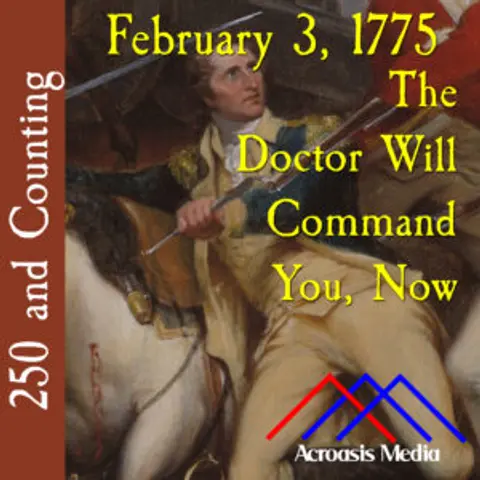
250 and Counting: February 3, 1775
Hugh Mercer is one of those people who was terribly important to the cause of Liberty during the American Revolution, yet his story goes untold largely because he died early in the effort. But if Mercer hadn’t come to America because he was on the losing side of a battle in Scotland, he wouldn’t have … Continue reading 250 and Counting: February 3, 1775
Feb. 1, 2025
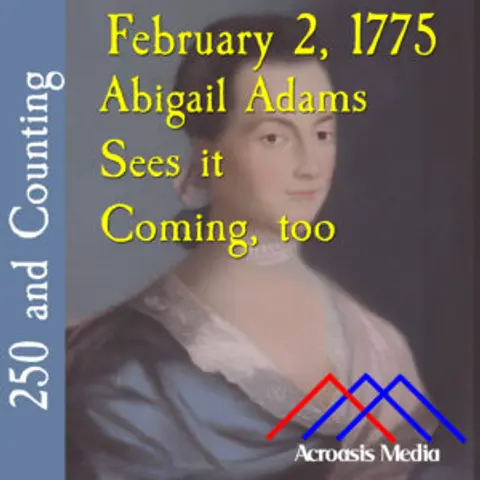
250 and Counting: February 2, 1775
After the Boston Tea Party, the government in Britain enacted what they called the Coercive Acts, or what the Colonists called the Intolerable Acts. (From here, it doesn’t feel like one name was any better-sounding than the other.) Because the Colonists were still hoping to preserve a decent relationship with the Mother Country, the First … Continue reading 250 and Counting: February 2, 1775