Episodes
July 19, 2025
July 20, 1775: A Tradition Begins
As long as we’ve had a Constitution, the United States has had a nominal separation between church and state. What that means is that Congress isn’t able to establish a state-sanctioned religion. For longer than we’ve had a Constitution, Congress has proclaimed days of prayer of some kind or another. For a long time, these days were announced not as a National Day of Prayer (the current nomenclature), but rather as “a day of fasting, prayer and humiliation.” Now, this isn’t the old Christian k...
July 18, 2025
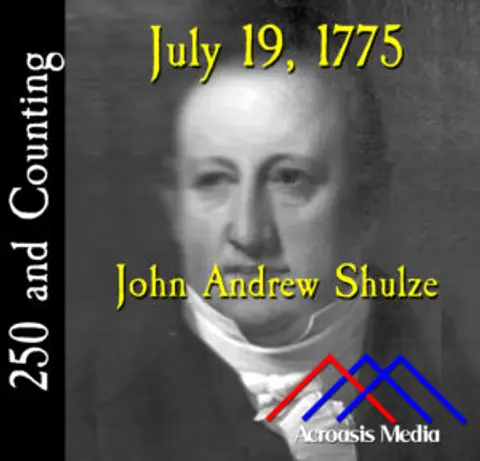
July 19, 1775: John Andrew Shulze
John Andrew Shulze was the sixth governor of Pennsylvania and a member of the Muhlenberg political clan. So this was a guy with some heavy firepower behind him, and he managed to use some of it in righteous ways. Shulze wasn’t completely successful with all of his endeavors, but even when he failed, he laid the groundwork for someone after him to succeed at it. After retiring from his job as governor, he was a delegate to the Whig Party’s first convention in 1839 and was president of Pennsylva...

July 17, 2025
July 18, 1775: The Burning of Fort Johnston
Although Fort Johnston was originally a British fort, a few years into the Revolutionary War, the Colonies recognized that it could be a valuable place to have a fort, and in 1778 they appropriated the money to have it rebuilt. That fort was also destroyed and, although reconstruction began in 1794, it took many years to complete the project. Time and again Fort Johnston was destroyed or abandoned, and then repaired or refurbished. The fort regained importance during the Civil War but was offic...
July 16, 2025
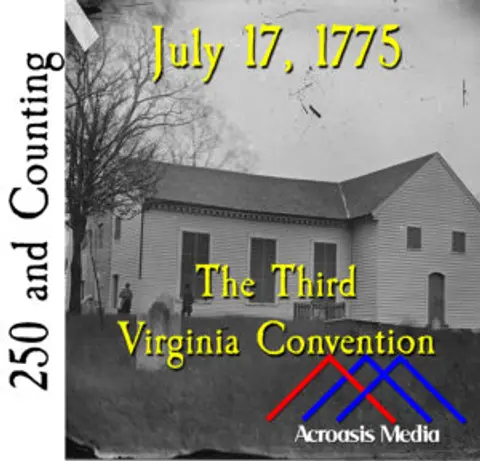
July 17, 1775: The Third Virginia Convention
Given the fact that the existing government of Virginia was technically extra-legal, it’s a little amusing to think that they themselves felt the need to conduct extra-legal activities of their own. A more cynical mind would think that they were hedging their bets, so that if anything Revolutionary were to come up and the British started rounding up people, they could say, “That wasn’t us…it was that Virginia Convention crowd!” A more cynical mind would think that. Heh. But the various convent...
July 15, 2025
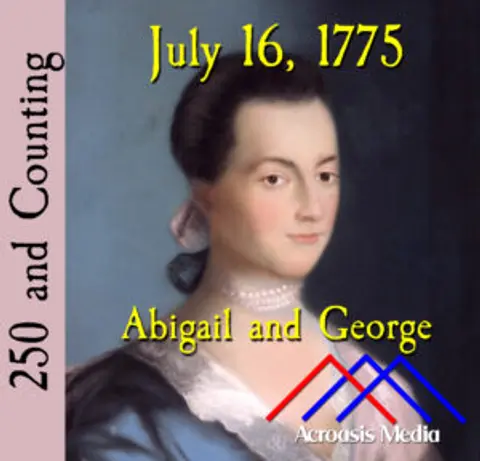
July 16, 1775: Abigail and George
As noted a couple of days ago, Abigail and John Adams wrote to each other quite frequently. Their relationship was not only deep with love, but with admiration for one another. If you get an opportunity, read David McCullough’s biography of John or, better yet, the Library of America’s volume of Abigail’s letters (not just to John but to many others). Their writing is florid without being mawkish. There’s a LOA volume of John’s correspondence as well. In today’s episode, they’re not pining for ...
July 14, 2025
July 15, 1775: Breakin’ the Law With Impunity
If you’re going to be in rebellion, you may as well do something rebellious. Thus was (presumably) the reasoning behind Ben Franklin putting forth a resolution that the Colonies would effectively ignore a ban on the importation of weapons and gunpowder to the Colonies. And while we’ve mentioned numerous times that the Congress doesn’t seem to do a lot more than form various Committees, again we need to stress that these were serious men, who gave serious thought to whatever they presented to t...
July 13, 2025
July 14, 1775: Support From An Odd Place
Lord John Wilkes was an interesting person who was always willing to run against popular opinion if he felt strongly that he was in the right. In 1769 he fought for the right of his voters – rather than the House of Commons – to determine their representatives. In 1761 he got Parliament to concede the right of publishers to print the content of Parliamentary debates. In 1776 he put forth a bill proposing Parliamentary reform. But on this day in 1775, Wilkes managed to anger a great number of p...
July 12, 2025
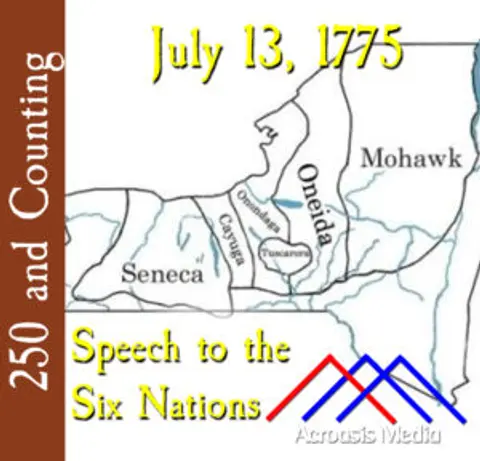
July 13, 1775: Speech to the Six Nations
The Speech to the Six Nations is one of those documents that pretty much answers what was going on with the Native Americans during the Revolution. Athough to be fair, it largely addresses what happened with the Native Americans in Upstate New York. But that area, being a border with Canada, was pretty important to the Independence cause. Part of the reason that the tribes took the document seriously is that each tribe received a series of belts which represented our intent and desire for peace...
July 11, 2025
July 12, 1775: Admiral Howe Comes to Town
General Sir William Howe was already in Boston when his brother, Admiral Richard Howe, arrived. So, say what you will about Boston during the siege, but you can’t say there was a lack of no Howe. Hi-yooooooooooooooooo! I apologize. Richard’s biggest problem was that he was known to have been part of prior reconciliation efforts and therefore known to sympathize with the colonists. But even though he did his duty, he was sometimes short on materiel to get the job done, and as a result he took th...
July 10, 2025
July 11, 1775: From John to James, and The Other Long Island
Oof, that’s a mouthful of title. Oh well, what’s done is done. As noted in today’s episode, James Warren was not related to Joseph Warren. On the other hand, he is related to Mercy Otis Warren, because he’s her husband. James and John Adams had a few ideas in common; the hard part was convincing a few others that they were in the right. Meanwhile, did you know there’s another Long Island? That sort of thing really plays havoc with our research. This one is in the Boston Bay, and it’s a famili...
July 9, 2025
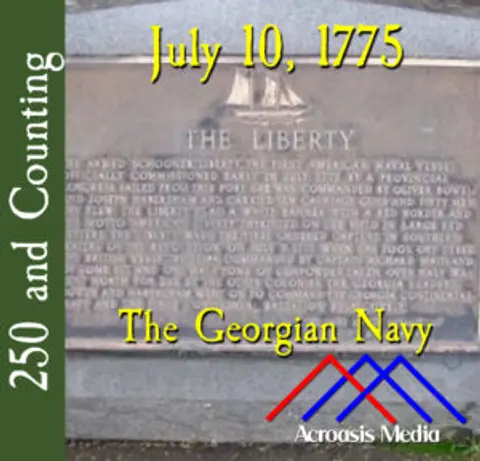
July 10, 1775: The Georgian Navy
Hey! We have a Navy now! Okay, it’s only one ship, but it’s a start. And to be clear, it’s Georgia’s navy, not the navy of the Continental forces. But we’re getting somewhere. And what’s more, on its first day it took on a British ship, with amazing results. Listen in and learn the story. The post July 10, 1775: The Georgian Navy appeared first on 250 and Counting.
July 8, 2025
July 9, 1775: Orders of the Day
Day Four of this thing and I’m still sounding kinda sexy. Or not, I have no idea. A look through George Washington’s orders of each day gives us an interesting peek into his mind. This was a guy who definitely had his finger on the pulse of what was going on with his troops. But if there was something he didn’t know about, he also recognized that there were things he didn’t know, so he would endeavor to find out. He was a strict commander; there are numerous accounts of his ordering courts mar...
July 7, 2025
July 8, 1775: Judge William Davies
N.B. While it’s Mike recording today, I write this part and I’m still a little under the weather, so I’ll be brief again. It’s Cake and Candles today for William Davies, born in Savannah on this day in 1775. Davies enjoyed careers in both the legal and political fields, and appeared to do well in both of them. Also, my brain might be addled by the drugs the doctor gave me, but my calculation has him dying at the age of 54, so Mike was a little off, there. That’s probably why he teaches History...
July 6, 2025
July 7, 1775 (no, really): Dear Abby
As you’ll hear today, I have a huge sinus infection and it took a lot of effort to get today’s episode recorded, so I hope you’ll excuse this part being rather brief. John and Abigail Adams was probably one of the best documented relationships of the Colonial Era, and it’s a ridiculously touching love story. It’s clear that they hated being apart, and you’d do well to watch the HBO/Max miniseries about him. In future episodes we’ll have to dedicate some portion to the literal language between ...
July 5, 2025
July 6, 1775: The Declaration Before The Declaration
Note: I realized belatedly that the episode that dropped yesterday was titled July 7, as was the audio file itself, but if you’ve listened, you know that it was in fact the July 5 file and what we’ve got here are a couple of typos that have mostly been fixed. My apologies for the error and thanks for your forbearance. While the Olive Branch Petition was a step toward reconciliation, and the Declaration that Congress adopted today was meant to be in the same vein, in fact it had the opposite effe...
July 4, 2025
July 5, 1775: The Olive Branch Petition
When the Second Continental Congress convened in May, there was a large faction of delegates who thought that peace with England was still possible, and made a specific effort to draft a message of reconciliation with King George III. They finished their document and presented it to the whole body of Congress on this day in 1775, which approved it and it was subsequently prepared and sent to Great Britain. In a few weeks we’ll talk a little bit about what happened at the other end. Note: I rea...
July 3, 2025
July 4, 1775: Washington’s First Orders
As mentioned yesterday, when George Washington came to Cambridge, he found a bit of a mess there: several disorganized groups of men, with more on the way, along with supplies still in transit. The first thing he needed to do was to get the fighting force organized, so he began a log book of his official orders. His first set, which came out on this day in 1775, took up about five pages of manuscript. But Washington wasn’t done, not by a long shot. Every few days he’d come up with something new...
July 2, 2025
July 3, 1775: Washington Takes Command
On June 15, 1775, George Washington was appointed Commander of the newly-formed Continental Army. On July 2, Washington finally arrived in Cambridge after a few stops in Trenton, New York and presumably a couple of other places. What he found was a huge mess. So on July 3, he officially took command and started the work of turning this ragtag crew into some kind of organized fighting force. The post July 3, 1775: Washington Takes Command appeared first on 250 and Counting.
July 1, 2025
July 2, 1775: Do You Know the Button Man?
As you listen to today’s episode, it’ll become clear that Mike had way too much fun writing and recording this one. But then again, I wrote the title, so. There are plenty of jobs out there that are kind of obscure, in the sense that it’s a job that somebody has, but you never really thought about. For instance, did you know that with some high-end perfumes, the labels are put on manually? Someone’s out there sticking the labels on the bottles, because either the bottles don’t go through the ma...
June 30, 2025
July 1, 1775: Cephas Thompson
Fun Fact: I say “Cephas Thompson” several times during this podcast, mostly because it’s fun to say. He wasn’t a formally-trained painter, but he had a good eye and some natural talent, and during his career he painted over 600 portraits, with roughly a fourth of those made entirely in Bristol, Rhode Island. Even after retiring from the itinerant artist life, he continued to work in Middleborough, Massachusetts until his death. The post July 1, 1775: Cephas Thompson appeared first on 250 and ...
June 29, 2025
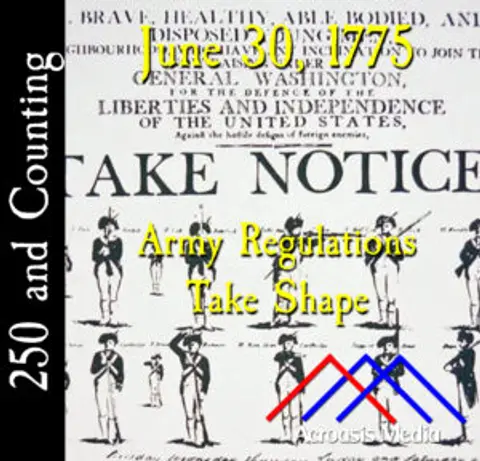
June 30, 1775: Army Regulations Take Shape
With the army being literally only a few weeks old, it was necessary to put together some regulations for this group, to ensure consistency throughout the Colonies. Interestingly enough, as the rules were revised over the next several years, a pattern of using another army’s regulations as a template began to emerge. This isn’t necessarily a bad thing: take what works and build on it, yes? A quick note about the cover art: it’s a recruitment poster from about that time, because a true Army Man...
June 28, 2025
June 29, 1775: Thomas Boyle, Privateer
Thomas Boyle wasn’t born in Baltimore, Maryland, but when he was a young man he made it his home and became quite successful there, as a merchant marine and an overall businessman. And, of course, given Baltimore’s penchant for naming streets after historic people and events, there is a Boyle Street. It’s not very long; in fact you see the entire road in the photo below. In this picture the viewer is standing on Fort Avenue looking down toward Key Highway. The green structure in the background...
June 27, 2025
June 28, 1775: A Day of Paperwork
It feels like we’re selling the day a little short, but not every day has to be Bunker Hill. Also, we’re discovering (and we hope you are, too) that sometimes it’s the smaller moments between the bigger ones that give us better insight into the hearts and minds of the people who lived during that time. Today’s artwork is a portrait of Jonathan Trumbull (brother of John Trumbull, the guy who painted so many of the Founding Fathers), but this painting—which was created in 1880, long after he died...
June 26, 2025
June 27, 1775: The Northern Department
“Schuyler” is one of those names in New York history that pops up quite frequently, partly because they were a prominent family. But it’s also one of those names that you may suddenly realize you’ve heard many times. “Schermerhorn” is another one (no kidding). So is “Burr,” for that matter, as in Aaron and family. Several Burrs are buried very close to the Long Island town where I grew up. I have childhood memories of passing a cemetery in Smithtown and seeing BURR on a few of the tombstones. I...