Episodes

March 16, 2026
The Siege Ends–March 17, 1776
It’s been 333 days since Lexington and Concord, when the British were forced to retreat to Boston and were bottled up there by Colonial forces. It’s been a week since the British said “enough” and decided to effect their departure from the city as soon as the weather cooperated. But today, the day finally came. It took about five hours to launch over a hundred ships, carrying thousands of soldiers, women and children from the city. It was Washington’s first major win and the last time the Br...
March 15, 2026
A Special Proclamation–March 16, 1776
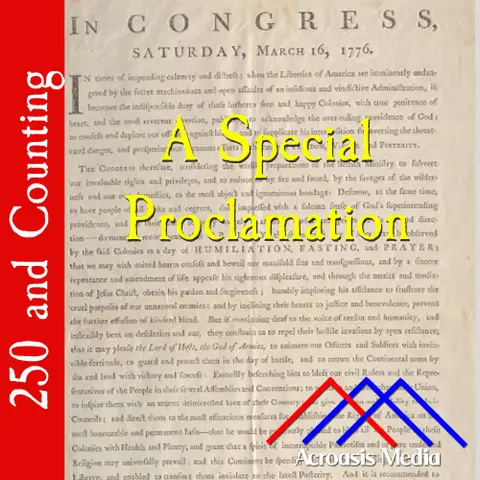
As we noted back in July, a day of prayer, humiliation and fasting wasn’t new to the Continental Congress. (Go back to that episode’s show notes to see my explanation of the word “humiliation” in this context.) And, as Mike notes in the episode, it wasn’t even close to the last for this Congress. That’s neither good nor bad; it probably gave everyone the opportunity to simply stop and contemplate matters. Tensions were rising high by now, and it would have been easy to make a rash, emotion-base...

March 14, 2026
Georgia Gets In The Game–March 15, 1776
Georgia delegates to the Second Continental Congress numbered exactly one until around this time. That would be Dr. Lyman Hall, who didn’t believe it was ethical for him to represent the entire colony when he knew that feelings were largely divided back home. Then came the Battle of the Rice Boats, on March 2 and 3. After that, it seems, things moved very quickly for Georgians: the Royal Governor, who’d been in and out of custody, fled to a nearby warship, the Provincial Congress was left in ch...

March 13, 2026
Congress Makes A Tough Call–March 14, 1776
There’s a ninth season episode of The Simpsons called “Sideshow Bob’s Last Gleaming” in which Bart’s nemesis, Sideshow Bob, steals a nuclear bomb and threatens to detonate it unless the town disables all of its television broadcasts. He delivers this ultimatum via a Jumbotron screen. Before ending the transmission, he says, “By the way, I’m aware of the irony of appearing on TV in order to decry it…so don’t bother pointing that out.” And to a certain extent, that’s what happened today in 1776 a...
March 12, 2026
Preparing To Take Back Boston–March 13, 1776
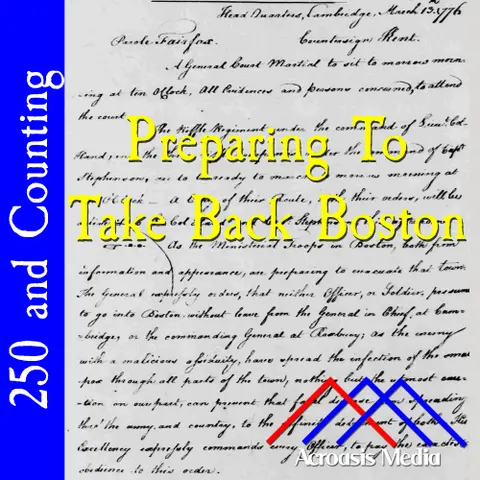
First: let me apologize for the slight change in sound quality for today’s episode. I’m not in my usual recording space and I’m not especially happy with the equipment I brought. At worst you’ll have to put up with it just one more time. Next: George Washington was a gentleman through and through, so the fact that his general orders sometimes focused on the Continental soldier behavior shouldn’t be a surprise. In today’s episode he concerns himself specifically with that, but for two reasons. O...
March 11, 2026
Baltimore Celebrates Women–March 12, 1776
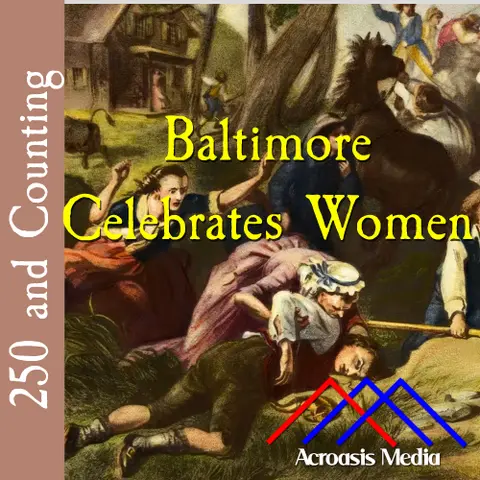
Of course it’s coincidental, but it’s kind of cool that we’re able to bring you this episode during Women’s History Month and the same week as International Women’s Day. Believe it or not, Mike and I have struggled with the fact that there’s very little representation of anyone from this era who isn’t a white male. We’ve managed to touch on a few women and African-Americans from time to time, but after 435 episodes (including today) we’re probably still in the single-digit range. Mike doesn’t ...

March 10, 2026
Getting Ready To Move–March 11, 1776
The focus today up in Cambridge, while waiting for the British to hightail it out of Boston, was getting the men ready to move to New York, and putting together Washington’s personal guard. Washington didn’t really need a personal guard in Cambridge, at least not much of one, because he was in the driver’s seat while he was there. The British were bottled up, and he was the stopper. But to move to New York and then defend that territory? Well, that was another project entirely. New York had mor...
March 9, 2026
Laundry Day–March 10, 1776
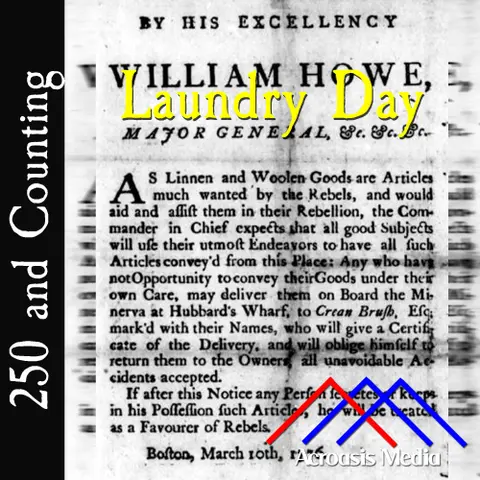
For a guy who’s technically on the wrong side of history, Crean Brush was a pretty interesting character. Mike mentions in the episode that Brush was jailed for some time during the Revolution, but time didn’t allow him to tell you how Brush managed to get out of jail. I’m not going to spoil it, but the truly fascinating story can be found in this article by Eric Weiser. This article was one of those serendipitous finds that turned up when I went looking for a picture of Crean Brush. It’ll take...

March 8, 2026
The Big Guns In Boston–March 9, 1776
The occupation of Dorchester Heights, just across the river from Boston, was perhaps the final step that George Washington needed to end the siege that had gone on for nearly a year. Of course, it wasn’t just occupying Dorchester Heights; Washington could have pretty much done that at any time. It was occupying them with a terrifying speed, thanks to Rufus Putnam (the guy in today’s cover art, by the way) and his clever plan for assembling the defenses there. And thanks also have to go to the b...

March 7, 2026
Samuel Tweedy–March 8, 1776
When Samuel Tweedy moved from Dutchess County, NY to Danbury, CT, it was a fortuitous time to do something like that. Danbury was undergoing an economic expansion as part of a post-war boom, which gave him extra opportunities to gain access to trade and manufacturing that he never would have seen back in New York, which was a largely agrarian economy at the time. Tweedy’s marriage to Ann Burr had both social and economic benefits, since Danbury was rather tight-knit as a community, and his havi...

March 6, 2026
Congress and Military Matters–March 7, 1776
Congress had a lot of military-related activities to tend to, and one of them was Isaac Melchior. (If you look him up you’ll see an alternate spelling of him as “Melcher.” We’re sticking with “Melchior” because we saw that first.) March 7 was a Thursday, so the Congress was figuring out what do do about Melchior’s apparent insubordination the previous Saturday when he loudly and rudely insulted Congress in general, and John Hancock in particular, because he felt that the captaincy they’d offere...

March 5, 2026
The Pennsylvania Thirteenth–March 6, 1776
The Pennsylvania State Rifle Regiment, also known as Miles’ Regiment, also known as the Pennsylvania 13th Regiment first came about when the Pennsylvania State Battalion of Musketry merged with Miles’ Reigment. We know it’s confusing, largely because there were so many names involved and that’s not even where the names ended. Samuel Miles was their commander when they were first raised, and he was their commander in 1777 at the Battle of Long Island. It’s especially notable because he allowed h...

March 4, 2026
Taking Canada’s Temperature–March 5, 1776
So here’s a fun story about Charles Carroll. As I’ve mentioned many times before, lots and lots of place names in Baltimore have strong historical connections and Charles Carroll is no exception. There is, of course, a Carroll Street, which starts in the southeast neighborhood of Morrell Park. It doesn’t go quite through that neighborhood though; it gets broken up by a couple of blocks’ worth of houses and resumes again. There’s another break as a railroad right-of-way comes through—but there’s...

March 3, 2026
Beginning of the End in Boston–March 4, 1776
Colonel Henry Knox took about ten weeks to get from Ticonderoga to Cambridge rather than the two he anticipated. But his arrival meant the siege’s end in Boston would come soon. Knox had brought something like 60 tons worth of material overland using hand-built sledges and carts drawn by oxen. The last leg of the trip is still a mystery, because Knox’ diary ends about two weeks early. What is known is that as he passed through the occasional town, people would line up to watch. So we know when ...

March 2, 2026
The Raid on New Providence–March 3, 1776
The raid on New Providence is probably one of those situations where we couldn’t really represent everything that was going on on this particular island, because there were a lot of moving parts. We especially overlooked the part at the end. Two of the ships went to St. Augustine, laden down mostly with gunpowder. Of the others, they headed further north, where they encountered the HMS Hawk and then the HMS Bolton. They ended up caputuring both ships. Then they bumped into the HMS Glasgow off ...
March 1, 2026
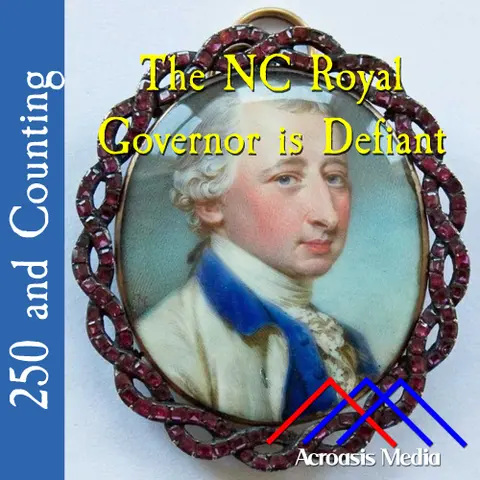
The NC Royal Governor is Defiant–March 2, 1776
Oh, that Royal Governor Josiah Martin. He might be defiant, he might be delusional. He might be in denial. What he was not, apparently, was cognizant of the effect that the Battle of Moore’s Creek Bridge had on Loyalist morale. Or, perhaps he did. At any rate, his order to raise the British flag anywhere a flag could be raised was more performative than anything else. This was Martin’s second big push to restore North Carolina to British control, but it wasn’t his last. Many months later the C...

Feb. 28, 2026
The French Connection–March 1, 1776
We bumped into a little dilemma when putting together this episode. Specifically, what do we do when 1776 doesn’t match up with 2026? As it turns out, 1776 was a leap year, so that year had a February 29, whereas 2026 does not. So we decided to do what most Leap Babies seem to do: mark the day on March 1. To that end, today marks two events: first, we take a look at an arrangement that France and Spain made to trade with America on a kind of gray market. That arrangement was first presented to...

Feb. 27, 2026
Phyllis Wheatley Gets A Fan Letter–February 28, 1776
Phyllis Wheatley was an 18th century poet who was born in West Africa and sold into slavery as a small child, living with the Wheatley Family in Boston. Phyllis wrote a book of poems which was published in 1773, after which she was emancipated. This makes her the first African-American author of a published book of poetry. Phillis Wheatley married a grocer named John Peters around this same time. They had three children, but unfortunately all of them died quite young. Phyllis herself died in o...
Feb. 26, 2026
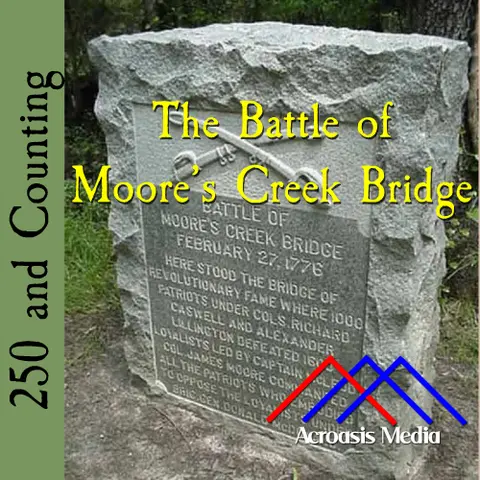
The Battle of Moore’s Creek Bridge–February 27, 1776
As Revolutionary battles go, the Battle of Moore’s Creek Bridge was relatively minor. It didn’t last very long, there weren’t a ton of losses on either side (though definitely more on the Loyalist side), and it led to the capture of hundreds of Loyalists. However, it changed the way the British viewed the Carolinas through the rest of the war. Overall, the perception was that the Carolinas were poor, and weak, and a stronghold of Loyalist sympathizers. And this was an easy assumption to make, e...

Feb. 25, 2026
Innis Green–February 26, 1776
Innis Green served as a Jacksonian Democrat in the U.S. House of Representatives during the 20th (1827–1829) and 21st (1829–1831) Congresses, essentially holding the party’s populist line. But he did deviate from party alignment on May 26, 1830, when Green voted nay on H.R. 287, the Indian Removal Act. Despite this, the bill passed narrowly, 102-97. This stance positioned him among Pennsylvania Jacksonians influenced by local Quaker and moral opposition to forced tribal relocations, contrasting...

Feb. 24, 2026
Another Washington in Uniform–February 25, 1776
I mention in today’s episode that William Augustine Washington lived on a Virginia plantation he’d inherited, and that his first house burned down. The second house he moved to, on the same property but a mile away (yow!), was called Blenheim. Washington used some of the bricks from the original house to add on to the Blenheim house, but he also used a bunch of them to start on a house and barn on a separate property. What a thrifty fellow! For what it’s worth, Blenheim is still standing and ...

Feb. 23, 2026
British People Noticing Things–February 24, 1776
A Coruña is a coastal city in northeastern Spain that’s often stylized as La Coruña, as Mike says in this episode. Its location makes it an ideal port for trade with other nations, and the American Colonies was no exception. Now, France gets a lot of attention for the assistance they gave us during the Revolution, but Spain was at least as helpful as France was. They were just quieter about it. So it was probably just a matter of time before some British officials noticed ships in the Spanish h...

Feb. 22, 2026
Our New Man in Virginia–February 23, 1776
Carter Braxton was born into money, as his grandfather was probably the wealthiest man in Virginia. This gave him the “in” he needed to become a gentleman farmer and a public official. In 1761 he was elected to Virginia’s House of Burgesses, and in 1769 he was a signatory to the Virginia Resolves, which protested parliamentary interference with colony affairs. While he was a Patriot at heart, as 1776 rolled around and he replaced Peyton Randolph as one of Virginia’s delegates to the Continental...
Feb. 21, 2026
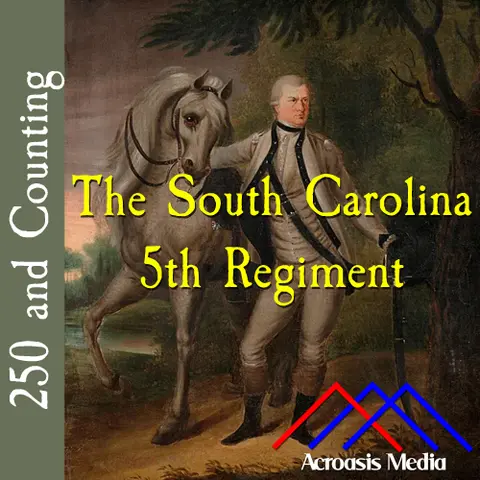
The South Carolina 5th Regiment–February 22, 1776
The South Carolina 5th Regiment ultimately wasn’t a huge success, with a single exception, which we’ll talk about in greater detail in a few months. But in those losses there were some long odds going on, so we’ll not judge too harshly. I learned a couple of things as a result of today’s episode. I own a piece of property in South Carolina, in the Myrtle Beach area, which is located in Horry County. I always wondered how it got that name, and now I’ve learned that Horry County was named after P...